 中國婦權
Women’s Rights in China(WRIC)
Committee for U.S. International Broadcasting (CUSIB)
Visual Artists Guild (VAG)
3-19-2025
President Trump has signed an executive order to revoke and drastically reduce the U.S. Agency for Global Media (USAGM) and its affiliated media organizations, including Voice of America (VOA), Radio Free Asia (RFA), Radio Free Europe/Radio Liberty (RFE/RL), Radio Marti (broadcasting to Cuba), and the Middle East Broadcasting Networks (MBN), which include broadcasts in Tibetan, Uyghur, and 48 other languages worldwide. We believe this will deeply shock and frustrate at least 500 million listeners around the world who lack freedom of speech. It means that the rare window through which they seek to understand the outside world and be understood by it will be closed. NGOs Women’s Rights in China (WRIC) and Committee for U.S. International Broadcasting (CUSIB) strongly urge President Trump to reconsider the decision to revoke USAGM. USAGM plays a crucial role in our country and the world. This soft power of international media is highly effective in countering propaganda in China and Hong Kong, where freedom of speech is suppressed.
Government-funded international medias, through the news, interviews, music, and educational programs, bring hope to countless people seeking freedom. Journalists thus become targets of dictators, with some frontline reporters being humiliated and detained during interviews. The awakening of generations of Chinese people over the past half-century owes much to VOA and RFA.
We understand that the agency has issues that need addressing. However, USAGM’s commitment through its soft diplomacy is also crucial to international human rights and U.S. leadership. The careers of dedicated journalists who risk their lives should not end here.
Dismantling these organizations not only harms American values but also ignores the urgent need of hundreds of millions of people worldwide for alternative media services like RFA, OCB (Radio Marti), RFE/RL, MBN, and OTF (Open Technology Fund). Without RFA’s critical role in translation services, the world would have even greater difficulty understanding the suffering of millions of Uyghur people in a timely manner. Especially as the Chinese Communist Party’s dictatorship aggressively expands its global propaganda apparatus, cutting these media outlets is detrimental to U.S. national interests. It is like handing a gift to America’s enemies or dictators.
Senior Beijing journalist Gao Yu, who has long been under surveillance, said upon learning that over a thousand VOA journalists were ordered to stop working, “The thought that VOA’s Chinese website won’t be updated the next day is more than just regret; it’s heartbreaking.” She posted on X on March 16, “This American action is like self-strangulation, giving way to Chinese state media and its external propaganda. For the vast majority of Chinese listeners who watch VOA over the Great Firewall, this is tantamount to building an impenetrable frozen wall in front of them.”
Renowned Chinese human rights lawyer Pu Zhiqiang said, “It’s very regrettable. Since 1989, listening to the Chinese programs of overseas media like VOA has become my habit. Back then, there was no internet or mobile phones; we bought shortwave radios to listen to ‘enemy stations’ because freedom of the press is crucial…”
Ms. Chen, a WRIC volunteer in Yunnan, China, said, “It’s unbelievable. After all, VOA and RFA are the most convenient media for directly conveying our voices to the international community and governments. Especially in countries without freedom of speech, we desperately lack honest media to tell us the true outside world.”
In stark contrast, the propaganda machines of the Chinese Communist Party’s external propaganda apparatus immediately rejoiced, saying, “VOA, you’ve met your day!”…
Meanwhile, the Chinese government is using state power to launch a massive “Telling China’s story well” propaganda offensive in democratic countries like the U.S. Xinhua News Agency’s overseas social media editorial department (Hai Mei Shi 海媒室) is using deep media integration with various overseas forces to aggressively promote the CCP’s international influence, aiming to dominate as a powerful, new, all-encompassing international media. In 2023, “Hai Mei Shi” was awarded the “National Pioneer Worker” honorary title by the CCP. The CCP also uses foreign propagandists and AI to spread rumors and sow discord on online social platforms, and employs infiltration and transnational repression to lure, induce, threaten, and intimidate politicians and Chinese dissidents in Western democratic countries.
Reporters Without Borders (RSF) 2024 World Press Freedom Index ranks China 172nd out of 180 countries and regions, making it one of the least free countries for press freedom in the world. Hong Kong ranked 70th in 2018, but in the four years since the implementation of the National Security Law in 2020, Hong Kong’s Press Freedom Index has plummeted to 135th.
China remains the world’s largest jailer of journalists, currently detaining 119 journalists, including 10 from Hong Kong. Since 2019, dozens of Hong Kong’s free media outlets and pro-democracy groups have been forced to close.
In conclusion, we strongly urge the Trump administration to carefully consider the disposition of media outlets like VOA. They are one of America’s active and advantageous soft power tools. The U.S. needs to use this soft power to undermine and divide hostile forces, and to allow the people of dictatorial countries to hear the American voice, see the world beyond the firewall, and understand the values of human rights, democracy, and freedom. Only then can America’s core values be promoted, and America remain invincible.
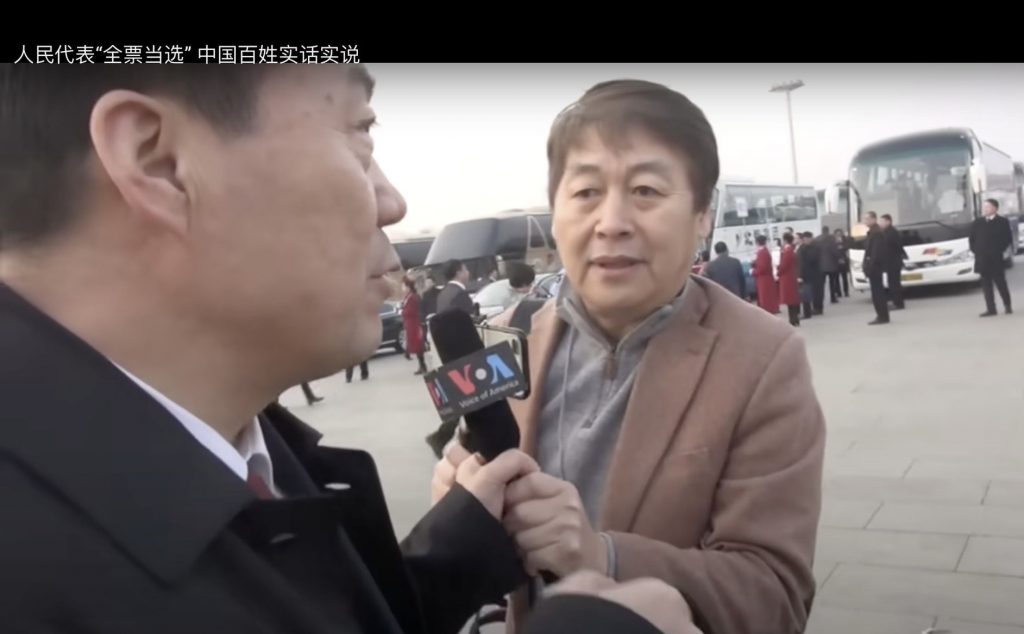
Ye Bing, a Beijing-based reporter for Voice of America (VOA) Chinese, and his assistant Allen were detained by Chinese police in 2018 when they visited retired professor Sun Wenguang in Jinan city Shandong China. VOA reporter Ye Bing visited China during the two sessions in 2018. (VOA data)

The picture is from the CCP party media “Qizhi Net” (旗幟網).
