WRIC Weekly Exhibition (8rd): Remembering the contributions of Zhang Zhan and giving them a voice.

By WRIC Zhou Mei                       12-13-2025


1)  In Support of Zhang Zhan


Today, we are here to speak out for Zhang Zhan, a Chinese citizen journalist who has risked her life to uphold the truth.


Zhang Zhan, born in 1983 in Xianyang, Shaanxi Province, holds a Master’s degree in Finance, is a former lawyer, and a Christian. In 2010, she came to Shanghai as part of a talent recruitment program, where she could have lived a stable and respectable life. However, she chose to witness the darkness, focus on the vulnerable, and speak out for the persecuted. Because of this conscience, she has been repeatedly arrested, detained, and suppressed by the police. Yet, no intimidation can stop her from acting in justice and showing mercy. At the beginning of the COVID-19 outbreak in 2020, the Chinese government blocked information and prohibited independent reporting. Zhang Zhan, however, went to Wuhan alone. With a mobile phone, she documented the long lines outside hospitals, the fear and reality under the lockdown, and exposed how the Chinese government detained independent journalists and harassed patients’ families.


Photo taken by Zhang Yan on 12-13- 025, outside the Flushing Library in New York. (WRIC)


Photo taken by Zhou Mei on December 13, 2025, outside the Flushing Library in New York. (WRIC)
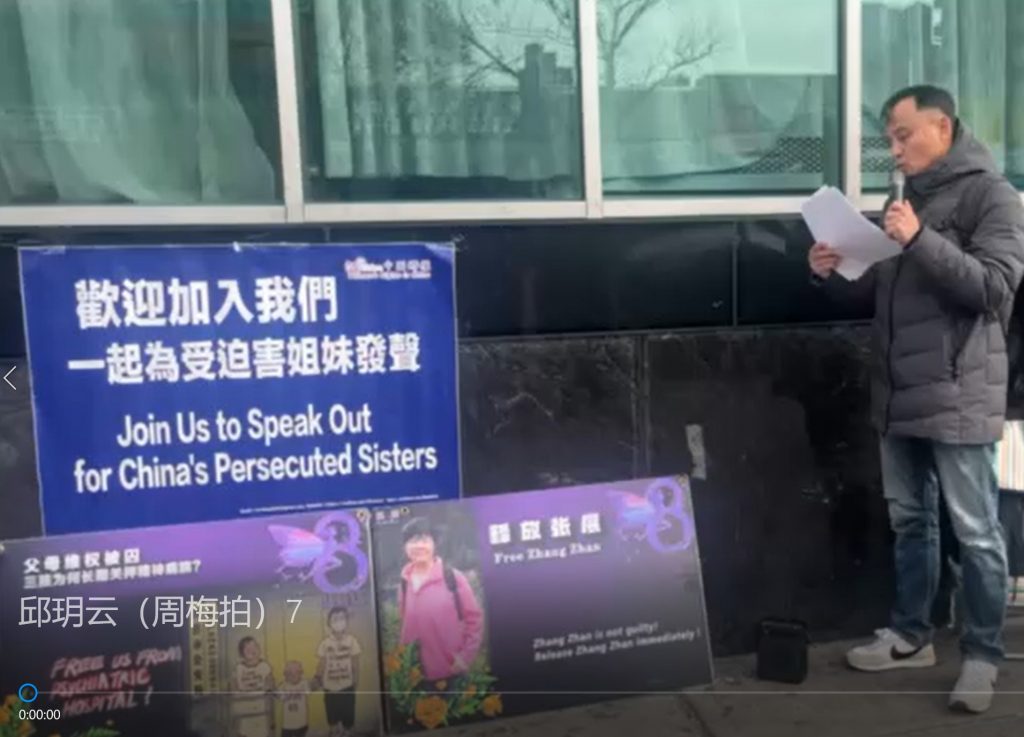
 

Qiu Yueyun has reading the stories of these heroines’ struggle. Photo by ZhangYan outside the Flushing Library, New York, 12-13- 2025. (WRIC)


Because she dared to speak the truth, she was arrested across provincial borders in May and sentenced to four years in prison for “picking quarrels and provoking trouble.” In the Shanghai Detention Center and Women’s Prison, she protested the injustice with a hunger strike, enduring torture including forced feeding, intubation, leg irons, and restraints. In court, she questioned the judge: “Don’t you think your conscience tells you it’s wrong to put me in the dock?” This was not only her cry for justice, but also a profound indictment of an era.


On May 13, 2024, Zhang Zhan was released from prison, but freedom did not return. She continued to be closely monitored, harassed, and followed. Just three months later, she was arrested again for traveling to Gansu to support human rights defenders. In September 2025, she was sentenced to four years in prison again on the same charge. Two four-year sentences—this is how the authorities punish those who speak the truth. But Zhang Zhan had already given her answer: She said, “Freedom is never free. The problem in this country is the system. I cannot stop because the evil has not stopped.” “If speaking out for one’s own survival is a crime, then I have no way to stop.” This is Zhang Zhan—a woman who refuses to remain silent, a citizen who values ​​truth more than life itself, a soul willing to bear the shackles for freedom but unwilling to yield.


Today, we stand here for her to tell the world: Zhang Zhan is not a criminal. She is one of China’s bravest witnesses. Speaking the truth is not a crime, pursuing the truth is not a crime, conscience is not a crime. We also want to tell the persecutors: You can imprison her body, but you cannot imprison her beliefs; you can judge her, but you cannot judge freedom; you can silence her for a time, but you cannot make the world forget her. The Chinese Women’s Rights Movement solemnly calls on the Chinese government: Release Zhang Zhan! Stop persecuting citizen journalists! Restore dignity to press freedom! Let speaking the truth no longer be a crime!


Photo taken by Zhang Yan on December 13, 2025, outside the Flushing Library in New York. (WRIC)
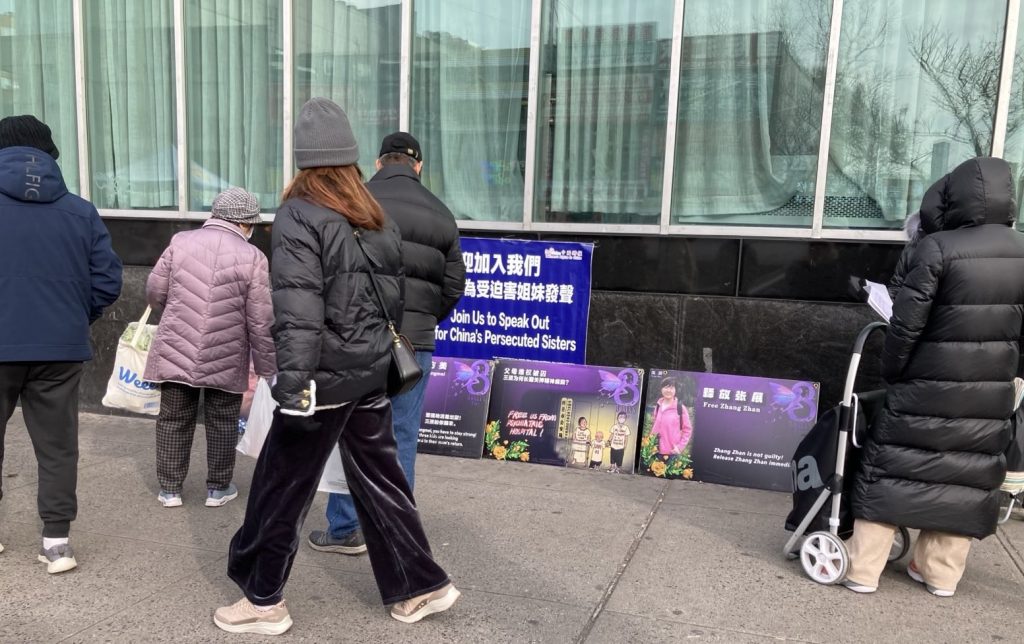
 

Photo taken by Zhou Mei on December 13, 2025, outside the Flushing Library in New York. (WRIC)


   2)In Support of He Fangmei


Today, we stand here to speak out for a mother, a courageous human rights defender—for He Fangmei, a Chinese woman who has suffered brutal persecution simply for protecting her child and seeking basic justice.


He Fangmei was born in Xinxiang, Henan Province in 1985. She is not a politician, not a social celebrity; she is just one of millions of ordinary mothers. However, her fate was completely changed on the day her daughter, just over one year old, suddenly became paralyzed after receiving the DPT vaccine. Faced with this sudden life-threatening disaster, she chose what all mothers would do—seek help from the government, seek treatment, and seek an explanation. But what she received was not assistance, but evasion; not the truth, but intimidation; not compensation, but repeated knocks on her door by the police. When she discovered countless families across the country suffering the same misfortune, she stood up and organized the “Vaccine Babies Home,” hoping to provide more treatment for victimized children and break the cycle of silence for more families. However, such good deeds became “crimes” under totalitarianism. She was detained, criminally detained, prosecuted, forcibly disappeared, and ultimately convicted.


Zhang Yan (right) loudly recounts the story of He Fangmei (second from right on the banner; third from right are her three minor children who were once detained in a mental hospital) through a microphone. Photographed by Zhou Mei outside the Flushing Library, New York, December 13, 2025. (WRIC)
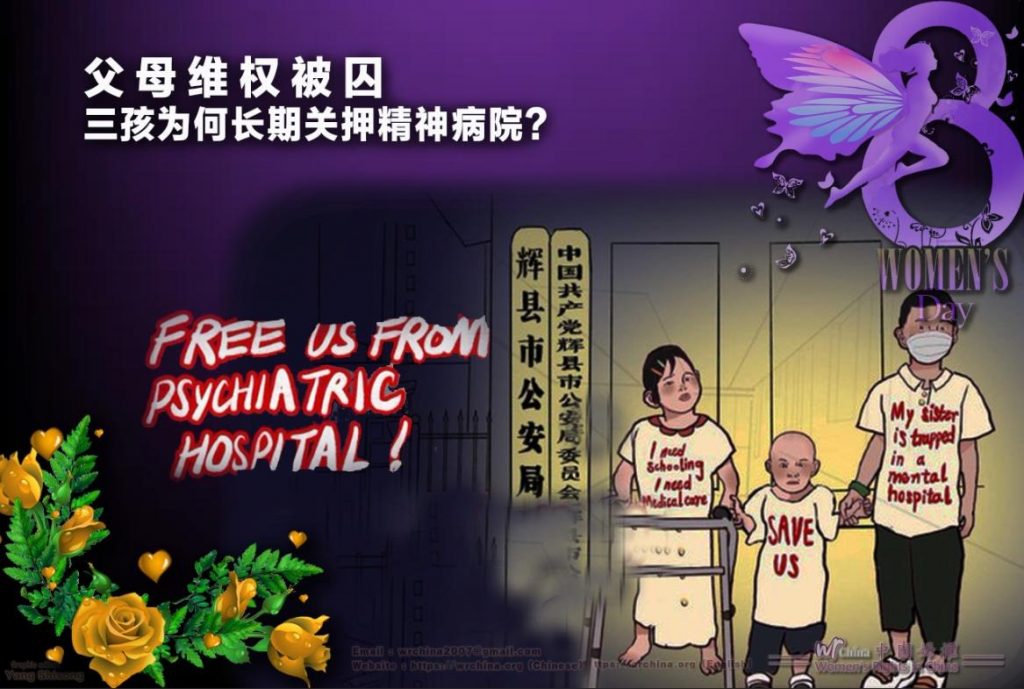
 

Banner image created by WRIC.


He Fangmei was placed under residential surveillance in a designated location for 18 months, giving birth to her infant daughter in a cold, confined environment. Shortly after giving birth, she was sentenced to a gruesome 5-year and 6-month prison term. Meanwhile, her torn family endured excruciating pain. Her husband was sentenced to five years in prison for supporting his wife’s activism; her two young daughters were hospitalized and then secretly moved, unable to be visited by relatives; her eldest son was placed in foster care elsewhere. A once complete and warm family was brutally crushed by the state apparatus. A mother seeking justice for her child has to pay the price of her entire family’s destruction? A citizen exercising their most basic rights has been met with imprisonment and nightmares?


We speak out here not only for He Fangmei, but also to tell the world: Under the rule of the Chinese Communist Party, if you dare to seek justice for children—you may be silenced; if you uphold the most basic human rights—you may be imprisoned, hunted down, and disappear.


Chinese women’s rights advocates strongly urge the Chinese government to: immediately release He Fangmei; guarantee the basic personal safety and visitation rights of her husband and children; stop persecuting vaccine victims’ families under criminal charges; allow lawyers to meet with them according to law and allow families to obtain information; and ensure that children harmed by vaccines receive genuine treatment, instead of becoming victims of political black boxes.


We stand with conscience, speak out for freedom, in the name of mothers, and in the name of humanity. For He Fangmei, for her children, for all those persecuted for their courage—we will not back down, nor will we remain silent. Our cries will not cease until He Fangmei is free.


Photo taken by Zhang Yan on December 13, 2025, outside the Flushing Library in New York. (WRIC)


  3) In support of Gulshan Abbas


Today, we stand here for a most basic, yet deprived right—to let the world hear the name of Gulshan Abbas. Gulshan Abbas, Uyghur, retired doctor. She was not a politician, not an activist; she was simply an ordinary woman who spent her life practicing medicine, caring for patients, and protecting her community.


However—in September 2018, she was forcibly taken from her home. No reason, no notification, no legal process. From that day on, her life was silently erased, disappearing behind the high walls and iron curtain of Xinjiang. Her family searched desperately for two years without any news. It wasn’t until the end of 2020 that they were forced to learn the truth—Gulixian Abbas had been secretly sentenced to twenty years in prison.


The banner in the picture shows a Uyghur doctor Gulixian on the far left. Photographed by Zhang Yan on December 13, 2025, outside the Flushing Library in New York. (WRIC)
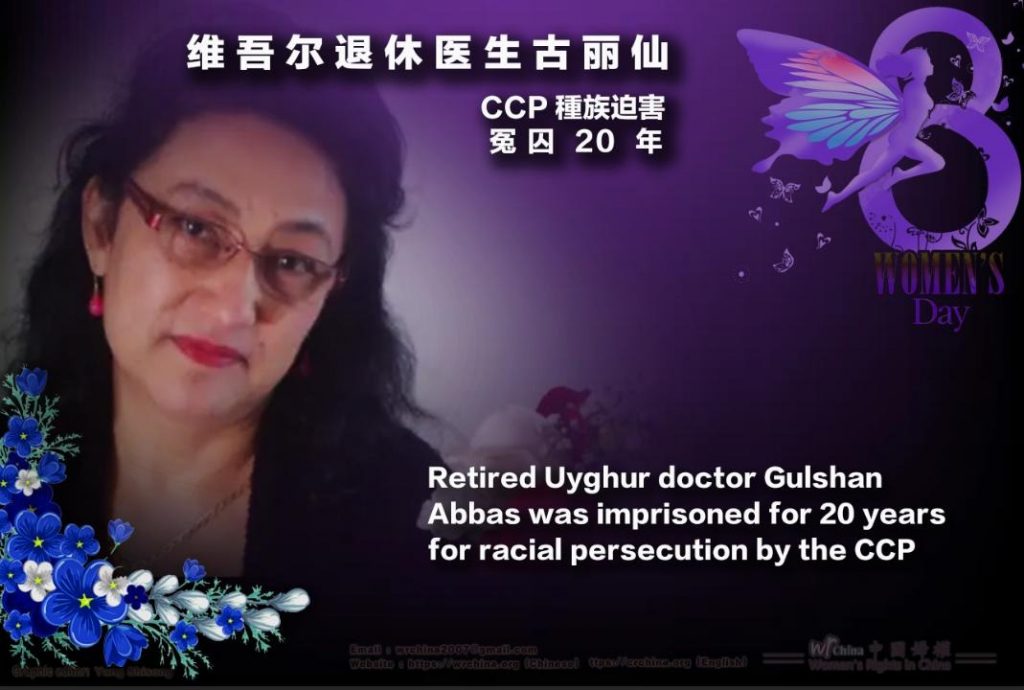
 

The banner image created by WRIC.


Twenty years—for a woman who had never committed a crime, never used violence, and was simply a retired doctor, this is not justice, this is punishment; not a verdict, but the destruction of her life.


What’s even more infuriating is that her arrest occurred exactly six days after her sister, Uyghur-American human rights activist Rushan Abbas, publicly revealed the truth about Xinjiang. This is not a coincidence. It is a warning, retaliation, and blatant political intimidation using a relative as a hostage.


Her sister once said, “I raised the microphone, and they took my sister away.” This is what Gulixian Abbas experienced. More than seven years have passed—where is she? Is she healthy? Is she still alive? No one knows.


When a country can imprison a retired doctor in the dark for twenty years, it can imprison anyone. When a regime uses relatives as hostages, it attempts to silence the voice of an entire ethnic group. We must face the truth—what the Uyghurs are suffering is a blatant genocide. Mass detention, forced labor, forced sterilization and abortion, forced marriage—systematically labeling an entire religious community as “criminal.” All of this is happening.


We solemnly appeal to the Chinese government: Immediately release Gulixian Abbas! Reveal her whereabouts! Allow her family and lawyers to visit her! Immediately cease the collective persecution of innocent Uyghurs under the guise of “counter-terrorism”! Gulixian cannot speak today, but we can. She cannot stand up today, but we can. Her freedom has not been restored, and our voices will not cease. As long as Gulixian is not free, we will not remain silent. Persecution of church pastors, denial of freedom of belief—the Chinese government’s trampling on the constitution is shameless!


(Photo: WRIC Zhang Yan)


WRIC Members Attended The HK Forum Candlelight Ceremony in LA

Photos by Zhang Zhijuan of WRIC

Web editor: Lu, Huiwen                                                                                           06-06-2025


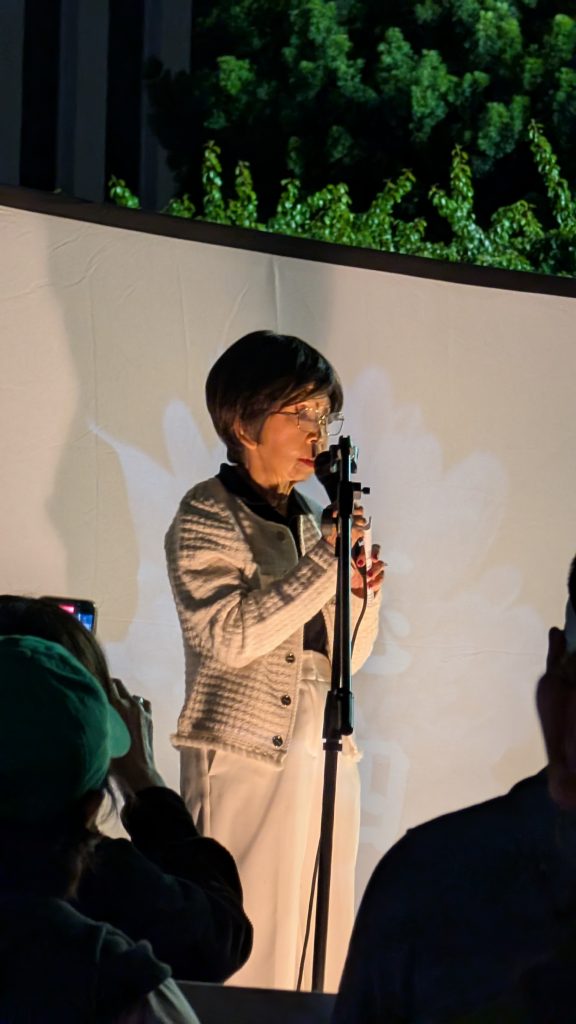
Tiananmen survivor Wang, Chaohua had give a speak.


Ann Lau, president of the Visual Artists Guild speaks.


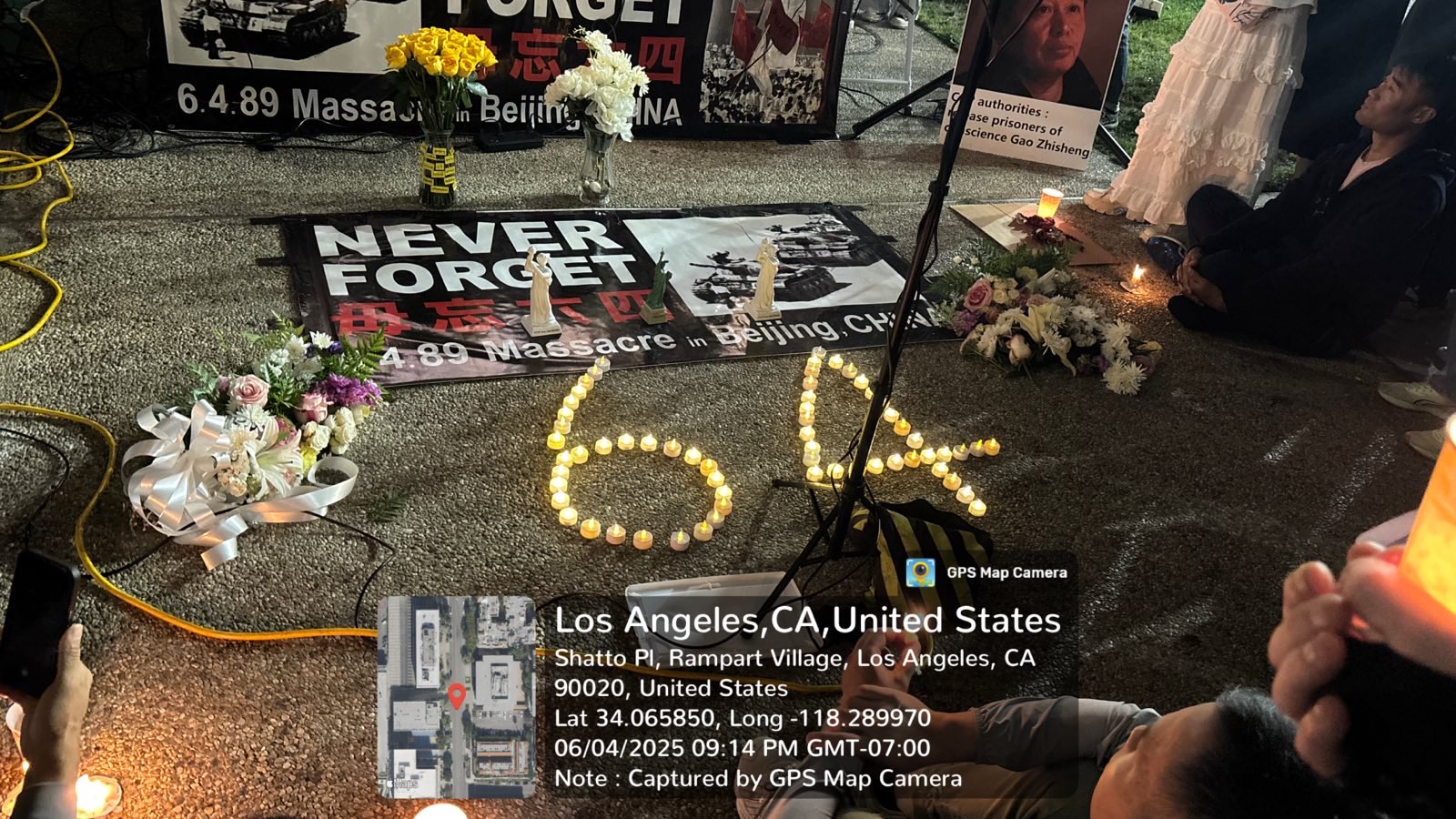
On June 4, 2025, Zhang Jing, Chairwoman Women’s Rights in China, traveled from the New York headquarters to Los Angeles to join members of the organization’s Los Angeles branch at 8 p.m. in front of the Chinese Consulate for the Hong Kong Forum, commemorating the 36th anniversary of the Tiananmen Massacre. The event drew many Chinese residents in Los Angeles, who lit candles in the night to mourn the victims of June 4, 1989.


In her speech, Chairwoman Zhang emphasized that China Women’s Rights has always been committed to speaking out for women, and she placed special importance on this commemoration. She stated that remembering June 4 is not only about honoring history but also about advancing democracy and human rights today and in the future. During the event, many participants offered flowers, and representatives from the Hong Kong Forum sang memorial songs in Cantonese, expressing deep mourning for the deceased and a yearning for freedom. These heartfelt acts not only created a solemn and moving atmosphere but also underscored the vital role China Women’s Rights plays in promoting social justice and human rights. Through this commemoration, the organization hopes to draw greater attention to women’s rights in China and to the pursuit of fairness and justice in society.


<iframe width=”560″ height=”315″ src=”https://www.youtube.com/embed/tCi8izA20jI?si=fXzu5fv7WR7xjiVT” title=”YouTube video player” frameborder=”0″ allow=”accelerometer; autoplay; clipboard-write; encrypted-media; gyroscope; picture-in-picture; web-share” referrerpolicy=”strict-origin-when-cross-origin” allowfullscreen></iframe>


NGOs Call on the Trump Admin: Do Not Close Off Chinese Access to Global Info.

    Women’s Rights in China(WRIC)

Committee for U.S. International Broadcasting (CUSIB)

Visual Artists Guild (VAG)

3-19-2025


President Trump has signed an executive order to revoke and drastically reduce the U.S. Agency for Global Media (USAGM) and its affiliated media organizations, including Voice of America (VOA), Radio Free Asia (RFA), Radio Free Europe/Radio Liberty (RFE/RL), Radio Marti (broadcasting to Cuba), and the Middle East Broadcasting Networks (MBN), which include broadcasts in Tibetan, Uyghur, and 48 other languages worldwide. We believe this will deeply shock and frustrate at least 500 million listeners around the world who lack freedom of speech. It means that the rare window through which they seek to understand the outside world and be understood by it will be closed. NGOs Women’s Rights in China (WRIC) and Committee for U.S. International Broadcasting (CUSIB) strongly urge President Trump to reconsider the decision to revoke USAGM. USAGM plays a crucial role in our country and the world. This soft power of international media is highly effective in countering propaganda in China and Hong Kong, where freedom of speech is suppressed.


Government-funded international medias, through the news, interviews, music, and educational programs, bring hope to countless people seeking freedom. Journalists thus become targets of dictators, with some frontline reporters being humiliated and detained during interviews. The awakening of generations of Chinese people over the past half-century owes much to VOA and RFA.


We understand that the agency has issues that need addressing. However, USAGM’s commitment through its soft diplomacy is also crucial to international human rights and U.S. leadership. The careers of dedicated journalists who risk their lives should not end here.


Dismantling these organizations not only harms American values but also ignores the urgent need of hundreds of millions of people worldwide for alternative media services like RFA, OCB (Radio Marti), RFE/RL, MBN, and OTF (Open Technology Fund). Without RFA’s critical role in translation services, the world would have even greater difficulty understanding the suffering of millions of Uyghur people in a timely manner. Especially as the Chinese Communist Party’s dictatorship aggressively expands its global propaganda apparatus, cutting these media outlets is detrimental to U.S. national interests. It is like handing a gift to America’s enemies or dictators.


Senior Beijing journalist Gao Yu, who has long been under surveillance, said upon learning that over a thousand VOA journalists were ordered to stop working, “The thought that VOA’s Chinese website won’t be updated the next day is more than just regret; it’s heartbreaking.” She posted on X on March 16, “This American action is like self-strangulation, giving way to Chinese state media and its external propaganda. For the vast majority of Chinese listeners who watch VOA over the Great Firewall, this is tantamount to building an impenetrable frozen wall in front of them.”


Renowned Chinese human rights lawyer Pu Zhiqiang said, “It’s very regrettable. Since 1989, listening to the Chinese programs of overseas media like VOA has become my habit. Back then, there was no internet or mobile phones; we bought shortwave radios to listen to ‘enemy stations’ because freedom of the press is crucial…”


Ms. Chen, a WRIC volunteer in Yunnan, China, said, “It’s unbelievable. After all, VOA and RFA are the most convenient media for directly conveying our voices to the international community and governments. Especially in countries without freedom of speech, we desperately lack honest media to tell us the true outside world.”


In stark contrast, the propaganda machines of the Chinese Communist Party’s external propaganda apparatus immediately rejoiced, saying, “VOA, you’ve met your day!”…


Meanwhile, the Chinese government is using state power to launch a massive “Telling China’s story well” propaganda offensive in democratic countries like the U.S. Xinhua News Agency’s overseas social media editorial department (Hai Mei Shi 海媒室) is using deep media integration with various overseas forces to aggressively promote the CCP’s international influence, aiming to dominate as a powerful, new, all-encompassing international media. In 2023, “Hai Mei Shi” was awarded the “National Pioneer Worker” honorary title by the CCP. The CCP also uses foreign propagandists and AI to spread rumors and sow discord on online social platforms, and employs infiltration and transnational repression to lure, induce, threaten, and intimidate politicians and Chinese dissidents in Western democratic countries.


Reporters Without Borders (RSF) 2024 World Press Freedom Index ranks China 172nd out of 180 countries and regions, making it one of the least free countries for press freedom in the world. Hong Kong ranked 70th in 2018, but in the four years since the implementation of the National Security Law in 2020, Hong Kong’s Press Freedom Index has plummeted to 135th.


China remains the world’s largest jailer of journalists, currently detaining 119 journalists, including 10 from Hong Kong. Since 2019, dozens of Hong Kong’s free media outlets and pro-democracy groups have been forced to close.


In conclusion, we strongly urge the Trump administration to carefully consider the disposition of media outlets like VOA. They are one of America’s active and advantageous soft power tools. The U.S. needs to use this soft power to undermine and divide hostile forces, and to allow the people of dictatorial countries to hear the American voice, see the world beyond the firewall, and understand the values of human rights, democracy, and freedom. Only then can America’s core values be promoted, and America remain invincible.


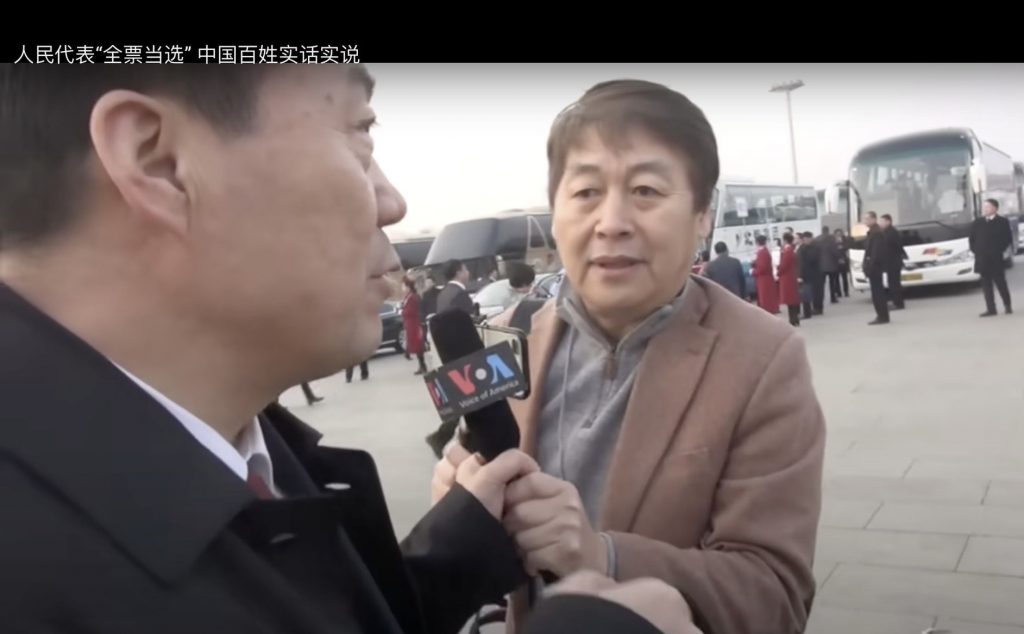
Ye Bing, a Beijing-based reporter for Voice of America (VOA) Chinese, and his assistant Allen were detained by Chinese police in 2018 when they visited retired professor Sun Wenguang in Jinan city Shandong China. VOA reporter Ye Bing visited China during the two sessions in 2018. (VOA data)


The picture is from the CCP party media “Qizhi Net” (旗幟網).


WRIC 2025 Women’s Day Calls for Attention to Women’s Rights Issues in China


Women’s Rights in China (WRIC)                March 8,2025


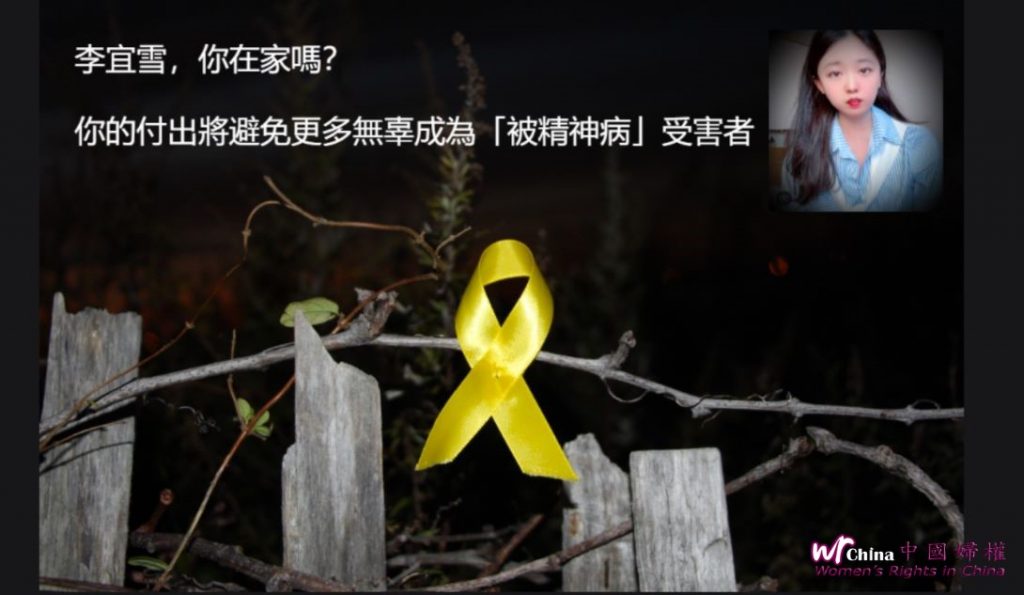
International Women’s Day on March 8 is a day to commemorate the struggle for equal rights for women. However, in China, the freedom, dignity, and even lives of countless women are bound and stripped away by cold iron chains. Three years ago, the “Chain Woman” case remains unresolved, with the truth still being distorted and covered up; the case of Li Yixue, who was forcibly sent to a mental hospital, is the latest in a series of publicized incidents of women suffering similar fates. Like many others, she continues to face threats of either silencing or being sent back to a mental hospital, and her lawsuit against the mental institution has disappeared without a trace. The so-called “pocket crime” of “subversion of state power” has unjustly caused thousands of women with ideals and aspirations to suffer imprisonment.


The basic rights of Chinese women are being stripped away, ignored, and even destroyed, to a degree more dangerous than 20 years ago. Around the year 2000, although Chinese society was not particularly friendly to women’s rights and support from the government was scarce, at least intellectuals in China were able to publish articles supporting women’s rights in some official media outlets, and feminists could freely write to expose injustices against women in social fields such as the workplace, promotions, and domestic violence. Women’s rights groups funded by overseas private foundations and the UN have a certain scale and have achieved a lot.There was also a wide public space for feminist writing, including those advocating for sexual liberation. However, in the more than ten years since Xi Jinping came to power, although laws and regulations seem to be continuously added or amended, grassroots organizations and educational institutions have launched campaigns to study the “Three Obedience’s and Four Virtues” and the concept of “male superiority and female inferiority.” The feudal culture that had been rejected for many years has resurfaced in today’s China, and the protection of women’s basic rights and feminist thought has seen a shocking regression. Women holding signs against sexual harassment are being arrested and imprisoned one by one, and advocating for women’s rights can only be done through humorous, roundabout expressions in comedy shows. The disconnect between legislation, law enforcement, and education in China is affecting the progress of society as a whole. As the Constitution stipulates, people have freedom of speech, assembly, and demonstration, but in reality, Chinese people have none of these freedoms. Those who exercise these constitutional rights are either enduring torture in prisons or are on their way to prison.


With the deterioration of China’s economic and political environment, the situation of Chinese women has become more difficult. The degree and method of suppression of women who fight for their rights and dare to speak out are the most horrible in decades. In addition to the hasty settlement of the Xuzhou “Chain Woman” case that attracted national attention three years ago and the whereabouts of the victim are unknown, in the case of a female master’s degree student in Heshun County, Shanxi, the government insisted that she was “lost” and “taken in” despite being trafficked and raped. Many departments are also suspected of publicly falsifying and shielding the interest chain, but the whole case has also been left unresolved. A primary school teacher in Guyuan City, Ningxia raped and molested at least 15 primary school girls, and was convicted of multiple crimes and sentenced to only 13 years. A middle school teacher in Baise, Guangxi, sexually assaulted an underage girl, causing her to commit suicide after suffering from depression for several years. The suspect has only been suspended from his job. The so-called “Education Camps” and “Pomegranate Flower Project” implemented by the Chinese government in Xinjiang, and the “Tibetan Children’s Boarding School” expanded in Tibetan areas, have caused a large number of Uyghur and Tibetan children to be separated from their parents, affecting the physical and mental health of countless children.


Despite the surge of the #Metoo movement in countries around the world, there are very few Chinese women who dare to stand up and accuse victims of sexual harassment, especially when facing defendants with money and power, it is difficult for victims to obtain legal support. For example, Zhou Xiaoxuan sued CCTV host Zhu Jun for sexual harassment. After years of legal wrangling , she eventually lost the case due to “insufficient evidence.”


Even worse, Chinese police blatantly sent human rights activists to mental hospitals for detention, such as Wang Liqin, He Fangmei (including her young son and two younger daughters), Ding Yan, Dong Yaoqiong, Li Tiantian, Wu Yanan, Li Yixue, etc. The police and hospital personnel who violated the law and tortured innocent people mentally and physically were rarely investigated and prosecuted. Women who dared to speak out for freedom have tragically sacrificed their own freedom, such as Huang Xueqin, Zhang Zhan, Xu Na, Wang Hongxia, Gu Lixian, Senji Zhuoma, Xu Yan, etc., as well as Hong Kong’s Gwyneth Ho Kwai-lam, Winnie Yu, Carol Ng Man-yee, Jessica Chu, Claudia Mo, Helena Wong, Tonyee Chow, Prince Wong, Alice Wong, Carol Ng, Tiffany Yuen, etc. Currently, more than 1,600 female political prisoners are detained in Chinese prisons.


On the occasion of celebrating International Women’s Day, we cannot forget or remain silent. We call on governments, human rights organizations, women’s groups, media, legal circles and all Chinese people with conscience to pay more attention to the basic rights of Chinese women, speak out for their personal freedom and freedom of speech, and urge the Chinese government to improve the social, political and economic status of women, so as to promote the change of a social culture that discriminates against women.


Our appeal is:

  1. Release all political prisoners in prison. Freedom of speech is not subversion of state power and cannot be convicted. Judicial errors must be corrected.
  2. Immediately amend the law and legislate to ensure severe punishment of criminals of sexual harassment, sexual assault, rape and domestic violence, especially those who commit sexual crimes against minors.
  3. Strictly enforce laws and regulations on domestic violence, sexual harassment, sexual assault and rape, and investigate the legal responsibilities of those who neglect, neglect and misjudge related cases.
  4. The Chinese government must strictly investigate the criminal activities of the profit chain of abduction and trafficking in similar cases such as the “Chain Woman” and publish the true investigation results of all similar cases.
  5. The legal responsibilities of those involved in the arbitrary detention of human rights activists and dissidents in mental hospitals, including police and medical staff, must be investigated.


We believe that justice may be late, but it cannot be absent forever!


WRIC NY Members Celebrates Spring Festival; Exiles Come Together for Support and Comfort

WRIC release                                                                01-02-2025


The Lunar New Year 2025 is coming, and the members of Women’s Rights in China(WRIC) New York members gathered for a meal on the second day of the Lunar New Year (February 1). Instead of choosing a restaurant, they chose to launch it in members’ homes for at least two reasons: full freedom to chat, no time limit; secondly, the food is healthy and clean, and the cooking skills are no less than those in restaurants. Everyone talked freely, talking about personal experiences, life in the United States and the current international situation, and also discussed whether WRIC  could establish a temporary shelter.


WRIC wishes all members and volunteers in the world a happy and healthy new year! Salute to WRIC veterans Gao Yu, Su Changlan, Li Hui, Li Yuanlong, Chen Qitang, Zhou Weilin and Liu Feiyue who are still without freedom in China!


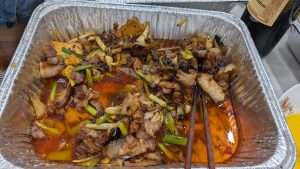
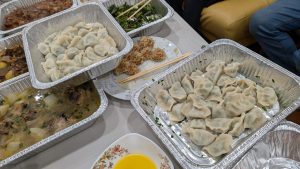
A dozen members gathered at Zhang Yan’s home. Qiu Yueyun was the chef, and Wang Li and Zhang Yan were the helpers. At the last stage of making dumplings, Attorney Zhang and Mrs. Li also made their own dumplings. They were all experienced in making dumplings. The dumpling skins they rolled were really thin. Wang Li’s stuffing was first-rate and the dumplings were very fragrant. The food you make yourself is delicious and healthy. The seafood was not absent. The other dishes were all delicious. The beef brisket and radish stew, the twice-cooked pork, Zhang Yan’s hand-dried bacon, Wang Li’s ketchup prawns, and the dumplings at the end were very popular. Everyone felt very great. The three or four children were also very happy. The neighbor brought a baby and became a little happy fruit. From one or two o’clock in the afternoon to eleven o’clock in the evening, a meal took seven or eight hours. There was very little dessert and watermelon left.


There was no extravagant setup, but the warmth and comfort were felt by all. Unfortunately, members who were far away, such as Yao Cheng, couldn’t attend. Wu Ting, though not living in New York, had planned to come with her husband but mistakenly got the time wrong, thinking the gathering was on Sunday instead. She must have regretted missing the opportunity to taste the handmade air-dried bacon.


WRIC members in New York had a joyful and happy time on the second day of the 2025 Lunar New Year.


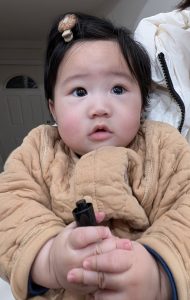
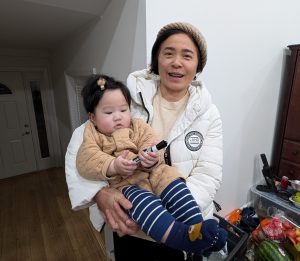
This little baby girl who appeared in the show is so cute!


JOE, who was speaking, was an early volunteer for Chinese women's rights. From an overseas student to someone who sympathized with and supported the democracy movement, and now is running for mayor of New York City, her life has been a series of huge leaps.


We forgot to take photos of the air-dried bacon, twice-cooked meat, meat balls and chocolate cheese cake below, and when I remembered, there were only a few left.


NYC Chinese to Hold Event Commemorating 35th Anniversary of Tiananmen Massacre

By WRIC                                            2024-05-25


The New York Human Rights and Democracy Groups will hold a rally and march to commemorate the 35th anniversary of June 4th.  The general public is welcome to participate and jointly condemn the atrocities of the Chinese Communist Party and commemorate the victims of the Tiananmen Massacre.


time:

April 2, 2024 3:00 pm

The expected length of the meeting is about 2 hours


Location: In front of Flushing Library, New York


After the rally, the march began.


Parade route:


The library runs along the triangle from Main Street to Northern Avenue.


Don’t forget June Fourth! Establish a democratic China!


Organizer:

Democratic Party of  China

Beijing Spring

Chinese Alliance for Democracy

Women’s Rights in China


Contact person:

Dong Yongpo: (929) 391-6591

Wang Yonghong: (917) 470-0671

Yang Shisong: (720) 639-0551

Zhang Shihuan: (929)634-4187


Coordinator:

Ning Xianhua

Zhang Jing

An Qiang


Forum on the China “Chained Woman” ——and in Recognition of Zhao, Lanjian for Exploring the Truth

WRIC                                                                         09-5-2022


At the end of January 2022, the “Chained Woman” case broke out in Xuzhou, China. The tragic experience of the “Chained Woman”, such as being abducted and sold, chained all the time, beaten, pulled all the teeth, raped and group-raped, and living a life inferior to livestock has aroused the deep sympathy and concern of hundreds of millions of people. Under the pressure of the public media, the governments of Jiangsu Province and Xuzhou City successively published five investigation reports, and lightly punished the responsible persons and several low-level officials while avoiding the important and high-level officials, and falsely claimed that the “Chained Woman” was Xiao Huamei from Yunnan Province. But Chinese netizens disagreed with the government’s conclusion, pointing out that the five reports were contradictory and full of loopholes.


Then Zhao, Lanjian, a reporter, broke through many barriers and found Xiaohuamei’s uncle in Nujiang Village at the southwestern border of China. Having interviewed Xiaohuamei’s uncle, he published the interview video and a written report Xiaohuamei’s Uncle: The Chained Woman Is Not Xiaohuamei, directly refuting the lies of the CCP government with factual evidence. The report immediately became viral, and received tens of millions of views. Then Zhao, Lanjian became the CCP’s target. He received dozens of telephone warnings, harsh questioning and intimidation from the police of five provinces and cities. In August of this year, Zhao, Lanjian successfully came to New York. He has been constantly speaking for the “Chained Woman” and telling his own experience and the truth.


Women’s Rights in China, Christian Alliance for Righteousness and other NGOs jointly organize this forum to voice for the countless “Chained Women” in mainland China, and to commend Zhao, Lanjian for his courage to explore the truth without fear of the pressure. We hope that Zhao, Lanjian will join us in the new environment and continue fighting for the rights of the Chinese women and children and social injustice. We cordially invite all with conscience to join us. Let us speak out for the voiceless who are suppressed at the bottom of society!


Theme:

Forum on the China “Chained Woman”  ——and in Recognition of Zhao Lanjian for Exploring the  Truth


Time/Venue:

September 17th, 2022, 2:00pm–4:00pm Taiwan Center

137-44 Northern Blvd, Flushing, NY 11354


Guest Speakers:

-Ann Noonan, Executive Director of Committee for U.S. International Broadcasting

-Ann Lau, Chair of Visual Artists Guild

-Reggie Littlejohn, President of Women’s Rights without Frontiers

-Ilshat H. Kokbore, Director of Uyghur Human Rights Project

-Tsultrim Gyatso, Chinese Liaison Officer at the Office of Tibet Washington DC

-Chen, Pokong, self-media commentator

-Zhou, Fengsuo, President of Humanitarian China

-Zhang, Lin, self-media commentator

-Wang, Juntao, President of China Democracy Party

-Reporter, Zhao, Lanjian (will share his experience and spiritual journey)


Presiders:

Zhang, Jing, President of Women’s Rights in China

Shao, Jun, President of Christian Alliance for Righteousness


Groups Rallied at the UN to Call for Revoke Peng Liyuan’s Status as “Special Envoy”

WRIC Report/Photos                                             03-08-2023


Front of the gate of the United Nations Headquarters in New York to demonstrate two demands, that is, to call for international attention to the incident of the “Chained woman” and the “Special Envoy” title of the Peng Liyuan. Groups participating in the demonstration include Women’s Rights in China, Christian Alliance for Righteousness, Church of Rock New York, Humanitarian China, China Reborn, China Democracy Party, the China Federal Party, and the Chinese Democracy and Human Rights Alliance. Representatives of each organization made statements. Zhang Jing, president of Women’s Rights in China has gave a speech and was entrusted to read Mr. Wang Dan’s speech.


Zhang Lin was giving a speech. (Photo by WRIC)

WRIC members was holed signs to Call for revoke Peng Liyuan’s status as “Special Envoy”.(Right: Jing Zhang) (Photo by WRIC)


The “Chained woman” in Xuzhou, Jiangsu, which was exposed two months ago along with the “Iron Cage Girl” in Yulin, Shaanxi, a few days ago, detonated the Internet world because of their extremely tragic experiences. Shocked and angry reactions blew up. In fact, this is just the tip of the iceberg. There are more than hundreds of thousands of women (girls) who are bought, sold, kidnapped, and raped in mainland China every year to which those are a common event. Because in addition to the general loss of conscience and corrupt hearts under the CCP’s rule, there are also institutional problems such as corruption in the public security bureau, law enforcement officers participating in crimes and becoming the umbrella for criminals, the pro CCP officials, from large to small, contribute to the “supply” of extramarital sex demand. The process is no different from an assembly line that handles humans. For example, Xuzhou was originally a beautiful virgin who was used by the secretary and county magistrate of Xuzhou Feng County to sexually bribe the mayor above. These women have been raped and gang-raped all their lives, turned into reproductive machines, tortured, sexually abused, chained, locked in iron cages, pits, and pigpens, and spent their lives as mental patients. The ones that are deemed to be useless are murdered.


Pastor Shao Jun was giving a speech. (Photo by WRIC)

(Photo by WRIC)


When the case of the “Chained woman” came to light, the local government tried its best to cover up and deny it. Later, the Internet around the world clicked on it more than 20 billion times. Amid the widespread clamor for accountability, the county, city, and even provincial governments had to conduct “comprehensive” and “in-depth” investigations and published five investigation reports. But they all point at a deer as if it was a horse, refurbish lies, and cover up mistakes. This once again fully demonstrates the usual methods of the CCP: Suppressing the media, deleting the posts, tracking down and suppressing those who revealed the truth, and centralizing these “Chained Women” and “Iron Caged Women” (or even make them disappear) to prevent them from being exposed again; They sacrificed pawns to save rooks, deal with a few small officials, etc.; instead of allowing the facts to be exposed, thoroughly investigating the truth, investigating the criminal and civil responsibilities of criminals, examining the root causes of the system, and improving the operation of public power.


Humanitarian China’s president Zhou Fensuo (Right).

Jing Zhang was giving a speech.

Li yuan (WRIC member. left 2) with the supporters of Ukraine.

China Democracy Party president Wang Juntao. (Right)

Jing Zhang was entrusted to read Mr. Wang Dan’s speech.


Although we were fortunate enough to leave mainland China to avoid such an inhuman fate, we still worry about our compatriots in China, including our loved ones in China, such as wives, mothers, daughters or sisters, lest they be knocked down when they are kidnapped, raped, and transported to some backcountry where they were forced to marry, raped and gang-raped, chained, and locked in a dungeon… Their dreams, happiness, and even dignity were brutally destroyed, and they would end up as a “Chained woman” or “Iron Cage Girl”.


Two letters were mailed to UNESCO, one was an open letter signed by 410 people, with a single petition, urging UNESCO to revoke Peng Liyuan’s Special Envoy status and to Promote Girls’ and Women’s Education; The statement of the demonstration in front of the gate, in addition to demanding that Peng Liyuan’s UN special envoy title be revoked, also called on the international community to pay attention to the incident of the chained woman in China, urge the Chinese government to truly and effectively combat human trafficking, thoroughly investigate the truth of the chained woman case, and deal with it seriously. All criminals involved in the case should be charged and they must compensate for the lifelong sufferings of the Chained Girl, Iron Cage Girl, and Cave Girl.

Two letters were sent to the UNESCO.


CSW 65 Webinar Jing Zhang : The actual social status of Chinese women

By WRIC Jing Zhang                        March 18, 2021


Note: United Nations CSW 65 Webinar – President Jing Zhang of Women’s Rights in China was invited to speak: The actual social status of Chinese women


The actual social status of Chinese women

Although we’re meeting over COVID this year for Women’s History Month, it hasn’t stopped us from focusing our attention onto women’s and girls’ rights there at the UN Commission on the Status of Women via the Internet. Today, we’ll share with you an overview of women’s status in China and the root causes for the severe discrimination against women there, with the hope to deepen and broaden the world’s understanding of women’s rights in China.


The centurial lack of women within the CCP leadership

 Within the century since the establishment of the Chinese Communist Party (CCP), the Politburo Standing Committee has consisted of men and only men. During its rule over China in the past 72 years, only 6 women in total have made it into the Politburo, and 3 of those were wifes of the General Secretaries or the Premiers: there hasn’t been any woman within the CCP’s leadership who could actually speak out for her sex. This gender imbalance in political participation is one of the main reasons for the deprivation of women’s rights. The making and execution of policies and law have historically been entirely dominated by a few decision-making men. Taking reproduction as an example, we see how the CCP leadership encouraged women to have multiple children in the 1950s, then between the 1970s and 2010s, inhumane measures were taken to enforce birth control and abortion in order to fulfill the One-Child Policy; then in the 2010s, the policy relaxed to a quota of two; and now as we’ve entered the 2nd decade of the 21st century, they are forcefully pushing for women to bear more children for the country. Such control over women’s fertility and the birth and death of babies has been exerted by just the few men within the Politburo.


The women depicted in the CCP’s political propaganda have always looked prime and radiant, exuding confidence and an air of intelligence, living freely and meeting life’s challenges deftly. But the latest data have revealed the truth of women’s lives in China: The Global Gender Gap Report 2020 published by the World Economic Forum ranked China in the 106th place within the 153 countries represented; even some African nations in extreme poverty were ranked higher for women’s status. Xi Jinping cashed in 10 million USD to UN Women in 2015 and received a chance to speak at the opening ceremony of the Global Leaders’ Meeting on Gender Equality and Women’s Empowerment in September that year. And during the few months before that, in order to silence the voices of dissent within China, his admin arrested the Feminist Five for just holding up signs against sexual harassment. Women’s rights in China worsen year after year under Xi’s rule, with inequality and discrimination faced by women becoming more and more common and widespread.


Life: WRIC with the feminist organizations protesting in front of the UN in 2015 in support of the Feminist Five. Right: WRIC protesting against the hypocrisy of Xi speaking at UN Women yet oppressing women at home (Photos by WRIC)


Systemification of sexual assault and rape

 Although the #MeToo movement did make its way into major Chinese cities over the past few years, but most victims of sexual assault in China have remained silent or could only speak anonymously online as they either couldn’t afford a lawsuit or had been blackmailed into not pursuing one. In March 2020, a blogger known as Stacey in China conducted a questionnaire survey online on sexual offences on women. She received over 45,000 responses over the span of a few days. Over 85% of the respondents admitted that they had been sexually harassed or violated before. Some have even left behind comments in which they shared their experiences of being harassed by male colleagues or bosses; there were also stories of them being fired after filing a case to their senior managers. In a report submitted by Professor Fang Xiangming to the WHO, 11.5% of girls and 9.6% of boys in China had been sexually assaulted before. This amounts to over 20 million children per year.


Jurisprudence researcher Tian Gang had also pointed that at least 21% of women in China had been subject to sexual assault, and 24.7% to marital rape. These are the numbers that the Chinese government allows out. One can only imagine how much bigger the numbers would be in reality.


About 80 million parents in China work in the cities and leave behind their children in the rural areas with their grandparents. These children are often subject to rape  by their extended family and other villagers. Often these rapists are the village officials or their kin, meaning that the parents of these children wouldn’t be able to do anything about the crimes. Minors also fall victim to rape by teachers at school. This phenomenon has persisted for years because the government never penalised the offenders. Wang Yu, a Chinese lawyer and the recipient of the 2021 Women of Courage Award, had led a protest in Hainan along with a few other feminist activists against a case of 6 primary schoolgirls being brought to a hotel and raped by their headmaster.


In September 2020, Xu Mouke, a 60-year-oldman in Leizhou City, Zhanjiang, raped an 8-year-old left-behind girl from his neighbor. The girl’s 11-year-old brother took this scene. He passed the photo to his father as evidence. The parents of the girl who were victimized said that they had called the police and accused Xu of sexually assaulting an underage girl. Because there was no evidence, the police did not open the case. (Internet picture)


Feminist activists including Ye Haiyan and Lawyer Wang Yi protesting in front of South Wanning Primary School in 2013 over the 6 pupils raped by the headmaster, holding up a sign saying “Get me if you want sex, leave the kids alone.”( Online)


In an event organized by WRIC to support 10-year-old Annie’s right to go to school, lawyer Wang Yu ( woman) came forward and negotiated with the police about the legality of the activity.(Photos by WRIC)


Sexual assault and rape crimes in China has become systemic over the years and across all layers of society as well as a spectrum of establishments.


I have myself witnessed female inmates being raped by prison officers back in the 1980s in Guizhou. They were often taken away by officers for ‘independent work’, and when they returned to the prison cell they were extremely spent and would only cower and weep in a corner. Anyone who spoke among themselves about it or who whistle-blew would be publicly shamed or punished. The recently surfaced case of the Ma sisters in Shenyang is another proof of the systemic inprison rape in China that the authorities do not even bother to hide anymore.


The systemic assault on women in any form of captivity is also readily found in peripheral China. The Uyghur women among the 2 million captives in the concentration camps in Xinjiang were not only forced to sing and dance for the Han managers, but also gang-raped by them. Many escapees from the camps have revealed to foreign media their experience and what they had witnessed. Tursunay Ziawudan told the press that during her 9 months in the camp, she was repeatedly raped by a man in a suit and face mask inside of a pitch-dark room without any surveillance cameras installed. The women in the camps would be taken away each night and raped by one or multiple masked men. She had herself been tortured three times by two to three men before they began to gang-rape her regularly. She considered herself extremely lucky to have been able to escape and vocalise the truth — most other women there could not even dream of the opportunity.


Within the Uyghur communities, after the men in the family had been kicked into the concentration camps, the emptied-out spot at home would be filled by a Han official. This is part of the CCP’s ‘matchmaking’ schemes. Over the years, the CCP has sent over 1 million Han men into Uyghur homes for surveillance.


 Life:Tursunay-Ziawudun, a Uighur woman, told her story in an interview with a BBC reporter. (Screenshot from BBC video)

Right: An Uyghur exile in Taiwan, in tears, on her experience of being sexually assaulted at an interview by CTS Taiwan in 2019 (Screencapped from CTS)


And down in Hong Kong, many female protesters and detainees had been subject to different kinds of sexual offences and even rape by the police officers. A prominent case is of a 15-year-old girl Christy Chan Yin-lam who was found dead naked in an inland harbour in September 2019 at the peak of the Anti-Extradition protests. She was known to have been a pro-democracy supporter. And the pathology expert who testified at the coroner’s inquest had expressed that the condition in which she was found was extremely unnatural. Her two lungs weighed differently, which was atypical of a drowning victim; and a prototypical yet crucial test that could’ve been done to constrain the potential causes of death was not done by the pathologist who carried out the autopsy. The case received an open verdict from the coroner’s jury due to insufficient evidence to confidently land on any other available causes of death, and her case has remained a mystery since. There were yet many more young female protesters being groped by the police during arrest operations. Some incidents had been captured on live streams, but yet more would have happened in places where they couldn’t have been documented.


A young woman at an Anti-Ex tradition protest in Hong Kong being pinned down and groped repeatedly by police officers. (Internet image)


Incidents of sexual violence against female protesters by the Hong Kong police.

Artwork in tribute to Christy Chan Yin-lam, the 15-year-old girl whose cause of death remains undetermined (Image credit back to its original artist)

Workplace discrimination

 Over the past 40 years, the economic growth in China has exacerbated the gender income gap in the country. A 2020 report by a human resources platform revealed that women earn only 70% of what men do in the cities in the five years leading up to 2020; the income gap became wider the longer they were employed. Discrimination against women is found through from university admissions to employment. According to Human Rights Watch, 11% of vacancies in the public service were open to men only in 2020; this number was 19% back in 2018 and 2019. WRIC has received reports from women on being discriminated against at the workplace: applicants for posts in journalism have been asked to sign off to terms such as not to have children within the first 5 years of employment on their contracts. Inequality is even worse in the rural areas: for the same amount of physical labour, women are paid 20% less than men.


According to an investigation done in 18 provinces in China by the All-China Federation of Trade Unions, 98% of the female workers in manufacturing in the rural areas do not have any health family planning insurance; 72% of them are unprotected by any health insurance, a shocking 29.6% of them have even been asked to work during pregnancy.


State-owned All-China Women’s Federation have published data on the female employers’ perception of the gender discrimination they experience: 22% of them expressed that there is severe discrimination; 59% expressed that there is a moderate level of discrimination. A civil society-led investigation on the condition of the current workplace for women in 2020 found that 27% of them had been told that certain posts are reserved for a certain gender only; 58.25% of women had been asked questions on their marital status or on family planning during job interviews; and 6.39% had been demoted or moved posts during family planning. Most of these data are officially published, meaning that the reality could be way worse.


Discrimination not only occurs in the workplace, but it also appears in any corner of society at any time. The judge’s decision is also inseparable from discrimination and injustice. A “blackmail case” in Jiangsu from March 2021 is jaw-dropping, but not uncommon.


A scandalous case of blackmailing occurred in Jiangsu in March 2021. A single woman had sexual relations with nine officials in five years. The judge sentenced the woman to 13 years in prison and confiscated her 3.726 million yuan of “extortion” from nine men and a fine of 5 million yuan. In this case, The government benefited 8.7 million yuan from the girl. Nine married men and the high officer all became victims.


The PUA culture is deemed as extreme misogyny by the West and yet when it found the right soil in China it proliferated as a full-blown industry. The leading PUA company in China had over 400 employees in 2017 and over 100,000 subscribed members. Another one, which runs an online course, had 2 million subscribers in 2018. These courses teach men how to inflict psychological pain on women, seduce and set up rapes charge up to a few tens of thousands of Chinese yuans for tuition.


‘Naked loans’ is an industry. Loan companies collude with the mafias and target college and even high school girls nationwide for high-interest transactions. Many students came from the rural area and couldn’t afford the high living cost in the cities, and as governmental funding is non-existent, they had to turn to the devil’s deals. The girls need to send over a selfie photo or video of themselves naked holding out their ID cards in some form of erotic pose as collateral when borrowing. If they couldn’t pay off the loans and the interest by the due date, the company would publicise their nudes and personal communications. Some girls could even be forced into prostitution to pay off their loans. Some have taken their own lives over this. WRIC received an email back three years ago in which over 100 girls’ stories of being sexually abused had been documented, along with their nudes. We haven’t been able to publicise these stories as we aren’t able to guarantee protection for the girls given the collusion between the police and the mafias in China.


Life: A salesman at a pop-up stall selling ‘naked loan’ plans outside of a university in Wuhan in 2016. (Online photo)

Right: Selfie of a naked female loaner holding up her ID card being used as collateral for the loan. (Photo by WRIC)

 Large-scale trafficking of women

  In the 2020 Trafficking in Persons Report published by the US State Department on 25th June, China was ranked the third worst. This is the fourth time that China has made it onto the list since 2017. Since the Chinese government had never submitted any law enforcement data, and the crime data reported were heavily hedged, it’s difficult to evaluate the reality of the situation in China. What could be found about the trafficking of women in China on the UN’s website is from 10 years ago, and the data came from the Chinese authorities themselves. (http://kidnap.bz.cn/2019/7477.html)


Women aren’t trafficked just within China, but transnationally as well. WRIC has received many alerts of illegal prostitutes from China in the US. They work all year around and may take up to a few tens of clients per day, even that barely covers the stowaway cost. Some have been rescued with help from the US police, and as we hoped that they could stand as witnesses against the traffickers at court after they had settled into their new lives on their V visa, they had not been able to due to fear of retribution at their families back in China.


The One-Child Policy had skewed the gender ratio of China, it created a phenomenon of at least 30 million bachelors without a match today. These men resorted to buying themselves a wife from South East Asia to bear them children. According to an incomplete survey, there were over 100 thousand ‘Vietnamese brides’ in China in 2015; less than half of them were legally married to a man, most of them lived in extreme poverty in rural villages and went about without an ID. Allegations of disappearances and deaths of these South East Asian brides are not uncommon, but there have never been any official numbers.


The public sign said: Buy a Vietnamese virgin bride for 200 thousand yuan (30,700USD).  (Internet picture)


Domestic violence and suicide as a norm

 According to the data from the state-owned All-China Women’s Federation, domestic violence occurred in 25% of the 270 million families in China in 2019; 157 thousand females commit suicide each year, 60% of those were caused by domestic abuse. One woman is abused at home every 7.4 seconds on average; the victims endure an average of 35 abuses before they’d call the police. Death by domestic violence makes up over 40% of foul play for women. The abusers are mostly male. A semi-state-owned women’s rights organisation has also pointed out that between 1 March 2016 and 31 October 2017, 533 cases of death by domestic violence had been recorded; these involved 635 deaths including also children, meaning that at least one person dies from domestic abuse each day on average, and she is likely a woman.


In light of the high divorce rate in China, a 30-day cooling-off period has been legislated and enforced since 2020. During these 30 days, victims of domestic abuse could be subject to yet more violence and threats. A young Tibetan woman in Sichuan was repeatedly attacked by her husband who habitually splashed gasoline onto her, with all her calls for help ignored by both the local law enforcers and the court, she was eventually burned to death after two weeks.


      A picture of the late Tibetan victim of domestic abuse.(Internet image)


China was once a country in which the female suicide rate was higher than that for male: rural women are 60% more likely to kill herself than men, while the global average finds that men are 25% more likely to commit suicide than women. Academics think that the movement of rural women to the cities had kept women away from the lethal herbicides with which they could use to kill themselves. However, as the Chinese government began their operations to chase rural workers back home as cities began to saturate, these figures are likely to rise again. The Chinese authorities are unlikely to take actions as they continue to push for a high rate of economic growth at the expense of the workers’ basic human rights. Against this backdrop, rural women and children will suffer the most.


Recent years have seen the Chinese government’s implicit plan to force rural-originated workers away from the cities as the urban areas got overburdened and as the government had finished milking out all the cheap manpower they could get from these workers. In 2017, the Beijing authorities began the most radical operation to force rural-originated workers back home. The mayor flattened an entire area that used to house over 10,000 workers and the families whom he deemed ‘lowlives’ overnight by claiming that there was a fire. From then on, there were no more rural-originated workers in Beijing, but only the urban population and the awe-inspiring skyscrapers that these workers had built.


With COVID-19 taking a serious toll on the country’s economy and with local authorities using epidemic control as an excuse to banish rural-originated workers, hundreds of millions of them will now return to the barren lands from which they gave their all to build a life away. What awaits the middle-aged women that return into such an environment is unemployment, infertility, discrimination and helplessness, and the old way of life in which they could just end their lives with a mouthful of herbicide, where there would be even less chance for them to access professional support. The Chinese government has ignored the severity of the consequences and has done nothing to prevent women from committing suicide.


The warzone-like ruins of the Da Xing district that used to be home to the rural workers in Beijing.  (Photo by Bryan Denton)


 Closing remarks:

The systemic sabotage of women by the CCP

Researchers have distilled the factors behind the high female suicide rates into 3 C’s: Communist, Confucius, and Commercial. In fact, the last C can’t be the main cause for suicide as the Chinese people are rather accustomed to poverty, and poverty-driven suicide attempts have been extremely rare. The real driver for the high rural female suicide rate is the 40-year-long draconian one-child policy along with a series of related legislation, which regressed society back into the malfunctional system of the past and led to the further degradation of what little remained of women’s rights in China.


Within the little-known Chinese Museum of Women and Children in Beijing, none of the displays were the drugs or tools used to control women’s fertility, nor are there any numbers or text showing the harm inflicted on the hundreds of millions of women subject to the cruel fertility policies devised by the government, nor anything about the forty million aborted babies as mothers were coerced to comply to the one-child policy. 40 years of the largest forcible birth control operation known to man had disappeared on the land of China, just like how children born in the 90s in China had never heard about the Tiananmen Massacre. All this reflects the ironic success of the CCP at covering up history and shutting up mouths forever.


Since Xi Jinping began his rule, women were put back into the home as just a wife and a child bearer. The status of women in society described in ancient literature that even Mao had scorned at has been brought back to life. In the CCP’s eye, the diminishment of women helps consolidate their rule. Xi’s oppression of women who would speak out against it paints a grim future for feminism in China, one in which patriarchy prevails and grows ever stronger and women’s rights and living space shrivel into nothing.


***********************

About Jing Zhang:

Jing Zhang is the youngest member of the Chinese Democracy Wall movement in 1979. She wrote the articles criticizing the Chinese government, and she was sentenced to 5 years in prison. After being released, she worked as an editor for a newspaper in Hong Kong. After Hong Kong returned to China in 1997, she came to the United States and continued to work as an editor for Chinese newspapers and continued to advocate for democracy in China.

In 2007, Jing Zhang  established the Women’s Rights in China organization, dedicated to fighting for the rights and interests of Chinese women and children and promoting women’s political and social status.


WRIC Releases E-Book The Status of Females in Rural China

WRIC Volunteer: Gordon Bi


The Status of Females in Rural China Introduction:


The Chinese government, in the name of the state, has carried out an anti-human massacre plan with the largest scale, the largest number of murders, the worst torture and the deepest harm in human history, which is the root of depriving Chinese women and children of their basic rights and interests. The abduction and trafficking of children, the gender imbalance, the aging society, and the upbringing problems among families, derived from the One Child policy, have caused serious social problems, even immeasurable disasters. The 5 main projects of WRIC include anti-forced abortion, helping child brides, anti-trafficking activities, support abandoned girls, and assist the rural baby girls. This book features more than 300 pictures, which all of them were taken by WRIC volunteers along with their true stories that show the reality of rural women’s lives in China. For this, our volunteers were jailed and given different sentences. If you research China’s One Child Policy and statuses of women and children in rural China, this book will tell you more details about the reality of 800 million people living in the countrysides.


About WRIC:


A complete set of pictures of cooking fetal corpses, being enjoyed by the old and young people around table, was spreading on the Internet in 2005: a fetal corpse was washed with clean water, another fetus and traditional Chinese medi-cines were placed on chopping board, a pot on fire, an ugly man’s face, and finally a family gnawed and drank the skin, the meat and the broth… Jing Zhang, a former journalist, was extremely shocked. Soon another scandal circulated on the Internet: two teenage female orphans in Nantong (Jiangsu Province) Children’s Welfare Home (orphanage) were hospitalized to remove their uteri, the president of the orphanage said that she was afraid that their menstruation would be unclean and pre-vent them from being pregnant. She also said that the whole Chinese industry did so. Next, a reporter exposed a long list of names of female orphans who had been deprived of their wombs. After a long talk by chance, Jing Zhang was inspired by the famous media colleague, Gao Yu and decided to do her best for the girls. In 2007, Jing Zhang founded Women’s Rights in China(WRIC), a non-profit organization (NGO) in New York. To safeguard the rights and interests of vulnerable groups in China, especially women and children, to be the voice for them, and to strive to build a fair and reasonable society, is the goal of WRIC’s mission.


According to the survey from WRIC, the Chinese government, in the name of the state, has carried out an anti-human massacre plan with the largest scale, the largest number of murders, the worst torture and the deepest harm in human history, which is the root of depriving Chinese women and children of their basic rights and interests. The abduction and trafficking of children, the gender imbalance, the aging society, and the upbringing problems among families, derived from the One Child policy, have caused serious social problems, even immeasurable disasters. The 5 main projects of WRIC include anti-forced abortion, helping child brides, anti-trafficking activities, support abandoned girls, and assist the rural baby girls. This book features more than 300 pictures, which all of them were taken by WRIC volunteers along with their true stories that show the reality of rural women’s lives in China. For this, our volunteers were jailed and given different sentences. If you research China’s One Child Policy and statuses of women and children in rural China, this book will tell you more details about the reality of 800 million people living in the countrysides.

WRIC, a group of sisters and brothers who have ideals and seek justice, have been working hard to safeguard the people’s legal rights for ten years, hand in hand and heart in heart. How many passions touched, success or failure, gains and losses, crying, laughing, and striving, the ideal of a just society to pursue together!

All the way, it was full of difficulties and dangers. Looking back ten years ago, we have no complaints and no regrets! On the occasion of celebrating the 10th anniversary of WRIC, we have published a realistic anthology “The Ten-Year Record of WRIC’s Forum” and a short documentary, which includes interviews, surveys, financial aids, supports and demonstrations we have done in the past ten years in mainland China and at our headquarters in the United States, in order to dedicate ourselves to WRIC’s volunteers who are fearless of the fierce power and imprisonment. They adhere to their beliefs and move forward and forward. Let us honor them with lofty respects! It is also a memorial to the death in the despotic and patriarchal society.

Sep. 2018


OPEN LETTER: Hold China Accountable for Crushing Dissent in Hong Kong

By  Women’s Rights Without

      Women’s Rights in China                             January 01, 2020


To:  President Trump, the United States  and the United Nations:

Congress


A peaceful and prosperous Hong Kong poses an existential threat to the Chinese Communist Party’s narrative that Chinese people cannot thrive under freedom and democracy.  The CCP has circumvented the rule of law by issuing a National Security Law that would crush all dissent in Hong Kong.


We call upon President Trump, the United States Congress, the United Nations, and people of conscience all over the world, to set aside all political differences and continue to take bold action to hold China accountable for its hubris.   We commend President Trump’s promise to end Hong Kong’s trading privileges, as well as the joint statement issued by the governments of the United States, UK, Australia and Canada, condemning China’s violation of the “one country, two systems” policy promised in the 1997 transfer of power from British to Chinese rule.


When Britain agreed to return Hong Kong to China in 1997, China agreed to afford Hong Kong protection of a “high degree of autonomy” in government, law and finances for 50 years, until 2047.   Abrogating this autonomy, the National People’s Congress (NPC) has passed a law bypassing Hong Kong’s own Legislative Council.   The CCP-owned China Daily stated that the new law is intended to “prevent, frustrate and punish any secessionist or subversive activity, the organizing of terrorist acts, and other acts that seriously threaten national security as well as activities of foreign and external interference in Hong Kong.”  Indeed, according to a top CCP official quoted in China Daily, its intent is merely “to protect Hong Kong residents from the criminal acts of a small number of extremists.”


In practice, this law can be used to crush free speech, criticism, protest and dissent.   Countless Chinese dissidents have been jailed on groundless charges of “subversion,” including Nobel Peace Prize winner Liu Xiaobo, who in 2009 was sentenced to 11 years in prison for calling for democratic reform.  He died while serving his sentence. Hong Kong activists rightly fear that this new law will render dissent, or even political discourse, a criminal offense.  It represents the end of “one country, two systems.”


Equally worrisome, the new law implies that security forces from mainland China, such as the Ministry of State Security, will be set up in Hong Kong.  According to a second article in China Daily,  “The NPC draft decision has also stipulated that organs of national security of the central government will set up agencies in Hong Kong, whose operation will be according to law.” The people of Hong Kong mounted massive protests to prevent extradition from Hong Kong to mainland China.  Now, the dreaded national security apparatus of mainland China will take residence Hong Kong.


We stand with the people of Hong Kong, who have suffered so terribly in their struggle to maintain the autonomy promised them.  We commend the actions the U.S. government has already taken to disengage economically from the PRC, including the May 27 declaration that Hong Kong is no longer autonomous, and President Trump’s announcement that the US will end Hong Kong’s trade privileges. These tragic actions should be blamed on the CCP, whose shameless maneuvers and raw power grabs have brought us to this point.


The global community needs to protect international security and economic interests.  On the table should be various economic and financial sanctions, such as those recommended by the Committee on the Present Danger:  China. In addition, we need to hold individuals accountable through the Global Magnitsky Act.


We also need to increase our commitment to the people of Taiwan, especially in light of the ominous statement by a top Chinese general that China will attack Taiwan to stop independence.  Hong Kong now, Taiwan next?


Taiwan is opening its arms to Hong Kong citizens who want to resettle in the face of the tightening grip of the CCP.   We call upon the United States and governments the world over to do the same.


While our two organizations advocate for women’s rights, we note that half of the people of Hong Kong are female.   Our organizations will, as always, do our part to assist women and children persecuted by China’s authoritarian regime.


Reggie Littlejohn, Founder and President, Women’s Rights Without Frontiers

Jing Zhang, Founder and President, Women’s Rights in China


Assist Baby Girls in Mountain Area

WRIC Yao Cheng                              March 8th, 2011


Over three months that the activity of WRIC is carried out in Feixi County, Anhui Province, it has been extended to four towns of Gaoliu, Gaodian, Gaoting and Mingchuan. On March 7th, WRIC volunteers came to Jinqiao Village, Guanting Town, which borders with Lu’an, to grant subsidies to female infants and pregnant women.


Jinqiao Village is located at the edge of Dabie Mountain., through which the Pihe River excavated artificially in 1950 s passes.  It is in hilly area. Jinqiao Village, with more than 2800 people, is the poorest village in Feixi County. The villagers here live disperse. When we first came here, we couldn’t find a suitable place to distribute subsidies.  So we chose village’s center, the village committee.


Helped baby girl of WRIC’s The Rural Baby Girl Assistance. (Program. Photo by Yao Cheng)


Because we informed them by telephone in advance, more than a dozen recipients of subsidies came here early. When they got the subsidies from our volunteers, they thought we were from the Family Planning Office of village. We explained that this was the money donated by some American non-profit organizations and benevolent people for the protection of baby girls. They told us that the Family Planning Office also has registered the data of baby girls and government would give them subsidies. But no one had received it. This made the village officers present very embarrassed.


There are neither good mountains nor farmlands. In order to maintain their livelihoods, most young and middle-aged people can only go out  to work and do some hard work in the city. But they cannot earn much money. Family planning officer didn’t distribute subsidies for a long time. So it is very welcome for us to pay them money. Therefore, when I proposed to look the situation of the birth of infants, she also provided information actively and introduced the relevant situations.


The specialist cadres told us there are nine children were born in this village, seven boys and two girls. There is a big gap between genders. The work of family planning is more and more difficult to ddo. Almost of them are pregnant when working outside.  Why are there so many boys and little girls? She didn’t know either. The situation of pregnancy cannot be accurately mastered. When we were distributing subsidies, a villager asked if we could give some subsidies to a legs-disabled woman. She had a disability certificate but could not get the disability allowance.  I immediately called a disabled friend in Hefei. He told me clearly that as long as she had a disability certificate, the government would definitely have subsidy for her. The reason why she didn’t receive it was probably that the village withheld it. I asked the specialist about it. She answered that she couldn’t receive both minimum living allowance and disability allowance.


Since I started the girl assistance program, I have visited many village committees. I have always been unclear about the sources of funds of village cadres for organizing tourism and drinking. The village does not belong to the first-level government departments. It should be said their funds are limited. The minimum living allowances are also allocated according to proportion of the population. Such as that disabled person, she occupies a quota of minimum living allowance. Then the village can withhold her disability allowance. In fact, she can receive disability allowance and give her minimum living allowance to another family. However, the village took her disability allowance as the funding of the village committee. In addition, I believe the government must have allocated the subsidies for families with girls. I have read the registration form, which is complete. Because the villagers are honest, they dare not ask for village cadres every day, or the cadres excuse them that the subsidies are not ready. Then it will be end with nothing.


Corruption of village cadres is a very serious problem in China, not only in Wukan, but also in almost all village committees throughout the country. The poorer the village, the more serious it is.


Women’s Rights in China Condemns Su Changlan Sentencing in Fuoshan Court

By WRIC                                                                            Apr 01, 2017


On March 31, 2017, women’s rights activist Ms. Su Changlan was sentenced by the Guangdong Fuoshan Intermediate Court to three years for “subverting national government” to three years in prison plus three more years without political rights. Ms. Su had already been illegally detained for two and half years through numerous delays of court dates. Her alleged subversions amounted to interviews and reports of civilian petitioner Ma Shenfen and an expose of the abuse and death of Cao Shunli, published on the WRIC website and attributed to her by the Chinese government. The judgment, lacking concrete instances of subversion, instead mentioned Women’s Rights in China nine times and WRIC founder Zhang Jing three times. Ms. Su and Ms. Zhang’s friendly Skype chats were used to pad the otherwise vacuous judgment, signifying the Xi Jinping regime’s renewed suppression of non-governmental organizations and an era of NGO frost in China.


Articles published by Ms. Su on www.wrchina.org included only reporting on the rights and welfare of women and children in China, searches for missing children and renuiting kidnapped child brides in Fujian Province with their parents. Contrary to the court judgment’s allegations of “fraud and libel”, each report and interview was verifiable and factual, with real events and persons, from the charitable and humanitarian perspective. In comparison, the Fuoshan Intermediate Court was the glaring example of obfuscation and slander. Su Changlan was arrested in October, 2014 for “spreading information about Occupy Hong Kong”. She subsequently spent two and half years behind bars, after the Guangdong Superior Court had to unprecedentedly grant the government four delays in the case. Deviating from legal procedure, the police refused to admit any mistake or release her. Ms. Su, in ill health, frequently went on hunger strikes and was determined to resist her unlawful detention.


Women’s Rights in China is a non-profit organization registered in the United States in 2008. WRIC’s projects in China, in charitable cooperation with women’s and children’s human rights organizations, included the search for missing children, assistance for abandoned female infants in nunneries, reuniting child brides in Fujian through investigations and DNA collection, legal aid for victims of governmental population control and milk subsidies for baby girls in the countryside. The Chinese government not only did not assist these activities in any way, but regarded WRIC as an enemy and obstructed and suppressed its activities. The Xi Jingping government has declared that all foreign human rights NGO’s as hostile organizations and actively oppressed and purged domestic civil society organizations in contravention to universal humanitarian principles.


WRIC strongly condemns Ms. Su Changlang’s prison sentence as a blatant assault on the conscience of China. WRIC takes pride in Ms. Su and is proud to count her as one of her volunteers. She stated in her trial, “I love my country deeply. I love even more every citizen who lived on its soil, the people who are suffering from inhumane oppression. The mechanism of the government put me in the chair of the accused. The glare from the emblem of the state in front of me seems to be fading. But the strength of justice has let me see the light of hope. I am innocent.” (http://www.wrchina.org/archives/5120) WRIC will not submit to oppressive power, and will continue to defend the rights and welfare of women and children in China.


Women’s Rights in Chian volunteer Su Changlan (right) intervied Ma Shengfen’s rights deeds in Jan 2014.


Obstructed by Police during Nunnery Visit with Taiwanese Friend

Article by WRIC Volunteer:  Li Hui


Editor’s note:  The Birth Planning Policy has been implemented for 30 years and has caused human tragedies unseen in history. Those hundred million newborn and stillborn innocent souls killed by this national policy cannot be forgotten. Among these souls are those that would have been grateful for being brought to this world, but were wiped out. For example, these adopted girls at the nunnery should have had a happy childhood and a warm family, but this kind of normal life was strangled by the widely evil national policy before even emerging. What a tragedy! Nowadays, the problem of ageing population has surfaced, the gender proportion of the population is unbalanced, and child trafficking is rampant. The government’s policy is the origin of all these disasters, but not only does the government refuse to aid, comfort and solve the difficulties of the victims, they do the opposite and block all news, prohibiting the outer world from learning the truth, and even use suppression and threats to obstruct social assistance.

In July, WRIC helped a young Taiwanese female photographer arrange for a visit to a nunnery that takes in abandoned babies. Unexpectedly, the photographer was repeatedly harassed by the local police and officials from various government departments. She became so frightened that she could only end her trip and escape from mainland China as quickly as possible. We feel very helpless and frustrated about this incident. It was the first time for this girl to visit Anhui, China. She had been dreaming about being close to her mother’s hometown and feeling the vibe of its ancient civilization, but now she has been intimidated by the officials and the police and had to run away. It is a sad sight. In regard to the political situation of Taiwan, the Chinese Communist Party (CCP) has said they were “one family” on the surface, but in practice, they exert all energy into squashing up the survival space of Taiwan. Taiwan citizens are chased around the world and beaten up by the CCP just because they are fighting for a pitifully small amount of dignity and rights. This girl just walked around freely for a few days in China, would the sky collapse then? Before she boarded the plane, when she was still in Taiwan and had not even set foot on the mainland, the CCP had already collected relevant information. From this, we can see how much “homework” the CCP did, and what resources they tapped on, all to stop a girl from visiting another girl.


About 2 months ago, Taiwanese girl Mian Man was chatting with WRIC Jing Zhang. Jing gave her an introduction on the nunneries in mainland China which adopted abandoned babies. This practice was brought about by the Birth Planning Policy. Some rural families abandoned newborn girls at monasteries to keep the birth quota for a boy. Before this practice, some people gave away their baby girls or even killed them. Eventually, some parents didn’t have the heart to do so since it was their blood and flesh, so they thought of nuns, who were full of compassion. The parents secretly placed the newborn girls in front of the monasteries, hoping that the kind Buddhists could help keep the babies alive. The nuns did adopt the babies, since Buddhist doctrine specifies helping the wounded and dead, so they can’t leave someone who is about to die. Secondly, nuns cannot marry and have children, so they consider about their future and prefer to have disciples and someone to take care of them when they get old. Surprisingly, this act attracted a large amount of abandoned babies, all of which were girls.


After listening to Jing Zhang introduction, Mian Mian had a deep interest in the topic and wanted to go to see it herself, hoping that WRIC could contact the nunnery and assist. On one hand, she was indeed a Chinese, and her mom was from Anhui, so she could search for her ancestors in the mainland and view this old, mysterious land to realize her dreams. On the other hand, as a photographer, it was rare in the contemporary world that nunneries would adopt a large number of abandoned girls, and this humanistic wonder was also original material that she wished to obtain to create her art.


Not long after, Yao Cheng from WRIC sent me a message asking if I could be the guide for this Taiwanese girl to visit a nunnery that adopted girls. To ensure that the visit would be successfully accomplished, he didn’t tell me which nunnery it was, where it was located, and who to contact, only telling me that the visit would be in mid-July.


Around 2013, I was a volunteer for WRIC and participated in projects to assist women and children. It was especially because I took part in advocating for the right to education for Anni Zhang that I was detained, summoned and blocked at the border many times by the police and Public Security Officers from places such as Hefei and Fuyang. I was even sentenced. When Yao Cheng was working on this project in the mainland, I had already learned about the situation of these nunnery girls and wanted to visit these poor children. I was busy dealing with some matters before this, but now I had a chance, so I was more than glad to go.


In the morning on July 17, Yao Cheng told me that the Taiwanese girl would arrive in Shanghai two days after (19th) and would take the high-speed rail to Hefei, so I should pick her up at South Hefei station on the 19th and take her to our destination: Linjiang Nunnery along the north shore of the Yangtze River in Fuxing Town, Susong County, Anhui Province.


In the early morning of the 19th, I was already on my way to Hefei. Not long after I arrived at South Heifei station (at around 10am), I received a message from Yao Cheng that Susong County Bureau of Religious Affairs and the Fuxing Town police both called Linjiang Nunnery. At first, they asked if a Taiwan reporter was coming there, then warned them that they could not meet with her. Shi Hongwen, a girl from the nunnery replied that she never heard that any a Taiwan reporter was coming. (At that time, due to a flight delay, the Taiwanese girl hadn’t even crossed the Chinese border. I really admire the level of monitoring of the Public Security Bureau. Although we used chatting software from foreign countries and used a new cell phone number, the resourceful cyber police, penetrating every corner, had immediately monitored the content of our conversation and had preparation plan ahead of time). Due to the flight delay, it was already 8pm when I picked her up. We could only stay in Hefei for the night.


台湾年轻摄影师绵绵(左三)和尼姑庵的女孩们。

Young Taiwanese photographer Mian Mian (third from the left) and the girls at the nunnery.


李惠和尼姑庵的大女孩 819203728021899430 李惠和绵绵。

Form lift : Mian Mian and Shi, Hongwen. In 2012, WRIC raised money for Hongwen heart bypass operation. Ten years old Shi, Hongxin. Mian Mian and WRIC volunteer Li Hui.


It was too hot the next day so we decided to get to the nunnery by car. At around 12pm on the 20th, after a long journey of almost five hours, we finally arrived at the remote nunnery in Fuxing Town, Susong County, Anhui Province. Although it was called a nunnery, it was actually a few makeshift houses that were just built. Since the flooding of the Yangtze River, the already torn Linjiang Nunnery was soaked and lay in disarray. The three master and disciples could only live a harsh life in some makeshift houses. The old master was almost 80 years old and had adopted two girls: one just turned 20 and the other was only 10 years old. The elder girl was named Shi, Hongwen and had Congenital Heart Disease. In 2012, WRIC raised money for her heart bypass operation. The younger was named Shi, Hongxin and was studying at the village elementary school. Besides the government subsidy of RMB600 that the 10-year-old receives (which will cease once she turns 18), the three can only live on sparse donations. Now that the nunnery was flooded, life was extremely difficult for them. They lived from hand to mouth, not knowing at dawn what might happen by dusk.


Just a few minutes after the Taiwanese girl and I had arrived, seven to eight government officials came. They were from the Susong County Bureau of Religious Affairs, the United Front Work Department of the CPC Central Committee, the Propaganda Department etc. They claimed that they had been sent to take part in flood relief (which was false, it was more to monitor us). Actually, they had already came in the afternoon on July 19th (since they didn’t get the latest information on the flight delay), and had got nothing. These few middle-aged men had no respect for the serenity of a Buddhist temple and randomly barged into the nun’s bedrooms. They kept monitoring us and tried to talk about nonsense. Even when we were having lunch, they stood at our side and refused to leave. I didn’t shy from telling on them, and said to one official from Bureau of Religion, “Since you are from the Bureau of Religious Affairs, you should know your duty: how many real-life problems have you solved for the nunnery? How much money have you donated? How much funding have you applied for them?” He argued, “They don’t have the proper registration, and are not recognized by the government, so they cannot be helped.”


I said, “The three here are old, weak, sick and disabled. They don’t even have enough to eat and keep warm, how would they be able to register? They have such a difficult life, but not only do you ignore them, you obstruct social support that can rescue them! Friends from across the border have travelled dozens of thousands of miles to donate and assist them today, but you aren’t welcoming them, and even treat them as criminals, guarding them closely. There were so many of you barging into the nunnery! You scared the children so much they aren’t coming out. What impact have you brought to those around you? (At that time they suddenly charged into the nunnery and did scare 10-year-old Little Hongxin, who rarely sees men. So many tough-looking men busted in that the little girl immediately panicked and closed the door to hide from them. She was too afraid to even come out for lunch).


After we finished lunch, the United Front Work official from the Department of the CPC Central Committee got straight to the theme with me, asking for my name, phone number, address etc., then started questioning my Taiwanese friend on why she was here and told her to show her passport and relevant ID. They asked for details regarding the aim of this trip and took photos before leaving. Not long after this group left, 4 Fuxing Town police came, clearing the road with their police car and arriving with weapons and all. One of them was even a policewoman. Just after getting out of the car, they demanded Mian Mian for her ID and took pictures, and had her fill in a form. They told me to give personal information as well. Following that was again a series of investigation and questioning. One of them seemed to be the little leader.


His face tightened and he left with arrogance, saying “Foreign nationals staying the night at a nunnery must report to the precinct upon arrival to our town. If you don’t leave tomorrow, we won’t come to serve you, you must go to the precinct.”


The next day, we planned to walk around the village after getting up. Just as we walked out, a police car followed us like a shadow, staying on guard in secret. They took no notice of the scorching, fiery sun in the midst of the hot summer, and rode dozens of miles to this remote countryside in the early morning to stalk and “protect” us. How dutiful of them! If they had used so much manpower and resources to really serve the people, why would they have to worry that the social situation was unstable? This sovereignty of China sees every person as an enemy wishing to overthrow them. A young Taiwanese girl born in the 80s travelled tens of thousands of miles to mainland China just to understand the lives and conditions of the girls at a nunnery. For a small matter like this, they had to dispatch so many people in such a state of insecurity and panic! They didn’t take into account the heat of the day and for three consecutive days, dispensed so much manpower for surveillance and harassed us. This sovereignty looks strong and unbeatable, but is actually the weakest.


According to sources, due to the Birth Planning Policy, abandoning babies at nunneries have become common. These nunneries are mostly located in poor and remote rural areas, such as in Anhui and Chongqing. The majority of these nunneries are not recognized by the government. WRIC has started this rural girls; assistance project since 2008, but because of the interference of the Chinese government, it has not been able to function normally since 2011. These girls’ health is not guaranteed. Buddhists are vegetarians, so the children can’t even eat eggs and milk, not to mention fish and meat. They don’t have medical insurance, so when they get sick, they can only allow themselves to be treated by folk methods from the masters. They cannot receive normal education from the family and school, and can’t feel the love from a father and mother, so have serious psychological problems. A lot of them have autism. From my short time of meeting with them, I already discovered that 20-year-old Hongwen and 10-year-old Little Hongxin both have this kind of autism, especially Little Hongxin, who never spoke and only nodded or shook her head when I asked anything, with no smile on her face. She never communicates with strangers and doesn’t have any books and toys; she doesn’t have a spiritual world. We put in a lot of effort and gave her some toys. Finally, right before we left, we saw a hint of a smile, and she promised to take a picture with us to keep for memory. They have lived in such an environment since they were a child, so when they grow up, they naturally can’t assimilate into society. Therefore, many girls choose to become nuns.


Mian Mian originally intended to stay in the mainland for a week, so her return ticket was scheduled for 7/26, and she planned to go to other places. However, what happened right before her eyes showed that she should not stay long in the mainland. Thus, after donating RMB1000 to the nunnery, she refused my repeated pleas for her to stay, and suddenly changed her high-speed rail ticket date, disposed of her original flight ticket, and bought a flight ticket to Taipei within the shortest time possible. She experienced hardships and passed through tens of thousands of miles from the U.S. to China, but only stayed for three nights, and fled back to Taipei during the midnight on July 22. Before she left, she called me and in an extremely excited tone, told me that she was so lucky to leave this country; she didn’t want to stay one minute longer in the mainland. Since the internet here is often blocked, she couldn’t login to her email and social network accounts and couldn’t contact her friends. More unbearable was that she herself was treated as a hostile force and was monitored and harassed. She couldn’t feel any sense of security, and said that she would never go the mainland again.


The Kidnapped Girls

Interview video by Germany’s ARD


Women’s Rights in China(WRIC) volunteer Su, Changlan is showing a German reporter WRIC’s two programs that address the issues of child brides and missing / kidnapped children. In the video interviews with actually victims of these atrocities are shown. Later that year – 2014- Changlan was put in jail for ” Subversion of State of Sower” and is still in jail at the present time.


http://www.daserste.de/information/politik-weltgeschehen/weltspiegel/videos/china-die-gestohlenen-maedchen-100.html


Screenshot_1         Screenshot_2 Screenshot_3            Screenshot_6 Screenshot_4         Screenshot_7

Xi Appears at UN Women’s Conference WRIC: Shameless

Live Coverage by WRIC Volunteer Yujun Zhang on Sept. 28, 2015


1-2

Since becoming President of China, Xi Jinping has cruelly oppressed NGOs, including feminist organizations. A large number of NGO offices have been “investigated” and have lost documents due to confiscation. Many were closed down. A group of feminists, including The Five Sisters, have been unlawfully detained. Female journalist Gao Yu, who is already 70 years old, was also given a charge and put into jail. She was prohibited to seek medical attention outside, an inhumane act considering her serious illness and old age. Su Chanlan, volunteer of Women’s Rights in China (WRIC), just helped Chinese women and children and took part in anti-trafficking activities, but was arrested for “subverting state power” and imprisoned. Many rights-defending lawyers and staff, including female attorney Wang Yu, faced unprecedented oppression, and was hauled into jail one after another.


Xi Jinping’s disrespect for women has reached a “peak”. In 2013, he gave a new guideline for the All-women’s Federation, demanding it to serve the Party: women should actively take on the responsibility for sustaining “family morals” and harmony, not mentioning a word on Chinese women’s effort in fighting for equality and status in the past hundred years.


From the recent acts of Xi’s government, we can see that feminism will not undergo true development in his era. Instead, it will regress to a hundred years in time.


US president candidate Hilary Clinton wrote on her official twitter page: Xi hosting a meeting on women’s rights at the UN while persecuting feminists? Shameless.”


Xi’s speech at the UN was “cold inside and hot outside”: there were only a few people in the audience, while the protests outside were heated. WRIC joined the protest, pointing out that Xi was a hyprocrite.


An Investigation on China Village’s One Child Policy “Three Examinations”

Women’s Rights in China Founder Jing Zhang testified in Congress US Neb 10, 2009

Picture24

Summary: In rural villages, the Chinese government’s One Child policy is enforced with the ¨Three Examinations,〃 which check women for use of contraceptive rings, pregnancy, and illness practice that is hostile and abhorrent to women.

Picture20
WRIC Founder Jing Zhang (left four)testified in Congress US in Neb 10, 2009.
Picture21
Jing Zhang giving a speech before testifying for the hearing


From September 2008 to March 2009, we visited the provinces of Shandong, Guangdong, Guangxi, Sichuan, and He Bei to investigate the conditions of rural villagers with regard to the One Child Policy. During this time, the focal points of our investigations were the so-called ¨Three Examinations,〃 which check women for use of contraceptive rings, pregnancy, and illness four times each year.


The Head of the One Child Policy Commission, Zhao Bai Ge, said: ¨There exist 240 million women of childbearing age inChina now, and among them, 83 percent use birth control and contraception.〃 There is some truth in those words. For example, during a trip to a village in Hebei, we found that among the 288 women in that village, 279 women of childbearing age wore the contraception ring (about 92 percent). Only those who have womb defects did not use the intrauterine device.


But Zhao Bai Ge, a Cambridge graduate, has also said: ¨Chinaˇs One Child Policy is not as controlling as it seems. The people are voluntarily choosing to enforce the policy.〃 That is a complete lie.


Not only do enforcers of the policy disrespect womenthey have no regard for the ethic of preserving personal privacy.
According to a 17-year enforcer of the One Child Policy, as well as several women who have undergone the Three Examinations, the procedure is as follows:
1. The woman is stripped naked for an external physical examination. Her abdomen is pressed to determine if there is any pregnancy, and her breasts are kneaded and squeezed to see if breast milk comes out. Often there are mothers who have no more breast milk.

2. The uterus is checked for the presence of a contraceptive ring.

3. Using a vaginal mirror, the appearance of the vagina is examined. (This part of the procedure is often omitted in poor villages since each vaginal mirror costs 5 RMB). If the vaginal folds appear to be new, this is taken as evidence of either a recent birth or miscarriage. In the case of a miscarriage, proper proof must be provided. If it was a birth, an investigation is launched on the legality of the birth under the terms of the One Child Policy.


While interviewing the One Child Policy supervisor in a SiChuan village, we consulted a book titled “One Child Policy Contract and Protocol”. It clearly indicates that if villagers do not make their appointed date for the Three Examinations, they will be fined 10 RMB a day. We have spoken with many mothers; not one of them wants to go to a gynecological clinic four times a year for a uterine checkup.


Furthermore, women are forced to carry an introduction letter written by their villageˇs One Child Policy supervisor whenever they travel. Those who travel to foreign lands must first report to a local One Child Policy supervisor for the three examinations, and then mail the results back to their own villages. If the village commission office does not receive the test results, a large fine will be imposed upon the family of the woman.


One can imagine the limitations that the quarterly examinations impose on women; their life-giving capacities, travel, and even them most intimate relationship between husband and wife are all controlled by the government. It can be said that until Chinaˇs women reach menopause, they are confined like sows by the fence of forced birth control, controlled and monitored by the government with the sole purpose of not allowing them to have children.


Truthfully, mothers are given no respect in China; their wombs are the property of the Communist regime, raised like livestock with their every use subject to approval. Mothers are required to keep a record of their uterine activities, including the date they put their rings in and the type of ring used, when their periods come each month and duration of their period, and the date on which their child was conceived. To the Communist Party, every mother is a suspected criminal and the three examinations are ways to stop the mother from committing the crimeit is a precaution against future motherhood.


In a way, enforced wearing of the contraceptive ring is like putting shackles on womenor rather, like putting tracking devices on them so that they may be watched and monitored like animals. Women cannot be touched and their men cannot display any interest. The ring guards the motherˇs uterus, representing the nationˇs power, and, as decided by the law, the ring is the nationˇs defender of that power. It lies deep within the womanˇs vagina, not only killing the husbandˇs sperm but also providing the One Child Policy workers with a key to that ring.


If someone dares defy the law and removes the ring, it becomes proof of a crime as severe as murder. The perpetrator will be punished immediately. We interviewed women living on boats on the Guang Dong (Guang Xi River), the majority of whom have removed their rings. They have become escaped criminals ever since, living in constant fear of being caught and punished. Imagine a baby who has to hide inside its motherˇs womb for nine months before it can secretly be born into a society far more dangerous than the womb, then watch its mother face cruel punishment, jail time and heavy fines. And when this child grows up, he or she will have to live under the restrictions of the One Child Policy as well, and will be forced to live a life of fear and unfairness.


In November 2008 we took a long-distance bus trip to Bo Bai County in Guang Xi to investigate the One Child Policy. Upon entering the county borders, a large advertisement for the One Child Policy said: ¨The One Child Policy services create families so that every village and every household can blossom!〃 There are even One Child Policy slogans on both sides of traffic signs with blue background and white text. Itˇs like passing through a bizarre One Child Policy road.


We visited small towns in the Bo Bi Xian County: Shuang Wang and Sha Po.
To protest the imposition of the three examinations on women in Bo Bai Xian County (in particular the fines and penalties for children that exceed the One Child Policy limit), the people there organized the largest uprising since theTiananmen Square demonstrations. More than 50,000 people from the county surrounded and destroyed six government office buildings in the villages and smashed the concrete roads in order to obstruct police cars. There were at least seven deaths, including two police officers who were beaten to death by the rebellious masses and five student demonstrators who were trampled to death. More than 200 people and 100 students were captured and jailed.

What is more, the incident exposed the corruption of the local government, which had used the policy penalties as their own income. Prior to the rebellion, the countyˇs official Website stated that ¨the entire county has provided more than 5,800 men to the labor force, produced more than 200 cars, tied the tubes for the countyˇs 17,000 women, performed abortions and installed contraceptive rings, and imposed [One Child] policy fines that reach up to 7.88 million RMB.〃

(Note: This content was subsequently deleted from the Website.)


In order to investigate the factors leading up to the rebellion, we questioned local barbers, photographers, cab drivers, street peddlers, restaurant workers and hotel personnel, etc., and found that there were a few main points. The factors that these people resented most greatly were the corruption of policy personnel, the fact that the government uses One Child Policy penalties to accumulate wealth, and the unfairness of suddenly enforcing policy rules very strictly after 10 years of leniency.


This last point is one that peasants and farmers repeatedly complain about most bitterly. Previously the One Child policy was not enforced very strictly in Bo Bai County; families with two, three and even up to five children were not uncommon. In those days offending parents could pay off policy personnel with a few hundred RMB. Now, those who exceed the policy limit are forced to pay a finebut now that their ¨illegal〃 sons and daughters are already grown up and attending junior high school, the parents refuse to pay more money. To deal with the villagersˇ refusal to pay up, policy enforcers organize third-class county cadres and policemen into a large military unit, marching into towns and letting no family escape from investigations of policy offenses. They imposed 1000 RMB fines on women who do not make their Three Examination appointment and had the courts of law enforce that payment. They also used an extreme course of action, the ¨One Ring, Two Tie〃 procedure, in which they force (by binding) a woman to go to the hospital, where a ring is inserted and, in addition, a tubal ligation is performed (a surgical procedure in which the fallopian tubes are cut, clamped, blocked, or tied to prevent the womanˇs eggs from reaching her uterus; the sperm is also blocked from traveling along the tube to meet the egg).


Ever since March 1, 2007, a One Child Policy leadership group established by Bobai Countyˇs policy personnel has raided the houses of extremely poor families and villages, tearing down the meager establishments and destroying possessions. Peasants began to hide in the mountains and along the lake shores. More than 250 mothers were captured and arrested at a reservoir near the town of Jiangning and taken to a hospital. There pregnant women were given an abortion shot, women who were not pregnant yet had a contraceptive ring inserted, and those with two or more children had their fallopian tubes cut off surgically.


In the small town of Yingqiao, male villagers and middle school students found this to be the last straw. They rushed into the homes of One Child Policy personnel and smashed their belongings. Afterwards they escaped to the mountains, but were eventually surrounded by more than 300 police officers, and 13 of the villagers were arrested and sent to prison. Especially in the town of Shuangwang near Guangdong, many female villagers who were familiar with the area escaped to Pubei County and Lianjiang City in Guangdong, where they were chased by potential captors sent from Bobai County. The husbands and elderly relatives who were unable to escape with the women were taken hostage by policy personnel, and even larger fines were imposed upon them.


The uprising in Bobai County was defeated, and the rebellious villagers were forced to pay a heavy price: Some older mothers agreed to have their tubes tied in order to beg the government to release their sons from imprisonment, and some women were even forced to undergo tubal ligation three times. Many people were stripped of their homes. Policy personnel took away valuables like electric appliances, farming tools, iron framed beds, aluminum window panes, pigs, chickens, cows, and sheep, while goods of little value such as pots, pans and teapots were all smashed. Many villagers took their sons and daughters to spend the nights in the mountain forests, where many became very ill. Countless families were broken up. Like the aftermath of theTiananmen Square incident, rebellion was once again resurrected in the villages.


The Chinese government has used inhumane methods to implement its One Child Policy. It defies human rights. It is uncivilized and barbarous. This sort of behavior must be condemned by humanity because every human being is born of a mother. Mothers should not be disgraced and humiliated by any government as they are by the Chinese government.


These are the findings of our extensive investigation into the Three Examinations. The department charged with enforcing the One Child Policy is gradually becoming more secretive, especially after the central authorities sent down orders to keep all work confidential. All the people that we interviewed and any exact locations have been concealed for the sake of their safety, which the reader will surely understand.

(Please credit www.wrchina.org)


WRIC in Hearing: Chinese Government Crackdown on Jasmine Revolution Extends to Women and Children’s Organizations

Source: WRIC                                                      May 12, 2012


WRIC Founder Jing Zhang (from right to fourth) was testifying in Congress.

Picture15


In February of this year, inspired by the wave of democratic mo vements in the Arab World, the Chinese-language internet community gave birth to messages of the Jasmine Revolution. The Chinese Communist Government reacted in panic and severe crackdown, in blatant violation of the Chinese Constitution and the UN Charter. It dismissed international condemnation, arrested hundreds of dissidents, civil rights attorneys, artists including Jiang Tianyong and Ai Weiwei, even members of the public in the streets who happened to carry jasmine flowers. In Guizhou province, since March 18th, more than a dozen dissidents were arrested for more than a month without reason. One of them, Ms. Wu Yuqin had cancer. Her eighty-year-old mother was also arrested for defending her daughter. Two other women, Wang Lihong and Liang Haiyi, were also arrested and charged for expressing opinions related to the Jasmine Revolution. The Chinese government has also put non-governmental organizations and their workers under surveillance. The work of All Girls Allowed had suffered drastic impacts because of threats and harassment of the police and National Security Bureau.


WRIC Volunteers under Surveillance

Women’s Rights in China is a non-profit organization registered in the United States. WRIC operates many projects benefiting girl babies and orphans in a number of provinces in Mainland China. One of these, the Rural Girls Assistance Program was a charitable project whose aim was the aid of rural Chinese mothers and baby girls. Every month we distribute funds to help families of baby girls buy milk and supplement the nutrition of pregnant women. The purpose of this aid was to encourage women who gave birth to girls, to combat traditional discrimination against women and to erase gender imbalance. More than 500 babies and orphans have benefited in this program. However, since March of this year, our workers and volunteers have been harassed by local police and security agents. They had been detained and interrogated multiple times and forced to divulge every detail of this program. Officials of local towns and villages disseminated rumors that workers were trouble makers who would be arrested by the police, which troubled and frustrated mothers who received aid.


Police in one province (to protect the personal safety of our workers, we elect not to identify the specific location.) not only conducted forced interrogations, but also sent two agents to record the aid distribution locations by video. They followed our workers on their visits to families in remote villages, “witnessing” the conversations between our workers and families receiving aid. When our workers and local families were talking at the doorstep, they would stand close by. When our workers entered local houses, they would enter and sit down as well. One may well imagine our workers and the rural families’ feelings. Some families requested to stop receiving aid in order to escape police attention. They feared that the attention would have long-lasting ill effects for the whole family. Many volunteers also backed out of this charitable project. They entered our work to do good for the local community but found themselves treated as felons under open police surveillance. Neighbors of our workers also became suspicious and opposed their work.


Picture16Mothers came to receive aid from WRIC via Rural Girls Assistance Program, (Picture Provided by WRIC)

Picture17

A police agent (black leather jacket) videotaping mothers receiving aid from Rural Girls Assistance Program, (Picture Provided by WRIC)


A farmer whose family receive our aid was forcibly pushed into a police vehicle for interrogation. His cell phone was confiscated. The police threatened him, asking whether the aid carried any conditions, what the volunteers said to him, whether there was any encouragement to join Falun Gong. He was not released until an interrogation lasting hours after he was no longer deemed a “suspect”.


In another location of WRIC’s program, as a result of police harassment, field workers and some aid-receiving families requested an early end to the Rural Girls Assistance Program. Hundreds of baby girls and their families would lose the 100 yuan per month assistance for milk, which carried no conditions. To a family whose monthly income was only between 300 to 500 yuan, this would represent a grave loss.


A field worker told me, “It’s hopeless. If we continue the program, we might get into prison. If the government wants to arrest someone, there’s no shortage of made-up charges. In China, it’s not easy to do good even if you want to. The government wants to watch everything. It doesn’t want to overlook any detail, even your though. They have all the money and all the manpower. That’s what it means to have a strong and glorious country.”
Arrests in Tiananmen Doesn’t Spare Pregnant Woman

The openings of the People’s Congress and the Political Consultation Congress in March coincided with the Jasmine Revolution. The government’s surveillance and oppression became even more rampant. Police arrested all “questionable personalities” found in sensitive locations Tiananmen Square and McDonald’s Restaurants and kept in detention centers such as Jiu Jin Zhuang( Short-term imprisonment center ) in Beijing. Ms. Nie Nina, a woman from Henan province, got in touch with us through difficulties. She has now been pregnant for five months. Her family house was forcibly demolished, she could find no redress from the local government. She was forced to petition the central government in Beijing and was beaten many times as a result. She had been put into administrative detention in Beijing’s Jiu Jin Zhuang center. On March 28th, Ms. Nie was transferred from Jiu Jin Zhuang to her local detention center for ten days. During this time, she suffered beatings, including to her head, from the hands of government agents.


On April 19th, Ms. Nie was again arrested and kept in Xiangcheng, Henan detention center. Seven to eight male government agents undressed her in the court yard of the detention center in front of 60 onlookers, leaving only the bra on her upper body. Afterwards, she was dragged to ultrasound exams and threatened with forced abortion. She was extremely frightened and greatly humiliated. In the end, because her pregnancy was deemed “legal”, she was spared an abortion after her family frantically called for help. During her three day detention, she was given no food or water by the authorities. One day she was suffering severe stomach pain from hunger, a woman working in the kitchen sneaked some bread to her. Government agents told her, “We’ll kill you if you go to Beijing to petition again. Police in Beijing told us to arrest you.”
Picture18

Picture19
March 15, 2011 Ms. Nie is forcibly arrested by police and government officials.(Pictures provided by WRIC)

     I asked if she had visited sensitive locations with connection with the Jasmine Movement. She answered that she had no idea about any “jasmine”. Her only purpose was to uphold her rights by petitioning in Beijing.


Similarly, a victim of the Birth Planning Policy was detained in Jiu Jin Zhuang in March. A farmer’s wife from Nanping, Fujian province was forced to undergo tubal ligation, a sterilization operation several years ago. The doctor mistakenly severed the ureter tract of a kidney, leading to infections in her kidney system. Even when Beijing hospitals proved that the ureter tracked was medically severed, local government and hospital refused to compensate her, forcing her to petition the central government.


According to her, after multiple arrests, beatings and detainment, she was used as an example of “illegal petitioner in arrest” in the local television station’s program, which led to the destruction of her reputation and collateral punishment to her children and family. When she was taken into hospital in March for forced “treatment”, she lost all freedom. She was followed by agents even when she went home to pick up clothing. Local law enforcement agents threatened that if she petitioned the government again, her death would be in “murky” circumstances. She only recently knew that the nervous atmosphere was the result of something called “jasmine”. She said that one kidney was completely destroyed, her head was also beaten. She estimated that she would not have long to live and had no desire to persist in living. Hearing these words, the only things we could offer were comforting words and prayer.


Cutting Off Foreign Funding, Scholarships Stopped


The Orphan Scholarship Program is one of WRIC’s projects. As a result of the One Child Policy and bias against girls, many new born girls were abandoned by parents quickly after birth. Buddhist nuns in Tongcheng, Anhui province adopted many abandoned baby girls. WRIC provided scholarships and aid to more than twenty of these orphans according to their ages. Since the beginning of this year, the guardians of these orphans, the nuns suddenly became unenthusiastic about such assistance. They almost completely stopped accepting aid in February and March. After a special investigation, we discovered that the nun in charge of accepting the funding, a member of the Tongcheng Buddhist Association, received pressure from “talks” with local authorities. She was no longer willing to have any connection with economic aid from abroad, even charitable foreign Christian donations.


The central government announced its orphan assistance program many months ago. The funding was supposed to be retrospective to January of 2010. In our March, 2011 investigation, we discovered that even provincial-level welfare agencies had not seen the funding, let alone city-, county-, and township-level agencies. In the Tongcheng nunneries, not one has heard of such assistance.


We do not know whether the Orphan Scholarship Program had any connections with the government crackdown over the Internet Jasmine Revolution or the content of the conversations between Tongcheng police and the nuns, but the sudden change in the nuns’ attitude towards scholarship donations speaks to the pressure they were under. It also speaks to the Chinese government, especially local government’s suspicion of foreign charities and donations. This suspicion totally dismisses the needs of the most vulnerable group, the interests of the abandoned orphans. In other words, the Communist government, in order to maintain stability for its rule, not only controls dissidents, civil rights advocates and internet opinion, but also keeps surveillance over activities of foreign non-governmental organizations. As these organizations’ work mainly benefit women, children and disease patients, such controls led to direct suffering of these vulnerable communities.


Before Valentine’s Day, Su Changlan’s Husband Detained for Wanting to See Wife

Source: WRIC   Translated by Tony Chong Flannery                   02-16-2015


Liu Xiaoyuan, the lawyer of WRIC volunteer Su Changlan(left picture), stated yesterday that on the afternoon of February 15 he contacted the older brother of Su Changlan’s husband Chen Dequan, as well as the wife of Su Changlan’s older brother Su Shangwei. Both people told Mr. Liu that it was not until they found a local Chancheng national security brigade in the morning that they received a detention notice. The notice said that Chen Dequan and Su Shangwei were suspected of criminal provocation, and on February 14, 2015 they were detained. They are currently in custody at a detention center in the Chancheng


Su Changlan and her husband are both behind bars, leaving a high school-age son alone and uncared for. After Su Changlan was detained, the family lost its primary economic support. When Su’s husband went out without his wife to search for missing children and to defend the rights of child brides in Fujian, he was in two car accidents that left him nearly paralyzed. His accidents happened one after the other, and he spent several months hospitalized with his injuries. As a result, he has been at home trying to recover his health for the last few years.


To let Su Changlan’s son continue his studies at boarding school and pay his living costs, volunteers at WRIC headquarters in New York worked together to donate money for his studies. But the money sent to China via Western Union was frozen by the government and the police in Foshan, Guangdong would not allow Chen Dequan to collect it. Up to now the boy still has not been able to receive any of the donations for his education, and after losing his father’s care, what a blow the youth’s spirit and life have suffered! However, he knows his mother is an upstanding and decent mother who stepped forward bravely for a disadvantaged group and shouted that they had done no wrong. His father only wanted to know the mother’s situation and see her—what’s wrong with that? As so many families celebrate this New Year, this child is out in the bitter cold on his own.


Image designed by WRIC’s Zhang Jing.


Su Changlan was accused of incitement to subvert state power and arrested three months and 18 days ago. Then on February 14, 2015, Valentine’s Day, her husband Chen Dequan and her older brother were detained on the same day by the police in Foshan City’s Chancheng District on charges of criminal provocation. According to Mr. Liu’s understanding of the situation, on February 12, because the Foshan Public Security Bureau’s national security detachment refused to see him and would not respond to petitions, Su Changlan’s older brother Su Shangwei stood beside the Foshan Public Security Bureau’s sign holding a piece of paper with “Su Changlan is innocent! Expressing my hope” and “Send Su Changlan home! Conscience is nonviolent!” and took two photographs.


After returning home, he might have posted the photos online. The next day, the night of the 13th, Su Shangwei was subpoenaed and taken away. On the 14th, a little after 3 AM, Chen Dequan was also taken from his home. Up to the present, three people have been detained for trying to rescue Su Changlan. Besides Chen Dequan and Su Shangwei, there is also Chen Qitang (Tianli). After Su Changlan was arrested, Tianli always accompanied her family members as they sought negotiations with the police, and also wrote an essay appealing the detention. On November 24 of last year, a woman who claimed to have been imprisoned with Su Changlan called Chen Dequan to arrange a meeting. She also especially wanted Tianli to come along and meet her. The next day, the three had just sat down at a hotel in Dali, Nanhai District when the police seemed to appear out of nowhere to arrest them. After this, Tianli never returned home, having been detained by the Nanhai police on suspicion of inciting subversion of state power. Tianli’s circumstance is the same as Su Changlan’s, and even now Tianli is not allowed to meet with a lawyer.


List of Several Missing Children from 2013

saved01Chen Kun, male, 7 years old, home address No.66 Pike Tree Bay, Luhua Village, Baituo Town, Qingshui County, Gansu Province. First-grade student at Baituo Town Yuping Center Primary School, missing after school at 11:30 on 8 May, 2014, wearing a checkered shirt, black velvet trousers, black velvet shoes. Kind-hearted people, please help find him. Contact no. (family) 13579299613 (teacher) 13993831358.


PictureXin yanlin, female, born 11 March, 2009, missing from Xian City Gaojiabao since 25 July, 13 with no clues found. Small eyes with short hair, wearing a red-and-white checkered dress with black tights. Loves laughing, eyes form two seams, single eyelids. RMB $50000 as gift of gratitude for those who can provide true information and RMB $100000 for bringing her home. Tel. 1344804066. The child knows her name, she will nod her head when you call her name, and she knows her father is Xin Yunliang and Mother is Cui Huifang.


Picture01Tonight, Wenzhou Bridge Police Station received report of a case of a 7-year-old daughter missing since 7am on the way from Jiaotou Building to Galaxy Kindergarten. Her name is Zhang Sisi, wearing a denim coat and jeans. Her family is extremely anxious, and hopes anyone who knows anything about the case immediately contact Wenzhou Bridge Police Station:.


Picture03Bai Yong, 5 years old, lives in No.2, Daijia Tan, Yumen Town, Yumen City, Gansu Province. Missing when playing alone at entrance of home since 22 March, 2014, wearing a red-and-white checkered coat, dark brown jeans, black sports shoes. Can speak Mandarin, but mainly with a Gansu Dingxi accent. Hope anyone who knows anything about the case please contact his father Bai Xinjun, (Weibo: Wuyan) Tel. 13830770731~13014101920.


Picture04Urgent! Looking for Zhu Haorong, born in 2008, missing since 26 Feb, 2014 across a large supermarket in Daliang Town, Shende District, Foshan, Guangdong. Height around 1.1 m, with large eyes, single eyelids, a pointy chin and a scar at the edge of his left eye. Autistic, weak in communicating with other. Wearing a light blue and black vest over uniform of South China Daycare Centre (yellow and black stripped), and wearing slippers when missing.


saved01Suan Junyun, male, 10 years old, left Room 912, No.8 Dongpu Road, Bucong Village, Shajing Street, Baoan District, Shenzhen on 2 Mar., 14 and missing since. Anyone who knows anything about the case please contact Shajing Police Station 0755-27729110.


Picture05Looking for abducted child Wu Mingsong! Male, 7 years old, abducted at the starting end of the Old Bridge under Hailian, Chenghai, Shantou, Guangdong on 10 Mar, 12! He is from Xianju, Tiazhou, in Zhejiang and can write his own name. Interview with his parents can be found at: http://t.cn/zOiVbt7. Kind-hearted folks please help forward and pay attention to any clues! Tel. 13211253080.


Picture06Yuan Yongquan, male, 5 years old, missing after wandering away at Guandu Town market, Botou District, Zhanjiang City, Guangdong on 29 Jan., 14 at 4-5pm. Height 1 m, Weight about 30 kg, with short hair, slightly thin, single whorl on head, single eyelids, large area burnt on right thigh, accent of local dialect. Wearing red velvet coat, light blue velvet trousers, navy green shoes when missing. Can name father, mother and teacher and tell where he lives. Contact person: Yuan Riqiang 15113601583.


Picture07Han Picture08Xiangyang, from Jinger Village, Yuanlong Town, Maiji District, Tianshui City, Gansu. Male, 7 years old, about 1m tall, missing since 23 Jan., 14, wearing gray cotton-padded jacket, yellow pants, black warming shoes, if there are any informants, please call us, we will surely thank you! For the happiness of a family, please be active and help forward! 18520811896 13434790279 13993859205


Picture09Lixin, 6 years old, abducted at Jingshanchen Village, Changcheng Industrial District, Yonghang on 21 Jan., 14 5 pm. Parents are extremely anxious, posting missing person notices everywhere. Seeing his father’s tears, hope Xiaoqiang can help, and let more people read this message, thank you! If anyone saw this child, please contact 13588612279.

WRIC Published “The Orphans of Shao” Oct 24, 2014

“The Orphans of Shao” consists of case studies that exemplify more than 35-year long-lasting policy in China, the One-Child Policy. Due to the effect that the National Law has created, Mr. Pang exposed the corrupted adoption system in China. The farmers in many villages are forced to fines that they cannot afford to pay so the officials take their children away. The officials then sell the children for a low price to government orphanages. The orphanages then put these children up for international adoptions and collect the high prices fees for these adoptions. The international adoptions are usually in Europe and in the United States. These families that adopted these children truly believe that the children are orphans. After their children were kidnapped by the officials, the parents embarked on a long and draining odyssey to recover them. After searching fruitlessly for many years, the heartbroken and desperate parents were on the verge of losing all hope. At that time an investigative reporter discovered new leads for them. The reporter published an exclusive report exposing the kidnapping of their children by the Family Planning officials.


Zeng Youdong has one twin daughter in the East and one in the West. The older daughter was taken and kidnapped. Now she has been adopted by an American family. Pictured in the photo is the older twin sister after years of living in the United States.

             Zeng Youdong has one twin daughter in the East and one in the West. The older daughter was taken and kidnapped. Now she has been adopted by an American family. Pictured in the photo is the older twin sister after years of living in the United States. 

A family portrait of Yang Libing, his wife Cao Zhimei and their daughter before his elder daughter was snatched away by the Family Planning Office. Like other local peasants, Yang Libing hadn’t gone through the registration procedures on time after he got married and had children.

             A family portrait of Yang Libing, his wife Cao Zhimei and their daughter before his elder daughter was snatched away by the Family Planning Office. Like other local peasants, Yang Libing hadn’t gone through the registration procedures on time after he got married and had children.


Women's Rights in China (NGO organization) is very fortunate to gain Mr. Pang's copyrights to publish his book in the United States in English. Mr. Pang has suffered many murderous threats due to his work on this book. It is our hope that we can bring one journalist's hard work into fruition as well as the whole truth behind how the government implements the One-Child Policy in China. The product of this book is the result of many volunteers' hard work. Publish Date: 10/24/2014 Also you can order the book in the below link on WRIC's website, wrchina.org/. https://crchina.live-website.com/?page_id=6858.

Or


The nuns and the girls in the monastery (Part 1)

Source: Women’s Rights In China               2008-3-13


  1. Patriarchy prevails the cultural city


I have heard by chance that the nuns from the Liu’ An and An Qing cities, under extremely difficult living conditions, had adopted many homeless girls. Since it was during the Chinese New Year holidays, I have decided to have a look at the situation there, and if it was indeed the case, perhaps, I could help the children in some ways.


Since the winter had just passed, there was heavy traffic congestion almost everywhere, hence I have chosen to head towards to the Tong Cheng city, which belong to the area of the An Qing city, located near the He Fei city.


This was the most renowned cultural city in the Ming and Qing dynasties. It was well-known for its Tongcheng literacy studies. The city once frequently produced scholars and renowned writers, and even had a family who held the prime minister position for three dynasties. Even in its present days, the quality of education and the cultural atmosphere in the An Hui province is also one of the best. Why, in a economic developed city where the people are educated and civilized, will there be frequent happenings of homeless children, especially the many cases of abandoning your very own biological child?


Upon alighting from the car, I headed straight towards the Pure Lotus Society, where the City Buddhist Association was located. Here lived four nuns, Priestess Kenosis, whom received me, had me introduced to the association and explained the situation of the nunneries nearby that were also adopting homeless girls.


“There are 3 girls in our nunnery now:”


The first child: Shi Lai Xing, adopted in year 1991;


The second child: Shi Wei Yi, adopted in year 1993;


The third child: Shi Zong He, adopted in year 2006.”


“Lai Xing and Wei Yi were abandoned outside the nunnery, while Zong He was found by the bus station and hence we adopted her.”


“Why do they have the surname ‘Shi’?” I asked, feeling puzzled.


“This is because when we adopted the children, we do not know their surname, hence we decided the children will follow the surname of the Buddha: Shi.” Priestess Kenosis explained.


“Do other nunneries adopt homeless girls too?”


“There are many of them. Baby girls are always being abandoned, and they are all adopted by the nunneries, however there are too many of them, and we cannot afford the increasing living expenses. We have tried our best to put them up for adoption, yet there are really no families to take them in, hence we will have to support them ourselves. There are fifty plus nunneries here in Tongcheng, we are unable to give an accurate number as to how many girls we have adopted in total.”


“I would like to visit the nunneries that have adopted the girls to have a look at the situation.”

“Since the snow in the villages has yet to melt, and the traffic is inconvenient, it is better to visit the nunneries nearby in this county.”


With the company of Priestess Kenosis, I have came to visit the nunneries in the city, namely, Gu ling Quan, Qiu Feng An and Bai Yun An.


The girls from Gu Quan Ling and other nunneries during Chinese New Year in 2008. (Photo/ Xin Lian, WRIC volunteer)


The Gu Ling Quan nunnery: 6 girls

The first girl: Shi Quan Wei, adopted in year 1991;

The second girl: Shi Quan Xing, adopted in year 1992;

The third girl: Shi Liu Ying, adopted in year 1992;


The fourth girl: Shi Quan Gen, adopted in year 1995;

The fifth girl: Shi Quan Hui, adopted in year 1998;

The sixth girl: Shi Quan Lin. Adopted in year 2002.


The Qiu Feng An nunnery: 2 girls.

The first girl: Shi Lai Ying, adopted in year 1994;

The second girl: Shi Qian Ke, adopted in year 1999.


The Bai Yun An nunnery: 2 girls.

The first girl: Shi Jie Ming, adopted in year 1992;

The second girl: Shi Jie Shun, adopted in year 1998.


Just the city’s four nunneries alone have already adopted 13 girls in total. The total number of nuns in these four nunneries is lesser than the number of the adopted girls. This was certainly out of my expectation. Yet, what was more surprising was the explanations of the situations by the nuns.


The first shocking fact was the background of the girls. These girls were abandoned immediately after birth by their parents, some wore clothes while some only have a piece of cloth. They were either abandoned outside the doors of the nunneries or the nearby forest or roadsides. Amongst the girls, Quan Gen had the most cruel fate. After her birth, her parents left her on the grassland, which they had set it on fire. It turns out that she survived the ordeal and was found by an old lady that passed by. The old lady sent her to the nunnery, from which the nuns sent the infant to the hospital for immediate treatment. Tears welled up in my eyes when I saw young little Quan Gen’s small and highly tanned body.


Secondly, why were the abandoned babies all female? The nuns explained that the village executed the one-child policy. All families wish to have a son, why have a daughter to take up the child quota? Hence, they either kill the infant girls or abandon them, as no families are willing to take in infant girls. They knew that nuns are known to be benevolent; hence we will usually find infant girls being abandoned outside the nunnery. The Priestess Sheng Ying said, just she alone, she has picked up around twenty infant girls. There was one year during the New Year where she consecutively adopted three girls on three consecutive days. She had simply found too many infant girls that she could not remember how many exactly are there. There was once she opened the nunnery door later than usually, and the infant had been frozen to death.


In addition, there is an issue regarding supporting these children. Because there are too many of them, and thus the living and education expenses have become unbearable. Therefore, they have submitted a proposal during the two meetings in the city during 1997, which has been approved, giving each child a birth certificate. Moreover, regardless of the age, every child will receive financial aid of 70RMB every month. Today, there is a policy that states that three documents need to be submitted when adopting a child. Hence, the children whom are adopted after 1997 do not need to have a birth certificate.


Economically speaking, 70RMB is just barely enough to buy three packs of milk powder, and not to mention they would be of the lowest quality. The nuns said that when money run low, they can only feed the babies twice per day. Though it is heart-wrecking seeing the babies cry due to their empty stomach, yet they had no choice. As the children grow up, they need to attend schools. School fees at elementary and secondary levels are still manageable, yet the pre-tertiary education levels require several thousands per semester. Thank goodness that the children are sensible and mature, they saved up by eating salted vegetables, which would cost them only a few cents everyday. Some of the children had decided to stop education after secondary school level, suggesting that their results could not catch up. Yet, the nuns all knew the real reason behind this, that the children wanted to lessen the burdens of the nuns. Whenever someone fell ill, what is left for them are the old ancient treatment methods, as they really could not afford the hospital fees. Moreover, the children do not have medical insurance, one consultation would cost them a few hundred RMB, or even up till four-digit figures, they simply don’t have this kind of money.


The vegetarian diets in the nunneries are certainly not the best for the children’s physical development, as they undergo adolescent. As I visited several nunneries, I have discovered that the vegetables, grown by the nuns, around the nunneries have all frozen to death. When new year comes, with no money to buy vegetables, everyone could only celebrate with salted vegetables, it is no wonder that the nuns and the children all had a pale face.


Initially, I wanted to stay on a few more days to visit more places, and have a look at more children. Yet, I simply could not bear to look at their poor state anymore. Seeing how difficult their living conditions are, I would not be able to leave for home with money on me. I gave them 2000RMB, which is to be split among them, as that is all I have with myself. I managed to get the last train heading back to He Fei on that day, as I see the beautiful expressway that pass by the bus window, the limousines whizzing through it like a river flow, who would pause, and think of the nuns living in the run-down nunneries, using the little donations to educate and bring up the many, many of abandoned children. As an individual, what I can do to help is really insignificant and limited, I would really to call out to everyone to kindly extend your warm helping hands to help the nuns and the children.

Pure Lotus Society: 00865566121902;         Gu Ling Quan Nunnery:00865566132842

Qiu Feng Nunnery:008613966637657;      Bai Yun Nunnery:00865566735110


  1. Though bringing up a child is difficult, the nuns don’t bear to send them to the social welfare institutions


Since it was the Lantern Festival, where people visit their relatives, I visited the Guan Yin nunnery located in the Bang Bu district.

Before this, I have managed to connect with the Duo Bao nunnery in the Liu’ An City through my friends, and mentioned to them that I would like to take a look at the six adopted girls in the nunnery, to see how have they been. While mentioning this, I also talked about helping to source for fundraising activities overseas to foot for the children’s living expenses. Little did I know that it was precisely because of this reason, that the nunnery refused my visit to them.

Because of the refusal to my visit by Duo Bao nunnery earlier, I have decided to visit the Guan Yin nunnery as a devotee. It was the fifteen day of the New Year, which means the Chinese New Year celebration is coming to an end. The nunnery was cold and empty. In front of the hall Of Great Strength sit a nun of about 40 years of age. Accompanying her, were two old ladies, of about 60-70 years old. A puny girl was sitting in and hearing their conversation.

After placing my offerings to the Buddha respectfully, I chatted with the middle-age nun.

“How many nuns are there in the nunnery?” I asked.


“There are three of us.” The nun answered, in a friendly tone.


“What is the child here for?” I asked, pointing to the girl beside me.


The elderly beside me explained: “ She was adopted by the nuns, there are two more girls who are not here, one of them attending classes in the kindergarten, while another in high school. This one (pointing to the girl beside me) is a little silly, if not she wouldn’t be staying at home (nun) staring blankly.”


“Where did the children come from?” I continued asking.


“All of them were sent to the nunnery by the public.”


“All of them are girls?”


“Of course! Who would bear to abandon an infant boy?”


“But would you all be able to support them?”

“Even if we can’t support them, we have no choice. People abandoned the children outside the nunnery pin hopes on us to bring these girls up, we could not simply wash our hands out of this.”


“That’s putting you all in a difficult position, most families already have difficulties bringing up one child, you all are bringing up three children, this is really not easy.”


“Precisely.” The nun said sadly. “The main issue is that the children do not have any citizenship account, what worries me are the school fees. I have plan to buy the two girls, who are attending schools, an account from the village, but an account from the village meant paying fees if you were to attend school in the city. The clothing and food expense are not a big problem, the residents and devotees donate much of these stuffs to us, and thanks to them, although it isn’t any easy life, but this is far better than my own childhood.”


“If they don’t have an account, why not send them to the social welfare institutions? This will solve the problem, isn’t it?”


“Send to there? No, I won’t bear to leave them. Perhaps you don’t have much understanding of these institutions. Inside are mostly children with physical disabilities, from a slanted nose to disfigured eyes, from lacking an arm to lacking a leg, those who are sent in without physical disabilities will be sold away within five days, or even lesser than three days, and if they were sold to foreigners, the institutions will even earn much profit!”


“These unfortunate girls are sent here, and I went through a hard time bringing them up, they wouldn’t bear to leave me either, I’d rather die than to send them there.”


A girl that was brought up by the nuns in 2008 Chinese New Year. (Photo: WRIC )


Upon conversing with the nun, I suddenly figured out something that has been puzzling me for a long time, that is, the reason why the nuns, despite all these difficult circumstances, did not send the children to the welfare institutions. Before arriving at Beng Bu, I gave a call to He Fei social welfare institute for children, explaining that I would like to visit the children there and perhaps buy them small gifts during the Chinese New Year. The person on the receiver was a young girl, claiming to be a staff in the institution. I asked about the total number of children in the institution, and whether if they need any supplies. The receiver replied, “It is private and confidential with regards to our total number of children, we have to follow the rules.” Hence, I said that if I do not know the number of children, how do I know how much quantity to buy. The receiver’s answer: The more, the better.


So the total number of children is a secret? What’s so secretive about this?


As I walk out of the Guan Yin nunnery, I wanted to take picture of an intellectually-disabled girl, yet when I turn back, the girl has already ran far away, staring at me with great fear in her eyes. She isn’t stupid; she must have run away when she heard the conversation between the nun and me. In future, I must take note of this issue and never talk about social institution in front of the orphans, because it took them so long to have a home of their own.


WRIC Report on Child Trafficking in China

WOMEN’S RIGHTS IN CHINA                                                                                                    2011


Child-trafficking has become a severe social problem in China. It has become an extensive and lucrative illegal trade. The government’s One Child Policy is the root cause of the problem which directly and indirectly created and stimulated the “market” for trafficked children. Criminal groups made up mainly of members of the same family (*a) go into vast areas of the Chinese countryside and kidnap or barter children and young women for sale in other areas. 10 years ago, the children were mainly sold to coastal provinces like Fujian and Guangdong. The buying market has quickly expanded north. The areas where the children came from have also expanded from the southwest inland mountain areas to the northwest and Central Plains areas.


The Chinese government has a longstanding policy of secrecy over statistics of the missing persons. It has never published the real numbers of the nation-wide child-trafficking problem. As the problem increased in severity, under pressure from foreign governments and NGO’s, to mend social stability and its imago, the Chinese government initiated five separate “operations” combating human trafficking. During each “operation”, public security organs would disclose relevant data. However, these data were incomplete and unorganized. Little cooperation existed between the central and regional governments and different departments. After “processing” through different government agencies, the data on missing children became even more convoluted and could not give accurate figures on the missing and trafficked population. Civil society efforts to compile data have been hampered by the expanse of the country and lack of resources. However it is possible for WRIC to give a rough estimate from our own data and governmental figures.


1. Data on Rescued Children 

According to the Ministry of Public Security, since the April 2009 “Battle to Establish the National Anti-trafficking DNA Database”, the nation’s public security organs took in blood samples of suspected trafficked children. As of September 20, 2010, 130,000 samples had been collected from the children (* b), along with blood samples of 34, 000 parents of missing children. 813 abducted children were found to be matches in this way. That is, only 6.2% in the database matched the sampled parents. 93.8% remained unclaimed.   July 1,2005, Xinxiang, Henan police rescued 35 babies, only 1 was reclaimed, 34 children did not find the birth parents, accounting for 97% of the total;   Ministry of Public Security published in 2009 the first rescue of 60 children (* d). 55 so far could not find their birth parents, accounting for 92% of the total;   On June 3,2009, Wuhan Railway Police uncovered the baby trafficking gang headed by Yu Li Hong of Yunnan Province. 46 infants were rescued. None were claimed, 100%;   Shanwei police early in 2010 detected a serious case of baby trafficking, rescued 26 children, of which 11 remain unclaimed, 58% of the total;   On September 5,2010, Anxi, Fujian police rescued 41 trafficked children. None were claimed, 100% of the total.   In a small village in Putian, Fujian, WRIC helped reunite three women who were trafficked as young girls with their birth families. None of the three were in governmental databases. Even more shockingly, in a village in the same municipality, almost every family had bought children from traffickers. Local police and census takers always looked the other way. Neither did they help the suddenly appearing children in searching for their birth family in any way. From these instances, it is clear that child trafficking is far graver than the 130,000 number of the Public Security Ministry or even the 6.2% reclamation rate of its database suggested.


2. Civil Society Activities in Child Search and Rescue

In Mainland China, child trafficking first occurred in the southwestern provinces of Yunnan, Guizhou and Sichuan. It has now spread to nearly all provinces and autonomous regions, with the possible exception of Tibet. From databases maintained by civilian non-governmental websites, Henan has become the province where the problem of missing children has become the most severe. Numbers in Guangdong, Fujian, Guangxi, Shaanxi, Hebei provinces are also skyrocketing. In the December, 2010 Huijiawang (Return Home Net) activities in North China, it was discovered that kidnapping of girls had increased markedly in the last two to three years. In regions of Henan, Hebei, Shandong, Shanxi and Shaanxi, rural villagers bought child brides in large numbers. The price for such trafficked children had also increased from several thousand yuan in the past to twenty or thirty thousand. Girls in their teens and young women were also targets of kidnapping.


The main method by which parents of missing children search for their lost children is to travel to various places with their own resources, if possible with the help of extended family. The parents often post notices of their missing children on websites and major train stations. The effort quite often exhausts the resources and life savings of the families.   The Return Home network (www.crchina.org), affiliated with Women's Rights in China has maintained contacts with various regional organizations of missing children’s parents since its founding in 2008. More than 4,000 families looking for their missing children have registered on the website. In three years, with two grants from All Girls Allowed, wrchina.org/ organized several large scale anti-trafficking activities in severely affected provinces. During these activities, the Return Home Net tried to avoid all harassment by local police, gathered representatives from various provinces for parental victims for conferences and invited attorneys for legal advice (*d). Convoys plastered with pictures of missing children traveled through eight provinces and held educational exhibits in markets and towns, attracting widespread attention from the public. Although the expense was heavy, through the wrchina.org/ platform, parent volunteers from dozens of provinces helped many trafficking victims to reunite with their birth families. Mr. Guo Gangtang of Shandong and Mr. Chen Fuyu of Guizhou succeeded in uniting several families through their travels although they could not find their own missing children.


However, the strength of the civil society efforts was thin. The parent volunteers were under tremendous financial pressure and harassment of local governments. In September, 2008, more than 40 parents petitioned China Central Television to tell their stories. They were arrested and taken under guard back to their localities for further detainment. In January, 2010, three vehicles and representatives from five provinces looking for missing children were detained in Taiyuan, Shanxi.

January, 2010, a parent volunteer is picking up posters torn by local police. In the background, more policemen are chasing away volunteers.
Detainment for over 20 hours in the garage of the local police station.
 In addition, parents who were interviewed by Hong Kong and foreign media have been under constant police
surveillance. They were banned from all travel on pain of immediate arrest. The Zhen family of Zhanjiang, Guangdong is still under
such treatment.

3. Civil Society Missing Children Websites 

  
As the Chinese government had not set up dedicated agencies to find missing children and child trafficking is a 
constantly growing problem, parents looking for missing children spontaneously organized provincial child rescue 
leagues and websites. 

At present, dozens of missing children sites exist in China. Each site is registering information on missing or abducted 
children information. But many are charging fees for registration, some are semi-governmental, such as 
Baobeihuijiawang, which has become the only government approved NGO in the area. Independent, non-profit websites 
like wrchina.org/ of WRIC are rare. Nevertheless, many parents anxious to find their children are willing to pay to publish 
their children’s information. With the help of the websites and their users, there have been some cases of success. So far, 
these separate databases range between 10,000 to 15,000 each. Some information is overlapping, but most of these 
cases are outside of the government registrations. 
An anti-trafficking exhibit organized by WRIC in Fujian, 2009.
Volunteers educating the public in Fujian.
 
The missing data are caused by four main factors: 
  
a. A large number of trafficking occurred in the rural areas. There is often no photo of the child, let alone the funds to 
publish them online. Even the contact with local volunteers, the most that could be gathered was text information. 
On WRIC's wrchina.org/, 3,000 missing children had have no photos.

  
b. One -child policy and gender discrimination inhibit rural families from reporting missing children, particularly girls. Many 

families prefer boys. The kidnapping of a girl obviates heavy government fines for “illegal” births and opens the opportunity for

additional children.

  
c. Many families give up after long periods of their little loved ones’ disappearances. WRIC volunteers found two women in Putian, Fujian whom they were kidnapped 24 years ago from Guizhou. Neither of them were in the case files of Guizhou police or

government. Their parents never officially registered their disappearance with the police and gave up long before. Rural residents

were often less educated and reluctant to seek help from government. 

d. Families sometimes break up after the child had gone missing. Both parents might hide their past history after 
remarrying and might not recognize their missing children even if found. The most recent case happened in January, 2011. 
Wong Qionghua of Huizhou, Guangdong found her birth parents through WRIC volunteers. Her siblings even recognized 
her voice in the telephone. But her mother categorically refused to recognize her. Ultimately it was discovered that she 
had been sold by her mother, who feared any more complications if she were to return.

4. Street Children As Entertainment

           Large numbers of street children are inconsistent with China’s growing national wealth, negatively impact 
its international image and tourism, and could also serve as a source of future social unrests.
           
           There are 610 medium-sized cities in China. If there are 100 begging children per city, there are 60,000 children. There are at least 1000 begging children in each of the 50 large cities. In medium and large cities in China alone,
there would be more than 100,000 begging homeless children. Combined with those who live in the vast countryside and rural towns,
the national total could be as high as a million. 
           Most of these children are trafficked, many under the control of criminal organizations. During the Spring Festival in 
February 2011, the Central People’s Broadcasting Station uncovered a large scale, long running child trafficking ring that 
forced children to beg. The child victims were under the control of adult organizations in systematic begging operations. 
All profit belonged to the head of the organization. Even crueler was the artificial disabling of some of the children to elicit 
more sympathy from the audience and more profit for their handlers.

Recently, Professor Yu Jianrong of the Academy of Social Sciences, Institute of Rural Development, started the blog 
‘photo rescue child beggars’ which attracted attention from web users in the country and various law enforcement agencies.
In less than a week, users submitted photos of 24,000 begging children to the blog.
5. Government Orphanages in the Child-Trafficking Trade 

Some of government orphanages also engaged in the child trafficking trade. They took in “illegal” births and abandoned 
infants and are profited by domestic and foreign adoptions, collecting high fees. Zhenyuang County orphanage in Guizhou 
province gained more than 110,000 yuan through such adoptions. However, media investigations discovered that the 
“orphans” were “illegal” babies kidnapped from rural families by government Birth Planning officials. A girl who was 
“donated” in such a way would offset the heavy government fines. A foreign “adoption” cost from $20,000 to $30,000
for American families.
 
The newborn girl of this farm family in Zhenyuan, Guizhou was taken by government orphanage in lieu of a heavy fine.
           More shockingly, since 2002, six government orphanages in Hunan had been buying babies in large numbers from 
human traffickers in order to profit from later foreign adoptions. In 2005, Hengyang orphanage alone bought 78 
infants from traffickers.
           Beijing Sun Village (Taiyangcun) is an orphanage that takes in children whose parents had been incarcerated. 
It was founded by a former female prison guard and once hailed as a model of Chinese charities. WRIC 
investigations in 2007, 2008 and 2009 revealed that girls who lived in Beijing Sun Village had been raped and 
abused. Some infants who entered the orphanage disappeared in days without leaving any trace in internal 
registries or its website.
 
 
This girl entered Beijing Sun Village in June, 2007. She disappeared in 4 days.
This three-year-old child, photographed in Beijing Sun Village on October 18, 2007, disappeared a week later.
 
One of four guard dogs at Beijing Sun Village in 2009 before they were exposed by the media. 
The administrators said they were used to prevent children from escaping. 
Unexplained is why homeless children would want to escape their orphanage.
 
           In May 2011, the Birth Planning agency in Longhui County, Shaoyang City, Hunan province abducted more than a 
dozen “illegal” above-quota infants. Their surnames were all changed to Shao in the county orphanage. Some had 
been sold for adoption overseas at the price of 3000 US dollars a head.
Yang Libing, wife and daughter Yang Ling in a family portrait before Yang Ling was abducted by Birth Planning officials.
           According to incomplete statistics, since the 1990’s, about 120,000 Chinese children had been adopted by 90,000 
foreign families from 17 countries. 70,000 of these children went to the United States. This is one factor that 
contributed to the difficulty of finding missing children.

Conclusion:
  
           The Chinese Ministry of Public Security’s DNA database registered samples from 130,000 children suspected of 
being trafficking victims. Most of these were from those who were rescued in the last two years. The DNA samples 
from families looking for their missing children only numbered 34,000. 3/4 of the families had stopped 
looking or lost hope. In the last ten years, there were 500,000 abducted children in China. In the decade of the 90’s, 
when child trafficking was about twice as prevalent, the number could easily reach in the millions.
           China’s aging population, mandatory family planning policy, gender imbalance and other factors created incentives 
for the human trafficking trade. Tempted by the prospect of strong profits, criminal groups have become more 
organized and professionalized, their activities hardly impacted by the government’s superficial measures which never 
addressed the root cause of the problem. Without more dedicated and more effective involvement of law enforcement,
in the foreseeable future human trafficking would only expand and continue to destabilize Chinese society.  
  
(Translated and abridged from an original report in Chinese. www.wrchina.org)
Notes: 
* a. A streamlined family trafficking operation 
 http://www.womensrightsofchina.org/?viewnews-3390 
Family-based criminal trafficking group kidnapped 49 infants in three provinces for four years.
http://www.gdzjdaily.com.cn/news/2010-04/19/content_1190244.htm 
* b. Xinhua News Agenc: 813 matches from DNA anti-trafficking database
http://news.xinhuanet.com/legal/2010-09/20/c_12589721.htm 
* c. Ministry of Public Security 
http://www.mps.gov.cn/n16/n1252/n1687/n2257/2080658.html 
 * d. “Return Home Net” Report on activities in northern China 
https://crchina.live-website.com/?content=show_article&id=776&parent=34 
 * e. The Southern Weekend: Guizhou Zhenyuan orphanage baby trafficking investigation 
http://news.qq.com/a/20090714/000281.htm http://406465685.blog.163.com/blog/static/4100725420096321337916/ 

(2) The Road Long, The Burden Heavy: Concluding Report of North China Anti-Child Trafficking Activities

 Women’s Rights in China’s volunteer, Yiao Cheng                         All photos are by WRIC’s volunteers.

WRIC's Photo exhibition on the street

WRIC’s Photo exhibition on the street


Pamphlet distributed on bus in Shan Xi

Pamphlet distributed on bus in Shan


Pamphlet in crowded area

Pamphlet in crowded area

Photo exhibition near a bridge

Photo exhibition near a bridge

Pamphlet in grocery market

Pamphlet in grocery market


Recent Child Rescue activities crossed vast rural areas north of the Yellow River, through five provinces, thirty counties and municipalities, totaling 3,000 kilometers. We distributed more than 60,000 pamphlets and other educational materials. We organized a dozen large pictorial exhibits. Our travels left impact on every hamlet, market, school and gas station we visited. On behalf of WRIC, I express my sincerest thanks to friends and media who supported us along the way. Thanks were also due for all the parent volunteers in the convoy, who during their time searching for their own children, also contributed to the cause of every family with a missing child.


Looking back at our recent project, we could be gratified for our successes and recognize our shortcomings. Here is a conclusion of some of these lessons.


First, we gathered systematic and somewhat comprehensive information about missing children in North China. Northern areas that were destinations of child trafficking were relatively scattered, contrary to the south. Poor rural areas dominated. Trades of human traffickers tended to happen in provincial border regions where law enforcement was lax. Northern families who bought children did so mainly for reasons of adding sons and child brides. The trend showed that the target of kidnapping were changing from boys dominating to more girl victims. Girls from age 7 to even teens were going missing. Although there could not be precise estimates on the numbers, cases that organizations in northern provinces had knowledge of were increasing exponentially. The child trafficking situation was deteriorating rapidly.


Secondly, recent activities alleviated the mood of many parents, and voided conflicts with the government. Northerners had straightforward tempers. Fruitless and frustrating searches often resulted in increasingly sharp conflicts with the government. As a result, child search activities and organizations could not receive any support or cooperation from governmental authorities. This conference and convoy emphasized measured interactions with the government. The conference proposed a bettering of relations with the government to the utmost of our ability. The suggestion to refrain from in-person petitions to Beijing was accepted by most attendees. We concluded that to root out the problem of child trafficking,


to reunite more children with their parents, the only hope rested largely with the government. During our travels we chose mostly rural routes. We had no conflict with local governments.  Wherever they prohibited our assemblies, we would leave. We could not have  our meeting in Zhenzhou, we held it in Xingxiang. We could not travel to Taiyuan, we went to Xi’an.

Thirdly, appropriate methods produced obvious results. Before, northern parent activists mainly acted on their own. Searching with limited funds in a country of this size had predicable results. Their economic situation could not but sink into difficulties. Our activities gave hope to everyone. Representatives all agreed with WRIC’s thinking and planned closer cooperation in the future, to use WRIC as a platform and maximize the potential of the internet for better efficiency. We hoped to be able to organize similar activities several times a year. When appropriate, northern parents could travel together to the south and vice versa. During this project, we receive much information about kidnapped children, including leads on dozens of cases that would be posted on WRIC after confirmation.


Finally, previous urban focus began to shift to rural area. Most kidnapped children were sold to villages. This project not only gathered information on kidnapped children, but also raised awareness of child trafficking problems among rural area residents. To see so many children missing and sold shocked many villagers. The tears of the parents and the care of volunteers moved many local residents deeply. Countless friendly locals donated, showed us directions and gave us case information. All the way through our travels, hotels and restaurants gave us discounts. Parking lots didn’t charge us a cent. Every place we went, as soon as we began to exhibit our posters, passersby began to help.


Our shortcomings were mainly a result of our insufficient preparation. Parents also gave many suggestions for improvement. Equipments were inadequately prepared. There were troubles with the cars, the loudspeakers, educational materials, et al.


This was the first time WRIC reached northern areas of the country. Our understanding of the local situation was not full. Our activities paled in comparison to the efforts of the parent volunteers. Credits to any success should mainly go to them. WRIC only did what it should do. We wish the parents success in finding their children, to fulfill their dreams of reunion of their families in the new year.


(1) The Road Long, The Burden Heavy: Concluding Report of North China Anti-Child Trafficking Activities

 Women’s Rights in China’s volunteer: Yiao Cheng                                    All photos are by WRIC                  


The sixteen day Northern China anti-child trafficking and child rescue activities had concluded. It consisted of two parts, the citizen’s anti-trafficking conference and the educational convoy that travelled through five provinces.

These actions happened after the northern Child Search organizations suffered many setbacks in recent years. The causes of these setbacks included inadequate methods of parents searching for their missing children, lack of organization and financial resources. The most important impediment was that the government considered many of these parents as “destabilizing factors”. Some desperate parents who did not succeed through years of searching often resorted to frequent petitions to the government. As a result of government attitude, parents could only stay home helplessly or wander aimlessly looking for their offspring, even coming into conflict with local police authorities. Civilian’s child search activities therefore were in a state of chaos.


With the invitation of the northern league, WRIC decided to hold these recent projects in rural areas in Henan, Hebei, Shandong, Shanxi and Shaanxi provinces where child trafficking was a particularly severe problem.

On December 8th, WRIC director Yao Cheng arrived in Zhengzhou, Henan. Representatives of child search organizations from different parts of the country planned to arrive by the 11th. However in the afternoon of the 10th, Zhengzhou police arrested Henan members who were responsible for the reception of the representatives. Other Henan members who were planning to attend were also under police control.


Plans had to be changed at this point. The conference was postponed. Representatives convened in Xinxiang, Henan on the 13th.On the afternoon of December 14th, the First Huijiawang Chinese Citizens’ Anti-Child Trafficking Conference commenced at the Huangguan Jiari Hotel in Xinxiang. Over twenty representatives from Henan, Hebei, Shandong, Shanxi, Shaanxi, Guizhou, Zhejiang, Guangdong and other locales attended. The agenda consisted of three items. The first was the legal problems citizens’ child rescue activities faced; The second was the exchange of information of kidnapped children; The third was the discussion on the next anti-trafficking plans.


WRIC’s missing children event  pamphlet  December 2010.    Parents of Missing children distributing  pamphlet. 

IMG_0068My beautiful picture


IMG_0058

WRIC’s volunteer Chen Qitang (red jacket) explain the missing children issues


During two days’ discussions, free and independent debates flourished. The outcome exceeded expectations. The first beneficial result was the clarification of thinking. During the conference, representatives concluded that all activities were aimed at finding the lost children. A kidnapped child meant a destroyed family. Without the return of the child, parents vowed, they would never stop searching.


In the opinion of the conference, the government had the foremost responsibility in child search activities. With its control of the power of the law, if the government really put effort into it, finding more lost children should not have been a problem. With effort from the government, the parents reasoned, it would be easy to stay patient even if their own children remained missing. Under current circumstances, to foster better working environments for civilian efforts, it was necessary to refrain from some radical actions and remain rational. But it was also necessary to communicate the desires and requests of the parents to the government. In-person petitions to Beijing should be replaced by written ones. The conference decided to reflect in writing the difficulties the parents faced in hopes of better cooperation of governmental authorities for faster and more return of the children.


During the discussion of legal issues, representatives expressed many opinions on our activities’ legality, the functions of the government and the parents’ rights and obligations. Mr. Jiang Tianyong, an attorney of the Beijing Gaobolonghua legal office answered every question. Regarding the responsibility of the government, Mr. Jiang reasoned that child trafficking was at least the failure of public safety. Child search should be mainly the responsibility of the government. It should not target the parents as subversive elements merely because of some petitions. The parents had no political aspirations. They only wanted the government to assist in looking for their missing children. More tolerance on the government’s part was called for. It should devote the resources it used to monitor the parents into searching for the children instead. Only this could solve the petition “problem”.


The second agenda was the exchange of information. Mr. Chen Puyu of the Guizhou child search league shared the successful experiences of that organization. Guizhou had suffered severe child trafficking problems, which also started very early in that province. Civilian activities to recover kidnapped children started more than twenty years ago through the individual efforts of parents who gradually became organized. So far they had found more than one hundred lost children. Cooperation existed not only between parents, but also existed between the parents and the government and media. Recently, with the help of Huijiawang and other civil society organizations, Guizhou had successful results almost every year.


The conference recognized that it was necessary to strengthen in the future intra- and inter-provincial cooperation, particularly between northern and southern provinces. The flow of trafficked children seemed to be of the southerly direction. Many northern children were sold into the south. Although there were also some southern children who were sold in the north. Only through mutual assistance, achieving common sharing of information, could we increase the efficiency of our efforts. Future efforts would necessarily be through the internet, particularly WRIC  as a platform.


Conference attendees gave Huijiawang’s efforts high praises. They also gave many suggestions and comments to improve WRIC  as a bridge of the child rescue effort.


Finally, consensus was reached through northern and southern representatives’ discussions on concrete future steps. The emphasis should be tailored to current flow of kidnapped children, focusing on Fujian, Guangdong, Hebei and coastal areas of Shandong, border areas between provinces, rural areas, particularly the schools and family workshops in those areas. The targets of the search should be on lost children who were looking for their families. Older children who retained memories of their original homes and the desire to search for their parent had much higher chances of success than parents searching for their lost children. To facilitate this, we would make more educational material aimed at children, to increase the ability of trafficked children to receive assistance. On the question of organization, individual actions of parents should be avoided as much as possible. Most parents through years of searching had exhausted their financial resources. Concentrated organizations would expend such resources more efficiently. It would also more easily reach respectable scale, hopefully ensuring better safety for activists.


Couple Acquired Foreign Residency, Still Fined for Above Quota Birth

Source:   WRIC                                           08-15-2011 


In order to have another child without incurring Population Control fines, a couple, Mr. Yi and Ms. Gong of Changzhou acquired residency of a foreign country and give birth to their “illegal” above quota child in Hong Kong. When they returned to Mainland China, the family was still fined a quarter million Renminbi in “social compensation fines”.


In April, 2007, the Yi family had a son. The newborn gave limitless joy to the couple. But after a time the couple wanted another child. Jiangsu Province policies prohibited them from having a second child. The desire for one more persisted, the couple thought of the idea to give birth in Hong Kong. To be safe, in April and November of 2008, the husband and wife bought residency permits of the Niger Republic. Ms. Gong gave birth to a boy on March 25, 2009 in Hong Kong. When they returned to the mainland with their children, the couple still received notice of fines from the Population Control Bureau.

預約出生登記

The receipt of the notice didn’t panic the Yi’s. They were prepared and requested a revision to the administrative decision from the district government. The revision process upheld the fine. The couple then sued in court to dismiss the fines. They thought they had already acquired residency permits in a foreign country and the certificate issued by the Changzhou City Overseas Chinese Affairs Office confirming their status as returning overseas Chinese. Plus, the second child was born in Hong Kong and had permanent resident status there. His “social welfare” was the obligation of the Hong Kong government and not contrary to the Chinese Population Control Law.


The court dismissed the Yi family’s claim as returning overseas Chinese. By Chinese law, “Overseas Chinese” must have been permanent residents of a foreign country for a minimum of 18 months in two years. Although the couple had acquired permanent residency of Niger, they still lived in Mainland China, and therefore not conforming to the national government’s definition of overseas Chinese.


In 2007, the National Population Commission ordered that Chinese citizens, who had acquired residency rights in a foreign country without living in that country, would be treated as Mainland residents. The decision was emphasized in 2010. If both husband and wife were Mainland residents, the children born abroad who had been living in China for over 18 months would count towards the Birth Planning quota, which means that if the parents’ residency was registered in a mainland locale, “illegal” births would entail a fine regardless of where the birth happened. The Yi family was still under the control of Jiangsu Province’s Birth Control Policy.


The Yi couple paid 250,000 yuan in “social compensation” fines.


Jing’s Speech: CCP Crackdown on Jasmine Revolution Extends to Women and Children’s Organizations


WRIC Jing Zhang testified in Congress US                  May 13, 2011


WRIC Founder Jing Zhang (from right 4 ) testified in Congress US. From right 3: Harry Wu, Wei Jingsheng, Huang Ciping. (photo by WRIC)


In February of this year, inspired by the wave of democratic movements in the Arab World, the Chinese-language internet community gave birth to messages of the Jasmine Revolution. The Chinese Communist Government reacted in panic and severe crackdown, in blatant violation of the Chinese Constitution and the UN Charter. It dismissed international condemnation, arrested hundreds of dissidents, civil rights attorneys, artists including Jiang Tianyong and Ai Weiwei, even members of the public in the streets who happened to carry jasmine flowers. In Guizhou province, since March 18th, more than a dozen dissidents were arrested for more than a month without reason. One of them, Ms. Wu Yuqin had cancer. Her eighty-year-old mother was also arrested for defending her daughter. Two other women, Wang Lihong and Liang Haiyi, were also arrested and charged for expressing opinions related to the Jasmine Revolution. The Chinese government has also put non-governmental organizations and their workers under surveillance. The work of All Girls Allowed had suffered drastic impacts because of threats and harassment of the police and National Security Bureau.


WRIC Volunteers under Surveillance


Women’s Rights in China is a non-profit organization registered in the United States. WRIC operates many projects benefiting girl babies and orphans in a number of provinces in Mainland China. One of these, the Baby Shower Gift Program was a charitable project whose aim was the aid of rural Chinese mothers and baby girls. Every month we distribute funds to help families of baby girls buy milk and supplement the nutrition of pregnant women. The purpose of this aid was to encourage women who gave birth to girls, to combat traditional discrimination against women and to erase gender imbalance. More than 500 babies and orphans have benefited in this program. However, since March of this year, our workers and volunteers have been harassed by local police and security agents. They had been detained and interrogated multiple times and forced to divulge every detail of this program. Officials of local towns and villages disseminated rumors that workers were trouble makers who would be arrested by the police, which troubled and frustrated mothers who received aid.


Police in one province (to protect the personal safety of our workers, we elect not to identify the specific location.) not only conducted forced interrogations, but also sent two agents to record the aid distribution locations by video. They followed our workers on their visits to families in remote villages, “witnessing” the conversations between our workers and families receiving aid. When our workers and local families were talking at the doorstep, they would stand close by. When our workers entered local houses, they would enter and sit down as well. One may well imagine our workers and the rural families’ feelings. Some families requested to stop receiving aid in order to escape police attention. They feared that the attention would have long-lasting ill effects for the whole family. Many volunteers also backed out of this charitable project. They entered our work to do good for the local community but found themselves treated as felons under open police surveillance. Neighbors of our workers also became suspicious and opposed their work.


A police agent (black leather jacket) taping mothers receiving aid from WRIC the Rural baby Assistance Program. From Right was WRIC’s volunteer Li, Yuanlong. ((photo by WRIC))


A farmer whose family receive our aid was forcibly pushed into a police vehicle for interrogation. His cell phone was confiscated. The police threatened him, asking whether the aid carried any conditions, what the volunteers said to him, whether there was any encouragement to join Falun Gong. He was not released until an interrogation lasting hours after he was no longer deemed a “suspect”.


In another location of WRIC’s program, as a result of police harassment, field workers and some aid-receiving families requested an early end to the Baby Shower Gift. Hundreds of baby girls and their families would lose the 100 yuan per month assistance for milk, which carried no conditions. To a family whose monthly income was only between 300 to 500 yuan, this would represent a grave loss.


A field worker told me, “It’s hopeless. If we continue the program, we might get into prison. If the government wants to arrest someone, there’s no shortage of made-up charges. In China, it’s not easy to do good even if you want to. The government wants to watch everything. It doesn’t want to overlook any detail, even your though. They have all the money and all the manpower. That’s what it means to have a strong and glorious country.”


Arrests in Tiananmen Doesn’t Spare Pregnant Woman


The openings of the People’s Congress and the Political Consultation Congress in March coincided with the Jasmine Revolution. The government’s surveillance and oppression became even more rampant. Police arrested all “questionable personalities” found in sensitive locations Tiananmen Square and McDonald’s Restaurants and kept in detention centers such as Jiu Jin Zhuang( Short-term imprisonment center ) in Beijing. Ms. Nie Nina, a woman from Henan province, got in touch with us through difficulties. She has now been pregnant for five months. Her family house was forcibly demolished, she could find no redress from the local government. She was forced to petition the central government in Beijing and was beaten many times as a result. She had been put into administrative detention in Beijing’s Jiu Jin Zhuang center. On March 28th, Ms. Nie was transferred from Jiu Jin Zhuang to her local detention center for ten days. During this time, she suffered beatings, including to her head, from the hands of government agents.


On April 19th, Ms. Nie was again arrested and kept in Xiangcheng, Henan detention center. Seven to eight male government agents undressed her in the court yard of the detention center in front of 60 onlookers, leaving only the bra on her upper body. Afterwards, she was dragged to ultrasound exams and threatened with forced abortion. She was extremely frightened and greatly humiliated. In the end, because her pregnancy was deemed “legal”, she was spared an abortion after her family frantically called for help. During her three day detention, she was given no food or water by the authorities. One day her was suffering severe stomach pain from hunger, a woman working in the kitchen sneaked some bread to her. Government agents told her, “We’ll kill you if you go to Beijing to petition again. Police in Beijing told us to arrest you.”


Nie Lina, a pregnant woman from Xiangcheng, Henan, was arrested while petitioning in Beijing during the two sessions in March 2011 and was detained for 15 days. (Photo by WRIC)
​


I asked if she had visited sensitive locations with connection with the Jasmine Movement. She answered that she had no idea about any “jasmine”. Her only purpose was to uphold her rights by petitioning in Beijing.


Similarly, a victim of the Birth Planning Policy was detained in Jiu Jin Zhuang in March. A farmer’s wife from Nanping, Fujian province was forced to undergo tubal ligation, a sterilization operation several years ago. The doctor mistakenly severed the ureter tract of a kidney, leading to infections in her kidney system. Even when Beijing hospitals proved that the ureter tracked was medically severed, local government and hospital refused to compensate her, forcing her to petition the central government.


According to her, after multiple arrests, beatings and detainment, she was used as an example of “illegal petitioner in arrest” in the local television station’s program, which led to the destruction of her reputation and collateral punishment to her children and family. When she was taken into hospital in March for forced “treatment”, she lost all freedom. She was followed by agents even when she went home to pick up clothing. Local law enforcement agents threatened that if she petitioned the government again, her death would be in “murky” circumstances. She only recently knew that the nervous atmosphere was the result of something called “jasmine”. She said that one kidney was completely destroyed, her head was also beaten. She estimated that she would not have long to live and had no desire to persist in living. Hearing these words, the only things we could offer were comforting words and prayer.


Cutting Off Foreign Funding, Scholarships Stopped


The Orphan Scholarship Program is one of WRIC’s projects. As a result of the One Child Policy and bias against girls, many new born girls were abandoned by parents quickly after birth. Buddhist nuns in Tongcheng, Anhui province adopted many abandoned baby girls. WRIC provided scholarships and aid to more than twenty of these orphans according to their ages. Since the beginning of this year, the guardians of these orphans, the nuns suddenly became unenthusiastic about such assistance. They almost completely stopped accepting aid in February and March. After a special investigation, we discovered that the nun in charge of accepting the funding, a member of the Tongcheng Buddhist Association, received pressure from “talks” with local authorities. She was no longer willing to have any connection with economic aid from abroad, even charitable foreign Christian donations.


The central government announced its orphan assistance program many months ago. The funding was supposed to be retrospective to January of 2010. In our March, 2011 investigation, we discovered that even provincial-level welfare agencies had not seen the funding, let alone city-, county-, and township-level agencies. In the Tongcheng nunneries, not one has heard of such assistance.


We do not know whether the Orphan Scholarship Program had any connections with the government crackdown over the Internet Jasmine Revolution or the content of the conversations between Tongcheng police and the nuns, but the sudden change in the nuns’ attitude towards scholarship donations speaks to the pressure they were under. It also speaks to the Chinese government, especially local government’s suspicion of foreign charities and donations. This suspicion totally dismisses the needs of the most vulnerable group, the interests of the abandoned orphans. In other words, the Communist government, in order to maintain stability for its rule, not only controls dissidents, civil rights advocates and internet opinion, but also keeps surveillance over activities of foreign non-governmental organizations. As these organizations’ work mainly benefit women, children and disease patients, such controls led to direct suffering of these vulnerable communities.


First Chinese Citizens’ Anti-Child Trafficking Conference Held in Henan Province

Source:   WRIC                                                                          12-15-2010

From December 14th to 15th, Huijiawang (Reunion Network) organized the first Chinese Citizens’ Anti-Trafficking Discussion and Conference. Over twenty representatives of parental organizations in search of kidnapped children came to Henan from the Henan, Hebei, Shandong, Shanxi, Hubei, Zhejiang, Guizhou, Guangdong provinces. This conference was held before WRIC’s North China child rescue tour. The agenda of the conference consisted of three topics. The first was a discussion on the legal issues regarding citizens’ activities in looking for trafficked children. The second was the exchange of information of search and reunion activities. The third dealt with future steps that organizations should take to find kidnapped children.


Photo: Front row from left: Jiang Tianyong, Tian Li, Su,Changlan, Yao Cheng ,Including some of the missing children parents’s representatives.


In the discussion of legal issues, representatives expressed many concerns over the legality of civilian efforts to search for lost children, the function of government and the rights and obligations of child-finding organizations. Mr. Jiang Tianyong, an attorney from the Beijing Gaobo Longhua Legal office, gave advice on each topic of discussion. On the role of government, Mr. Jiang opined that the kidnapping of children was at least partially the government’s responsibility due to the failings of public safety. The government should take that responsibility seriously instead of treating petitioning parents as socially undesirable destabilizing elements. The parents did not have political aspirations. Their aim was limited to urging the government to help find their missing children. The government should be more tolerant, to redirect the resources spent on monitoring the parental activists trying to rescue trafficked children, to help and support these parents in their search instead. Representatives resolved that under the current political climate, in order to continue normal child-search activities, we should avoid extreme actions as much as possible. Future petitions would come in mostly written, rational form. It was the decision of the conference to express in writing the difficulties the parents searching for their children faced in China, hopefully soliciting more support and assistance from the government, and resulting in the speedier return of more missing children.

During the conference, representatives from various locales exchanged information. They introduced their experiences in searching for their children and the lessons learnt in turn. The conference decided to strengthen future communications, aiming for a more effective and efficient exchange of information and resources.

Conference attendees gave high praise for WRIC’s efforts. They also gave many valuable suggestions. Some of the common ground reached during the conference were: to concentrate on the Fujian and Guangdong provinces, and the border regions of Henan, Hebei and Shandong provinces; to concentrate more on helping kidnapped children who are looking for their families; to produce more media that will educate children, in order to assist parents who cannot independently search for their trafficked offspring.

Peng Qinglan’s Road Home ( Part 2 )

WRIC’s Yao Cheng             All photos by WRIC                November 31,2010


On the morning of the 18th, Chen Fuyu rented a car to drive to Xiaping Village in Machang Town. He went to the Peng family house as soon as he arrived in the village. “I’m here. I’m at Peng Qinglan’s home.” He called me. I asked Mr. Chen to hand the phone to Peng’s relatives to confirm our findings. As soon as the elderly Mr. Peng received the phone he asked me in shaking voice, “Is it my daughter looking for us? Was she looking for us?” I quickly answered yes. “Where is she?” He asked in such desperation I abandoned thoughts of further confirmation. It was a wait of twenty two years. There was no reason for us to force the man and his family, who must have been thinking as they were in a trance, to wait another minute. I gave him Peng Qinglan’s number. Afterwards, her phone stayed busy for the rest of the day. She told me when I met her days later that the call lasted uninterrupted for some twelve hours. She talked to most relatives in the village.


On the afternoon of the 21st, I arrived in Putian. Peng Qinglan and her Putian relatives welcomed me at the station and found a hotel for me. I called Mr. Chen, who was in the hotel to send me over the internet pictures he took of the Peng family in Xiaping village. Peng Qinglan waited anxiously by the laptop. I could only wish that the speed online could accelerate little by little.


WRIC's Yao Cheng and  Pengqing Lan

                                                                  WRIC’s volunteers Yao Cheng and Peng Qinglan.


“Papa looks the same, only older. My mother was a little pudgier back then, but much thinner now. Even my sister looks old now.” Said Peng as she looked over the photos. We onlookers didn’t say anything, sharing in silence all her emotions of deep joy and sorrow.


I interviewed Peng about her kidnapping and the rest of her life. It was a day during the summer vacation in 1988, the eight-year-old Peng Qinglan and a neighbor’s daughter went to visit her father who was working about twenty kilometers away. On the way they met a middle aged woman who was holding a boy. The woman told the girls she was going the same way. The girls were trusting, so they went with the woman, who spoke the local dialect. When they felt something was wrong and wanted to go home, the woman told them she was going to buy some pretty clothes for the girls. They already had no idea where they were. The woman brought the girls on a bus then a train, all the way across southern China to the coastal Fujian Province. Peng Qinglan was sold to the Wu family. About the other girl, there was no news since.


There are two child brides in this family. This is a typical family structure in Putian region.


Peng’s name was changed to Wu Yuqin. The Wu family had seven children counting Peng. She had three new elder sisters, three younger brothers and a younger sister. She helped her “adopted” mother with chores and didn’t go to school since the time she was eight. She married at age nineteen, to a famous local opera singer. The local opera was a nationally recognized cultural heritage and was subsidized by the government. She now had an eleven-year-old son in school. She worked in a factory. She told me that life was relatively good. Her adopted parents treated her well. Relations with her adopted siblings were also very good. After she found her Guizhou family, a brother in the Wu family actually came back from work in Xinjiang (northwest China) to visit.


The brother who came back from Xinjiang invited us all to dinner. Peng’s husband had to perform that night. He would see me a day later.


Peng Qinglan’s Road Home ( Part 3 )

WRIC’s Yao Cheng                    All photos by WRIC                        November 31,2010


Peng Qinglan’s Putian house was located in a village on the edge of the city. Of her adopted parents and seven siblings, most traveled to other cities for work. When I visited only a brother and a sister-in-law were present. Families of this size were quite common in this village. People here did not have a tradition of heavy emphasis on children’s education. None of the five daughters in the Peng family finished elementary school. Two of the sons only went to eighth grade. Only one graduated middle school. It was local opinion that kids only needed to be able to read and count some money to get by. Without much education, they were almost all working in labor-intensive industries such as masonry and commercial fishing. Such work required large numbers of male laborers. It was understandable that families would often want seven, eight, up to a dozen children.


Sons who were born in the family were “supplemented” by boys who were trafficked and bought. All of them would need to get married in adulthood. So more girls would have to be bought as well. One human tragedy followed another.


Villagers told me that almost every house had children who “came” this way (a common euphemism). Peng told me that one of her three sisters was also a kidnapped girl and hoped that one day we would be able to find her original family as well. If every family in this medium-sized village of 300 household had one trafficked child, a town comprising ten villages would have 3000 such children. Putian County had 53 townships. It would not be too much exaggeration to estimate that the total number of trafficked children would number in six digits in this county alone.

Pengqing Lan memories of home and the river still in front of home, which is just got even smaller.


Pengqing Lan memories of home。


WRIC had already helped a woman who was sold into the same village less than a year ago. Xiao Guangyan lived nearby. Because of our prior work with Ms. Xiao, we already had some contacts in the village friendly towards us. But it was easy to see that many other families were avoiding us at all costs. They were afraid that the children they bought would be gone once they found their real parents.


Xiao Guangyan invited me to her house at noon. Peng Qinglan came as well, along with many friends and relatives of both families. Both women came from Guizhou province. They not only wanted to thank us for fulfilling their wish to reunite with their families but also hoped that we would do the same for many of their friends. During the meal of seafood dishes, they told me that many villagers with similar experiences wanted to search for their families after Xiao and Peng’s successes. Many however were reluctant both for not knowing how to do this and for fear of irritating their current families. They hoped that Huijiawang would start by helping clandestinely.


When we were helping Xiao and Peng I never thought that far. Now we were faced not with one or two people looking for their family, but the missing children who ended up in this village and town, to the tens or hundreds of thousands in Putian, to Fujian and Guangdong, the two rich coastal provinces where the problem was particularly widespread. It was a sobering thought.


Comparatively, life in Putian was richer than the Guizhou hill country. But it didn’t mean a happy life for trafficked children who were sold here. They seldom could make their own decisions about marriage when grown up. Girls who were bought as child brides of course had no choice at all.


During the day I spent in the village I tried to strike up conversations with as many people as possible. I passed our cards to everyone, hoping many more people would find WRIC through the cards, to know more about Huijiawang, to be helped by us one day and to become a volunteer as well.

Peng Qinglan and her husband was very happy that she have decided to begin her search for her birth parents.


Peng Qinglan’s Road Home ( Part 4 )

WRIC’s Yao Cheng                    All photos by WRIC                December 1, 2010


At 8:30pm, November 24, the crowd stood along both sides of Liuzhi Tequ Street. Among them were local residents and the Peng family and their friends who came from thirty kilometers away. As soon as our small convoy drove into the street, throngs of people surrounded our vehicles to catch a glimpse of the woman who disappeared for twenty two years. Peng Qinglan, who had been talking with us lightheartedly a minute ago, broke into tears as she stepped out of the car. Peng cried in the embrace of her mother and sister. Twenty two years of heartbreak came out at that moment.


10

妈爸爸 姐

 Peng Qinglan’s father,mother and  a sister.


Mr. Chen Fuyu and I received from the Peng family flowers and pennants thanking our service. After a brief interview with the media, our cars drove straight to their home village of Xiaping. Three miles away from the village, we heard the sound of firecrackers going off in celebration. Fireworks lit up the night sky and painted colors on the dark mountainsides.


Child hood memories came rushing back to Peng Qinglan. The river and the elementary school were still there. The old mud brick family home was not, replaced by a three-room brick house. Friends and classmates of the pass had all turned to middle age.


The most awkward reminder was the difficulty in language. She could not speak a sentence of the local dialect. Any conversation between the blood relative  had to go through a translator.


Peng’s husband, a brother and a cousin from the Wu family also made the same trip. The atmosphere was amicable, other then a briefly uncomfortable exchange between Peng’s sister and the Wu brother. “Your family had seven siblings, why kidnap our sister?” Others laughed, but the brother was downcast. “We didn’t kidnap her. We only paid so she would be with us. Now that we are all one family, let’s not talk anymore about this.”


It was a raucous party for the whole village till dawn. Peng’s family would not allow us to travel through the hills by night so we stayed. But the noise didn’t allow us much sleep anyhow. When I woke up, Peng’s family volunteered to lead me to see the fields, school and the river, which I had only known as topographical features on a computer map when we were searching for the family.


After breakfast, we prepared to leave the village. All the Peng family came out to say farewell, plus many others from the village. An elderly woman waited by the village gate the longest. She was the mother of Peng Simei, the girl who was kidnapped with Peng Qinglan twenty two years ago. We waved at her so she could leave lest she catch the chilly mountain air in the morning. The night before, I had explained to her again and again that it was much harder for parents to look for children than for kidnapped children who reached adulthood to search back for their parents. We would look for information of Peng Simei from all sides. She was lost at the same age of eight or nine with Peng Qinglan. We could believe that she remembered her village and family as well.


WRIC’s Yao Cheng was holding Pengqing Lan’s family gave honor flags. Photography by WRIC


The Double Persecution of Gu Guangyan: The Travails of a Chinese Woman Who Gave Birth to A Girl

By WRIC Volunteer Li Yanglong
Gu’s husband wanted a son. He already had two daughters. He asked his wife to try one more time, illegally, to bear a son.  She was determined to give the family a boy who could carry the family name forward.
Gu’s first daughter was six, the second one four and half. As Gu related to WRIC fieldworkers during an interview late in her pregnancy, her in-laws already despised her because of the two daughters. When Gu went for her ultrasound accompanied by her husband, she found that the couple in line before their own appointment had aborted their 5 month old baby because she was a girl. There, it was revealed that Gu was carrying a girl.  Gu’s husband was more understanding then. He didn’t show visible displeasure or force her to have an abortion like the other couple.
Immediately following the ultrasound exam, Gu’s mother-in-law demanded that she have an abortion. Despite Gu’s pleas, the in-laws forced her out of the family dwelling and disowned her in public. Pregnant and without options, Gu returned to her parents Gu’s mother, perhaps to save some face for future reconciliation, defended her mother-in-law to WRIC volunteers somewhat, and explained that her husband’s family was also very poor. They discriminated against girls but didn’t kick her out.
WRIC Volunteer Li Yanglong visited Gu’s family. Aug,2010 (Photos: WRIC)
As WRIC volunteers’ s photos and videos showed, Gu’s living condition at her parents’ place was makeshift. She had little bedding and almost no furniture. The house was already damp and dark. To avoid any passerby’s seeing her and informing authorities, the curtains were drawn all day. When it rained, the water streamed from the roof along several walls to form puddles in the corners of the floor. She had lived in this almost total darkness for several months. All activity in such cramped space turned her life into a jail sentence. Her husband had never visited since her move. Nor did he send any food or supplies. All of Gu’s needs fell therefore on her mother. Gu counted herself lucky that during this pregnancy she never had any serious illness that would require hospitalization. Otherwise, she said, it would be either dying in her tiny prison or getting dragged by government officers from the local Birth Control Office for an abortion. At this point of the interview with WRIC, Gu broke down to tears.
WRIC volunteers asked Gu if she had enough supplies for the baby such as clothing and formulas. She said that since conditions were bad and resources few, there wouldn’t be too much special preparation. The clothes of the two older ones were still around, just needed a wash. As for food, she would have to make do with what her family had. Gu’s mother added, however, that difficult as it was financially, the family would at least buy a chicken to supplement her diet.
Gu’s family lived close to the local Birth Planning Office. She could not risk hospital prenatal exams and lived in fear that any moment she would be arrested by government agents for a forced abortion. Neither was there enough money to hide out in another city. WRIC volunteers discussed with her other options farther away from the Birth Control Office and relatively safer.
We concluded that the most secure option that ensured a successful birth was to move around and only rush to the hospital in a hired car at the last moment. Several years ago, some doctors without moral scruples would sell out expectant women to agents for money. This behavior had diminished somewhat lately due to the government’s “Stability above all else” policy (forced abortions and heavy fines had touched off mass riots in several provinces). Perversely, the government Birth Control Bureaus actually benefit from “illegal” births since they could impose heavy fines at will. However, constant shifting of address was still an essential strategy to avoid extremely late forced abortions just in case.
Gu Guangyan was expelled by her in-laws because her third pregnancy was another girl. She is here hiding in her parents’ house. (photo by WRIC)


Gu’s pregnancy continued after the interview. On September 7th, she gave birth to a healthy girl. Two days later,  WRIC volunteers visited Haizijie again. By this time Gu had moved to her uncle’s house with better safety and living conditions. The baby weighed eight pounds and had already been named Yao Siqi. Gu and her husband, who was present at this interview, had decided that after the third daughter, they did not plan on having any more children and would instead devote all their energy to their three daughters.
Gu’s husband related that on List 18th, Haizijie Birth Control Office fined him 4000 yuan. At first, the agents threatened him with 10,000 yuan a day in fines if Gu did not submit to an abortion procedure in three days. After his persistent pleading and bargaining, with some favors called in by friends and relatives, the temporary reprieve only cost 4000. But the receipt required Gu to present herself at the Birth Control Station on List 20th for a tube ligation operation (in the ninth month of her pregnancy!) or else suffer the consequences by themselves.
While they were happy with the arrival of their new born baby, the government’s “or else” on a procedure with which they could not possibly comply made Gu and her husband shudder. Looking ahead, “maneuvering” with the Birth Control bureaucracy loomed more difficult and much more menacing than the challenge of raising their three children.
WRIC volunteers delivered some emergency aid and expressed our commitment to advocate for Gu’s behalf.


In September, Gu Guangyan gave birth to a baby girl. WRIC workers visit her and congratulate her for this blessing from the Lord. Gu Guangyan’s new baby will face traditional prejudice and discrimination from her husband’s family in addition to governmental punishment. She was grateful to WRIC assistance, without which, she says, she doesn’t know how to face the future. (photo by WRIC)


Chinese Government Forced Birth Planning: The Ugly reality

By  WRIC                        Feb 2010


From the dawn of humankind, the reproduction and perpetuation of the species followed natural laws. Human civilization also followed these natural laws step by step in its development. In the ancient Orient, throughout a history littered with tyrants, no Chinese dynasty dared to order their population to follow the dictates of the ruling elite regarding their child bearing.


However, after the Communist takeover of China, the Party brought wave after wave of political persecutions and atrocities to the people. These included: the death of tens of millions in its civil wars with the Nationalist Party; the death of millions in the Korean War; the Great Leap Forward famine that cost the lives of thirty million; the countless casualties of the Cultural Revolution; and the forty million infants and expectant mothers killed by the Forced Birth Planning of the government after the start of the “Reform”! The last would prove to be the biggest mass killing in human history. I will not talk about the killing of babies after birth, the documentary Kuqi de Yinling (The Dying Babies) already exposed that bloody and sorrowful truth.


Hunan Birth Planning Committee Violently Destroy Farmer’s Home (Picture By Anonymous )


Shifeng Village, Xinhua County, Hunan Province, was in the middle of a national scenic preserve. The mountainous terrain and high altitude produced a hearty breed of farmers who daily endured heavy labor that ordinary city dwellers would be hard-pressed to imagine. Without retirement benefits, local villagers could only depend on their children to care for them in old age. This fact produced difficulties for the government’s Birth Planning Committee. Like most other Chinese villages, the women were subjected to periodic examinations several times a year to check for “illegal” pregnancies. When resistance was encountered, the government agencies would engage in punitive measures including confiscation of cattle, demolition of family dwellings, heavy fines and the jailing of relatives to bring the women to heel. Illegal pregnancies had to end in forced abortions. The court refused to intervene in any of the violations of human rights.


Lou Lixiang, 37 year-old mother of a child in Shifeng missed the 2007 Spring General Pregnancy Examination. Local Birth Planning departments visited four times and ultimately smashed their wooden family dwelling. The family stayed homeless for more than a year.


When Xihua County’s Birth Planning Committee discovered that Ms. Lou missed her General Pregnancy Examination, it also received tips from informants that she might be pregnant. The Action Group of the committee visited the village four times between May and July, 2007. It used violence to wreck the family house and threatened Lou’s family to reveal her whereabouts. The father of Lou’s husband, Zhuo Muyuan, was forced to witness three of the demolitions. Local villagers reported that the Group Agents wrecked the house four times after unsuccessfully threatening the house of Lou Lixiang’s brother-in-law. Every single agent had to smash one wooden wall or window during each wrecking. In addition, Lou’s father-in-law, who was 83-years-old, was jailed for one night for her absence and fined 200 yuan and 600 yuan bail. Neither amount, however, carried a written receipt.


Lou Lixiang and her husband persisted and give birth to their second child in hiding on October 6, 2007. On January 16, 2008, Zhuo Muyuan was jailed when he returned to the village to meet with the Birth Planning Committee. He wasn’t released until he received the news that his mother died of anxiety and anger during his detention.


On March 17th, during the author’s interview, Guo Yongzhi (deputy executive of Shuiche Town, Xinhua County, in charge of birth planning) and Li Zhongqing (Party Committee member) stated that local villagers lacked education and culture. The farmers had no concept of the rule of law and needed to follow population control regulations. The only effective manner to deal with families of illegal pregnancies was “hard, harsh and hot”. Their attitude served to illustrate the multitudes of Chinese rural Birth Planning officials only too well. Government agents and officials have no regard for the peasants’ daily struggles, the insufficiency of farm labor, the meager and inconsistent income, and the crushing burden to care for the elderly. Democracy was a good joke to the officers in power. The only thing that mattered was to hold onto their office and climb into a higher one. The accumulation of money and the pleasure of their superiors was the only concern of such men.

The Nuns and Girls In the Monastery (Part 2)

Source: WRIC  Translator : Chia Kiah Yeen                                                                                        3-10-2009


They were abandoned right after their births, just because they are girls


Twelve years ago, because of their female gender, the six children were abandoned by the door of a monastery right after their births.  They are being adopted by a sixty-plus years old nun.

Nun Duo Bao with the girls(Source/WRIC volunteer Yao Cheng)


Nun DongShi’s monastery is situated in Liu An City of Anhui Province. It is in an isolated mountainous area. It is surrounded by mountains, and it did not have any traffic roads before.  Offerings and visitors were rarely seen. It only had tap water and electricity a few years ago. Despite the difficult living conditions, the old nun did not abandon the babies, she did her best to take care of the babies with her soul.


Shi Weiyi and Shi Zhonghe, studying in a high school and a kindergarten respectively (Source/WRIC reporter Xin Lian)


Life went on peacefully, yet, since the kind old nun passed away last year, these poor children lost their sources of livelihood suddenly. The villagers from the villages are aware of their situation, although they have pity on the children and have thoughts of adopting them, yet their living conditions simply made it impossible for them to support these children. Furthermore, these children lived with the nun since their childhood, and had formed strong bonds with the monastery and could not bear to leave the monastery. After some families of better living conditions adopted two of the children, the four children left in the monastery and their lives became much tougher. They needed to be more independent in handling their daily issues. Often, kind-hearted villagers will give them some clothing and food, however, what they can help is still limited. Life goes on, these young children overcome all odds and survived through the next few years.


The year before last, Duo Bao monastery in Liu An City adopted these four children. The nuns spent all of their monthly living expenses to send them to school. Till today, the four children have healthy bodies, and have gained much knowledge in school. The main issue now for the poor nuns is paying for the miscellaneous school fees for all children and this issue leaves them in a state of melancholy. Indeed, this is not a small amount of money. This can be illustrated as a family in the middle-income range, who earn just enough to send one child to school. But to send several children to school…its mission is impossible.


In the Chinese rural areas, due to the cultural preference for sons and the family planning policy, families who had female infants usually kill their children secretly. This saves the childbirth quota for sons. Some female infants were left floating along the river, and those who were fortunate enough were picked up by passersby. Others were abandoned by the roadside, and some will be adopted and some will be sold to traffickers. The safest bet is to place them in front of the temples or churches. , leaving them in the hands of the kind-hearted nuns.


These abandoned girls also face much of an identity crisis, which directly affects their lives. Are they considered nuns? No, they had not gone through any ritual or ceremony in order to be one. How about citizens? That’s even more inaccurate, since births are not acknowledged by both their families and the government, they are not even entitled to the most basic national identity card. Be it the fault of the parents or the government, the child is innocent, they, like many other girls, have their intelligence  and adorable appearance, naturally, they deserve the dignity that any human should have.


This is the farmland of a poor monastery polluted by garbage.(Source/ WRIC Yao Cheng)


The Da Bie mountainous area, situated in Liu An was once known as a red base, till today, it is still one of the biggest poverty areas in China. Firstly, because it is much isolated from other states, the villagers had a more old-fashion mindset, favoritism for sons is also stronger. There are few monasteries here, the nunneries are especially rarer.  The number of girls living in the monasteries are fewer than those in Tong Cheng, yet giving up daughters for adoption or even selling away daughters are much more common. Some girls joined the labor force at the age of 14,15. Most girls in the Southern part of China come from Huo Qiu, Mount Holyoke and Jin Zhai. Speaking about this, one would think of the poster girl for Project Hope in China, shown in the “Beautiful eyes” project, is Su Ming Juan. She came from Jinzhai County Tao Ling Zhang Wan village. With the help of good Samaritans, Su is currently out of poverty and even hold a white-collar job now. Yet, do you know something? Among the old Shan Zhai area, there are still thousands of girls under the “Da Yan Jing” project awaiting good Samaritans to help them out!