 中國婦權
中國婦權









From December 14th to 15th, Huijiawang (Reunion Network) organized the first Chinese Citizens’ Anti-Trafficking Discussion and Conference. Over twenty representatives of parental organizations in search of kidnapped children came to Henan from the Henan, Hebei, Shandong, Shanxi, Hubei, Zhejiang, Guizhou, Guangdong provinces. This conference was held before WRIC’s North China child rescue tour. The agenda of the conference consisted of three topics. The first was a discussion on the legal issues regarding citizens’ activities in looking for trafficked children. The second was the exchange of information of search and reunion activities. The third dealt with future steps that organizations should take to find kidnapped children.

Photo: Front row from left: Jiang Tianyong, Tian Li, Su,Changlan, Yao Cheng ,Including some of the missing children parents’s representatives.
In the discussion of legal issues, representatives expressed many concerns over the legality of civilian efforts to search for lost children, the function of government and the rights and obligations of child-finding organizations. Mr. Jiang Tianyong, an attorney from the Beijing Gaobo Longhua Legal office, gave advice on each topic of discussion. On the role of government, Mr. Jiang opined that the kidnapping of children was at least partially the government’s responsibility due to the failings of public safety. The government should take that responsibility seriously instead of treating petitioning parents as socially undesirable destabilizing elements. The parents did not have political aspirations. Their aim was limited to urging the government to help find their missing children. The government should be more tolerant, to redirect the resources spent on monitoring the parental activists trying to rescue trafficked children, to help and support these parents in their search instead. Representatives resolved that under the current political climate, in order to continue normal child-search activities, we should avoid extreme actions as much as possible. Future petitions would come in mostly written, rational form. It was the decision of the conference to express in writing the difficulties the parents searching for their children faced in China, hopefully soliciting more support and assistance from the government, and resulting in the speedier return of more missing children.
During the conference, representatives from various locales exchanged information. They introduced their experiences in searching for their children and the lessons learnt in turn. The conference decided to strengthen future communications, aiming for a more effective and efficient exchange of information and resources.
Conference attendees gave high praise for WRIC’s efforts. They also gave many valuable suggestions. Some of the common ground reached during the conference were: to concentrate on the Fujian and Guangdong provinces, and the border regions of Henan, Hebei and Shandong provinces; to concentrate more on helping kidnapped children who are looking for their families; to produce more media that will educate children, in order to assist parents who cannot independently search for their trafficked offspring.
WRIC’s Yao Cheng All photos by WRIC November 18,2010
On November 16th, I received an email forwarded by one of our volunteers. It was written by a woman who was abducted as a girl. “Original name: Peng Qinglan. Born September 12th, 1979. Father: Peng Guanglin. Mother: Wang Xinmei. A brother named Xiaogui. Two sisters. At that time, because my father worked at a factory, he sent me for keeping at the house of our neighbor whose husband and son were co-workers of my father’s. During summer break in June, 1988, I went swimming with the neighbor’s daughter. The two of us were kidnapped together.
“I vaguely remember that I lived in Liuzhiping Village. I was in second grade then. The elementary school was facing my house, several rice paddies away. I also remember that there were many fireworks workshops in the village. Other than that, I couldn’t remember much more information.”
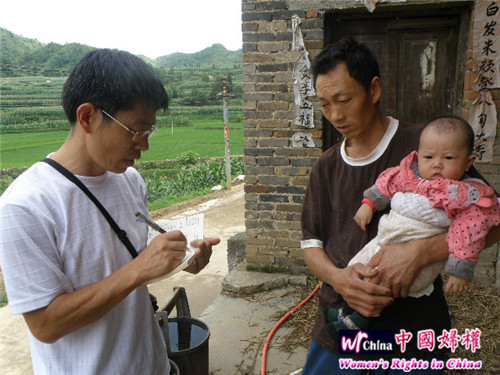
I transferred the email to our Huijiawang (Reunion Web) volunteer in Guiyang, Mr. Chen Fuyu. Mr. Chen was also a parent searching for his son, who had disappeared for seven years. During these years, he was not only looking for his own son, but also became the organizer of networks in Guizhou province searching for kidnapped children. Other than some small businesses to support his livelihood, Mr. Chen spent almost all his time in the service of the parents of trafficked children. He had so far found five such lost children and reunited them with their parents.

Chen Fuyu (second, from the right) is a parent of a missing child and also WRIC volunteer.
After our discussion, Mr. Chen immediately left his business to travel to Liuzhou County. He arrived in the county seat on the night of the 17th and reached Pingzhai Town police station the next morning. However, he could not find a match to the information in the email going over the residential records of the local villages. The government was conducting a census, so record-keeping should be reasonably good. Pingzhai’s government officials and police were very confident that there was no such Peng family in their jurisdiction. Mr. Chen went to Pingzhai with great enthusiasm and fair hope of success. This pronouncement was like a bucket of cold water poured over our heads.
I told Mr. Chen not to give up. Peng Qinglan was already eight to nine years old when she was kidnapped, so her memory should not err too much. Mr. Chen found a local internet café. We analyzed the situation and strategized together online. I was also on the phone with Ms. Peng at the same time. When we looked at Liuzhi’s surrounding areas, I noticed on the online map a village called Xiaping near the Machang River. I asked Peng if her family lived by a river. She said yes. I asked if she remembered a place called Machang. “Yes, I used to go there often.” Did she remember a village named Lizhai? “My sister was married there. There’s also a Miao village up the hill.” There was a Miaochong Village nearby on the map. Other geographical features also fit her recollections.
Mr. Chen and I were excited again. I was beside myself. “Found it! We found it!” Peng Qinglan, who was still on the phone, was also ecstatic.
It was night by then, Mr. Chen was still in Liuzhi, which was twenty kilometers away from Machang over mountainous roads. He went to the neighborhood committee and found the officials there very accommodating. They were moved by the enthusiasm of the Huijiawang volunteer. One of the workers here phoned a relative living in Machang, telling him to go to Xiaping Village no matter how late the night was and call back with the message as soon as possible.
It was a long night. Mr. Chen and I couldn’t get to sleep waiting for the phone call. It must have been a sleepless night for Ms. Peng as well. We were waiting for one night. She had been waiting for twenty-two of her thirty years on earth.
WRIC’s Yao Cheng All photos by WRIC November 31,2010
On the morning of the 18th, Chen Fuyu rented a car to drive to Xiaping Village in Machang Town. He went to the Peng family house as soon as he arrived in the village. “I’m here. I’m at Peng Qinglan’s home.” He called me. I asked Mr. Chen to hand the phone to Peng’s relatives to confirm our findings. As soon as the elderly Mr. Peng received the phone he asked me in shaking voice, “Is it my daughter looking for us? Was she looking for us?” I quickly answered yes. “Where is she?” He asked in such desperation I abandoned thoughts of further confirmation. It was a wait of twenty two years. There was no reason for us to force the man and his family, who must have been thinking as they were in a trance, to wait another minute. I gave him Peng Qinglan’s number. Afterwards, her phone stayed busy for the rest of the day. She told me when I met her days later that the call lasted uninterrupted for some twelve hours. She talked to most relatives in the village.
On the afternoon of the 21st, I arrived in Putian. Peng Qinglan and her Putian relatives welcomed me at the station and found a hotel for me. I called Mr. Chen, who was in the hotel to send me over the internet pictures he took of the Peng family in Xiaping village. Peng Qinglan waited anxiously by the laptop. I could only wish that the speed online could accelerate little by little.

WRIC’s volunteers Yao Cheng and Peng Qinglan.
“Papa looks the same, only older. My mother was a little pudgier back then, but much thinner now. Even my sister looks old now.” Said Peng as she looked over the photos. We onlookers didn’t say anything, sharing in silence all her emotions of deep joy and sorrow.
I interviewed Peng about her kidnapping and the rest of her life. It was a day during the summer vacation in 1988, the eight-year-old Peng Qinglan and a neighbor’s daughter went to visit her father who was working about twenty kilometers away. On the way they met a middle aged woman who was holding a boy. The woman told the girls she was going the same way. The girls were trusting, so they went with the woman, who spoke the local dialect. When they felt something was wrong and wanted to go home, the woman told them she was going to buy some pretty clothes for the girls. They already had no idea where they were. The woman brought the girls on a bus then a train, all the way across southern China to the coastal Fujian Province. Peng Qinglan was sold to the Wu family. About the other girl, there was no news since.

There are two child brides in this family. This is a typical family structure in Putian region.
Peng’s name was changed to Wu Yuqin. The Wu family had seven children counting Peng. She had three new elder sisters, three younger brothers and a younger sister. She helped her “adopted” mother with chores and didn’t go to school since the time she was eight. She married at age nineteen, to a famous local opera singer. The local opera was a nationally recognized cultural heritage and was subsidized by the government. She now had an eleven-year-old son in school. She worked in a factory. She told me that life was relatively good. Her adopted parents treated her well. Relations with her adopted siblings were also very good. After she found her Guizhou family, a brother in the Wu family actually came back from work in Xinjiang (northwest China) to visit.
The brother who came back from Xinjiang invited us all to dinner. Peng’s husband had to perform that night. He would see me a day later.
WRIC’s Yao Cheng All photos by WRIC November 31,2010
Peng Qinglan’s Putian house was located in a village on the edge of the city. Of her adopted parents and seven siblings, most traveled to other cities for work. When I visited only a brother and a sister-in-law were present. Families of this size were quite common in this village. People here did not have a tradition of heavy emphasis on children’s education. None of the five daughters in the Peng family finished elementary school. Two of the sons only went to eighth grade. Only one graduated middle school. It was local opinion that kids only needed to be able to read and count some money to get by. Without much education, they were almost all working in labor-intensive industries such as masonry and commercial fishing. Such work required large numbers of male laborers. It was understandable that families would often want seven, eight, up to a dozen children.
Sons who were born in the family were “supplemented” by boys who were trafficked and bought. All of them would need to get married in adulthood. So more girls would have to be bought as well. One human tragedy followed another.
Villagers told me that almost every house had children who “came” this way (a common euphemism). Peng told me that one of her three sisters was also a kidnapped girl and hoped that one day we would be able to find her original family as well. If every family in this medium-sized village of 300 household had one trafficked child, a town comprising ten villages would have 3000 such children. Putian County had 53 townships. It would not be too much exaggeration to estimate that the total number of trafficked children would number in six digits in this county alone.

Pengqing Lan memories of home and the river still in front of home, which is just got even smaller.
 。
。
WRIC had already helped a woman who was sold into the same village less than a year ago. Xiao Guangyan lived nearby. Because of our prior work with Ms. Xiao, we already had some contacts in the village friendly towards us. But it was easy to see that many other families were avoiding us at all costs. They were afraid that the children they bought would be gone once they found their real parents.
Xiao Guangyan invited me to her house at noon. Peng Qinglan came as well, along with many friends and relatives of both families. Both women came from Guizhou province. They not only wanted to thank us for fulfilling their wish to reunite with their families but also hoped that we would do the same for many of their friends. During the meal of seafood dishes, they told me that many villagers with similar experiences wanted to search for their families after Xiao and Peng’s successes. Many however were reluctant both for not knowing how to do this and for fear of irritating their current families. They hoped that Huijiawang would start by helping clandestinely.
When we were helping Xiao and Peng I never thought that far. Now we were faced not with one or two people looking for their family, but the missing children who ended up in this village and town, to the tens or hundreds of thousands in Putian, to Fujian and Guangdong, the two rich coastal provinces where the problem was particularly widespread. It was a sobering thought.
Comparatively, life in Putian was richer than the Guizhou hill country. But it didn’t mean a happy life for trafficked children who were sold here. They seldom could make their own decisions about marriage when grown up. Girls who were bought as child brides of course had no choice at all.
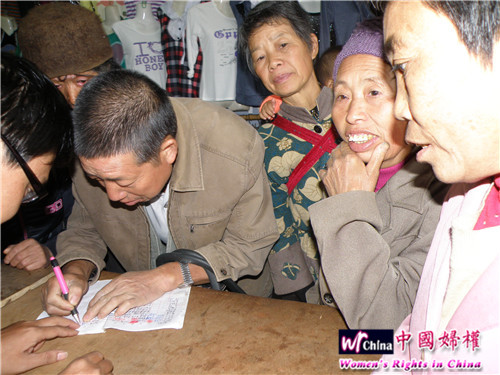
During the day I spent in the village I tried to strike up conversations with as many people as possible. I passed our cards to everyone, hoping many more people would find WRIC through the cards, to know more about Huijiawang, to be helped by us one day and to become a volunteer as well.

Peng Qinglan and her husband was very happy that she have decided to begin her search for her birth parents.
WRIC’s Yao Cheng All photos by WRIC December 1, 2010
At 8:30pm, November 24, the crowd stood along both sides of Liuzhi Tequ Street. Among them were local residents and the Peng family and their friends who came from thirty kilometers away. As soon as our small convoy drove into the street, throngs of people surrounded our vehicles to catch a glimpse of the woman who disappeared for twenty two years. Peng Qinglan, who had been talking with us lightheartedly a minute ago, broke into tears as she stepped out of the car. Peng cried in the embrace of her mother and sister. Twenty two years of heartbreak came out at that moment.


Peng Qinglan’s father,mother and a sister.
Mr. Chen Fuyu and I received from the Peng family flowers and pennants thanking our service. After a brief interview with the media, our cars drove straight to their home village of Xiaping. Three miles away from the village, we heard the sound of firecrackers going off in celebration. Fireworks lit up the night sky and painted colors on the dark mountainsides.
Child hood memories came rushing back to Peng Qinglan. The river and the elementary school were still there. The old mud brick family home was not, replaced by a three-room brick house. Friends and classmates of the pass had all turned to middle age.
The most awkward reminder was the difficulty in language. She could not speak a sentence of the local dialect. Any conversation between the blood relative had to go through a translator.
Peng’s husband, a brother and a cousin from the Wu family also made the same trip. The atmosphere was amicable, other then a briefly uncomfortable exchange between Peng’s sister and the Wu brother. “Your family had seven siblings, why kidnap our sister?” Others laughed, but the brother was downcast. “We didn’t kidnap her. We only paid so she would be with us. Now that we are all one family, let’s not talk anymore about this.”
It was a raucous party for the whole village till dawn. Peng’s family would not allow us to travel through the hills by night so we stayed. But the noise didn’t allow us much sleep anyhow. When I woke up, Peng’s family volunteered to lead me to see the fields, school and the river, which I had only known as topographical features on a computer map when we were searching for the family.
After breakfast, we prepared to leave the village. All the Peng family came out to say farewell, plus many others from the village. An elderly woman waited by the village gate the longest. She was the mother of Peng Simei, the girl who was kidnapped with Peng Qinglan twenty two years ago. We waved at her so she could leave lest she catch the chilly mountain air in the morning. The night before, I had explained to her again and again that it was much harder for parents to look for children than for kidnapped children who reached adulthood to search back for their parents. We would look for information of Peng Simei from all sides. She was lost at the same age of eight or nine with Peng Qinglan. We could believe that she remembered her village and family as well.

WRIC’s Yao Cheng was holding Pengqing Lan’s family gave honor flags. Photography by WRIC