Ms. Jianglin Li, a Chinese-American historian and expert on contemporary Tibetan history, died of illness at her home in Georgia, USA, on Christmas Eve 2024 at the age of 68. Ms. Jianglin Li worked at the New York Public Library after obtaining a double master’s degree in 1988. She began studying Tibetan history in 2004 and wrote six historical books, including “1959: Lhasa! – How the Dalai Lama Escaped” and “When the Iron Bird Flies in the Sky: The Secret War on the Qinghai-Tibet Plateau from 1956 to 1962”, which brought distorted and omitted historical facts to light and recorded them in history, and also left a valuable legacy for contemporary Tibetan history research. Jianglin Li is indeed a brave and outstanding Chinese-American woman. Her death not only made her loved ones and friends deeply saddened, but also brought irreparable losses to international Tibetan history research.
The memorial ceremony for contemporary Tibetan historian Ms. Li Jianglin on January 12, 2025.
On Monday, Hong Kong’s National Security Division of the Police took away Hong Kong Public Opinion Research Institute Chairman and CEO Robert Chung, along with two staff members of the Institute, for questioning. As of the time of writing, they had been detained for more than 30 hours, and it was reported that they were released in the evening and early morning hours. On Tuesday (14th), the National Security Division took further action and “invited” Dr. Chung Kim Wah’s wife, Wu Liping, and his son, Zhong Zixi, to the police station for questioning. Zhong Zixi left the Mong Kok Police Station around 12:30 PM, while his wife left the Tin Shui Wai Police Station around 1:00 PM. Neither of them responded to questions from local reporters.
In response to inquiries from Chasing News in the UK, Chung Kim Wah stated that he would not respond at this time.
Hong Kong Chief Executive John Lee, Secretary for Security Chris Tang, and the National Security Division, in a press release issued at 11:37 PM on Monday, avoided mentioning the surprise investigation involving the public opinion research institute or Chung Kim Wah. They only stated that the investigation concerns suspicions that an individual may have used their organization to assist a fugitive who has fled abroad and is suspected of continuing to engage in activities that endanger national security. They also invited one of the board members and two staff members from the affected organization to the police station to assist with the investigation, and noted that “no one has been arrested at this stage.”
At a press conference before the Executive Council meeting on Tuesday (14th), Chief Executive John Lee was asked about balancing the need to abide by the law and cooperate with overseas organizations. He responded: “Regarding actions that endanger national security, I have said many times that we must strictly enforce the law, and we will pursue all individuals involved in crimes that harm the nation. If any individual or organization has any connection with or provides support or assistance to individuals who endanger national security, we will conduct a thorough investigation and pursue the matter to the end.”
According to the National Security Law, the Hong Kong police can apply to the court to extend the detention of those arrested for national security-related crimes from 48 hours to 7 days. If necessary, they can apply for another extension of 7 days, meaning that the relevant individuals may not be released on bail until 16 days after being taken away, or they could face formal charges and court proceedings. During the first two days of detention, arrestees may be prohibited from meeting with any lawyers.
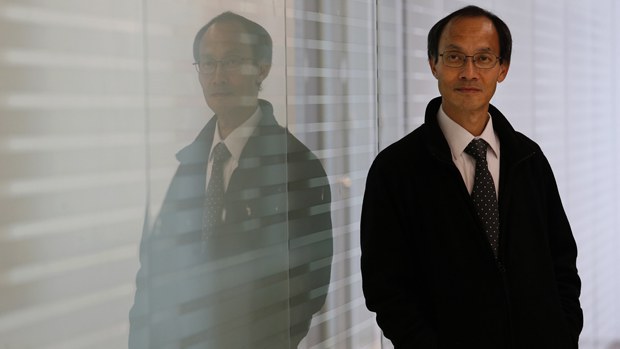
Dr. Chung Kim Wah.(Photo courtesy of the internet)
The Hong Kong Police National Security Division previously raided the Hong Kong Public Opinion Research Institute, seizing computers, servers, and other materials. The Chairman and CEO of the Institute, Robert Chung, has filed a lawsuit in the High Court, requesting the police to return the materials. (Photo courtesy of Reuters)
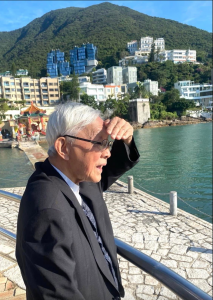
January 13, 2025 is the 93rd birthday of Cardinal Zen Ze-kiun, the retired bishop of the Catholic Diocese of Hong Kong. Cardinal Zen Ze-kiun was involved in the “612 Humanitarian Support Fund” case in May 2022. The Hong Kong government accused the fund of not registering as a society as required and was fined HK$4,000 by the court; he was also accused of “conspiring to collude with foreign forces.” Bishop Zen was subsequently granted bail to attend the funeral mass of Pope Benedict XVI in the Vatican. After returning to Hong Kong, he was sent to the hospital for treatment due to breathing difficulties on January 22, the first day of the Lunar New Year, and was discharged on March 19.
He currently looks rather thin, but in good spirits. He said that since his serious illness, every day since then has been a gift from God.
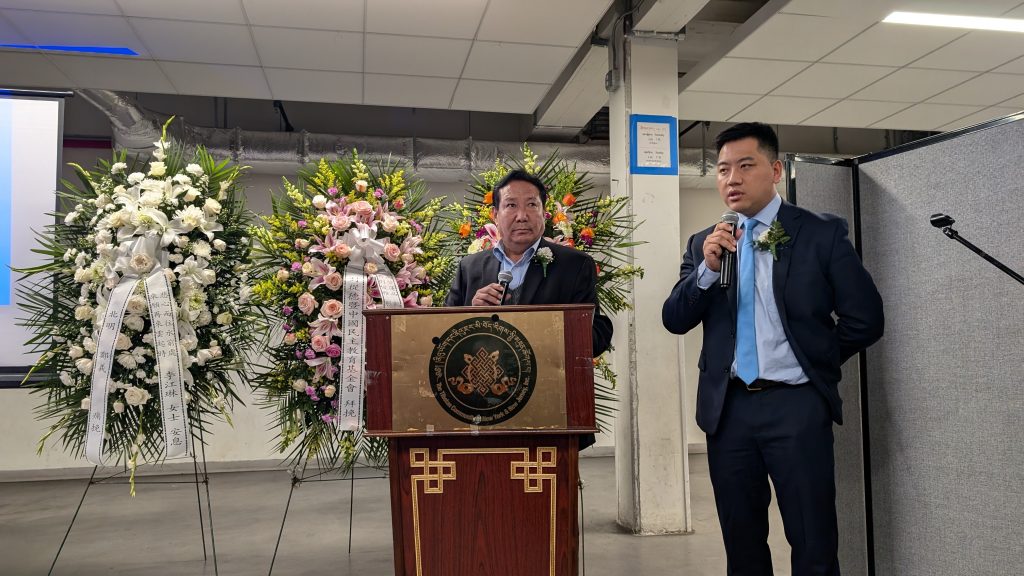
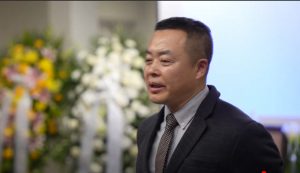
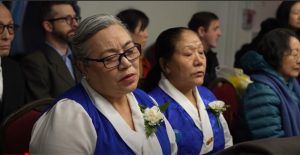
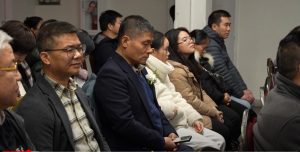
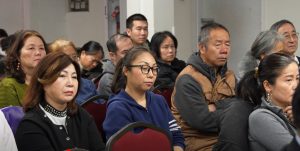
On January 12, 2025, the Tibetan Administration in North America and the NGO Women’s Rights in China held a memorial ceremony for contemporary Tibetan historian Ms. Li Jianglin at the Tibetan Cultural Center in New York. More than 60 Chinese and Tibetan friends from all over North America mourned Li Jianglin. White roses and her favorite lilies were placed around Li Jianglin’s portrait. The venue was simple, solemn, solemn and warm.
The service began with the monk Langjie Ciren Geqi reciting prayers and chanting sutras to comfort the soul and offer blessings for Li Jianglin. Dressed in red and yellow robes, the monk’s deep and resonant chanting seemed to transcend time and space, directly accompanying Jianglin as she journeyed toward the ultimate paradise.
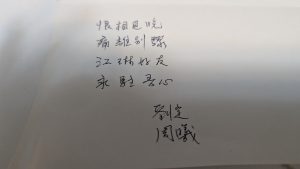
Li Jianglin’s husband, Mr. Ding Hongfu, sent a mourning message, deeply grieving for his beloved wife. Jianglin’s only daughter, accompanied by family members, quietly mourned her mother at the service.
Mr. Gesang Ciren, President of the New Jersey Tibetan Association, Ms. Tenzin Awang, President of the Tibetan Middle Path People’s Movement Organization in New York, and Li Jianglin’s close friends, including He Qinglian, Cheng Xiaonong, Hu Ping, Chen Poking, Jin Hehui, Huiyun, and others, shared stories of Jianglin’s life and her academic achievements.
In addition to the He Qinglian couple, those who sent floral tributes included Beiming and Zheng Yi, Feng Congde and the Democratic Education Foundation, the Women’s Rights in China, the Chinese Youth Stand for Tibet, as well as Mr. Ma Jian and Mr. Zhang Pu from the UK.
Tibetans in plain clothes also attended the memorial ceremony.
Photo by Women’s Rights in China.
Photo by Women’s Rights in China.
The memorial service began with a slideshow of photos depicting Li Jianglin’s life and work, sharing moments of joy from her life. (Provided by Women’s Rights in China)
Dr. Li Hengzhen read the mourning speech on behalf of Mr. Ding Hongfu, grieving for his beloved wife. Mr. Ding began by expressing his gratitude and eternal remembrance for all the friends who had helped Jianglin in various ways.
He wrote: In 2012, I accompanied her on a secret trip to the Tibetan areas in Sichuan, Qinghai, and Gansu. We personally witnessed the scenes of Tibetan people being suppressed. By the Yellow River, we reached several Tibetan settlements where people had been brutally killed during their escape. She and I had repeatedly cross-checked the descriptions of the Tibetans, Google satellite maps, and contemporary printed atlases, and confirmed that it was indeed this place. Now it is just a vast plain. It was a rainy day, with the sky high and the clouds low, the chill cutting through to the bone. Nearby, there was a Buddhist stupa, and several elderly women were walking around it in prayer. Perhaps, they were the survivors of those settlements. Jianglin gazed at the Yellow River in the distance, suddenly kneeled on the ground, and cried out in the pouring rain. She shouted: “Your suffering, I will tell the world. I promise, I will tell the world!”
This was her – a woman who appeared gentle on the outside but was strong on the inside.
Mr. Ding continued: Jianglin and I were always together, never apart. When I drove out, she was always by my side. Day by day, we were always seen together. We went to Europe for conferences, to India for interviews, sharing a piece of bread and a bottle of water. We admired the landscapes of the Indian subcontinent and gazed at the Himalayan starry skies together. We complimented each other and admired each other. We had many, many plans, dreams, and ambitions, but we never expected life to come to such an abrupt halt. My dear wife, my beloved, you are my whole life, you are my entire world. Jianglin, wait for me there. I will come to be with you soon, never to part again, and never to let you feel lonely again.
Dr. Li Hengzhen read the eulogy of Mr. Ding Hongfu in mourning for his beloved wife. (Photo by Women’s Rights in China)
Tsering Gyatso of the Tibetan Representative Office in North America pointed out that Ms. Li is an outstanding historian who has devoted her life to recording and studying the modern history of Tibet. She is not only a scholar, but also a seeker of historical truth. We just saw in the video that Ms. Jiang Lin’s works such as “Lhasa 1959” and “When the Iron Bird Flies in the Sky” are all based on rigorous historical research. She has a very high status in the hearts of Tibetans. Ms. Jiang Lin’s contribution goes far beyond the scope of academics. She is a guardian of historical truth and a practitioner of the spirit of humanitarianism. Her pursuit of truth and her spirit of upholding justice will always inspire us and will always be a role model for the new generation to pursue justice.
Tsultrim Gyatso of the Tibetan Mission in North America: Li Jianglin is the guardian of the historical truth. (Photo from China Women’s Rights)
Economist and a close friend with Jinglin, Ms. He Qinglian said,In the face of the Chinese Communist Party’s complete suppression of any discourse on Tibet, the most difficult part was collecting materials in Tibet. Jianglin interviewed many survivors of the 1959 uprising, and this was indeed fraught with many challenges and hardships. This is not something that could be written in the comfort of an office or library.
She continued: In Chinese culture, historical works are held to very rigorous standards, requiring the three elements of talent, history, and virtue, all of which must be present. In this regard, I believe Li Jianglin’s book is truly deserving. First, she succeeded in collecting materials, particularly some that had never been gathered before, and some that will be difficult for future generations to access due to the narrowing of the time window. One of the key aspects of her work is the oral history. Li Jianglin’s book fills a gap and clarifies historical facts.
Ms. He Qinglian said that Li Jianglin’s book fills a gap in history. (Photos by Women’s Rights in China)
Mr. Gesang Tsering, Chairman of the New York New Jersey Tibetan Association, presented a white khata to Li Jianglin’s portrait to show his respect for Jianglin. He called on Chinese friends to study the Tibetan issue like Teacher Jianglin did and tell more and wider Chinese people about the real situation in Tibet. Here I would also like to say that Teacher Li Jianglin’s lifelong efforts were her good deeds, and she will go to a bright world in the next life.
Mr. Gesang Tsering (Left) hopes that everyone will tell more Chinese people the true situation in Tibet like Teacher Jiang Lin. (Photo by Women’s Rights in China)
Hu Ping said:Li Jianglin achieved extraordinary accomplishments in her lifetime, with two major contributions. In addition to her outstanding contributions in researching the Tibet issue and publishing several remarkable historical books, another significant contribution was the irreplaceable role she played at the Flushing Library. Among the cultural activity centers for overseas Chinese, New York stands out, and within New York, the cultural hub for the Chinese community is undoubtedly Flushing. Flushing is home to a library, and the library had Li Jianglin…
While serving as the project coordinator at the International Information Center of the Flushing Public Library in Queens, New York, Li Jianglin organized over a hundred lectures and forums, providing an invaluable platform for Chinese people from across the Taiwan Strait and advocates of freedom and democracy. These events attracted tens of thousands of attendees, both Chinese and international, and were widely reported by Chinese and English-language media. She was also the first to introduce the Chinese film “Better to Live Miserably than to Die Well” on AIDS in China to the United States, and she promoted an online campaign to help AIDS orphans in mainland China. This demonstrated her deep sense of conscience and compassion.
Additionally, Mr. Hu Ping read the mourning speech on behalf of the President of the Independent Chinese PEN Center, Mr. Cai Chu, to honor Li Jianglin:
We were deeply saddened to learn of the passing of Ms. Li Jianglin on Christmas Eve of 2024. On behalf of all the members of the Independent Chinese PEN Center, President Cai Chu extends heartfelt condolences to Ms. Li’s family and offers our deepest sympathies.
Li Jianglin was an early member of the Independent Chinese PEN Center and served as the center’s deputy secretary-general. She made outstanding contributions to the cause of freedom and independent writing, and she was deeply loved and respected by the members.
Since 2004, Ms. Li devoted herself to the independent study and writing of Tibetan history, publishing six historical works, including “1959: Lhasa! – How the Dalai Lama Fled” and “When the Iron Bird Flies in the Sky: The Secret War on the Qinghai-Tibet Plateau, 1956–1962”. Her works corrected distorted historical facts, filled gaps in international Tibetan history research, and highlighted the courage and determination of an independent scholar and conscience-driven writer who faced the truth of history and wrote with unflinching integrity.
Ms. Li’s outstanding academic achievements and objective, fair historical character earned her widespread praise from both the Tibetan and Han communities, as well as from the international Tibetan history research community. She was hailed as a brave and outstanding Chinese writer, and she became a source of pride for the Independent Chinese PEN Center and for Chinese female writers.
Her passing represents an irreplaceable loss for both the independent writing community abroad and the field of Tibetan history research, which brings deep regret and sorrow to the members of the PEN Center.
The PEN Center will encourage its members to carry on Ms. Li Jianglin’s legacy, working to promote cultural exchange between the Han and Tibetan peoples, and urging writers and scholars to actively engage in independent research and free writing on Tibetan history and culture, producing more excellent works.
Hu Ping said that Li Jianglin had made extraordinary achievements in her life, mainly in two major contributions. (Photo by Women’s Rights in China)
Tenzin Ngawangshi, the president of the New York New Jersey chapter of the Tibetan Middle Way People’s Movement, said: We commemorate Ms. Li Jianglin and thank her for her selfless dedication and contribution to the study of Tibetan history. I know that many people present today have witnessed Ms. Jianglin’s contribution to the Tibetans, which also shows the support of everyone present for the Tibetans. Your support and dedication means the world to us, and I would like to take this opportunity to express my deepest gratitude to each and every one of you. (Photo by Women’s Rights in China)
Chen Pokong said:Before we left China, we had little understanding of the Tibet issue and the situation of the Tibetan people. At best, we were unaware, and at worst, we were misinformed or misunderstood. Even regarding the Dalai Lama and his followers, there were many misconceptions. However, after coming abroad, through international information, through contact and exchange with Tibetans, and by listening to their true voices, we were transformed. We now understand Tibet and its people better, and we have greater respect for the pursuit of justice by the common people. Many of our theories about human rights were shaped by the opinions of exiled writers and activists, who are all engaged in a common struggle for Tibet. Li Jianglin was one of them. She made the world aware of the suffering faced by Tibetans, and Li Jianglin’s name will be remembered in history.
(Photo by Women’s Rights in China)
Jing Zhang , President of the WRIC ,Jinglin’s one of a close friend, shared her sisterly bond with Jianglin. She said:We had many things in common: both came from families of CCP cadres, both became what the CCP viewed as “rebellious traitors”, and both were like wandering ghosts in Chinese culture who cannot return to their self roots. The most important commonality between us was that we both believed that the CCP regime must change. Wherever there is freedom, there we will make a home.
I remember that year when she secretly returned to China, traveling to Tibetan areas in Qinghai, Tibet, and several other provinces to interview and verify information. Using Google Maps, she compared the sites of bombing raids carried out by the Chinese Air Force during the so-called “liberation” of Tibet, targeting Tibetan settlements. I remember when I saw her off at JFK Airport in New York, we made a pact: if she didn’t return on time, it would mean something had happened to her, or that she had been arrested by the CCP. In that case, I could start calling for help to locate and release her. Fortunately, she escaped unharmed and returned safely, though her computer was confiscated by the national security agency. Luckily, she had backed everything up beforehand.
In the following days, while Jianglin, who researched history and religion, became more focused on uncovering the true history of Tibet and the politics of the United States, I remained fixated on human rights and women’s rights issues in China, unable to let go.
Finally, I want to tell everyone that, before she passed away, Jianglin told her beloved Ding Hongfu: “I have forgiven everyone, and I ask everyone to forgive me.” I believe that by “everyone,” Jianglin meant both the people she had wronged and those who had wronged her. Jianglin let go of it all, and she passed away peacefully.
Jing Zhang said: I know she has gone to a paradise where there will be no more pain, but I still can’t let her go and feel sad. (Photo from Women’s Rights in China)
Dr. Cheng Xiaonong, a political commentator and theorist, emphasized in her brief speech that Li Jianglin has left a valuable legacy for history and will also have a profound impact on the future Tibetan world. (Photo from Women’s Rights in China)
Huiyun, a young friend Jiang Lin made in recent years, shared the whole process of her relationship with Jiang Lin. They met because of Jiang Lin’s book 1959 Lhasa. Before Jiang Lin died, Huiyun and several other young people were waiting by her side. Huiyun was also very sad. But she said: Jiang Lin passed away very peacefully. She passed away very quietly. Please also wish her peace of mind.
Huiyun shared the whole process of her relationship with Jiang Lin. (Photo from Women’s Rights in China)
Wang Anna, founder of Guang Media, recalled that in 2015, she found the book “When the Iron Bird Flies in the Sky” in Tianyuan Bookstore in Hong Kong. She was very shocked. The book was very good, so she bought several copies and brought them back. Later, every time she went to Hong Kong or had friends from Hong Kong, she asked them to go to Tianyuan Bookstore to buy this book and “Lhasa in 1959”. This was her earliest deep impression of Jiang Lin.
Anna Wang called on scholars coming to the United States from China to be like Jiang Lin and to pioneer new historical research in their own way.(Photo from Women’s Rights in China)
WRIC Board Member Huang Ziyin read a passage from Li Jianglin’s 1959 Lhasa preface:
In March 2008, the Lhasa riots broke out again, marking the third such uprising in Lhasa in nearly 50 years. During the riot, a young man from Lhasa shouted, “We are the ones you killed 49 years ago. We have come back.” This statement had a profound impact on me. How many Chinese people understand the pain embedded in those words? This statement also tells us that we cannot avoid history. We must re-examine the events of 1959, looking at them from a different perspective. We must separate propaganda from historical facts and understand what truly happened in Lhasa in March 1959. Otherwise, we will never understand the pain of Zheng Mingzhu, and we will never comprehend why uprisings in Tibet occur roughly every 20 years.
An ancient saying goes, “Use history as a mirror to guide one’s work.” Standing before the mirror of history, we can not only see the past and present, but also the future. I believe, as Han Chinese, we should clean the mirror of history, wiping away the stains of weakness and the illusion of glory painted by propaganda. We should remove the dust that has accumulated over the years on the truth of historical facts, so that we and our descendants can clearly see what really happened in the past. Only by doing so can we say we want to turn evil into good, and we can discern right from wrong. Only then can we achieve the inherent goodness in our hearts.
This book represents a small effort I have made. I humbly present it to the readers and hope it serves as a starting point for further discussion. I hope more eyewitnesses will share their experiences and memories, and I hope more historical data will be published. I would be more than happy to correct any mistakes or omissions in this book.
Ms. Huang Ziyin read a passage from Li Jianglin’s preface to “1959 Lhasa” with great emotion.(Photo from Women’s Rights in China)
Dr. Jin Hehui, an economist and another close friend of Li Jianglin, along with the Yun couple, also traveled a long distance to attend the memorial. Dr. Jin said:Li Jianglin was a scholar of religion, and she had done extensive research on Jewish architecture and history. At that time, she might have proposed some viewpoints that were quite shocking to us.
Dr. Jin recalled: There was a question that Jianglin often asked. She would say, from the history of the establishment of Israel, why was there no God? Why did Moses not cross the Jordan River? This was a profound religious question she had an understanding of, and the reason, she believed, was that God did not appear in Jewish history. The reason was that a person born into slavery could not establish a free nation, so God did not let Moses cross the Jordan River. The ones who could cross the obstacle were the people who grew up during 40 years of wandering in freedom—the generation cultivated by Jesus—who could establish a free nation.
So, I think, just like you, we all grew up under the education of the CCP. At the beginning, our thoughts were all enslaved; none of us were free. If we want to establish a free country, we must first become free individuals. In the process of becoming a free person, we must give up many things, and we must also learn to think as free people. This means we must have respect for humanity, care for others, yearn for freedom, and have the courage to face everything, including the cruelty and inhumanity we see far too often.
Dr. Jin said, I believe the evidence you see is that, as someone from a “red family,” in the end, Li Jianglin used her books to tell and declare to everyone that she was a free person. Ultimately, she possessed a free soul, a pure soul. She was someone who had the qualification to cross the Jordan River.
Dr. Jin Hehui said that Li Jianglin has a free and pure soul. (Photo from Women’s Rights in China)
Some audience members who came from far away to attend the memorial service gave brief speeches, and some brought flowers to place in front of Jiang Lin’s portrait to mourn her. Zhao Lanjian, Rong Wei and others gave speeches to express their respect for Jiang Lin.
(Photos from Women’s Rights in China)
(Photos from Women’s Rights in China)
At the end of the memorial service, a video of messages from some of Li Jianglin’s friends, pen pals and netizens around the world was played. (Photos from Women’s Rights in China)
As the monks chanted, the participants silently blessed Jiang Lin. (Photos from Women’s Rights in China)
From : The Bereaved “Tiananmen Mothers” in Beijing 01-04-2025
On December 28, 2024, bereaved families of the Tiananmen Square Massacre victims gathered in Beijing for the first time since their annual meetings were disrupted by the pandemic. The atmosphere was heartfelt and emotional as the families reunited after several years apart, exchanging sincere greetings and rekindling a deep sense of connection.
The Tiananmen Mothers’ New Year’s Gathering on December 28, 2024. Mother Liu is second from the left in the front row; Mother Qi is in the center.
However, the reality remains harsh and sorrowful. Time has etched its mark on everyone. Many elderly parents, now burdened by declining health, are no longer able to attend these gatherings. Though their hearts remain with others who have lost children, their voices are heard only when fellow bereaved families visit to convey messages of care and support. The once-young spouses and siblings of the victims—who were in their twenties and thirties 35 years ago—now find themselves in their sixties and beyond, their graying hair and weathered faces bearing the weight of decades of grief and hardship.
Looking back, many bereaved family members have passed away without ever seeing justice for their loved ones who were unjustly killed. This is the cruel and heartbreaking reality. Over just the past decade, from 2014 to today, significant changes have occurred within this community.
The Tiananmen Mothers’ gathering on February 2, 2015. Mr. Jiang Peikun is all the way to the right in the front row, and Ms. Ding Zilin is third from the right in the second row.
The Tiananmen Mothers’ New Year’s Gathering on December 28, 2024. Mother Liu is second from the left in the front row; Mother Qi is in the center.
Photos from the 2014 gathering capture the now-deceased Xu Jue, Yin Min, Gao Jie, Wang Shuanglan, Tan Shuqin, and Feng Youxiang; six individuals who are no longer with us. The final pre-pandemic gathering took place at the end of 2019, after which these meetings were put on hold. At the 2025 Lunar New Year gathering, notable attendees included “Mother Liu” and “Mother Qi,” elderly women now in their eighties and seventies, accompanied by their husbands. These parents represent some of the few remaining survivors in a community that continues to diminish with time.
At the event, You Weijie, a member of the support team, delivered a heartfelt speech. She shared that in November, she and her colleagues visited elderly parents of victims in Beijing and reached out to bereaved families living outside the city, through letters and WeChat. As part of their efforts, they distributed the last remaining donations received years ago from compassionate Hong Kong citizens, hoping these small gestures could offer comfort and support. Tragically, the past two years have seen the loss of several bereaved family members. One father, Wang Deyi, passed away just a day before they had planned to visit him, and another, Zhao Jinsuo, a disabled man battling lung cancer, died on Christmas Day. He had intended to attend this gathering if not for his passing. These unexpected losses served as poignant reminders of life’s fragility, deeply affecting the group.
Ms. You recognised the presence of two mothers who exemplify the resilience of this community: the 80-year-old “Mother Qi” and the 70-some “Mother Liu,” who attended alongside her husband. Together with siblings, spouses, and disabled survivors, they form a steadfast but dwindling group. Ms. You expressed profound gratitude to the justice-minded individuals who have provided steadfast support over the years. While the government remains silent, the memory of the 1989 Tiananmen Massacre and the unwavering call for justice continue to resonate among the public and within this determined community.
The Tiananmen Massacre, which occurred 35 years ago in 1989, remains a painful and unresolved chapter in history. As 2025 begins, the 36th anniversary draws near, but the future for those seeking justice remains uncertain. Plans for collective memorial activities – including those marking the 25th and 35th anniversaries – have been repeatedly thwarted by the authorities. These occasions were intended as moments for bereaved families to grieve openly and demand accountability, yet police interference has left an enduring sense of loss and unfulfilled resolution. Mourning innocent loved ones is a fundamental human right—morally, emotionally, and legally—and should never face obstruction.
We call upon all who cherish peace, oppose violence, and uphold justice to stand with us in condemning the government’s brutal actions, which saw military force used to kill unarmed civilians. Until the authorities acknowledge the Tiananmen Massacre, apologize to the victims’ families, and confront this atrocity with honesty, we will continue to fight for dignity, justice, and the rights which should be afforded to every human.
The Tiananmen Mothers’ New Year’s Gathering in 2019.
 中國婦權
中國婦權