HK Blind Lawyer is Phoenix Rebirth “Freedom Flower” Blooms in Canada

By Zhang Jing, WRIC                                           6-24-2025


Joy Luk, a blind lawyer currently exiled in Toronto, Canada, is Hong Kong’s first and only blind lawyer, and a frontline warrior in Hong Kong’s democracy movement. In 2019, at less than 40 years old, she frequently appeared on the front lines of protests, big and small. Holding a megaphone, she stood between police lines and protestors, mediating and providing legal aid to arrested protestors. As a result, she became a target for the police and was often harassed. She left Hong Kong at the end of 2021, came to Canada, and was granted political asylum.


Currently, the indomitable Joy Luk has not only been admitted to the University of Toronto Faculty of Law but has also diligently attended every single class, completing the initial steps for national lawyer certification in Canada. Once other steps are completed, she will officially obtain her Canadian lawyer’s license. Recently, at the request of the Law Society of Ontario, she submitted an official recent personal photo, suggesting that Joy Luk is expected to officially begin her legal career in this foreign land within the year.
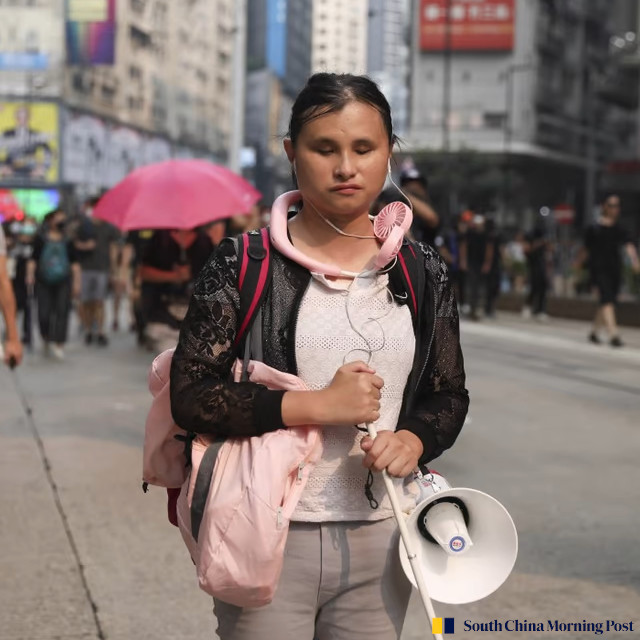
 

Image from South China Morning Post.


Joy Luk was born blind due to retinal atrophy caused by premature birth and studied at the Ebenezer School for the Blind from a young age. Later, with the advent of text scanners, the text from thick textbooks and reference books could be stored and then read by visually impaired students using speech software or braille displays. In her upper primary and junior secondary years, Joy developed a strong interest in law. She listened to “The Unwritten Law,” which was later adapted into a movie, and couldn’t help but imagine herself in the protagonist’s shoes, wondering if her own future would be similar. She found a braille version of the Basic Law in her school library and read it multiple times. She later earned a Bachelor of Laws from City University of Hong Kong and a Master of Laws in International Human Rights Law from the University of Hong Kong, becoming Hong Kong’s first blind lawyer. She interned at a law firm and was passionate about promoting democracy, human rights, and disability rights. She also worked in the complaints department of the Hong Kong Equal Opportunities Commission, handling discrimination and sexual harassment cases, putting her knowledge into practice.


In mid-November 2019, after the intense clashes at CUHK (Chinese University of Hong Kong) subsided, the conflict shifted to PolyU (Hong Kong Polytechnic University). The clashes escalated on the evening of the 16th, with riot police firing numerous tear gas rounds at protestors, who retaliated by throwing petrol bombs at the intersection of Chatham Road South and Austin Road. After much difficulty, lawyer Joy Luk arrived at Entrance A of the Polytechnic University. She painstakingly climbed over piled-up debris to enter the PolyU campus. She was mentally prepared for arrest, imprisonment, and disbarment. “If I’m disbarred because of this political movement, so be it,” she said.
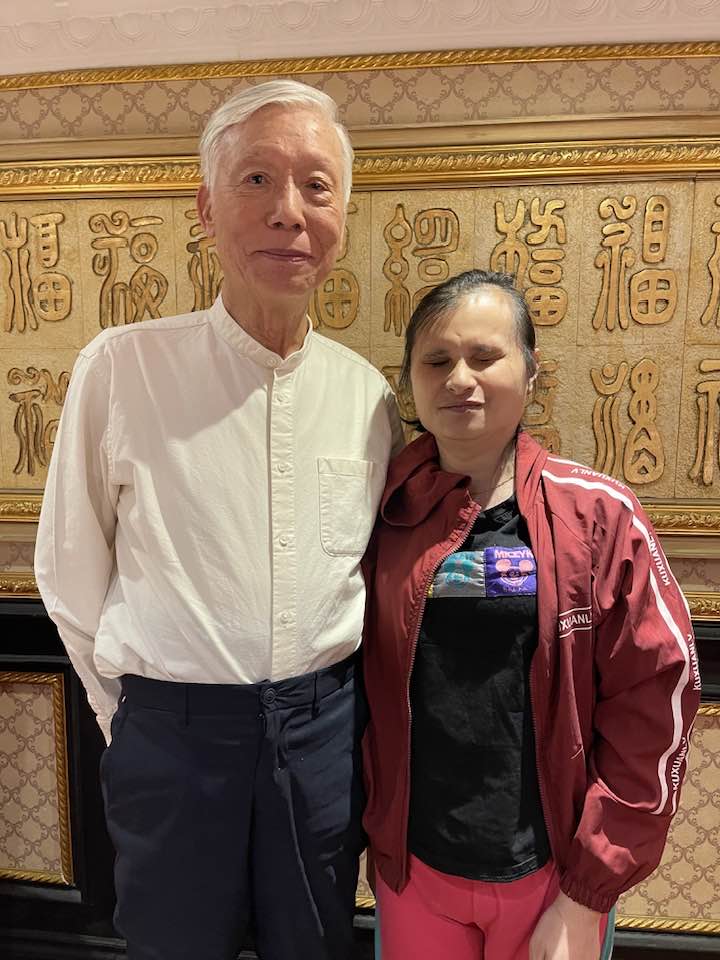
 

Lawyer Joy Luk with Reverend Chu Yiu-ming. (Online)


Around noon on the 17th, the conflict between police and citizens intensified, with police deploying two water cannon vehicles and a ‘Rapier’ armored vehicle. Tear gas and petrol bombs flew back and forth. The scene was engulfed in flames and smoke. Around 3 o’clock, police again deployed two water cannon vehicles, firing long blue and clear water jets. Immediately after, police suddenly charged at the protestors. Instantly, shouts and reprimands filled the air, the scene was extremely chaotic, and protestors were forced back into the campus.


On November 10, 2019, Joy Luk was at Sha Tin MTR station where a group of protestors were “renovating” the station. The station was about to close its gates, and she just made it, lying down directly under the rolling gate to buy the protestors at least 10 more minutes to prepare. (Online image)


Image from the internet.


At the time, Joy Luk was at the front. This was completely different from the scenes she had experienced in the past: acting as a “tank man,” blocking between police and protestors, reasoning with police, and delaying time for protestors to escape. But this time, she was hit by a water cannon and injured. On the afternoon of the 17th, Joy Luk was hit by tear gas at the PolyU siege conflict site. Suffering from heart disease and asthma, and having gone without medication for an entire day and night, coupled with the attacks from water cannons and tear gas, her physical condition was very poor. Several students took her to the on-site first aid station. On the afternoon of the 18th, the police issued an order, demanding protestors leave by 10 PM, otherwise they would be considered guilty of “rioting.” At 6 PM, Joy Luk vaguely felt the danger escalating, and she advised a female student next to her to leave: “You are still young, you still need to study.”


Joy Luk is an international human rights lawyer; she decided to stay. She said, “When protestors are arrested, I can use my legal knowledge to inform them of their rights.”


As she recalled this civilized and orderly protest movement: “The true goodness and beauty of the crowd were truly moving, and as a visually impaired person, I felt it even more deeply. I still remember Denise Ho carefully holding my hand and guiding me through the crowd.” Denise Ho is a Canadian-Hong Kong pop singer who was arrested at the end of last year for having served as a consultant for Stand News. A few days later, Stand News announced its closure.


“The Hong Kong police’s use of violence to suppress everything precisely highlights the true spirit of this non-violent protest,” said Chu Kwok-chung of the Toronto Association in Support of Patriotic Democratic Movements of China (Toronto Alliance). He had strongly urged the Canadian government to expand the lifeboat scheme, ease conditions for political asylum, and expedite refugee approval procedures. The Toronto Alliance strongly urges the Canadian government to accelerate the processing of political asylum applications and relax the screening conditions for Hong Kong applicants. Chu Kwok-chung said: “Canada should pay more attention to the loss of freedom in Hong Kong, so that these brave Hongkongers can start new lives here.”


The persistence of the blind female lawyer is not just a story encouraging people to strive for personal success; it is a line in the epic of Hongkongers’ fight for freedom, a note in a tragic and heroic battle song, and an ordinary yet unforgettable inspirational deed.


Donate to support the blind lawyer’s living expenses during her studies, so she can continue to be a human rights lawyer: 

https://gofund.me/695148b9


A Brush as a Sword, A Thousand Days of Witness: Xu Weixin’s “Ukraine: Every Day”

By WRIC’s Jing Zhang                                         06-20-2025


In the annals of human civilization, art has always stood as an unwavering witness and profound reflector of its times. As the flames of war engulf Ukraine and countless lives grapple with the smoke and turmoil, Mr. Xu Weixin, a painter from China, has raised the powerful voice of art through his unique and tenacious endeavors. Wielding his paintbrush like a sword, he has undertaken the extraordinary feat of painting one piece every day, meticulously documenting the tears, blood, and triumphs of the Ukrainian people’s resistance against aggression. From the onset of the Russia-Ukraine war until today, he has created over 1,200 works. This remarkable achievement is not merely an artistic marvel but a resolute declaration of human conscience and justice.


A Journey of Artistic Witness

On the evening of June 6, 2025, within the historic walls of the Ukrainian Institute of America in New York City, Mr. Xu Weixin shared the deeply personal journey behind his “Ukraine: Every Day” series with an audience of international scholars, professors, NGO representatives, and friends. That day marked his 1,197th consecutive day of painting and his 1,197th piece chronicling the lives and events of war-torn Ukraine. Beginning in April 2022, as the conflict intensified and lives hung in the balance, Xu Weixin chose to stand with Ukraine through his art, condemning the aggressors and championing justice.


Xu Weixin confessed that in 2014, when Russia invaded Ukraine and annexed Crimea, he hadn’t paid close attention. However, Russia’s full-scale invasion in 2022 struck him as an act of bullying that fundamentally undermined the UN Charter and global order, threatening to ignite a much wider conflict. This realization spurred his decision to use his artistic talent to document the war daily, hoping to ignite broader awareness across various spheres.


This path, he admitted, has often been a solitary one. Despite bouts of illness or overwhelming fatigue, he has steadfastly honored his commitment: “paint Ukraine every day.” Balancing this immense dedication with his other professional obligations has been a formidable challenge.


Xu Weixin’s “Ukraine: Every Day” series has deeply moved countless strangers online. Among them is Ms. Jasmine, who, inspired by his art, has penned over 460 poems to accompany his paintings. These verses, overflowing with sincerity and a powerful sense of justice, are entirely devoid of any financial motive.

( Photos by Jing Zhang)

Xu, Weixin (the one in red) and his Chinese interpreter. ( Photos by Jing Zhang)

( Photos by Jing Zhang)

( Photos by Jing Zhang)


Six Themes: A Visual Epic of War and Humanity

Mr. Xu Weixin’s “Ukraine: Every Day” series transcends a mere collection of paintings; it is a profound visual epic woven with brushstrokes and vibrant colors. Xu distills the brutal realities of war and the enduring brilliance of humanity into six poignant themes. These scenes depict everything from domestic animals fleeing Russian bombardments to people, in their panic, prioritizing the safety of their beloved dogs. Every stroke is laden with deep reflection and emotion:


( Photos by Jing Zhang)

( Photos by Jing Zhang)


-Invasion and Slaughter/ A Silent Accusation:

Xu Weixin’s art confronts the raw brutality of war head-on, freezing on canvas the aggressors’ atrocities and the loss of innocent lives. His depictions—crumbling ruins or the desperate faces of victims—serve as silent indictments, questioning the inhumanity of war and awakening viewers to the priceless value of peace. These paintings are visceral historical markers, eternally reminding the world of the profound suffering war inflicts.


( Photos by Jing Zhang)


-Resistance and Combat:

An Unyielding Will: Amidst the smoke-filled battlefields, the Ukrainian people demonstrate an inspiring will to resist. Xu Weixin’s brush captures the heroic stances of frontline soldiers and the unwavering resilience of ordinary citizens engaged in resistance. Whether armed soldiers or civilians fighting for their homes, their figures are imbued with an indomitable spirit, showcasing their fearless courage in the face of tyranny.


-Righteous Aid/ Global Solidarity:

Ukraine’s struggle has resonated globally, drawing widespread empathy and support. Mr. Xu Weixin’s works frequently illustrate the international community’s solidarity with Ukraine, depicting the arrival of aid supplies from various nations or the steadfast support of international leaders. These images coalesce into a powerful current of warmth, underscoring the international community’s commitment to defending justice and foreshadowing the ultimate isolation of evil.

( Photos by Jing Zhang)


-Unyielding Ukrainians:

The Spirit of a Nation: The crucible of war has forged an even more resilient national spirit within the Ukrainian people. The Ukrainians in Xu Weixin’s paintings are not just victims of conflict but fierce protectors of their homeland. They might be ordinary citizens steadfastly performing their duties amidst the fighting or demonstrating their remarkable resolve to rebuild homes from the ruins. These artworks encapsulate the Ukrainian people’s unwavering pursuit of freedom, dignity, and independence.


-Sacrifice for Freedom: Eternal Remembrance:

Countless Ukrainian sons and daughters have made the ultimate sacrifice to defend their freedom and homeland. Mr. Xu Weixin’s work also pays profound homage to these brave martyrs. With solemn brushstrokes, he depicts their monuments; with deep, somber colors, he expresses his mourning and remembrance for the fallen. These paintings stand as eternal memorials, ensuring future generations never forget the immense price paid for liberty.


-Ukraine Will Endure:

A Chapter of Hope: Despite being consumed by war, Ukraine’s vitality has remained unbroken. Xu Weixin’s paintings ultimately culminate in themes of hope and rebirth. Children and their family dogs escaping bombardment, the wounded emerging from craters and rubble, and soldiers returning to the front lines after recovery—all convey the Ukrainian people’s extraordinary resilience and their unwavering aspirations for the future. They hold firm to the belief that their homeland will ultimately expel the invaders and reclaim peace and prosperity.


In the entire history of global art, it is truly unprecedented for an artist to continuously paint daily for a distant nation’s war with such remarkable frequency, tenacity, and unwavering dedication. Mr. Xu Weixin is not merely an artist; he is a courageous warrior who has immersed himself in the torrent of his times with his paintbrush. Each of his works serves as a poignant call for peace, a steadfast commitment to justice, and a heartfelt blessing for the people of Ukraine. This singular persistence is, in itself, a miracle. As host Vita Golod aptly put it: “Xu Weixin’s sincerity inspires the Ukrainian people like a war drum.”


Mr. Xu Weixin’s more than a thousand paintings, imbued with profound artistic power and the brilliance of humanity, will undoubtedly stand as a powerful prophecy of Ukraine’s eventual triumph. These works will be forever etched into the gallery of history, narrating the legendary story of a nation rising in adversity and ultimately achieving victory. We are incredibly fortunate to witness the creative endeavor of such an artist and are deeply moved by the resilience and hope he conveys. Xu Weixin has expressed his wish that, once Ukraine expels the invaders, his paintings might be exhibited in the National Historical Museum in Kyiv. We firmly believe this vision will soon become a reality.


After dessert, the paintings will be auctioned. All proceeds will go to Ukraine.


After dessert, the paintings will be auctioned. All proceeds will go to Ukraine.


Cheng Lei: ‘I’m catching up on four years. I missed my children so much’

By Cait Kelly                               06-07-2025


After years in a Chinese prison, the journalist talks about freedom, falling foul of Chinese authorities and trying to make fried potato on her cell floor.


“That is a crotch shot!” says Cheng Lei, laughing at my phone’s screensaver. I tell her it’s a picture of my legs but she’s sceptical and laughs even more. You could be forgiven for expecting Cheng, 49, to be serious and sombre: the journalist spent three years and two months in prison in China for an absurd crime. Detained as a spy and kept in isolation for months, she was constantly watched by guards, and did not hear the voices of her two children for years.

But she displays a quick wit, a devilish sense of humour and a relaxed laugh. She switches between analysing the rise of the Ministry of State Security under President Xi Jinping, to laughing about how the ladies in her cell would share a book about male yoga. Let’s just say it was not for the poses.

It’s the second day of winter, and the morning sun is warming Melbourne’s Botanical Gardens. We’re strolling past rows of camellias and rhododendrons.

Cheng says she picked this spot because of the colour. “Look at where we are” she says as tears well in her eyes. It’s been 19 months since she was released from prison and returned to Australia, thanks to intensive and high level diplomatic efforts by Australia during a period of worsening relations with China. She is still adjusting.


Cheng compares her freedom to ‘being a newborn’. Photograph: Charlie Kinross/The Guardian


“I compare it to being a newborn, so every sensation is very intense,” she says.

“It’s almost too much, but in a good way.”

Cheng’s book about her time in prison, Cheng Lei: A Memoir of Freedom, is frank and – like her – funny, describing everything from the excruciating boredom and psychological torture she experienced in prison, to her secret orgasms (turns out, prison does not kill your libido). No topic is left off the table. Between jokes about menstruation and constipation, Cheng offers her readers a rare glimpse of the secret world of China’s state control. “It gives you an insight into how they think about espionage, about state security,” she says. “It’s about how insecure they are.”

In prison Cheng and other inmates slept on a piece of wood, the toilet walls were made of glass, and there was no caps for toothpaste tubes. Everything was grey. She recalls making a birthday sign for another prisoner, but even this was frowned upon by the guards. Prisoners were only meant to use pencils once a month to write letters home.

“We were underground, effectively in a coffin. And so tightly guarded,” she says.

A lot of the time, she was trying to escape boredom. She would ask the guards and her family and friends for new books – books that she could savour, that were long. So desperate was she for reading material she devoured a 700-page book on interest rates and even gave Einstein’s Theory of Relativity a crack.

“I read enough to realise I didn’t understand it,” she says.

Now, as she walks slowly through the gardens, she wipes away tears as she lists what she missed. Nature is something she keeps returning to. How much she still loves hearing Australian bird songs, and how, when she returned to Australia, going to the beach was one of the first things she wanted to do with her children, now 16 and 13.

When she was imprisoned, Cheng dearly missed the Australian bush and going to the beach. Photograph: Charlie Kinross/The Guardian


In prison, there were times she forced herself not to think about her children because it became too much to bear.

When she was given her prison sentence, she immediately calculated how old her children would be when she was released. She missed her daughter’s first day of high school, and cheering on her son at soccer. Missing them was more suffocating than her small cell.

“I didn’t know if I’d ever see them again,” she says. “They had to go … all that time not sure when I’d be back.”

So when Cheng stepped off the plane she immediately went back into “mum mode”, she says.

“I’m catching up on four years,” she says. “I just missed them so much.”

Cheng was born in China, but at the age of 10 her family migrated to Australia. She wanted to study journalism, but her father persuaded her to do commerce – there was no way Australian media companies would hire a Chinese reporter he said, half-joking that the popular and long-serving SBS TV presenter Lee Lin Chin wasn’t retiring any time soon.

But unfulfilled, she ended up doing an internship at the Chinese state media company CCTV, before heading to Singapore and then back to the rebranded state network CGTN in 2012.

Her life in Beijing was big and fast, she was a glamorous TV presenter, her show watched by millions. She interviewed everyone from the Australian ambassador to China, Geoff Raby, to David Beckham. She visited embassies and rubbed shoulders with China’s elite.

On 13 August 2020 she went to work thinking she was going to meet her boss about a new show proposal but instead walked into a meeting room filled with 20 people.

“I am informing you on behalf of the Beijing State Security Bureau that you are being investigated for supplying state secrets to foreign organisations,” one of them said.

They took her to her apartment, where they went through her rooms, confiscating all her electronic devices. Cheng says she was “naive” – she knew she had done nothing wrong, and thought she would be released in two or three days.

After almost a year in prison, Cheng was charged with espionage, but her crime was innocuous: sending a private text message, eight words long, seven minutes too soon. She had allegedly broken a media embargo on a speech by the Chinese Premier by texting Bloomberg journalist, and then friend, Haze Fan, that there would be “No growth target. GDP. 9 Min jobs target”.

Breaking a media embargo in Australia would merit, at most, a verbal slap from the boss and being dropped from a media list. It would be a shitty day at work, and you might need a whinge and a wine on the way home. But it wouldn’t be a life-changing crime.

The original document Cheng had been given did not have an embargoed time on it. A year later, the prosecutor told security officials gathering evidence against her that they had to prove it was embargoed for the case to go ahead.

“So they got the classification bureau to do up a document. Which they did, because they’re all on the same side, and the state must win at all costs.”

In China, national security trials are often conducted in secret, with sentences announced sometimes months after the trial. The conviction rate is more than 99%.

Months after her arrest, she was charged, and told how long her sentence would be two weeks before her trial was due to finish.

Her friend Haze was also imprisoned, and Cheng could hear her down the corridor. By then, agents had combed through their 60,000 texts and interrogated her for hours on end about their friendship. She began to wonder if their friendship had been a dangerous transaction. Had she been used?

“Honestly, I went through a lot of anger. But then also wished she was in my cell, because she was more fun to talk to. She did suffer, and I want to talk to her, because I want some form of closure, and I want to find out what happened to her.”

Cheng says her arrest was more diplomatic pawn-playing than serious criminal conduct. “If it wasn’t [the embargo] they would have found something else,” she says. Now, after 19 months back at home, Cheng is a presenter on Sky News. In China, she is still hounded online by trolls, and state police have used a picture of her for an advertisement recruiting people to work for them breaking spies.

Cheng is reflective. For her whole life she has straddled two cultures and two countries, and she is now defined by having been caught in the middle of frosty relations between the two. But in prison, with endless time, she taught herself how to change her thoughts.

“There was a time I was in solitude in a really hot cell. I switched my thinking from ‘Oh my gosh, this is horrible! Even my hair feels like it’s on fire’, to I imagine I love the heat.

“I was like, OK, I’m going to make chips. We got these horrible steamed potatoes and I would flatten them between bits of plastic packaging and then lay them out in the sun and check them every hour. It didn’t really work, they were still a bit chewy.

Cheng’s prison experience has left her a more thoughtful person who can adapt to her surroundings. Photograph: Charlie Kinross/The Guardian


“But it was something new and something fun.”

She now spends less time on Instagram and more time thinking about the people she loves. If someone honks at her, or she gets a traffic fine, she doesn’t feel the stress she might once have. She shrugs and moves on.

“I love that I got to a space where I can see adversity for what it is. It’s just a counterpoint,” she says. “You never feel happy if you’re happy all the time. Each annoyance is a chance to adapt.”

Cheng Lei: A Memoir of Freedom is out now through HarperCollins


Why you can rely on the Guardian not to bow to Trump – or anyone

I hope you appreciated this article. Before you move on, I wanted to ask whether you could support the Guardian’s journalism as we face the unprecedented challenges of covering this administration.

As Trump himself observed: “The first term, everybody was fighting me. In this term, everybody wants to be my friend.”

He’s not entirely wrong. Already, several large corporate-owned news organizations have settled multimillion-dollar lawsuits with the president in order to protect their business interests. Meanwhile, billionaires have intervened editorially in the news outlets they own to limit potentially unfavorable coverage of the president.

The Guardian is different: we have no interest in being Donald Trump’s – or any politician’s – friend. Our allegiance as independent journalists is not to those in power but to the public. Whatever happens in the coming months and years, you can rely on the Guardian never to bow down to power, nor back down from truth.

How are we able to stand firm in the face of intimidation and threats? As journalists say: follow the money. The Guardian has neither a self-interested billionaire owner nor profit-seeking corporate henchmen pressuring us to appease the rich and powerful. We are funded by our readers and owned by the Scott Trust – whose only financial obligation is to preserve our journalistic mission in perpetuity.

What’s more, in a time of rising, democracy-threatening misinformation, we make our fiercely independent journalism free to all, with no paywall – so that everyone in the US can have access to responsible, fact-based news.

With the administration already cracking down on free speech, banning reporters from the Oval Office, and the president and his allies pursuing lawsuits against news outlets whose stories they don’t like, it has never been more urgent, or more perilous, to pursue fair, accurate reporting. Can you support the Guardian today?


WRIC Members Attended The HK Forum Candlelight Ceremony in LA

Photos by Zhang Zhijuan of WRIC

Web editor: Lu, Huiwen                                                                                           06-06-2025


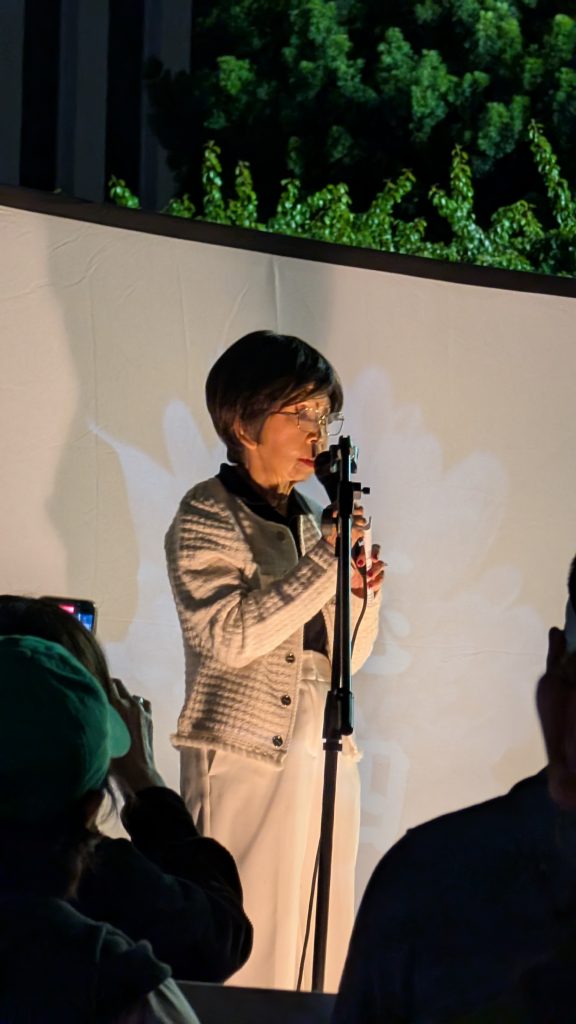
Tiananmen survivor Wang, Chaohua had give a speak.


Ann Lau, president of the Visual Artists Guild speaks.


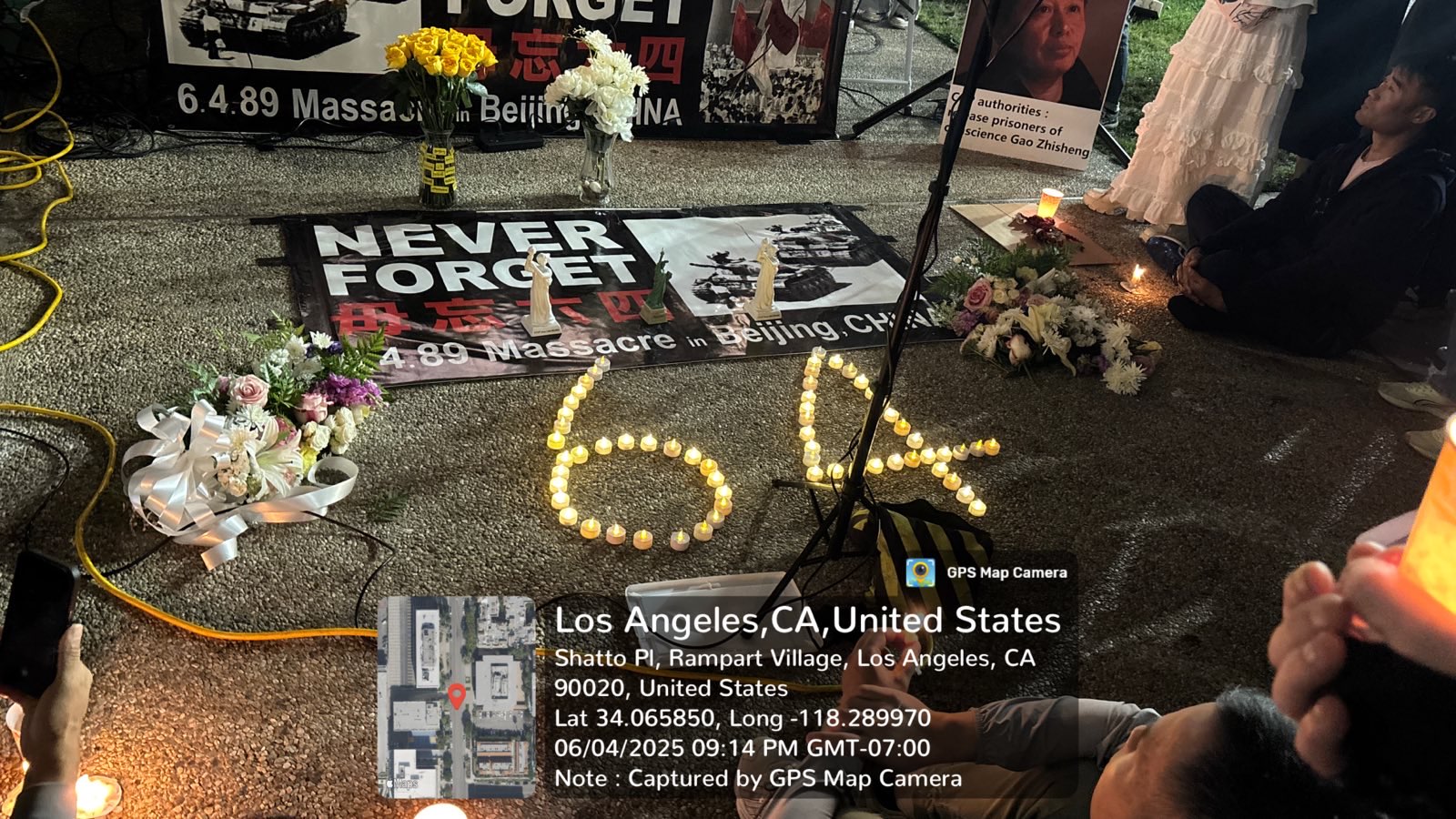
On June 4, 2025, Zhang Jing, Chairwoman Women’s Rights in China, traveled from the New York headquarters to Los Angeles to join members of the organization’s Los Angeles branch at 8 p.m. in front of the Chinese Consulate for the Hong Kong Forum, commemorating the 36th anniversary of the Tiananmen Massacre. The event drew many Chinese residents in Los Angeles, who lit candles in the night to mourn the victims of June 4, 1989.


In her speech, Chairwoman Zhang emphasized that China Women’s Rights has always been committed to speaking out for women, and she placed special importance on this commemoration. She stated that remembering June 4 is not only about honoring history but also about advancing democracy and human rights today and in the future. During the event, many participants offered flowers, and representatives from the Hong Kong Forum sang memorial songs in Cantonese, expressing deep mourning for the deceased and a yearning for freedom. These heartfelt acts not only created a solemn and moving atmosphere but also underscored the vital role China Women’s Rights plays in promoting social justice and human rights. Through this commemoration, the organization hopes to draw greater attention to women’s rights in China and to the pursuit of fairness and justice in society.


<iframe width=”560″ height=”315″ src=”https://www.youtube.com/embed/tCi8izA20jI?si=fXzu5fv7WR7xjiVT” title=”YouTube video player” frameborder=”0″ allow=”accelerometer; autoplay; clipboard-write; encrypted-media; gyroscope; picture-in-picture; web-share” referrerpolicy=”strict-origin-when-cross-origin” allowfullscreen></iframe>


The 36th Anniversary Of The Tiananmen Massacre By Chinese Communities In Los Angeles

By Su Shangwei                                                                                                                                       June 5th, 2025


On June 3, 2025, at 7:00 PM Pacific Time, Chinese communities gathered in front of the Chinese Consulate in Los Angeles to commemorate the 36th anniversary of the Tiananmen Massacre.

Su Shangwei, representative of the California Chapter of Women’s Rights in China, delivered the following remarks:

Thirty-six years ago in Beijing’s Tiananmen Square, the authoritarian regime ordered the military to carry out a bloody and brutal massacre against unarmed university students who cared deeply for their country and their people.

For every bereaved family, the pain of this tragedy is a wound that never healed. The images of bodies collapsing under gunfire, of tanks crushing the mangled flesh of students — these scenes became our collective nightmare.


The families of the victims have been crying out for justice for 36 years. The grieving parents who lost their children are now elderly; many have died in sorrow, never seeing any vindication for their loss. Some parents of the victims have already passed away, taking their pain with them to the grave. They never got to witness a so-called “reversal of June Fourth.” The path toward justice for the Tiananmen Massacre has only grown more distant and elusive.


We have a responsibility to let the people know the truth. A regime that maintains power through mass murder is evil beyond measure.


For 36 years, the Chinese Communist Party has been afraid of the truth. It has used the most ruthless methods to silence those who mourn the victims of June Fourth, charging them with “inciting subversion of state power.” The term “8964” is banned on the Chinese internet, and even lighting a single candle could lead to imprisonment under the charge of “picking quarrels and provoking trouble.”


Overseas, every year on June 4th, we gather to honor the victims and their families who have since passed. This is because the historical trauma etched in the hearts of the Chinese people will never be erased. It is also the echo of grief branded deep into the hearts of the victims’ loved ones.


History will never forget our innocent brothers and sisters who were so cruelly slaughtered.

We hope that through our struggle and efforts, our country can one day truly achieve democracy and constitutional governance. On that day, we will be able to build a memorial in Tiananmen Square, Beijing, to mourn and honor them.