WRIC Members Attended The HK Forum Candlelight Ceremony in LA

Photos by Zhang Zhijuan of WRIC

Web editor: Lu, Huiwen                                                                                           06-06-2025


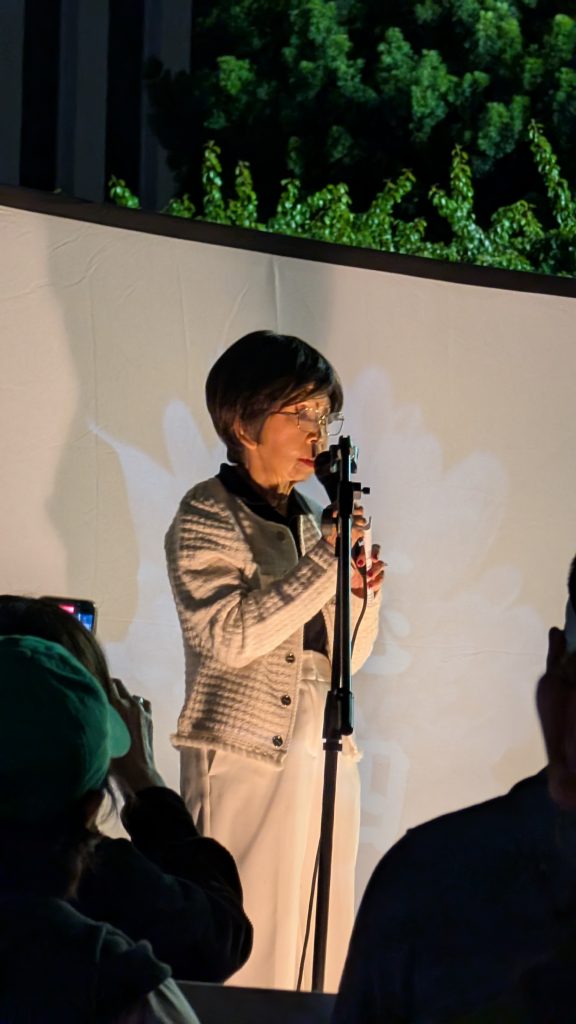
Tiananmen survivor Wang, Chaohua had give a speak.


Ann Lau, president of the Visual Artists Guild speaks.


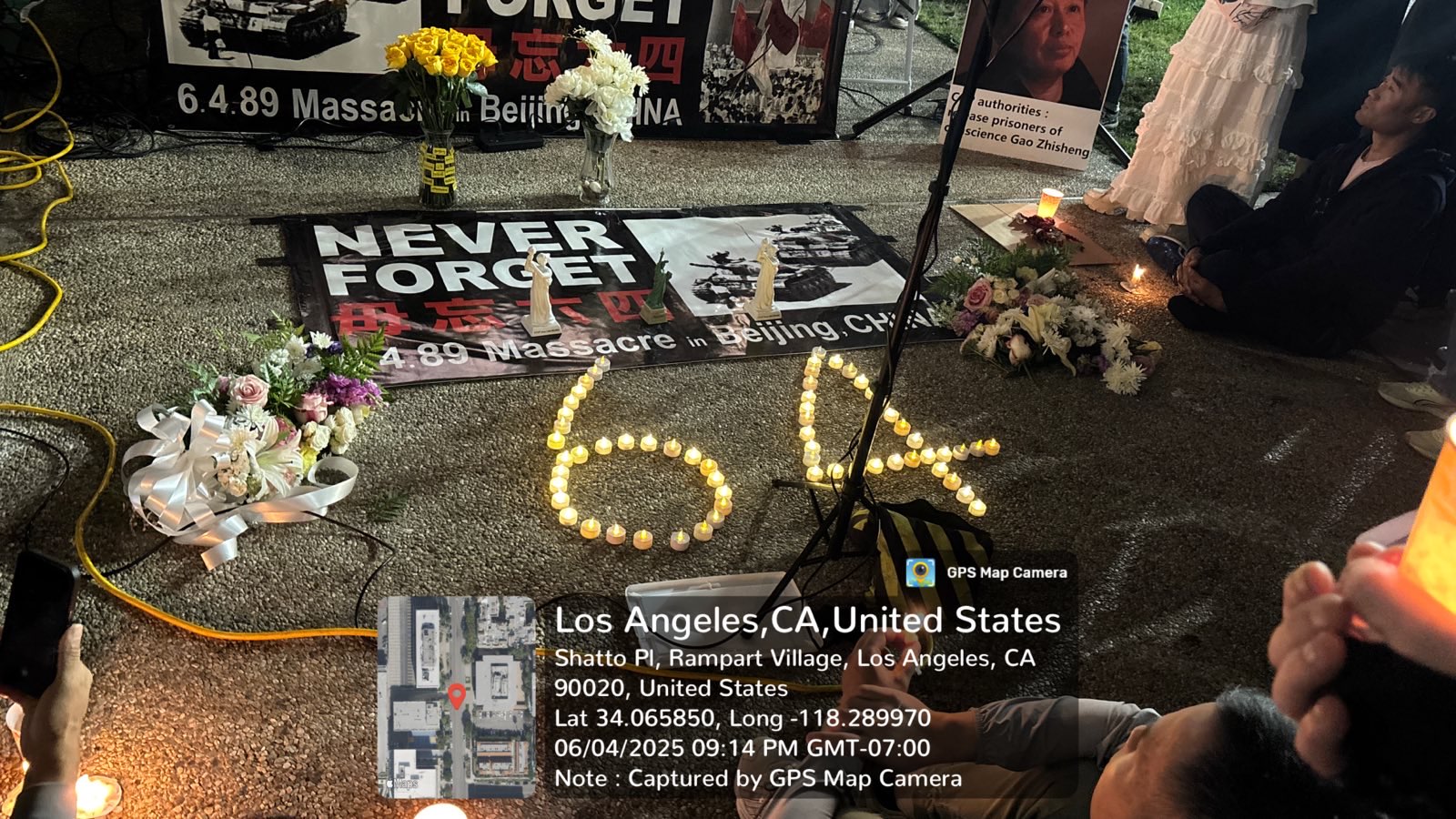
On June 4, 2025, Zhang Jing, Chairwoman Women’s Rights in China, traveled from the New York headquarters to Los Angeles to join members of the organization’s Los Angeles branch at 8 p.m. in front of the Chinese Consulate for the Hong Kong Forum, commemorating the 36th anniversary of the Tiananmen Massacre. The event drew many Chinese residents in Los Angeles, who lit candles in the night to mourn the victims of June 4, 1989.


In her speech, Chairwoman Zhang emphasized that China Women’s Rights has always been committed to speaking out for women, and she placed special importance on this commemoration. She stated that remembering June 4 is not only about honoring history but also about advancing democracy and human rights today and in the future. During the event, many participants offered flowers, and representatives from the Hong Kong Forum sang memorial songs in Cantonese, expressing deep mourning for the deceased and a yearning for freedom. These heartfelt acts not only created a solemn and moving atmosphere but also underscored the vital role China Women’s Rights plays in promoting social justice and human rights. Through this commemoration, the organization hopes to draw greater attention to women’s rights in China and to the pursuit of fairness and justice in society.


<iframe width=”560″ height=”315″ src=”https://www.youtube.com/embed/tCi8izA20jI?si=fXzu5fv7WR7xjiVT” title=”YouTube video player” frameborder=”0″ allow=”accelerometer; autoplay; clipboard-write; encrypted-media; gyroscope; picture-in-picture; web-share” referrerpolicy=”strict-origin-when-cross-origin” allowfullscreen></iframe>


The 36th Anniversary Of The Tiananmen Massacre By Chinese Communities In Los Angeles

By Su Shangwei                                                                                                                                       June 5th, 2025


On June 3, 2025, at 7:00 PM Pacific Time, Chinese communities gathered in front of the Chinese Consulate in Los Angeles to commemorate the 36th anniversary of the Tiananmen Massacre.

Su Shangwei, representative of the California Chapter of Women’s Rights in China, delivered the following remarks:

Thirty-six years ago in Beijing’s Tiananmen Square, the authoritarian regime ordered the military to carry out a bloody and brutal massacre against unarmed university students who cared deeply for their country and their people.

For every bereaved family, the pain of this tragedy is a wound that never healed. The images of bodies collapsing under gunfire, of tanks crushing the mangled flesh of students — these scenes became our collective nightmare.


The families of the victims have been crying out for justice for 36 years. The grieving parents who lost their children are now elderly; many have died in sorrow, never seeing any vindication for their loss. Some parents of the victims have already passed away, taking their pain with them to the grave. They never got to witness a so-called “reversal of June Fourth.” The path toward justice for the Tiananmen Massacre has only grown more distant and elusive.


We have a responsibility to let the people know the truth. A regime that maintains power through mass murder is evil beyond measure.


For 36 years, the Chinese Communist Party has been afraid of the truth. It has used the most ruthless methods to silence those who mourn the victims of June Fourth, charging them with “inciting subversion of state power.” The term “8964” is banned on the Chinese internet, and even lighting a single candle could lead to imprisonment under the charge of “picking quarrels and provoking trouble.”


Overseas, every year on June 4th, we gather to honor the victims and their families who have since passed. This is because the historical trauma etched in the hearts of the Chinese people will never be erased. It is also the echo of grief branded deep into the hearts of the victims’ loved ones.


History will never forget our innocent brothers and sisters who were so cruelly slaughtered.

We hope that through our struggle and efforts, our country can one day truly achieve democracy and constitutional governance. On that day, we will be able to build a memorial in Tiananmen Square, Beijing, to mourn and honor them.


Arab Spring puts women’s rights in the spotlightArab Spring puts women’s rights in the spotlight


Source: ReutersAuthor: Pulsihed Time: Dec 20, 2011email Print this article


 In post-revolution Libya, Egypt and Tunisia, women are exploring what the Arab Spring means for them. (Reuters)
By Marie-Louise Gumuchian
TRIPOLI | Tue Dec 20, 2011 5:58pm IST
(Reuters) – At a pre-wedding evening party in central Tripoli, a group of Libyan women sing traditional songs to the beat of a drum as they prepare to apply henna to the bride’s hands and feet.
Clapping her hands to the music as she waited for the bride to appear, 23-year-old Sarah Burruin said she has just one wish for women in the new Libya.
“I want women to be equal,” the engineering student said. “Whatever men do, I want women to be able to do it too. This is our time.”
In post-revolution Libya, Egypt and Tunisia, women are exploring what the Arab Spring means for them.
Since long-time leaders were toppled in the three north African states, many — not least in the West — fret the power vacuum will leave the door open for Islamist groups to take power and force changes that will damage women’s rights.
In Tunisia Islamists have already risen to power while in Egypt, they are leading staggered elections and have pledged to govern by Islamic laws.
In Libya, National Transitional Council NTC.L chief Mustafa Abdel Jalil alarmed many when he pledged to uphold Islamic law and ease polygamy rules in a speech to mark Libya’s “liberation” from Muammar Gaddafi’s 42-year rule, though he has since played down any suggestion of radical Islamist rule.
“I think where the Islamic laws will eventually bite is the rights of women. They already have declared (in Libya) that polygamy rules will be relaxed and who knows where that is going to go,” said Laleh Khalili, senior lecturer in Middle East Politics at the University of London.
TENSIONS IN TUNISIA
In Tunisia, where the Arab Spring was born when President Zine al-Abidine Ben Ali was forced to step down, “secular” women have mobilised to defend their western lifestyles after the Islamist Ennahda party swept to power in the country’s first free election, including claiming almost all the seats won by women.
Women are lobbying the political parties to protect a pioneering 1956 law granting them full equality with men and to counter the pressure mounting from radical Muslims keen to push them back into traditional roles.
“I have never been so worried about women’s freedom as I am now,” said Saida Garrach, a lawyer and activist in the Tunisian Association of Democratic “omen.
“The threat is everywhere – on what women wear, how they think. If you are not with them (Islamists), they will insult you, harass you. I’ve been sworn at in the street because of things I have said on television.”
While Ennahda has promised not to impose strict Muslim rules on society and to respect women’s rights, many secularist women say they do not believe these promises.
“Ennahda cannot make any threats now because everyone will turn against them,” said 30-year-old Houda Ben Zid, an insurance worker who wears the hijab. “But they could do something later. Our way of life could be threatened.”
A small contingent of Salafists – hardline Islamists not associated with Ennahda – have sought to implement their purist interpretation of Islam and overturn secularist laws.
Some have demanded segregated classes and the right for women to wear full face veils at university, spurring clashes with secular students.
In Egypt, the Islamist Muslim Brotherhood and the ultra-conservative Salafi party have claimed the most seats in the first two rounds of a parliamentary poll, the first free ballot in the Arab world’s most populous nation since President Hosni Mubarak was ousted in February.
Both parties advocate a more Islamic society but tell voters although they want more morality in public life they won’t impose Islamic moral codes and veils on women.
Campaigners say Egyptian women face some of the harshest treatment in the world: domestic violence, harassment and discrimination at work and in the law. Forced marriage of young girls is still common outside big cities.
Feminists say there is no better time to unite because the main factor that split the women’s movement – its domination by former first lady Suzanne Mubarak – has disappeared.
“It is known that the former president’s wife was the one behind any development on women rights and I fear that the new parliament seeking to gain popularity among the people will seek to eliminate those rules,” said Egyptian analyst Negad Borie.
A ROLE, YES, BUT WHAT KIND?
Although there is no doubt that Islamists will play an important role in the three states rocked by the Arab Spring, how those roles evolve will be shaped by each country’s unique social and cultural landscape.
Observers say Libyan society is more conservative than in Egypt and Tunisia.
“Egyptian women are strong, here is not like Libya. If they (Islamists) asked to pass stricter laws on women, the Egyptian society will not accept that,” said Samah Ahmed, an employee in Egypt’s Postal Service.
“We will not accept such thing and will go to the streets and make a big deal.”
Sitting in a Tripoli beauty salon waiting to get her hair cut, Jamila says she believes the majority of her countrymen practice moderate Islam.
“Libya is moderate but we fear extremists,” she said.
The 60-year-old was disappointed by NTC head Abdel Jalil’s comments on polygamy because they implied men would no longer need written permission from their wives to have another spouse.
“I like the fact that a man has to ask for permission to marry another woman, it protects women’s dignity,” she said.
Others considered the tone and timing of the speech and ceremony a slap in the face to women.
“I support Islamic values. I understand that in the Koran it says you can marry four women, no problem with that. I do not like when he said it, Liberation Day; there are more important issues than polygamy,” said Alaa Murabit, a student doctor and co-founder of the Voice of Libyan Women organisation.
“What made me angry was that a woman didn’t speak on Liberation Day. Have her speak on that international stage that day – it would have sent a very different message.”
Murabit last month organised post-war Libya’s first international women’s conference, which was attended by the country’s new leaders, including Abdel Jalil.
When he took the stage this time, he took care to enumerate the many ways women had supported and led Libya’s revolution and promised women would play an important role rebuilding the country.
There are a few women in the new government, including the ministers for health and social affairs.
As the country rebuilds after eight months of war, Libyan women are laying out their vision for a new beginning. Numerous women’s organisations have sprung up since Gaddafi’s overthrow, creating meeting centres and holding awareness lectures and workshops on social, political and business issues.
“For now we just want enough women to go to elections, this alone is a huge challenge,” said Amira Alshokri, co-founder of Tripoli-based NGO Phoenix. She said Phoenix had recently sent out thousands of invitations to women for a free “Know your rights” lecture, but only 50 showed up.
“In this sensitive time you would think this topic would trigger women to come…(Women) became too lazy to act because they knew their voice would not be heard, make a difference. This is what we’re working on right now, we want to raise awareness.”
A change is already apparent, said Ines Miloud.
The 21-year-old student says there are more women out and about in her small town of Yifran in Libya’s Western Mountains, as opposed to before the revolution when most women tended to stick to more traditional roles in the home.
“Before I would wake up, go to college and come back home. Now I am out all day,” she said. “My mother says: ‘You are like a boy’.”
Miloud has co-founded an association in the Western Mountains to promote women’s rights.
“We have a lot of talented women but they were just buried. They are still afraid from the Gaddafi era. We are trying to show them that they are free.”
Activists say it’s not just women who need to speak out, and not just on women’s issues.
“I think it will take much more to change the mentality in Libya. Everybody’s focusing on women’s development and women’s education … and they’re forgetting it’s not just women. It’s national development and national education,” Murabit said.
“Every woman has a different aspiration. I think the overall aspiration is to respect each woman’s individual choice.”
(Additional reporting by Yasmine Saleh in Cairo and Tarek Amara in Tunis; Editing by Sonya Hepinstall)
WORLDLIBYA
Women show the flags of Syria, Tunisia, Yemen, Egypt and Libya painted on their palms in the southern city of Taiz December 15, 2011. REUTERS/Mohamed al-Sayaghi

Egypt political groups refuse women’s rights, end death penalty, says rights groupEgypt political groups refuse women’s rights, end death penalty, says rights group


Egyptian women face uphill battle.
CAIRO: Egypt’s political groups have professed a claim to uphold human rights in the country, but are failing on ensuring women’s rights and ending the use of the death penalty in the country, said Amnesty International on Monday.
The London-based rights group said that although most of the large political parties in the country claim to have committed to human rights reforms during the transitional phase in Egypt, they are giving “mixed signals” and even refusing to protect women’s rights and abolish the death penalty.
Amnesty had called on political parties ahead of voting last November to sign a “human rights manifesto” to ensure “meaningful human rights reform” in the country, but now, three months later and the first session of parliament being held, women’s issues remain on the outside for most political groups.
The Freedom and Justice Party, which won the most seats in the new People’s Assembly, “was one of three parties that did not respond substantively, despite considerable efforts by Amnesty International to seek its views,” the organization said in a statement.
“With the first session of the new parliament sitting this week, it is encouraging that so many of the major parties engaged with us and were prepared to sign up to ambitious pledges for change on combating torture, protecting slum residents’ rights and ensuring fair trials,” said Philip Luther, Amnesty International’s interim Middle East and North Africa director.
“But it is disturbing that a number of parties refused to commit to equal rights for women. With a handful of women taking up seats in the new parliament, there remain huge obstacles to women playing a full role in Egyptian political life.
“We challenge the new parliament to use the opportunity of drafting the new constitution to guarantee all of these rights for all people in Egypt. The cornerstone must be non-discrimination and gender equality.”
The rights group has called on political leaders to act “if they want to create a truly equal society– for women and for men,” said Sanjeev Bery, advocacy director for the Middle East and North Africa in Washington.
“Women stood side-by-side with men in the protests, and they must be equal partners in the creation of a new government. All Egyptians must benefit from laws ensuring equal treatment and dignity.”
Women’s issues have been increasingly pushed aside in recent months by both activists and political leaders in favor of what they have called “universal human rights.” A number of activists have argued that to push women’s issues directly would be “divisive” and split the unity of the revolution.
Nehad Abu Komsan of the Egyptian Center for Women’s Rights (ECWR), in a previous interview with Bikyamasr.com, said that women’s rights must be pushed harder by political groups and activists alike. She echoed Amnesty’s argument that women were vital to the uprising last year and said her organization was determined to ensure women’s rights are on the agenda.
“We will continue to push for greater women’s freedom and justice in the country because now is the time when women can have a voice for change and can create a better life in Egypt,” she said.
But as conservative groups take control of parliament, their are worries still that the future for women in Egypt could be hit hard by new legislation that could restrict their movement and freedom.
The ultra-conservative Salafist al-Nour Party has already said it would like to see the veil a requirement for all women in the country and has repeatedly called for bikinis to be banned from beaches.
This has left many wondering where Egypt is heading.
“The real test for political parties will be to translate these pledges into initiatives in parliament to abolish repressive Mubarak-era laws, reform the police and security services, and pass laws which protect human rights and break with the legacy of abuse,” said Luther. “One of the first measures should be the lifting of the much-decried state of emergency.

The Path of the Women’s Rights Movement in U.S.The Path of the Women’s Rights Movement in U.S.

A Timeline of the Women’s Rights Movement 1848 – 1998
1848 The world’s first women’s rights convention is held in Seneca Falls, NY, July 19-20. A Declaration of Sentiments and Resolutions is debated and signed by 68 women and 32 men, setting the agenda for the women’s rights movement that followed.
1849 Elizabeth Smith Miller appears on the streets of Seneca Falls, NY, in “turkish trousers,” soon to be known as “bloomers.”
1849 Amelia Jenks Bloomer publishes and edits Lily the first prominent women’s rights newspaper.
1850 Quaker physicians establish the Female Medical College of Pennsylvania, PA to give women a chance to learn medicine. The first women graduated under police guard.
1855 Lucy Stone becomes first woman on record to keep her own name after marriage, setting a trend among women who are consequently known as “Lucy Stoners.”
1855 The University of Iowa becomes the first state school to admit women.
1855 In Missouri v. Celia, a Black slave is declared property without right to defense against a master’s act of rape.
1859 American Medical Association announces opposition to abortion. In 1860, Connecticut is the first state to prohibit all abortions, both before and after quickening.
1859 The birth rate continues its downward spiral as reliable condoms become available. By the late 1900s, women will raise an average of only two or three children.
1860 Of 2,225,086 Black women, 1,971,135 are held in slavery. In San Francisco, about 85% of Chinese women are essentially enslaved as prostitutes.
1866 14th Amendment is passed by Congress (ratified by the states in 1868), the first time “citizens” and “voters” are defined as “male” in the Constitution.
1866 The American Equal Rights Association is founded, the first organization in the US to advocate women’s suffrage.
1868 The National Labor Union supports equal pay for equal work.
1868 Elizabeth Cady Stanton and Susan Anthony begin publishing The Revolution, an important women’s movement periodical.
1870 For the first time in the history of jurisprudence, women serve on juries in the Wyoming Territory.
1870 Iowa is the first state to admit a woman to the bar: Arabella Mansfield.
1870 The 15th Amendment receives final ratification. By its text, women are not specifically excluded from the vote. During the next two years, approximately 150 women will attempt to vote in almost a dozen different jurisdictions from Delaware to California.
1872 Through the efforts of lawyer Belva Lockwood, Congress passes a law to give women federal employees equal pay for equal work.
1872 Charlotte E. Ray, Howard University law school graduate, becomes first African-American woman admitted to the US bar.
1873  Bradwell v. Illinois: Supreme Court affirms that states can restrict women from the practice of any profession to uphold the law of the Creator.
1873 Congress passes the Comstock Law, defining contraceptive information as “obscene material.”
1877 Helen Magill is the first woman to receive a Ph.D. at a US school, a doctorate in Greek from Boston University.
1878 The Susan B. Anthony Amendment, to grant women the vote, is first introduced in the US Congress.
1884 Belva Lockwood, presidential candidate of the National Equal Rights Party, is the first woman to receive votes in a presidential election (appx. 4,000 in six states).
1887 For the first and only time in this century, the US Senate votes on woman suffrage. It loses, 34 to 16. Twenty-five Senators do not bother to participate.
1899 National Consumers League is formed with Florence Kelley as its president. The League organizes women to use their power as consumers to push for better working conditions and protective laws for women workers.
1900 Two-thirds of divorce cases are initiated by the wife; a century earlier, most women lacked the right to sue and were hopelessly locked into bad marriages.
1909 Women garment workers strike in New York for better wages and working conditions in the Uprising of the 20,000. Over 300 shops eventually sign union contracts.
1912 Juliette Gordon Low founds first American group of Girl Guides, in Atlanta, Georgia. Later renamed the Girl Scouts of the USA, the organization brings girls into the outdoors, encourages their self-reliance and resourcefulness, and prepares them for varied roles as adult women.
1913 Alice Paul and Lucy Burns organize the Congressional Union, which later becomes the National Women’s Party. Members picket the White House and engage in other forms of civil disobedience, drawing public attention to the suffrage cause.
1914 Margaret Sanger calls for legalization of contraceptives in her new, feminist publication, The Woman Rebel, which the Post Office bans from the mails.
1917 During WWI women move into many jobs working in heavy industry in mining, chemical manufacturing, automobile and railway plants. They also run street cars, conduct trains, direct traffic, and deliver mail.
1917 Jeannette Rankin of Montana becomes the first woman elected to the US Congress.
1919 The House of Representatives passes the women’s suffrage amendment, 304 to 89; the Senate passes it with just two votes to spare, 56 to 25.
1921 Margaret Sanger organizes the American Birth Control League, which becomes Federation of Planned Parenthood in 1942.
1923 Supreme Court strikes down a 1918 minimum-wage law for District of Columbia women because, with the vote, women are considered equal to men. This ruling cancels all state minimum wage laws.
1933 Frances Perkins, the first woman in a Presidential cabinet, serves as Secretary of Labor during the entire Roosevelt presidency.
1941 A massive government and industry media campaign persuades women to take jobs during the war. Almost 7 million women respond, 2 million as industrial “Rosie the Riveters” and 400,000 join the military.
1945 Women industrial workers begin to lose their jobs in large numbers to returning service men, although surveys show 80% want to continue working.
1957 The number of women and men voting is approximately equal for the first time.
1960 The Food and Drug Administration approves birth control pills.
1960 Women now earn only 60 cents for every dollar earned by men, a decline since 1955. Women of color earn only 42 cents.
1963 The Equal Pay Act, proposed twenty years earlier, establishes equal pay for men and women performing the same job duties. It does not cover domestics, agricultural workers, executives, administrators or professionals.
1963 Betty Friedan’s best-seller, The Feminine Mystique, detailed the “problem that has no name.” Five million copies are sold by 1970, laying the groundwork for the modern feminist movement.
1964 Title VII of the Civil Rights Act bars employment discrimination by private employers, employment agencies, and unions based on race, sex, and other grounds. To investigate complaints and enforce penalties, it establishes the Equal Employment Opportunity Commission (EEOC), which receives 50,000 complaints of gender discrimination in its first five years.
1966 In response to EEOC inaction on employment discrimination complaints, twenty-eight women found the National Organization for Women to function as a civil rights organization for women.
1968 New York Radical Women garner media attention to the women’s movement when they protest the Miss America Pageant in Atlantic City.
1968 The first national women’s liberation conference is held in Chicago.
1968 The National Abortion Rights Action League (NARAL) is founded.
1968 National Welfare Rights Organization is formed by activists such as Johnnie Tillmon and Etta Horm. They have 22,000 members by 1969, but are unable to survive as an organization past 1975.
1968 Shirley Chisholm (D-NY) is first Black woman elected to the US Congress.
1970 Women’s wages fall to 59 cents for every dollar earned by men. Although nonwhite women earn even less, the gap is closing between white women and women of color.
1970 The Equal Rights Amendment is reintroduced into Congress.
1973 Billie Jean King scores an enormous victory for female athletes when she beats Bobby Riggs in “The tennis tournament watched by nearly 48,000,000 people.”
1973 The first battered women’s shelters open in the US, in Tucson, Arizona and St. Paul, Minnesota.
1973 In Roe v. Wade, the Supreme Court establishes a woman’s right to abortion, effectively canceling the anti-abortion laws of 46 states.
1974 MANA, the Mexican-American Women’s National Association, organizes as feminist activist organization. By 1990, MANA chapters operate in 16 states; members in 36.
1974 Hundreds of colleges are offering women’s studies courses. Additionally, 230 women’s centers on college campuses provide support services for women students.
1975 The first women’s bank opens, in New York City.
1978 For the first time in history, more women than men enter college.
1981 At the request of women’s organizations, President Carter proclaims the first “National Women’s History Week,” incorporating March 8, International Women’s Day.
1981 Sandra Day O’Connor is the first woman ever appointed to the US Supreme Court. In 1993, she is joined by Ruth Bader Ginsberg.
1984 Geraldine Ferraro is the first woman vice-presidential candidate of a major political party (Democratic Party).
1990 The number of Black women in elective office has increased from 131 in 1970 to 1,950 in 1990.
1992 Women are now paid 71 cents for every dollar paid to men. The range is from 64 cents for working-class women to 77 cents for professional women with doctorates. Black women earned 65 cents, Latinas 54 cents.
1993 Take Our Daughters to Work Day debuts, designed to build girls self-esteem and open their eyes to a variety of careers.
1996 US women’s spectacular success in the Summer Olympics (19 gold medals, 10 silver, 9 bronze) is the result of large numbers of girls and women active in sports since the passage of Title IX.

Chinese Women’s RightsChinese Women’s Rights


Confucian Ideas about Women
Confucian thoughts have greatly influenced the minds of China. During the Han dynasty, Confucianism became a part of the official education, which helped spread it across China. In later dynasties, male authority was enforced which brought a woman’s status down. In the Confucian society, women were to hold a lower position than men. Women could only obtain power by becoming a mother. They had the task of producing son and it was frowned upon if they birthed girls. Their nature was expected to be passive and to revolve around their husbands and their family. Other Confucian ideas taught many that women were the cause of disorder. It was also taught that women should not rule and that people were not to concern themselves with women’s ideas. Many of these ideas still influence the way Chinese women are treated today.
 
Discrimination in Education and Employment
Even though a law has been promoted to protect women’s rights, women are still discriminated. It’s hard for women to get jobs even if they have degrees. Most good jobs are open only to men. Women aren’t offered many nice jobs that pay fair. Men and women work equally but women get paid 78% of the pay the men get. Chinese women make up one-third of workers in the fields of trade, industry, finance, and communication. They also make up almost half of the workers in education and health. Women’s federations have created programs in rural areas to develop courtyard economies. Women work to weave household accessories out of maize husks. Young women get hired at embroidery factories so that they can continue to have babies but be able to work at home. Many rural girls aren’t being sent to school. Many rural parents don’t want to “waste” their money on a girl who will end up being married off to another family. Over 70% of school dropouts are girls and over 70% of about 220 million who are semiliterate or illiterate in China are women. In 1990, about 200,000 women were university graduates. This made up about one-third of the college graduates in China. Another factor of why there are women enrolled in higher education is because some universities openly express the fact that they discriminate against girls. This happens even if girls score equally as high or higher than boys in exams.
Women and the Government
The government made a gender equality law in 1949 but discrimination against women continues. In 2005, the Chinese government released a white paper to mark the 10th anniversary of the Fourth UN World Conference on Women. This law promotes equality between women and men in nine aspects including politics and family life. The white paper points out that the government is doing what they can to eliminate discrimination in education. The white paper also acknowledges the fact that the gender equality problems have not been resolved. Not many women play an important part in the government. The Central Committee is the highest ring of the Communist party in China. Only 22 members are women in the Central Committee of 192 people. Women’s political influence has increased over the passed 50 years but it still remains low.
 
Violence Against Women
It is very common in China for women to get abused. It is found acceptable in some parts of China for men to abuse their wives. There are not any laws to protect women from domestic abuse. Many authorities don’t report abuse because they think that wife abuse is a family matter. Most domestic abuse is found in urban areas. Many women don’t like to report abuse or get divorces because they are pressured to maintain a family. Women that suffer from abuse have no way of escaping because there aren’t any shelters that they can go to.
Abduction and Trafficking of Women
Women have been the primary targets of abduction, illegal imprisonment, physical and sexual assault, and sale. This remains a serious problem in China. Mainly only rural parts of China conduct trafficking. There are women that are being sold as brides in the black market. Men who have purchased women don’t get arrested meaning that the trade of women is still active. Usually when victims try to escape, they get brutally beaten, imprisoned, and possibly murdered. Even if a woman escapes, law enforcement officers recapture her. This happens because some officials say that the man who purchased the woman is the owner. Many women that are bought are also given marriage licenses to prove that they are married to the buyer. As China’s economy falls, more and more women are voluntarily. This happens because some of the women are being convinced by traders that if they are sold, they will get better opportunities. The government wants to stop the trade of women, but some officials are involved. Women can only be saved if they make a complaint or if their family makes a complaint.
Protection of Chinese Women’s Rights
Chinese women have trouble getting their laws enforced and many of them don’t know their rights and need to be informed of them. There are many organizations that deal with these problems. Many Women Organizations report women’s problems to authorities and suggest solutions. They also stress the fact that women want equality. Notices have been put up to stop trafficking women Fudan University has a union that calls women (mainly women that work) to remind them of their rights. Notices have been put up to remind people of women’s rights. China set up an All-China Women’s Foundation to protect and preserve the rights of women. The Constitution also enforces rights of women in political, economic, cultural and family life.

Downtown statue honors leader of women’s rights, Populist movementDowntown statue honors leader of women’s rights, Populist movement

Fernando Salazar/The Wichita Eagle
Mary Elizabeth Lease
Courtesy of the Kansas Historical Society/
Read more here: http://www.kansas.com/2012/01/23/2186252/downtown-statue-honors-leader.html#storylink=cpy
The sculpture of Mary Elizabeth Lease stands between Century II and the Wichita Public Library. It was paid for by the Hypatia Club, which wanted to honor the Wichita woman who started it with a classified ad in the Wichita Eagle. Lease went on to become one of the formidable leaders of the 1890s Populist movement.
What would Mary Elizabeth Lease think?
In the heart of Wichita, a statue of the famed 19-century Populist leader has been placed where crowds are sure to pass, compliments of the club she started.
The statue was placed in the summer by the Hypatia Club, the state’s oldest women’s club. Members of the club paid $65,000 to have local sculptor Babs Mellor create a likeness of Lease.
“We started out with another sculptor but she wanted to do something that was far out — you had to use your imagination for what it was. And, we decided we liked the real thing better,” said Josephine Brown, the club president.
The group has been working on the sculpture project for a year and a half. It is expected to be dedicated this spring. It’s been placed between Century II and the Wichita Public Library .
No doubt, Lease would have found a certain irony in the sculpture praising her efforts exactly 126 years after she moved mindsets as to what women could do, if they wanted.
In the beginning it would have been easy to give up.
In January of 1886 she raised the ire of Wichita Eagle publisher Marshall Murdock when she took out an ad in his newspaper.
Her ad in the Jan. 21, 1886, Eagle read: “We would most earnestly invite the intelligent women of Wichita, the artists, the musicians, teachers, actors, lecturers, and all women having the advancement of their sex in view, to meet Saturday, Jan. 23 at 3 o’clock at the residence of Mrs. Harry Hill, 321 Topeka Avenue.”
Murdock wrote an editorial urging husbands to keep their wives at home. The idea was simply unheard of in a Victorian society in which women catered to their men and, at best, only met to exchange recipes and for quilting bees. Lease wanted more.
In the beginning, it was as if God himself conspired against her and the club.
On the day of the meeting, temperatures were bitterly cold and a blizzard was raging as nine women banded together to form the Hypatia Club. The women named themselves after Hypatia, a fifth-century Greek female philosopher and educator who was persecuted and killed for her belief in open thought and discussion. Lease later went on to become a forceful national spokeswoman for the Populist Party during the 1890s and eventually moved from Wichita.
But the club and the ideals that she and the eight original members had established flourished.
By 1934, the Hypatia Club had grown so much — with so many of Wichita’s most prominent women as its members — that they bought a house on North Broadway as a place to have meetings.
The prairie square house at 1215 N. Broadway was designed and built in 1897 by Ulysses Grant Charles, a noted Wichita architect.
By the 1980s, the house — which still maintains many of its original windows, mirrors and plumbing fixtures — was in disrepair. The porches were falling off, the gutters hadn’t been cleaned out in years and water was beginning to enter the house through the rotting wood walls.
Club members applied for and were able to get the house nominated and placed on the National Register of Historic Places in the mid-1990s. They have since sold it and used a portion of the proceeds from the house to buy the statue. Helene Fuller Mitchell, a past president of the club who championed the efforts to get the statue, said she did so because “I feel like we are a part of Kansas history.”
“She (Lease) was an incredible role model when she couldn’t even vote,” said club member Jackie Nagel. The 19th Amendment, allowing women the right to vote, was not ratified until Aug. 26, 1920.
Still, Lease and the women of Hypatia did what they could to make lives better.
A plaque at the memorial reads:
“The memorial is dedicated to the memory of Mary Elizabeth Lease and the nine women who drove their horses and buggies through the snow blizzard of 1886 to meet and set a new direction for women in the prairie city of Wichita … It is a memorial to what the Hypatia women have accomplished to further the common good and general welfare of the people of the community.”
As a group, the women of Hypatia were able to:
•  Start the first formal welfare agency in 1887.
•  Start the first garbage pickup service in Wichita in 1901.
•  Help two club members became the first women to be elected to Wichita’s school board in 1913.
Their members, which have remained some of the most prominent family names in Wichita, have through the decades contributed significantly to local museums and the arts.
Lease championed women’s rights, helping establish the Wichita Equal Suffrage Association.
In 1890, Lease embarked on a speaking tour for the Populist Party, campaigning primarily against Sen. John J. Ingalls, the Republican incumbent. He lost the election.
It was a time when mortgage foreclosures and sheriff’s sales filled the newspapers. “Wall Street owns the country,” lamented Lease.
“Kansas had better stop raising corn and begin raising hell,” she told farmers.
She was called the “People’s Joan of Arc,” because of her efforts to rally and build the Populist movement.
And now, 126 years after her club was started, what would Mary Elizabeth Lease think of the statue that’s been placed in the heart of Wichita, which is a short distance away from where Occupy Wichita has held signs of protest?
“What would Mary Elizabeth Lease think? I think she would say you’ve come a long way, baby,” said Brown, the Hypatia Club president. “Would she be happy? Well, we are still supporting some of the things she supported.”

Roe v. Wade Turns 39: Top 5 Threats to Women’s Right to ChooseRoe v. Wade Turns 39: Top 5 Threats to Women’s Right to Choose

Roe v. Wade turns 39 today, but the number of threats to women’s right to choose has balloned in recent years.
In 2011, a record high of more than 1,100 anti-abortion provisions were introduced in the country’s state legislatures, representing a sharp increase over 2010, which saw 950 such provisions introduced according to a Guttmacher Institute study.
Enlarge
(Photo: REUTERS)
Roe v. Wade turns 39 today, but the number of threats to women’s right to choose has grown in recent years.
SHARE THIS STORY
MappingOurRights.org has made a map available that ranks states according to how much a women’s right to choose is currently endangered.
Of the 1,100-plus proposals nationwide, 36 states successfully enacted new restrictions on women’s right to choose in 2011, according to The Huffington Post.
Here’s the top 5 threats facing abortion rights today:
1. Mississippi’s push for a “personhood” constitutional amendment – The “personhood” proposal, which entered the national spotlight last year as the most restrictive such restriction proposed in the country, would have declared fetuses, or unborn children, as full “persons,” granting them full rights to “life, liberty and pursuit of happiness,” according to the Personhood USA advocacy group. The group is taking the Personhood movement nationwide, hoping to get such amendments added to state constitutions from Mississippi to Florida.
“A person, simply put, is a human being. This fact should be enough,” Personhood USA’s website reads. “The intrinsic humanity of unborn children, by definition, makes them persons, and should, therefore, guarantee their protection under the law.”
The implications of such a change to Mississippi’s constitution would be monumental. Some critics contend that it would make abortion a crime equal to murder of a full-grown adult.
2. Ohio’s “heartbeat” bill – This legislation would outlaw abortion as soon as a doctor can detect the first fetal heartbeat.
The first heartbeat can often be detected as early as six weeks into a pregnancy, meaning that many women won’t even know she was pregnant by the time she would be unable to lawfully get an abortion. The Ohio bill allows no exception for incest, rape or mental health issues.
The pro-choice movement has mobilized against the legislation, saying it unfairly endangers women and limits their right to choose.
As Think Progress has reported, a Cleveland obstetrician named Dr. Lisa Perriera, who opposes the bill, told Senate Republicans that “lawmakers do not belong in the consultation room with me and my patients,” adding that, “Banning abortion has never stopped abortion from happening. It has only made abortion unsafe or more difficult to obtain.”
3. TRAP laws – Targeted Regulation of Abortion Providers laws impose requirements on doctors on abortion providers that go beyond those imposed on other medical practices. Some such laws require further expensive and sophisticated facilities, some allow unannounced state inspections of facilities.
A number of states, from Kentucky to North Dakota have enacted such laws, which ReproductiveRights.org has come out hard against.
“These excessive and unnecessary government regulations – an ever-growing trend among state legislatures – increase the cost and scarcity of abortion services, harming women’s health and inhibiting their reproductive choices,” the ReproductiveRights.org website says about TRAP laws.
4. Laws mandating parental involvement – Laws that require parents to either approve or otherwise be involved in minors’ reproductive rights decisions are some of the most common abortion-restricting laws in the nation
These laws make it more difficult for minor females to make their own decisions about their reproductive health, and have even led to situations in which young women have been forced to make a choice between either getting an illegal abortion or giving birth to a child conceived via rape or incest.
The Center for Reproductive Rights calls such laws a major threat to the right to choose, and wrote in 2009 that more than 35 states mandate parental consent or parental notification before minors can obtain abortions.
“In their efforts to make inaccessible to as many women as possible, anti-choice forces have focused on burdening minors’ access to abortion,” the center wrote.
5. Mandatory and biased counseling laws – Laws mandating women obtain counseling before obtaining an abortion are one more restriction on choice that abortion-rights groups to which have been strongly opposed
Even worse, such groups say, are “biased” counseling laws, which require that such counseling be state-provided information that encourages carrying the pregnancy rather than getting an abortion.
The Center for Productive Rights has pushed hard to stop such laws from being passed, and wrote a major critique of them in 2010:
“The information is designed to persuade women to carry their pregnancies to term, and it generally includes descriptions of fetal development, adoption programs, and state laws requiring fathers to pay child support,” the center wrote. “In some states, this information must be provided to the woman orally, often by the physician, and in other states the information is contained in written materials prepared by the state.”

Fed Up Vermont rallies for women’s rightsFed Up Vermont rallies for women’s rights

Kristin Nelson (right) leads a chant as Fed Up Vermont marches from Bailey Howe Library at the University of Vermont to City Hall in Burlington on Saturday. / SHANE BUFANO, for the Free Press
Hayley Mason of Fed Up Vermont, a “grass-roots feminist coalition” formed in June, said a rally Saturday was the kickoff of a campaign to “eradicate sexism” on the University of Vermont campus, in the broader community and “eventually everywhere.”
Mason, 24, of Burlington, said the incident in December involving the UVM fraternity Sigma Phi Epsilon, which was shut down after distributing a survey to members asking whom they would like to rape, was only part of the reason for Saturday’s rally.
“Rape culture is bigger than one frat,” Mason said. “(Sigma Phi Epsilon) only embodied what we all want to fight against, oppressive inequality and a division between men and women.”
About 50 people braved the cold Saturday for the march that began at the Bailey Howe Library at UVM and ended at City Hall. Mason and another Fed Up member, Marni Salerno, led the crowd in chants with a bullhorn, saying, “Tell me what a feminist looks like!” to the answer, “This is what a feminist looks like!” from the marchers.
Another refrain went, “Hey, hey, ho, ho, rape culture has to go!,” and “We are unstoppable, another world is possible!”
As the group made its way down Main Street, a sprinkling of passing cars and trucks honked in support, with one driver giving the “thumbs up” through his window.
Once the marchers reached Church Street, they marched up and down the length of the pedestrian mall, chanting as they went. Some shoppers stopped to listen, others shot video of the rally with their smartphones, and still others ignored the entire affair.
Thomas Grace, 28, of Burlington said he joined the march to show support for women.
“The attacks on women in this country and around the world need to be fought against,” Grace said. “It needs to be men and women together.”
Once the marchers reached City Hall, the rally convened in the Council Chambers for three speeches from local activists, and “speak-outs” by anyone who wanted to address the audience.
Acting as master of ceremonies, Mason began by outlining the demands being made of UVM by Fed Up Vermont and other organizations including Vermont Workers’ Center, Peace and Justice Center, Vermont Federation of Nurses and Health Professionals, Occupy VT Burlington and more.
Mason said UVM:
• Must institute mandatory women and gender studies courses for all students.
• Must invest more resources into the women and gender studies department and make gender studies a Spire of Excellence.
• Must provide full transparency about sexual harassment, rape and gender violence in the UVM community and regularly report statistics about the occurrences.
• Must develop leadership bodies which reflect the gender composition of the UVM community and project the role of women as leaders.
The first speaker, Peggy Luhrs, was a co-founder of Fed Up Vermont and has been involved in women’s rights issues in Burlington since the early 1970s. Luhrs said when she first got involved in the movement there was very little protection for abused women from society in general, with no shelters for battered women, and no training for police involved in domestic disputes, but “there were women’s centers starting to spring up.”
The next speaker, Nancy Welch, is an English professor at UVM who also teaches courses in women’s studies.
Welch said the UVM campus had long been entrenched in “racism, sexism and corporate cronyism,” and that while the situation had improved over the years, she told rally participants that “everything you are doing to take on sexism on campus is hugely important.”
The final speaker was another member of Fed Up Vermont, Emily Eck, who said sexism and “rape culture” must be “attacked.” Eck said there were several steps people could take in this regard, including watching their language, not denigrating women, and not blaming rape victims for their own rapes.
“Don’t make rape jokes. Joking about rape is never harmless,” Eck said. “The last thing you can do is organize to overthrow social ills that have been festering for a long time.”