China’s Brutal One-Child Policy

By MA JIAN

Published: May 21, 2013

LONDON — ZHANG YIMOU, the celebrated film director and arranger of the 2008 Summer Olympics’ opening ceremony in Beijing, was accused last week of being the latest high-profile violator of China’s one-child policy. The People’s Daily, the Communist Party mouthpiece, alleged that Mr. Zhang had fathered seven children with four different women.

The news has ignited an angry online debate, with Internet users condemning the unequal application of a 1979 law that stipulates every couple may have just one child (or two for ethnic minorities and for rural couples whose first child is a girl). The truth is: for the rich, the law is a paper tiger, easily circumvented by paying a “social compensation fee” — a fine of 3 to 10 times a household’s annual income, set by each province’s family planning bureau, or by traveling to Hong Kong, Singapore or even America to give birth.

For the poor, however, the policy is a flesh-and-blood tiger with claws and fangs. In the countryside, where the need for extra hands to help in the fields and the deeply entrenched patriarchal desire for a male heir have created strong resistance to population control measures, the tiger has been merciless.

Village family-planning officers vigilantly chart the menstrual cycle and pelvic-exam results of every woman of childbearing age in their area. If a woman gets pregnant without permission and is unable to pay the often exorbitant fine for violating the policy, she risks being subjected to a forced abortion.

According to Chinese Health Ministry data released in March, 336 million abortions and 222 million sterilizations have been carried out since 1971. (Though the one-child policy was introduced in 1979, other, less-stringent family planning policies were in place before it.)

These figures are easy to quote, but they fail to convey the magnitude of the horror faced by rural Chinese women. During a long journey through the hinterlands of southwest China in 2009, I was able to find some of the faces behind these numbers.

On ramshackle barges moored on the remote waterways of Hubei and Guangxi, I met hundreds of “family-planning fugitives” — couples who’d fled their villages to give birth to an unauthorized second or third child in neighboring provinces.

Almost every one of the pregnant women I spoke to had suffered a mandatory abortion. One woman told me how, when she was eight months pregnant with an illegal second child and was unable to pay the 20,000 yuan fine (about $3,200), family planning officers dragged her to the local clinic, bound her to a surgical table and injected a lethal drug into her abdomen.

For two days she writhed on the table, her hands and feet still bound with rope, waiting for her body to eject the murdered baby. In the final stage of labor, a male doctor yanked the dead fetus out by the foot, then dropped it into a garbage can. She had no money for a cab. She had to hobble home, blood dripping down her legs and staining her white sandals red.

It is not surprising that China has the highest rate of female suicide in the world. The one-child policy has reduced women to numbers, objects, a means of production; it has denied them control of their bodies and the basic human right to determine freely and responsibly the number and spacing of their children.

Baby girls are also victims of the policy. Under family pressure to ensure that their only child is a son, women often choose to abort baby girls or discard them at birth, practices that have skewed China’s sex ratio to 118 boys for every 100 girls.

The Communist Party argues that the means justify the ends. When Deng Xiaoping and his fellow economic reformers introduced the one-child policy as a “temporary” measure in 1979, after Mao’s death and the end of the calamitous Cultural Revolution, they claimed that without the one-child policy, the economy would falter and the population would explode.

Thirty-four years on, despite mounting criticism, the Party still clings to it. But their argument is based on shoddy science: the birthrate, already falling before the policy was introduced, is now officially 1.8, or nearer 1.2 according to independent demographic experts like Yi Fuxian — much lower than the necessary 2.1 population replacement level. Mr. Yi and others have warned of China’s impending demographic disaster: a rapidly aging nation that a dwindling work force will be unable to support.

Rising incomes and urbanization generally lead to falling birthrates. If the one-child policy were scrapped tomorrow, most Chinese wouldn’t rush to produce as many offspring as Zhang Yimou. And despite recent signals that the Party might be considering gradually relaxing birth restrictions, there is still considerable resistance.

Stubborn hard-liners will not willingly abandon population control measures that have provided the government with an estimated two trillion yuan in revenue from fines, according to the demographer He Yafu, while allowing it to maintain firm control over people’s lives.

The public outrage voiced against Mr. Zhang during the last week plays into the Party’s hands. Instead of attacking the government’s barbaric policy, the people are being encouraged to criticize the rich for escaping its claws.

Ending this scourge is a moral imperative. The atrocities committed in the name of the one-child policy over the last three decades rank among the worst crimes against humanity of the last century. The stains it has left on China may never be erased.

Ma Jian is the author, most recently, of the novel “The Dark Road.” This essay was translated by Flora Drew from the Chinese.

http://www.nytimes.com/2013/05/22/opinion/chinas-brutal-one-child-policy.html?_r=1&
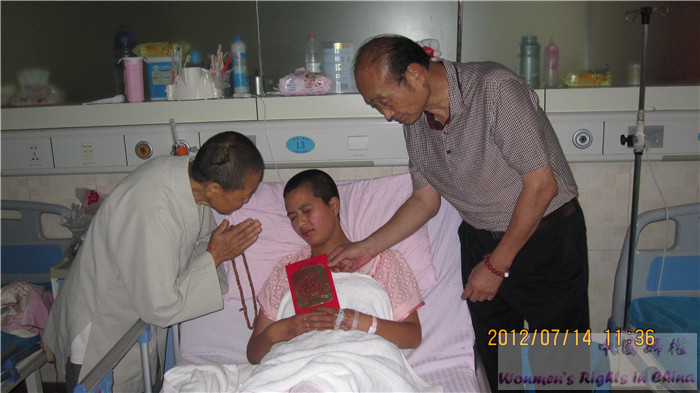
WRIC Volunteer Helps Monastery Girl of Her Heart Surgery

05/05/2013 07:12 4610 Comment

WRIC volunteer Chang Lan Release Date: 07/28/2012

Located near a Yangtze River ferry in the town of Riverside, Susong County, Anhui Province, the dilapidated looking building is a Buddhist nunnery temple. A female teacher who is in her seventies, Shi Shankai, adopted two girls. One of the girls is named Shi Wenxin, who is suffering with congenital cardiac septal defect and is in need for surgery. However, the nuns couldn’t afford the operation. Xinlian, a volunteer of WRIC, encouraged by her daughter, asked her father, Zhang Jiaju, to help. Mr. Zhang paid the surgery generously and the surgery went well. The patient, Shi Wenxin, was abandoned in swaddling clothes and was adopted by teacher Shi Shankai 16 years ago. Because of the illness, Shi Wenxin has never been able to go to school. The temple is far away from the nearest village, so there are not a lot of visitors. Another girl named Hong Xin, adopted by the old teacher, needed the nun to pay her tuition. So, lives for the three females are hard. From the very beginning, the old teacher had a dream to give the ill girl, Shi Wenxin, heart surgery. Recently, the old teacher realized that her dream has been on her mind for 16 years.

The moving story beginning with when CWRI volunteer Xin Lian engaged her focus in helping girls in needs at temples. When Xin Lian encountered Shi Wenxin’s story, Shi has already exceeded her best surgical period. The doctor warned Shi that the next emergency could be life threatening. Xin Lian says that if they were to ask people to donate money for the surgery, it would take too long. To save Shi Wenxin, Xinlian consulted her father and asked for his help. Her father, Zhang Jiaju, paid the whole fees of surgery without hesitation and sent Shi Wenxin to Anhui Provincial Children Hospital. The heart surgery is proved to be successful and Shi Wenxin will be discharged in a few days.

As a Buddhist, Mr. Zhang Jiaju loves to do charity work while working as a businessman. Under his funding support, a four-floor teaching building of a school was built in his hometown in the 1980’s. He also encouraged his daughter and his son-in-law in helping children in needs and helping lost children to find their parents in China. Sometimes, Mr. Zhang also supplies financial support for the activities if necessary. After “Beijing Ruifuxiang Investments Ltd” was found, Mr. Zhang has donated several times for charity involving girls in temples. In 2010, because of his financial support, Shi Zongyuan at Pure Lotus Society’s, Tongcheng, and in 2011, Lele, Shi Liuying’s little daughter, two girls’ lives were saved.

As a volunteer in WRIC, Xin Lian teaches her daughter to be loving in this world and it’s her daughter who is in high school that found Shi Wenxin when she was distributing funds to girls in temples. To help Shi Wenxin, the mother and the daughter became Shi Wenxin’s friend. The Grandpa, Mr. Zhang, the Mother, Xinlian and her daughter, a high school student that helped the girl in that temple to passed her most difficult time. They helped her with her surgery and helped her to continue living her life.

The Baby Girl Abandoned in Front of the Monastery—Shi Changshun

Comment 05-05-2013

Source: WRIC volunteer Xinlian reported 12-20-2011

In the early morning of August 28, 2001, When Shi Huiru, the master of nunnery at Bengbu, Anhui Province, opened the gate of nunnery; she found a paper box and something moving in it. She came closer and found that it was a little girl infant in the box. She held the infant in her arms and found a piece of paper with birth date of the girl August 14, 2001. Huiru understood immediately, it was another abandoned girl. This is the third girl who was abandoned here. She already adopted two infant girls already. Huiru named the third girl Shi Changshun. The Nunnery is located at a lane near Bengbu City Flower & Bird market. There are three nuns practicing there. Because of the location, visitors of the temples are normal. As time goes by, three girls are approaching the age where they should be admitted to a school and this causes the temple to meeting financial problems. The three children do not have a household that they can use to enroll in school; this means that they need to pay an extra fee called “out of local area.” The oldest girl could only afford to be in primary school for two years. The second oldest girl finished her middle school. And now they are both nuns in the temple. Shi Changshun had to strategically change the last name twice to avoid the extra fees.

In 2007, Shi Changshun was six. Because she didn’t have a household, she was not eligible to go to school. Shi Huiru failed many times to give her to a household because of the national birth control policy. Then she luckily found a nun named Wang in Wuhe County. They strategically asked Shi Changshun to be enrolled as a child of Nun Wang. After paying 5,000 Yuan worth of fines, and spending 1000 Yuan to eat with the birth control cadres, Shi Changshun got her household and was able to go to school. However, Shi Changshun has been living in the temple for more than ten years since then.

After interviewing Shi Huiru, I asked whether I could interview Shi Changshun at her school. The teacher Shi Huiru told me that the girl is very introverted and quiet. Two dogs in the temple are her best friends. The dogs are always waiting for her to come back from school. Shi Huiru did not want to disturb her life. So, I gave up.

I couldn’t have an interview with the girl, so I asked the teacher Shi Huiru if she knew what the plan of the girl is when she grew up. The teacher said she wanted to be a nun like the other two girls but I had my doubts if she really thought about her life in the future. The girl knows of the wonderful world. Did she really want to be a nun for the rest of her life? I really have no idea.

Donation Here

Check Payable to :

Women’s Rights in China
Mailing address :

136-31 41 Ave 2A Flushing NY 11355
Contact information:

Web: wrchina.org,    wrchina.org/

Email: wrchina2007@gmail.com, wrichina@yahoo.com

Address: 136-31 41st Ave, 2A Flushing, NY 11355

Donations to Women’s Rights in China are tax deductible. Non-Profit Organization No. Ex-261743656