Lions Club Organizes Women’s Day Celebration, Jing Zhang Accepts Award

WRIC                                                              03-06-2013


On March 16, 2013, Edison, New Jersey’s Visionary Lions Club organized the “2013 International Women’s Day Celebration.” Those in attendance included Edison mayor Antonia Ricigliano, New Jersey senator and Democratic Party candidate for governor Barbara Buono, and eminent female lawyers, while a group of girls put on a dance performance.
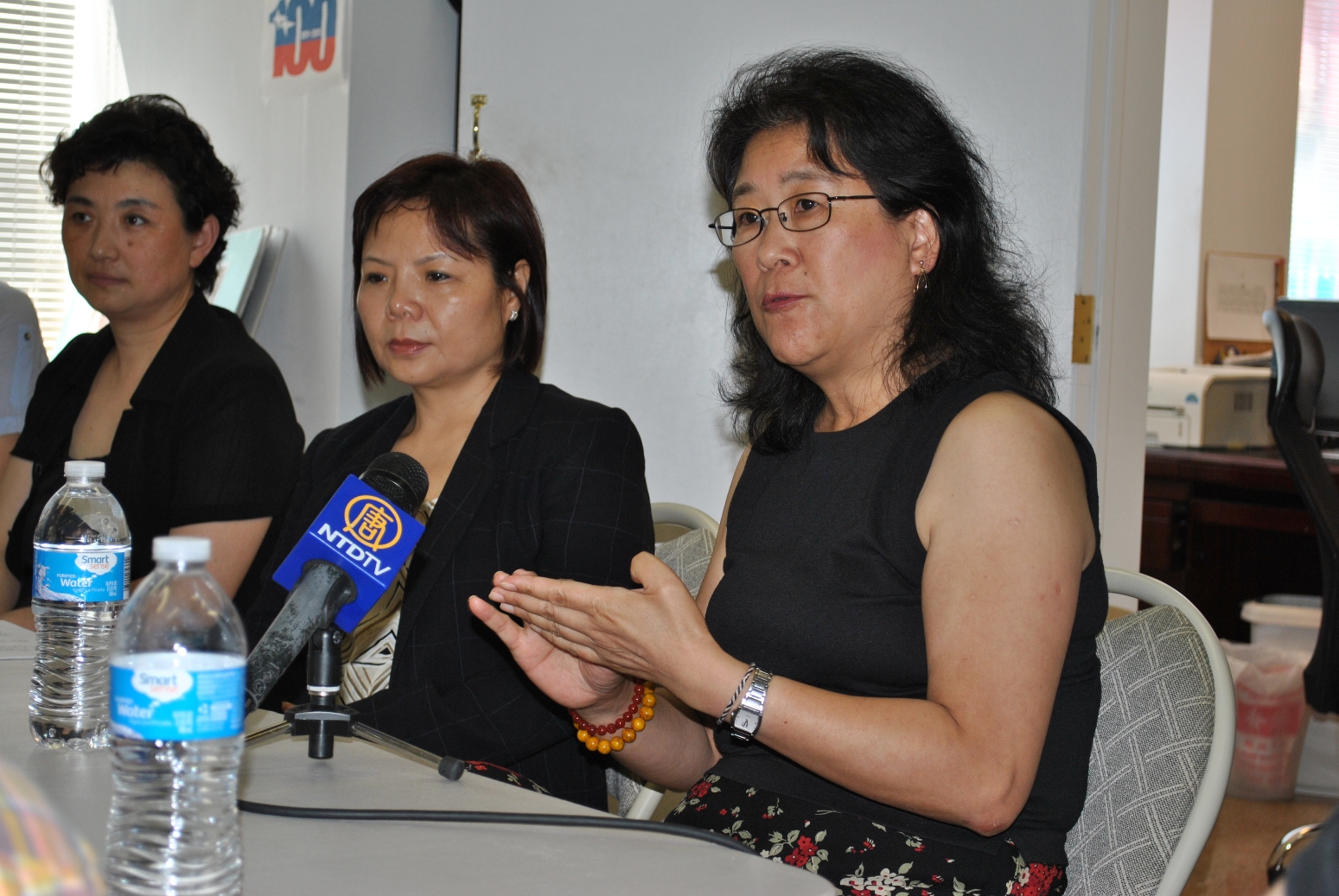


New Jersey Senator and Democratic gubernatorial candidate Barbara Buono presented a certificate of award to Zhang Jing, the founder of Women’s Rights in China. (WRIC volunteer photography)


The documentary film “It’s a Girl”, a film documenting the misfortunes of baby girls born in India and China, was shown at the gathering. Women’s Rights in China founder Zhang Qing was invited to deliver a keynote speech entitled ” China’s Family Planning Policy Exacerbates the Male-to-Female Ratio Gap” and received a medal and award in recognition of her tireless efforts and contributions toward protecting women’s and children’s rights over the past several years. This was an expression of recognition and encouragement towards Zhang Jing and Women’s Rights in China.


In 2013, experts estimated that the ratio of women to men in China was between 100:125 and 135. (WRIC volunteer photography)

In her speech,  Jing Zhang mentioned the girls who were abandoned in nunneries in China. (WRIC volunteer photography)


In 2011, US nonprofit organization Shadowline Films filmed the documentary film “It’s a Girl” with the assistance of Zhang Jing and Women’s Rights in China volunteers. The film documents the dual oppression and suffering of Chinese women and children under traditional patriarchal culture and coercive family planning policies. The film was released last year in various educational institutes and social strata across the United States and other countries, inciting a great reaction.


Jing Zhang stated that in the “It’s a Girl” documentary we see many similarities between the traditional cultures of female infanticide in India and China. We also see that ignorance, backwardness, and cultural dross leads to the arbitrary deprivation of many girls’ birthrights, so that a girl’s life may be threatened or violated at any time. The difference between China and India at this stage is that the One Child Policy implemented by the Chinese government more greatly intensifies the harm done to women and exacerbates the great disparity in the male-to-female ratio. China scholars assert that the data for the male-female birth ratio is 119:100, while the data from field surveys done by Women’s Rights in China in a number of rural areas is 125~135:100. That is to say, in the next 20 years, at least 40 million Chinese men will be unable to find a wife and must remain bachelors. This issue will severely affect the stability of social and family structures and will simultaneously effect the economies and security of neighboring countries. Forty million single bachelors could even directly threaten world peace.


WRIC’s board member Ann Noonan and Zhang Jing were at the meeting. (Photography by WRIC volunteer)


From left: Lions Club District Director John Kobland, DG, Zhang Jing, Edison Mayor Antonia Ricigliano and Chinese women’s rights volunteer Zhang Yujun. (Photo by WRIC Xu Yan)


In 2015, Jing Zhang received a certificate of commendation from members of Congress in recognition of her years of advocacy for women and children.


Jing Zhang introduced the causes behind the sharp decrease in the number of Chinese girls in rural areas, including the trade and drowning of female babies during the 80’s and 90’s and the currently popular fetal gender identification via B-mode ultrasound, which have in turn led to a large-scale gender imbalance.


Jing Zhang proposed that due to China’s strict One Child Policy and the increase in demand for the child trade market, child trafficking has become a human trafficker’s easiest route to making money. Add to this the allure of high prices paid by adoptive families from Europe and the United States (generally, the full adoption process costs between 30,000-50,000 USD), and the child trade becomes all the more common and all the more severe. In 2011, the exposure of “the Shao clan orphans” case received the broad attention of Chinese and international media. Because they did not have did not have a birth license and were born as “illegal” children, the children of namely rural families were sent to the Shaoyang City Social Welfare Institute (an orphanage) in Hunan province in exchange for a fine. The vast majority of these children were female and sold at high prices to international adoptive families through the orphanage. We know at least seven “Shao clan orphans” with natural [living] parents have since been adopted by American families.


While showing the documentary “It’s a Girl”, the tragic story of these women moved many to tears and the sound of sobbing filled the audience.


Other outstanding women were honored that day. (WRIC volunteer photography)

The girls’ singing and dancing express a strong sense of feminism. (WRIC volunteer photography)


The girls’ singing and dancing express a strong sense of feminism. (WRIC volunteer photography)


The One Child Policy Exacerbates Gender Imbalance in China

The One Child Policy Exacerbates Gender Imbalance in China
Jing Zhang
Women’s Rights in China

In “It’s A Girl,” we can see how the cultures of China and India have shared many similarities in discrimination against girls. This kind of backwardness and ignorance have threatened the lives of many baby girls. In contrast with India, it was China’ government’s One-Child Policy that exacerbates the persecution of women and offsets the already serious gender imbalance in the country. Experts estimate that the current gender ratio at birth in China is 119:100. According to investigations by Women’s Rights in China, the ratio in many rural areas was 125-135:100. In the next 20 years, more than 40 million men will not be able to marry. This problem is not just a social disaster, but is also a grave threat to world peace.

October, 2012, one girl among many boys after school in Hunan Province. (WRIC)

A woman who had been married to five men in the village in Fenhuang County, Hunan Province. (WRIC)

A common scene in Guangdong rural areas. (WRIC)

A baby girl abandoned in rural Anhui Province in June 2010. Nuns and WRIC provided her with medical care.

In September 2010, WRIC volunteers investigated the reasons behind the sharply decreasing number of girls in rural areas.

1) Common Methods to Limit Birth of Girls

Since the implementation of the One-Child Policy in the 1980′s through the 1990′s, families that wanted to have boys without going over the official quota often killed or abandoned baby girls. Villagers explained that a bucket of water would be placed next to the mother giving birth. If the baby were a girl, she would be immediately drowned in water and disposed. Other families abandoned or sold their girls. Buddhist convents in Anqing City, Anhui Province had rescued over a thousand abandoned girls.

Zongyuan at eight months old.

Zongyuan at two years.
(photos by WRIC)

In Changle City, Fujian, over thirty thousand girls had been sold in three decades to Putian, 100 kilometers away. Most of them became child brides. Babies who were killed or abandoned were almost all girls.

Two mothers looking for missing daughters (left) and two former child brides looking for their birth families. (WRIC)

These women who were sold in infancy as child brides in Putian, Fujian, 
participated in the conference organized by WRIC in search of their birth parents. 
While the 1980′s were the height of the child bride trade, the problem is still very serious. (WRIC)
The story of the “Orphans of the Shaos” was uncovered in 2011 and achieved international media attention, happened in The Shaoyang Municipal Children’s Welfare Institute (an orphanage) in HuNan providence, about illegally-born children of peasant families, because of no “fertility permit”. The local government officials sent theses illegally born children, mostly girls, to an orphanage, for secured fine, where adoptive families are to be “found” by the orphanage. However, our research has shown that some of these children have been sold to various countries, often at very high prices. We have documented evidence of at least seven biological parents who are the “Orphans of the Shaos” adopted by Americans.

Women’s Rights In China is preparing to publish the English version of this book about the “Orphans of the Shaos”. And since the Chinese Communist Party has NOinterest in the work we do, we need YOUR help to get the work funded. (PHOTO BY WRIC)

Because of the strict One Child Policy, the market for stolen or kidnapped children has grown tremendously. Human traffickers had latched on to this lucrative trade. Adoptions by western nationals usually cost between $30,000 to $50,000, further fueling demand.

WRIC volunteers and the parents of the missing children are currently workingin a number of provinces and cities and in the county where frequent trading of children to help parents find children and stop the trafficking . (PHOTOS BY WRIC)

In the last decade, especially since 2005, the abandonment of baby girls has begun to decrease, but still remains a problem. But boys still vastly outnumber girls. In two villages in Susong County, Anhui, boy accounted for about 65% of births in both 2010 and 2011. An elementary school teacher disclosed to us that there were only 16 girls among 57 students of his in total.

2) Prenatal Gender Selection by Ultrasound

Although China’s government has strictly banned gender selection through the use of ultrasound, in reality, private clinics, including mobile vans equipped with ultrasound machinery, can determine the gender of the baby in the womb for 100 to 200 yuan ($30). Government clinics often disregard the ban to help out friends and family or to earn extra income. In Susong county, one family bought their own ultrasound machine to make sure of having a boy. An ordinary couple in the city is allowed to have one child. A rural couple is allowed to have two. To stay within the quota and avoid paying the fines, families chose to abort girls immediately after ultrasound exam.

WRIC volunteer investigates illegal ultrasound clinic in Shaanxi Province, December 2012. (WRIC)

This illegal ultrasound clinic charges 200yuan if the result were a boy, 100 for a girl. (WRIC)


China’s government has realized the severity of the gender imbalance problem. In recent years it has increased propaganda efforts and implemented some incentive to encourage the birth of girls in some localities. However, these measures have had very limited effect, especially in rural areas. The main culprit is the forced Family Planning/One Child Policy, which is still held as a fundamental national objective. Coupled with easy and prevalent access to ultrasound and astronomical fines, this policy has led to disastrous gender imbalance that is still worsening.

Particularly in rural areas where the persecution of the one-child policy is most severe, female infanticide is still common. China and India are the traditional male-dominated societies. Violence and discrimination against female aspects are very similar, but China’s official one-child policy, and its 30-year history of implementing it, has deprived women of their basic rights —- their reproductive freedom.

Volunteer’s Experience in Fei Xi County


Written on 2013-03-12

Women’s Rights in China

Yao Cheng

Advocacy for China’s woman rights had started in the Fei Xi County for three months, and have since then been extended to four towns, namely, Gao Liu, Gao Dian, Guan Ning and Ming Chuan. On the 7th March, I have followed the volunteers for the advocacy of women’s rights to the Jin Qiao Village in Guan Ning town at the Liu’An junction.

The Jin Qiao Village is located at the Da Bie Mountain Edge, in the 50s, man pass through this hilly area while digging the Pi River. This is Fei Xi County’s poorest village, populated by around 2800 villagers. The villagers are relatively scattered across the area, thus when we initially reached, we could not find a suitable location to distribute out the funds, therefore we have chosen the village committee centre as the location for it is located at the centre of the village.

More than ten villagers came early waiting to collect financial aids. (Photo by WRIC)

Due to the phone calls made earlier, more than ten villagers came early waiting to collect financial aids. When they collect the funds from our volunteers, many thought that the funds came from the village family planning committee, the confusion only cleared when we explained that we are a group of non-profit organizations and charitable individuals from the United States. The villagers told me that the family planning committee had also recorded the female babies’ particulars, and promised that the government will give some financial aid, however, none have ever receive it. These made the village officials present at the spot embarrassed.

There is no suitable location for agricultural farming here, hence to sustain living expenses, majority of the youth have moved to the cities and take on the laborious jobs, though that didn’t bring them much money. The family planning committee probably could not get the government funding in time, thus they are more than welcome to us when we came to distribute financial aids. It is also why she actively gave me information about the babies in this village and gave introduction on the current situation when I requested for it.

The family planning officer told me that this village has had 9 newborn babies this year, of which 7 are males and 2 are females, which shows the great gender disparity, the family planning task has become harder to accomplish. Most pregnancies occur when the women are out to town at work. As to why there are more baby boys than baby girls, she has no idea why, due to the inability to gather the situation during the women’s pregnancy. While we were distributing financial aids, a villager asked if we were able to give aid to a handicapped woman. She had the medical record to prove that she had disabilities but was unable to get financial aids for the handicapped. I immediately called to ask a handicapped friend located in He Fei City, and he explicitly told me that as long as there is medical proof, the government will certainly grant financial aid to that individual, he suggested that the funds may be withheld by the village, which explains why the woman did not get the aid. I asked the officer with regards to this issue, she replied that the money is used for subsistence allowance, thus there was no distribution of financial aid for the handicapped.

Gao Liu Zhen with her twin daughters, Kang Miao Han and Kang Miao Jie.(Photo by WRIC )

As I participate in this campaign to help the baby girls, I have visited various village committees and became skeptical about the funds they get to go on regular holiday trips and drinking activities. These officers are not high-ranked government officials, they should only have limited monetary power, the government allocates out subsistence allowance in proportion to the population ratio. In our case of the handicap woman, she account for one share of the subsistence allowance, but the village had other plans for this funds. They had the financial aid for the handicap to be used for committee expense. Furthermore, regarding the financial aid that the government gives to the families with daughters, I believed that the government has certainly does their part, as I have seen the detailed record statements. Yet, as the villagers are generally quiet about it, they do not dare to request the village committees for funds every day. Even if they were to request for the funds, the village committees can simply used the excuse that the funds have yet to reach to stall for more time, and soon, who knows where the money goes to.

The corruption of the village committees pose a serious problem, which not only happen in Wu Kan, but almost in the whole country, poverty and corruption in the village has a direct relationship.
