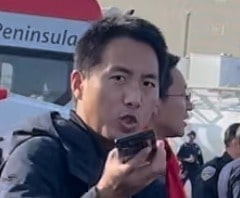
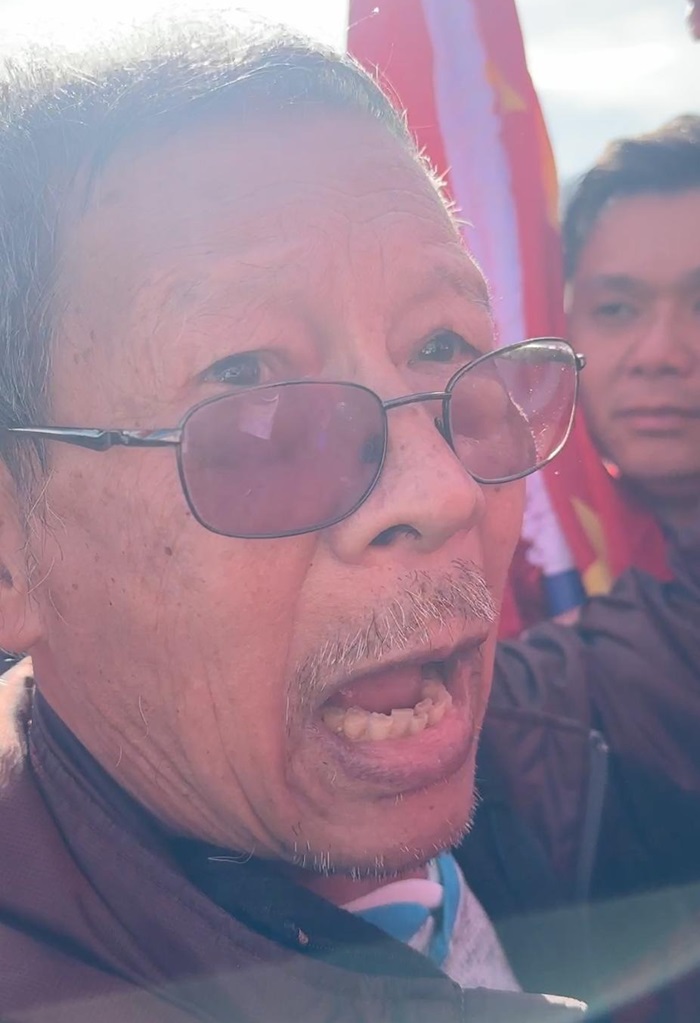
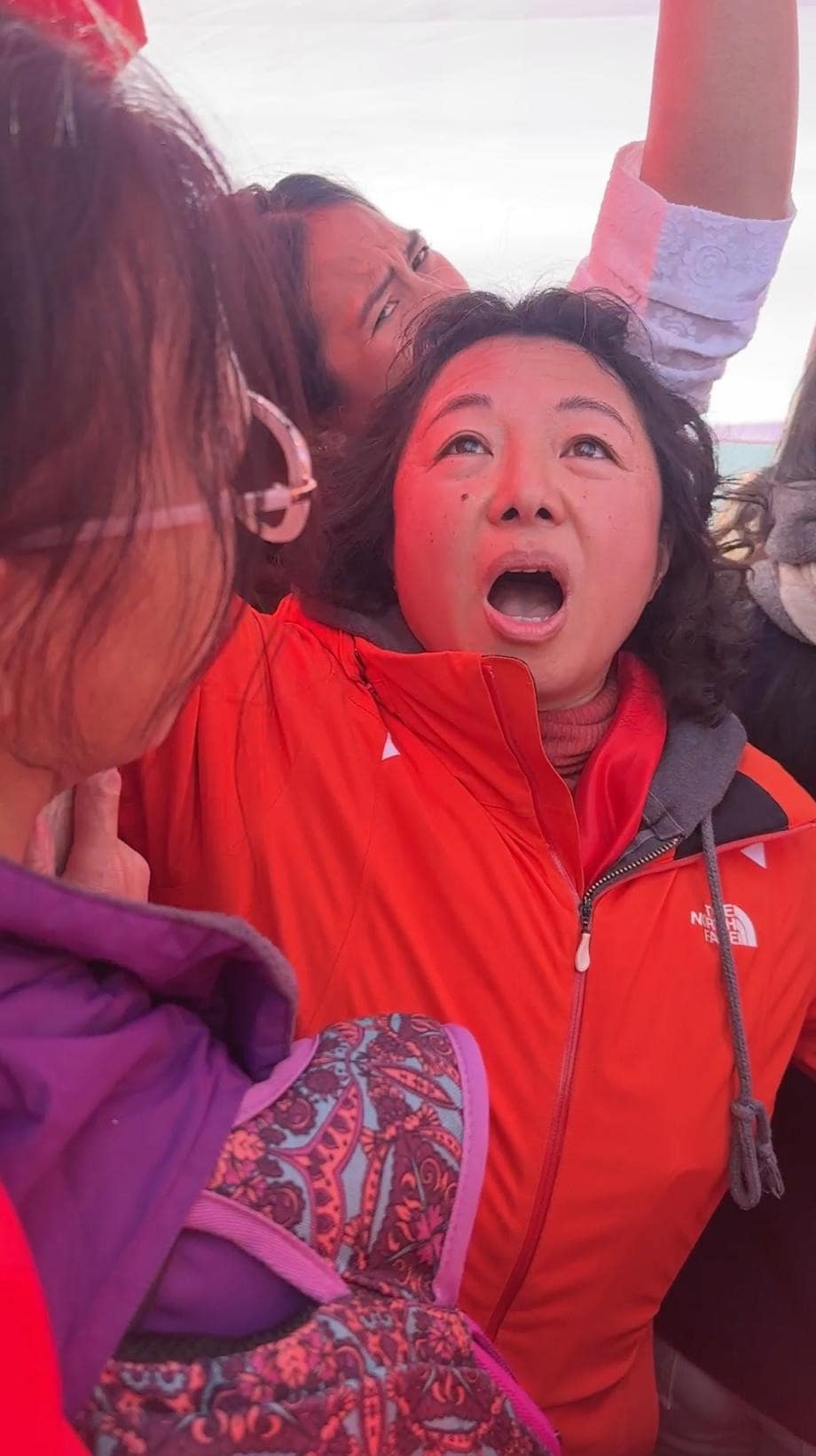
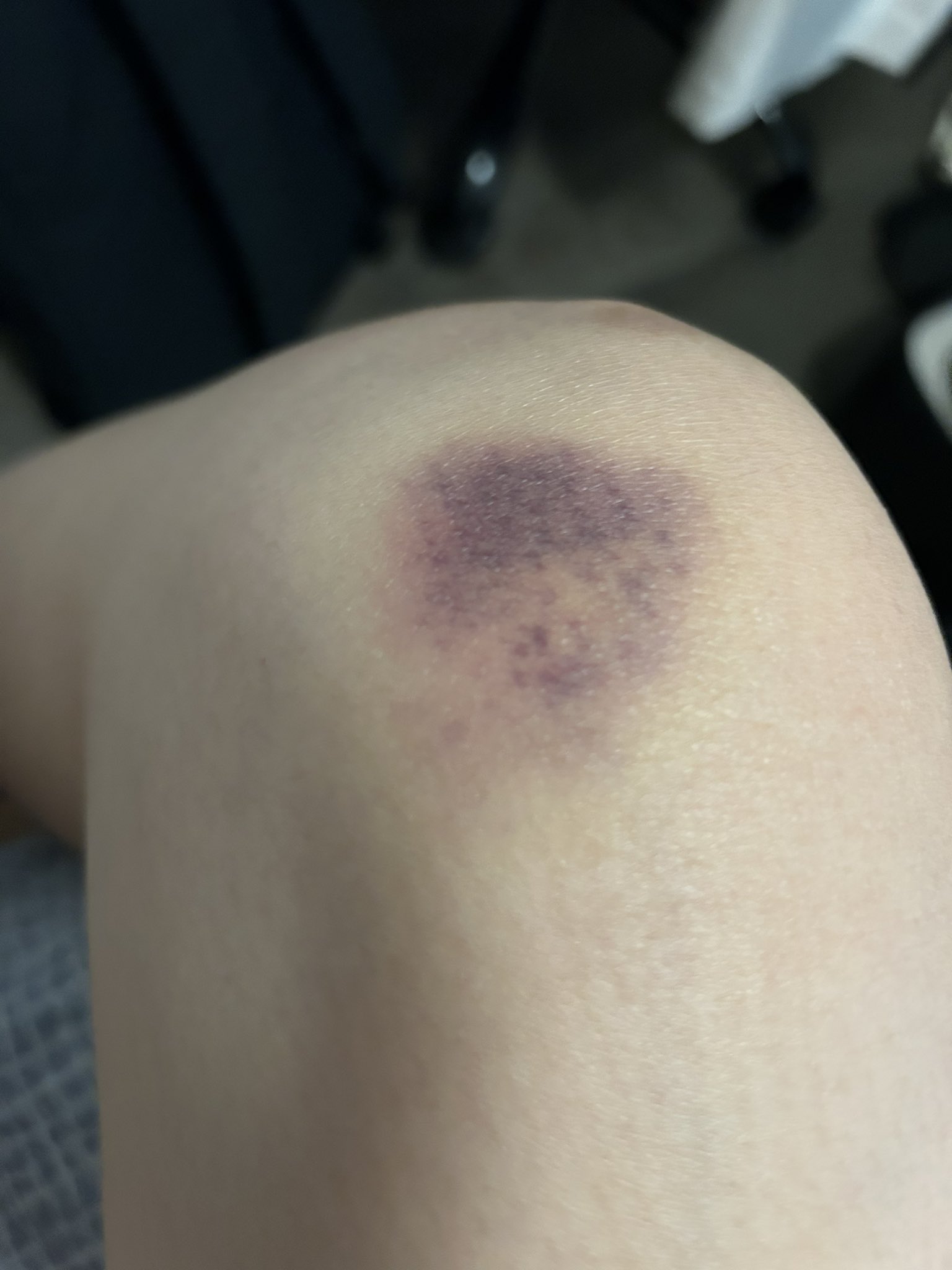
Han and Tibetans Mourn Li, Jianglin (video)

By WRIC                          01-19-2025


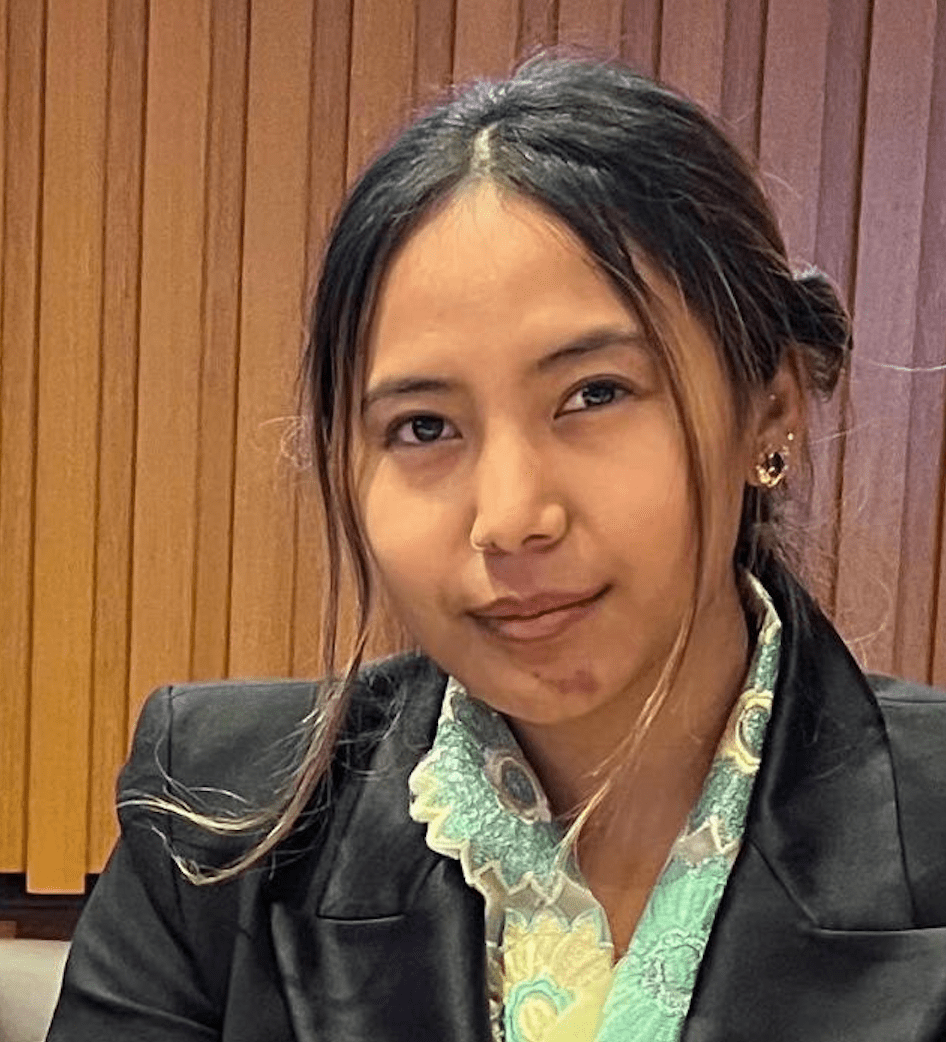
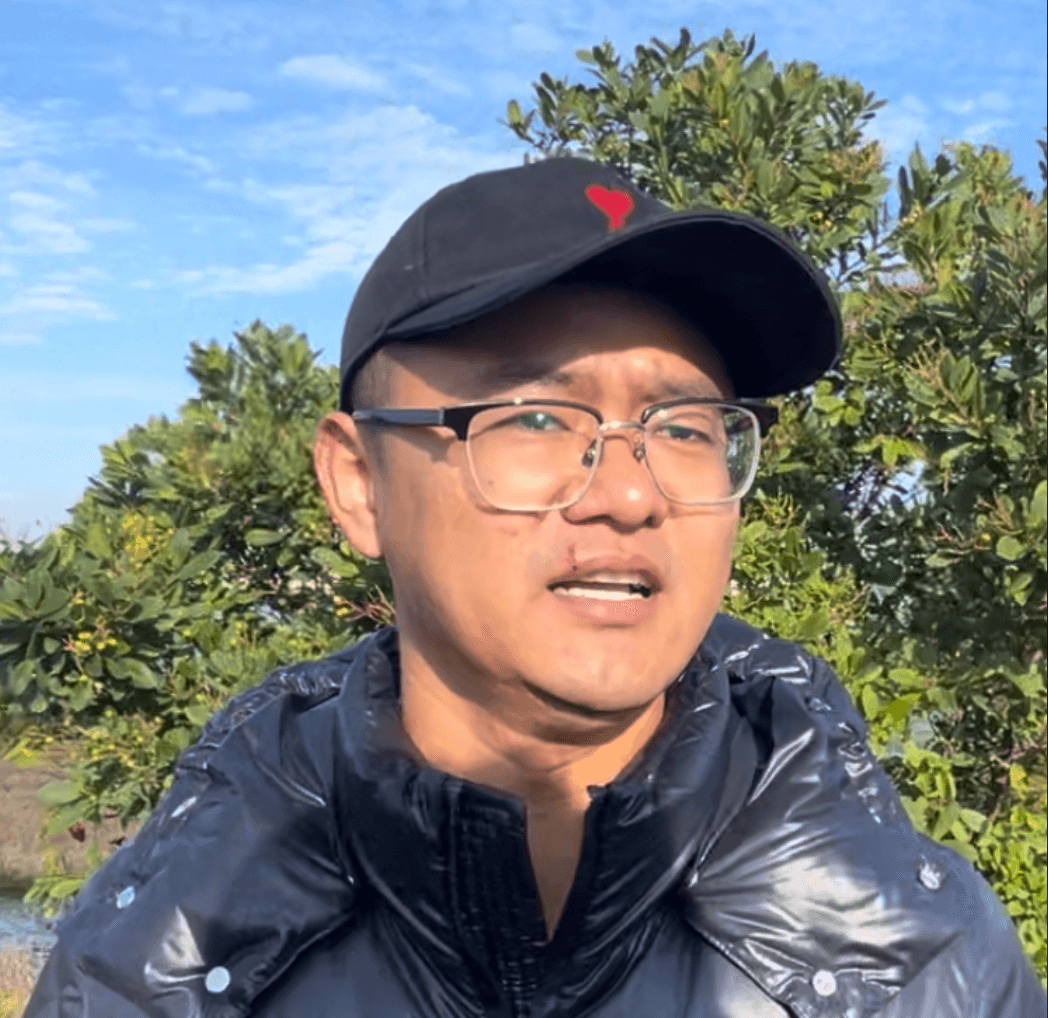
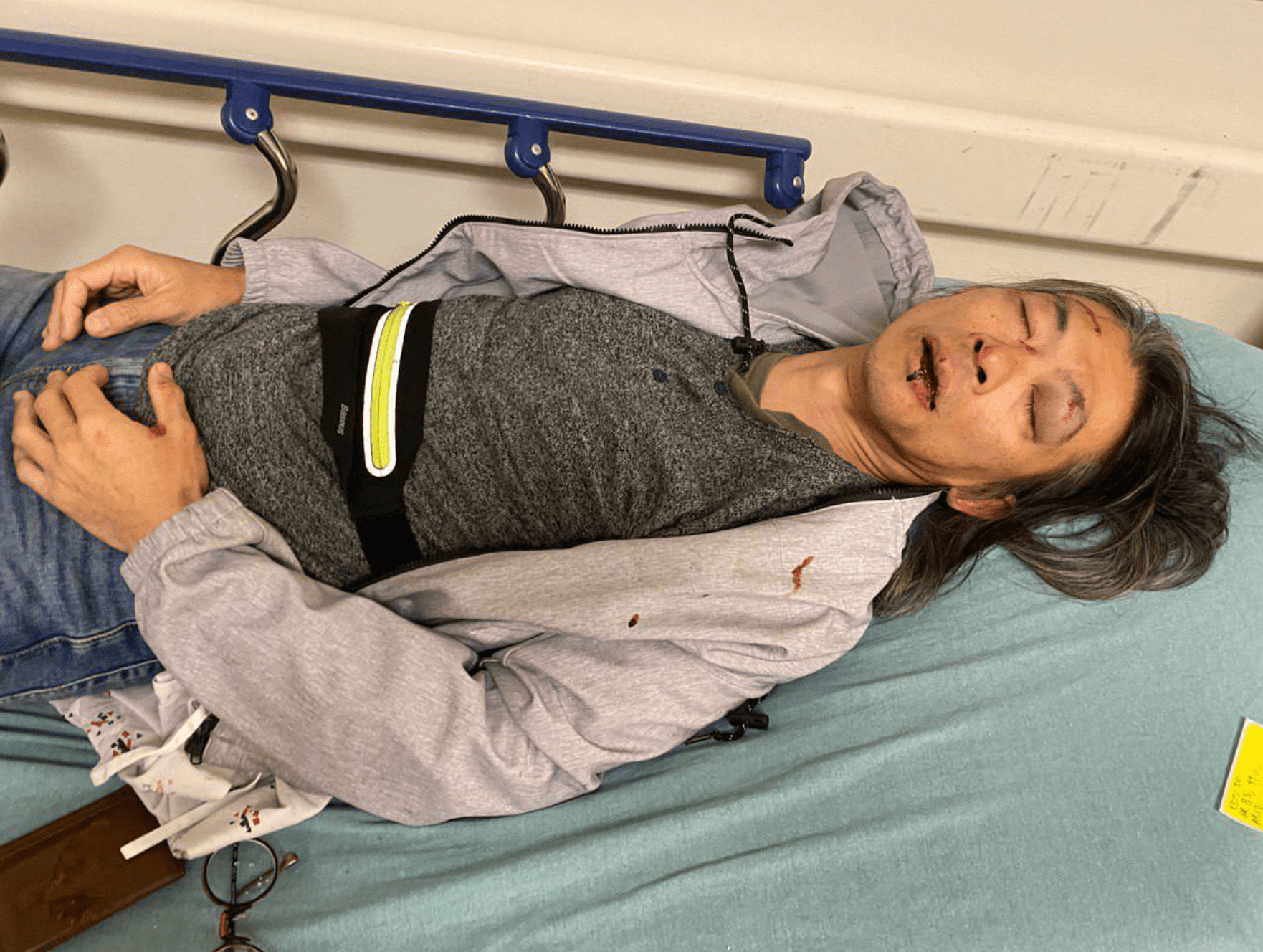
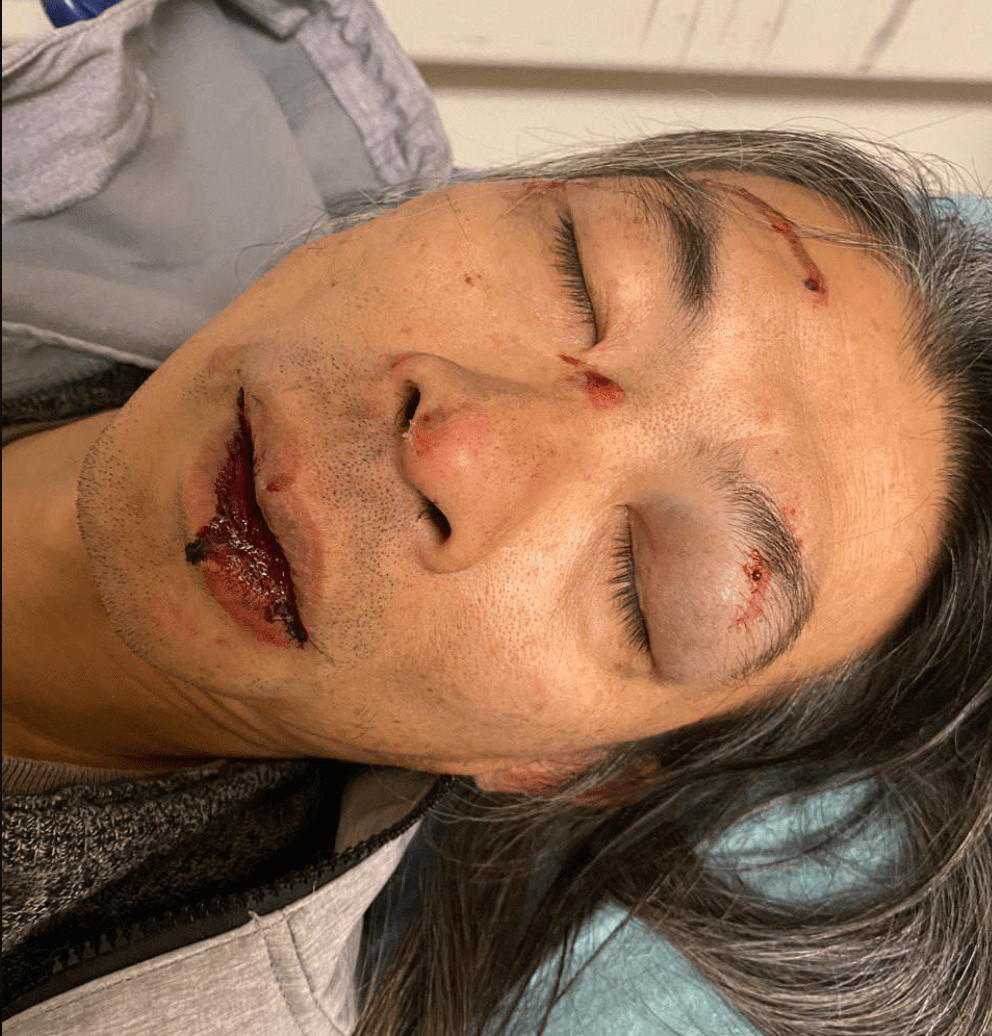
Ms. Jianglin Li, a Chinese-American historian and expert on contemporary Tibetan history, died of illness at her home in Georgia, USA, on Christmas Eve 2024 at the age of 68. Ms. Jianglin Li worked at the New York Public Library after obtaining a double master’s degree in 1988. She began studying Tibetan history in 2004 and wrote six historical books, including “1959: Lhasa! – How the Dalai Lama Escaped” and “When the Iron Bird Flies in the Sky: The Secret War on the Qinghai-Tibet Plateau from 1956 to 1962”, which brought distorted and omitted historical facts to light and recorded them in history, and also left a valuable legacy for contemporary Tibetan history research. Jianglin Li is indeed a brave and outstanding Chinese-American woman. Her death not only made her loved ones and friends deeply saddened, but also brought irreparable losses to international Tibetan history research.


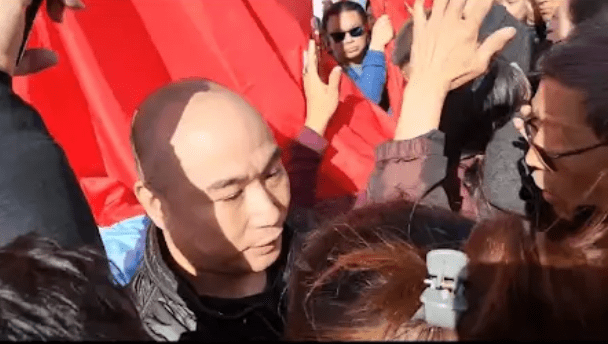
The memorial ceremony for contemporary Tibetan historian Ms. Li Jianglin on January 12, 2025.


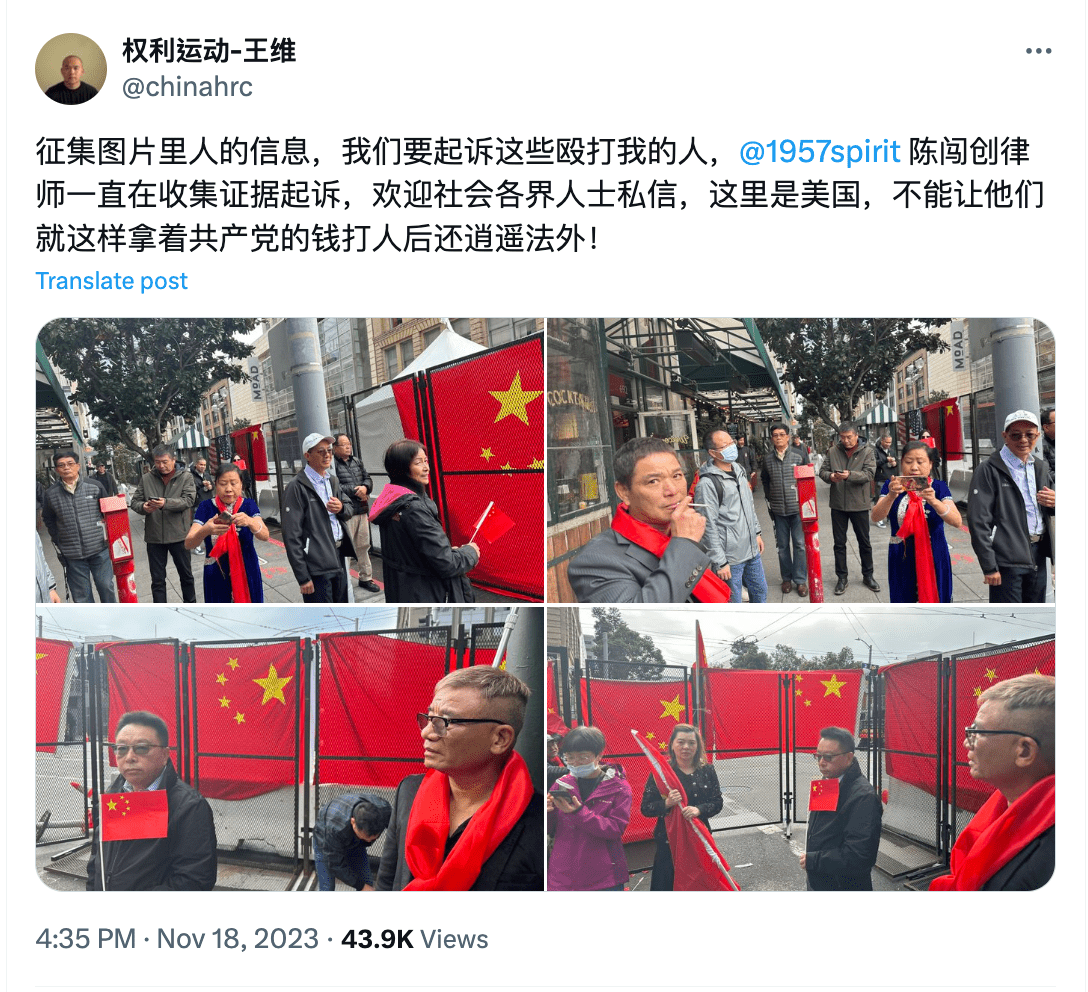
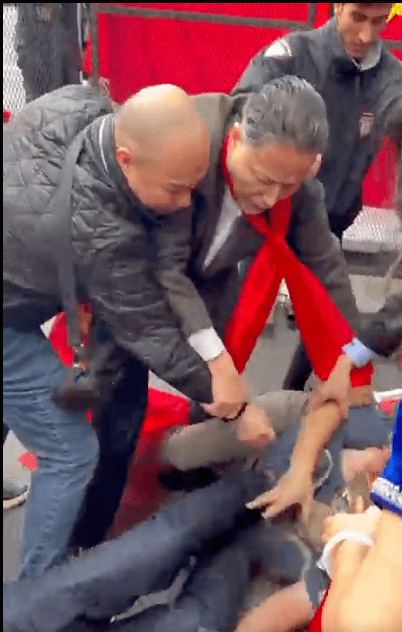
Exporting Repression: Attacks on Protesters During Xi Jinping’s Visit to San Francisco in November 2023

A joint report by Hong Kong Democracy Council and Students for a Free Tibet

   July 2024


Foreword

On November 15, 2012, Xi Jinping stood before thousands of members of the Chinese Communist Party in his first public speech as the leader of the unfree world. He vowed to fulfill one ultimate goal: the “great revival of the Chinese nation.” During the 11 years between the day Xi gave that speech and the day he attended the dinner hosted by US-China Business Council and National Committee on US-China Relations in San Francisco on November 15th, 2023, Xi’s repressive, hardline policies have changed China beyond recognition, for the worse.Under Xi’s reign of terror, the National Security Law imposed by the CCP in 2020 has eradicated any semblance of democracy in Hong Kong. Thousands of bright student leaders, brave youth activists, opposition politicians, and journalists have been arrested. As of May 31, 2024, Hong Kong Democracy Council’s database had documented 1,875 political prisoners in Hong Kong. In occupied Tibet, a vast system of colonial boarding schools has separated over 80 percent of Tibetan students from their parents. Along with other extreme attacks on Tibetan identity, these policies threaten the very continuation of Tibet’s language, culture, and way of life.

But the CCP has shown that its ambitions extend much further: over the past decade, China has invested great effort in strengthening its long arm of control through tactics of transnational repression. In November 2023, on the streets of San Francisco, this transnational repression took the form of alarming cases of physical violence and harassment by organizations and individuals affiliated with the Chinese government, aimed at intimidating and discouraging activists from confronting Xi during his visit. Countries around the world have identified China’s transnational repression as a direct threat to freedom everywhere, yet there remains a significant gap between rhetoric and action. This report by Hong Kong Democracy Council and Students for a Free Tibet emphasizes the urgency of enacting meaningful measures against transnational repression. Each case outlined in this report represents a brazen attempt by the Chinese government to stamp out dissent in broad daylight on American soil.

As masked thugs with metal poles openly roamed the streets of San Francisco, Tibetans, Hong Kongers, Uyghurs, and Chinese democracy activists, some as young as 16 years old, were often left to fend for themselves. Rather than hopelessness, though, what we witnessed was the sheer grit and resilience of our communities: a determination by activists and human rights defenders to exercise our right to free speech and peaceful protest. We saw young people using creative tactics to outsmart one of the world’s best resourced authoritarian governments, while documenting everything along the way. Activists used mass group chats and buddy systems, Hong Kongers shared useful tips gleaned from their dark experiences protesting in the streets of Hong Kong, and Tibetans spread their resilient sense of community developed through decades of organizing in exile.

During the 11 years since Xi took power, while he has relentlessly chipped away at any remaining spaces to advance democracy and freedom, community organizers and youth activists fighting against China’s colonial rule have learned one crucial lesson: we can stand together, or perish alone. In our shared struggle, we bring our cross-movement spirit from the streets of San Francisco to this report. Hong Kong Democracy Council and Students for a Free Tibet jointly publish “Exporting Repression: Attacks on Protesters During Xi Jinping’s Visit to San Francisco in November 2023.”

HKDC Executive Director Anna Kwok and SFT Executive Director Pema Doma
July 30, 2024


Executive Summary

This report documents acts of transnational repression (TNR) carried out by supporters of the Chinese Communist Party (CCP) against protesters during the visit to San Francisco in November 2023 of Xi Jinping, President of the People’s Republic of China. In all, 34 cases of harassment, intimidation, and assault are presented.

The report shows the mobilization and involvement of the CCP’s “united front” network in the United States (US). In many cases, united front groups and figures were present during acts of assault, intimidation, and harassment, and some actively participated in them. The report also documents coordination among CCP supporters that suggests direction and planning. Their actions created a pervasive atmosphere of intimidation that not only had a deterrent effect on protests throughout the duration of Xi’s stay but also interfered with protesters’ exercise of their free speech rights.

Most of the victims of the attacks were American citizens and residents, and all but one of the victims of the attacks had roots in China, East Turkestan, Hong Kong or Tibet. All were targets of TNR in San Francisco for demonstrating their opposition to Xi and the CCP. Some had previously been targets of repression in their homelands, or targets of CCP TNR, or both.

The report also examines the response mechanisms of US policymakers and law enforcement authorities at both federal and local levels. Despite strong awareness of CCP TNR at the federal level and a general commitment to countering it, agencies were unprepared to do so in San Francisco. Local law enforcement authorities exhibited a lack of awareness of TNR, were often unresponsive when alerted to the attacks, and took little and inadequate action in response to the attacks. The result was that protesters were insufficiently protected and perpetrators have not been held accountable.

This report makes 18 recommendations to the White House, relevant federal agencies, Congress, state and local authorities, and the United Nations, and includes the following recommendations:

This report makes 18 recommendations to the White House, relevant federal agencies, Congress, state and local authorities, and the United Nations, and includes the following recommendations:

This report makes 18 recommendations to the White House, relevant federal agencies, Congress, state and local authorities, and the United Nations, and includes the following recommendations:

–Investigate whether united front groups in the US are acting as unregistered foreign agents of the PRC in violation of the Foreign Agents Registration Act.

–Implement additional vetting for diplomatic visas issued to PRC applicants and screening for applicants connected to TNR activities.

–Offer protection to groups on US soil that are subject to TNR, including by expediting asylum cases and upgrading the existing Deferred Enforced Departure program for Hong Kongers to a Temporary Protected Status (TPS) designation.

-Pass legislation creating resources to combat TNR, such as the Transnational Repression Policy Act (H.R. 3654/S.831), the Stop Transnational Repression Act (H.R. 5907), the Combating Transnational Repression Act of 2024 (H.R. 7443), the Law Enforcement Support and Transnational Repression Hotline Act (H.R. 7433), and the Strengthening State and Local Efforts to Combat Transnational Repression Act (H.R. 7439).

–Maintain relations with a diversity of Asian American, Native Hawaiian, and Pacific Islander (AANHPI) groups representing different political views and identities and conduct due diligence on these groups’ backgrounds.


Methodology

This report is based primarily on the testimonies of 26 protesters and one journalist who were present in San Francisco during Xi Jinping’s visit from November 14 to 17, 2023, as well as on video and photographic evidence provided by protesters. Media reports and social media posts have also been of some assistance.

We have attempted to document all cases of harassment and intimidation of and assault on protesters that we came across. All cases described in detail have been substantiated by testimonies of participants and witnesses and/or video and photographic evidence.

We have attempted to identify those involved in attacks on protesters through the use of open-source research and facial recognition technology.

We have identified some groups and individuals as belonging to the Chinese Communist Party’s “united front,” meaning that evidence was found indicating that they have associated with Party organs and/or officials and/or representatives of the People’s Republic of China, and have taken actions aligned with the Party’s agenda. In most cases that evidence was found in reporting by Chinese-language media and on websites of Party organs or united front groups.

We have attempted to contact all of those identified in the report as CCP supporters as well as private security firms perceived to be associated with CCP supporters through email, telephone calls and letters. We notified them that they are mentioned in the report, asked if we might ask them some questions, and offered them the opportunity to respond and comment. As of May 15, 2024, most have not responded. None has responded affirmatively. In many cases, these groups and individuals have little to no online presence or website. Many of the email addresses and phone numbers they have made available online or in tax documents proved to be incorrect, out of date, or inoperative. In the first instance, we contacted them by telephone or email at the numbers and addresses that could be found. Where that did not succeed, and in cases where post addresses could be found, we sent letters to them. Only two could be reached by phone. Both made clear they did not wish to speak with us. One responded to email inquiries. None responded to letters. Of those identified in the report as being present on the streets of San Francisco during Xi’s visit, we have not been able to find contact information for three leaders of united front groups, one CCP member based in the PRC, and one convicted felon with no known united front leadership position.

We have also reached out to the San Francisco Police Department, the South San Francisco Police Department, and the San Mateo Sheriff’s Office for information and comment.

Where we have received responses, we have included those in the report.

The URLs of sources cited in the report were operative as of April 4, 2024. They were also saved at Internet Archive on or before that date.

Introduction

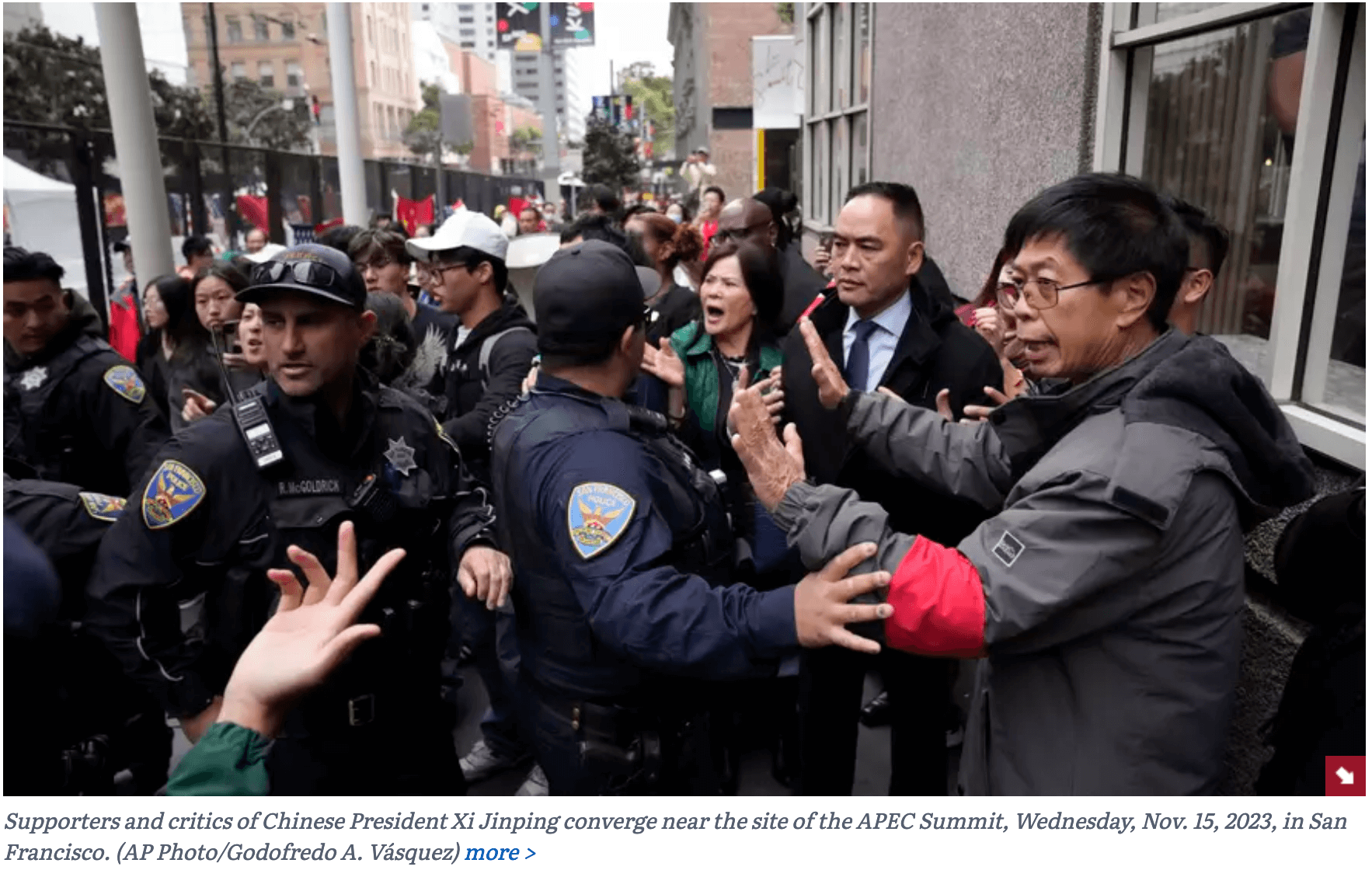
In November 2023, Xi Jinping, President of the People’s Republic of China (PRC), came to San Francisco to attend the Asia-Pacific Economic Cooperation (APEC) summit and meet United States (US) President Joe Biden. During Xi’s stay in the city from November 14 to 17, hundreds of Chinese, Hong Kongers, Tibetans, and Uyghurs demonstrated against Xi and the CCP’s harsh crackdown in their homelands.1 Dozens of protesters were harassed, intimidated, and assaulted. These attacks were carried out by CCP supporters or those acting on their behalf in what appeared to be an organized and coordinated manner. Leaders of united front groups in the US that have been linked to the CCP were involved in the attacks. The attacks constitute transnational repression (TNR) as they targeted opponents of the CCP in the US. Although the US government has identified countering TNR as a top priority, awareness and preparation on the part of law enforcement authorities in San Francisco appeared inadequate.2

This report describes the attacks on protesters in detail and is based primarily on interviews and testimonies of 26 protesters and one journalist, most of whom were victims of harassment, intimidation, and assault, as well as on photographic and video evidence. It highlights the attacks as a serious instance of transnational repression. It also identifies united front figures involved in the attacks. The report calls on the US government as well as local governments and law enforcement authorities at both the federal and local levels to identify shortcomings and improve efforts to:


1. prevent and counter transnational repression;

2.protect the rights of protesters and human rights defenders; and

3.hold perpetrators of transnational repression accountable.


The protesters were from different backgrounds. Most have their origins in China, East Turkestan, Hong Kong, and Tibet. Many are American citizens, and almost all reside in the US. This is a story that needs to be told because it is part of the history of these peoples—Chinese, Hong Kongers, Tibetans, Uyghurs—fighting for their freedom and their human rights, but it also needs to be told to assist authorities in the US and other countries to more effectively counter CCP transnational repression on their own soil.

At the center of the report is a detailed, chronological narrative of the attacks perpetrated by CCP supporters on protesters while Xi Jinping visited San Francisco. Preceding that are brief sections on the CCP and its overseas united front and on the US government’s prioritization of countering TNR in general and CCP TNR specifically. Following the chronological narrative are sections on responses and reactions to the attacks in San Francisco, analysis, and recommendations.

The CCP and Its Overseas United Front

In order to understand the transnational repression that took place in San Francisco, it is important to understand the network of organizations that enabled the repression and appeared to coordinate in organizing it.

The CCP puts enormous effort and resources into exerting influence and control over what it considers to be Chinese diaspora communities around the world, including not just Chinese immigrants and their families but also Hong Kongers, Taiwanese, Tibetans, and Uyghurs living abroad.

These efforts to control diaspora communities are closely tied to the CCP concept of the “united front” (統一戰線), the idea that the cultivation of support of and loyalty to the Party at home and abroad is central to maintaining the CCP’s power. To that end, the CCP employs both a set of directly-controlled party organs and a larger number of loosely linked overseas groups to carry out its united front strategy. In practice, the term “united front work” (統戰工作) is used rather elastically and can refer to activities carried out by both official agencies and informally associated overseas groups.3


United Front: Main Organs and Overseas Affiliates

Though these types of organizations are often grouped together as part of a loosely-defined “CCP united front,” this report takes care to differentiate between the two:

Specifically, this report uses the term “united front” (capitalized) to denote organizations which are constituent parts of the Chinese Communist Party, fully folded into Party infrastructure and directly controlled and operated by CCP authorities. On the other hand, this report uses the term “united front” (lowercase letters) to describe overseas groups which may not necessarily have formal ties with the CCP and its united front agencies, but are often used to carry out the CCP’s agenda.

The united front Work Department (中共中央統一戰線工作部/UFWD) is the CCP organ formally in charge of the CCP’s united front strategy. Its work is supplemented by that of the All-China Federation of Returned Overseas Chinese (中華全國歸國華僑聯合會/ACFROC), a key united front organization that, in 2018, was designated by the CCP as the main organ responsible for relations with overseas Chinese.4 ACFROC maintains provincial and municipal offices within the PRC that help maintain relations with Chinese expatriates from these localities. This report documents several connections between members of united front groups and local ACFROC offices.

PRC embassies and consulates also play a key role in cultivating united front groups overseas, often providing them with guidance and direction at key junctures. This report documents many instances in which key figures in united front groups met with or participated in events together with high-ranking PRC consulate officials.

Typically, CCP officials overseeing united front groups prefer that they preserve a facade of autonomy from CCP united front organs like the UFWD and ACFROC, as well as from PRC consulates. As noted by Anne-Marie Brady, an academic and expert on the overseas united front, the CCP “wants to avoid being seen to ‘lead’ [領導] the overseas Chinese community, but rather prefers to be seen to ‘guide’ [引導] them.”5

In actuality, however, united front groups rarely if ever deviate from the CCP’s official stance on any matter. Generally speaking, CCP united front officials strive to create a situation where overseas united front groups will know the Party’s will and do the Party’s bidding without requiring official direction or supervision. Brady notes that “[t]he goal of successful overseas Chinese work is to get the community to proactively and even better, spontaneously, engage in activities which enhance China’s foreign policy agenda.”6

Because of this strategy, civic organizations in diaspora communities may have united front links. united front groups may take the form of hometown associations, business associations, Chinese Students and Scholars Association chapters at foreign universities, or associations for the so-called “peaceful reunification of China” (the CCP’s preferred term for its efforts to bring Taiwan under CCP rule). Groups of this nature tend to display strong signs of united front links, and often have members who maintain close communication with CCP united front organs and appear at public events with PRC officials.

These groups also often seek to cultivate relations with politicians and officials—especially local politicians and officials—in the countries in which they operate, claiming to broadly represent the political views and concerns of the “Chinese community” or even the “Asian community,” crowding out a far more diverse representation of voices, especially those with views different from the CCP’s. In the US, local politicians and officials often meet these united front groups without appearing to be aware of their links to the CCP. While there is no official public list of united front organizations, organizations that exhibit many of the characteristics mentioned above appear frequently in this report as they and their leaders were present on the streets of San Francisco during Xi Jinping’s visit.

Additionally, many Chinese-language media outlets which are widely read in diaspora communities are nowadays controlled or influenced to one extent or another by the CCP or by businesses and interests loyal to the CCP.7 As such, they too may be considered part of a broader united front strategy. Much of the information about united front groups found in this report comes from pro-CCP Chinese-language diaspora media.


United Front: Understanding its Goals through the 1989 Tiananmen Massacre, 2008 Beijing Olympics, and 2019 Hong Kong Pro-Democracy Protests

While CCP efforts to cultivate the loyalty of overseas Chinese to the regime date back to the founding of the PRC in 1949 and even before, the current objectives of CCP united front work are multifaceted. The development of these new objectives can be traced to the 1989 Tiananmen Massacre, which marked a turning point in CCP relations with the diaspora.

In 1989, many overseas Chinese were shocked and outraged by the Tiananmen Massacre on June 4. The CCP realized it had a significant problem on its hands: criticism and doubts about the regime’s legitimacy were widespread at home and abroad. The political crisis led the CCP to increase its efforts to cultivate the loyalty of groups in Chinese-origin communities abroad, with the goal of securing the CCP’s political power among overseas Chinese.

The 1990s in particular, but also the following decades, have been a boom time for the development of the united front in the US. This development coincided with increased migration from the PRC to the US and a large increase in the number of Chinese students at US universities. Recent migrants and Chinese students became the main targets of united front work and often the main groups tasked with carrying it out. The PRC also experienced rapid economic growth in this period, allowing the CCP to exert greater influence around the world, including on diaspora communities.

While the earlier model of united front work focused on securing the CCP’s political power and exerting the CCP’s influence, the united front work this report examines in San Francisco includes a broader range of goals; among them, astroturfing public support for the CCP in the United States and neutralizing public displays of opposition.

These objectives of CCP united front work have been observed as far back as the 2008 global Olympic torch relay.8 The CCP considered the Beijing Olympics of 2008 as China’s grand coming-out to the world, and its global Olympic torch relay the glorious prologue. Therefore, when large numbers of protesters turned out during early stops on the torch’s tour and seriously damaged the effectiveness of the propaganda campaign, the CCP rapidly mobilized united front groups in Australia and Japan to ensure that the same wouldn’t happen in those places. The torch relay in San Francisco was also targeted for united front mobilization. These mobilized united front groups gathered to display overseas support for CCP leadership and to identify, manage, and neutralize any signs of opposition to CCP leaders and policies (i.e., protests).

The CCP regarded these efforts as so successful that they still serve as the template for overseas public events the CCP considers to be related to its core interests, such as foreign visits of top Party leaders and sovereignty over East Turkestan, Hong Kong, Taiwan and Tibet.

It is important to the CCP that it hide its controlling hand in the mobilization of overseas support. For the global Olympic torch relay stops in Australia and Japan in 2008, CCP officials and their agents initially boasted of their mobilization efforts, but when the Party began to perceive an international media backlash amid accusations of “rent-a-crowds,” it did what scholar James Jiann Hua To referred to as a “public ‘about face’ on openly supporting” these groups. Consequently, according to To, Chinese state media reports “emphasized that students had mobilized themselves and established the rallies at their own will,” and statements by PRC officials either “denied any involvement or deflected questions surrounding the embassies’ provocation of [overseas Chinese] nationalism. Furthermore, student groups were instructed to deny any links between the rallies and the embassy…”9 Since then, the same denial has followed countless welcoming parades and events.

The mass protests in Hong Kong in 2019 were another moment when the CCP felt its political leadership challenged and threatened, not just in Hong Kong but globally. Hong Kongers around the world showed support for the protests, with demonstrations in dozens of cities. The CCP mobilized the united front to counter these protests. According to a report by Alliance Canada Hong Kong, threats against and harassment of Hong Kong demonstrators were reported in 25 cities worldwide, including Australia, New Zealand, Japan, Germany, Denmark, France, the United Kingdom, Ireland, Canada and the US.10

This report describes a repeating pattern of attacks on protesters during Xi Jinping’s 2023 visit to San Francisco. This pattern is defined by the following aspects:


1. United front groups and figures involved in the CCP-supporting and counter-protest efforts are non-state actors. While their exact relation to the CCP as an institution may be somewhat vague or unclear, they are not formally, openly, or explicitly incorporated into Party structures. In other words, the CCP is effectively “outsourcing” repressive actions.

2. There are clear and well-documented connections between (i) the state organs of the PRC such as embassies and consulates, (ii) united front organs that are formal parts of CCP infrastructure in the PRC, and (iii) overseas united front groups that are informally connected to the party structure.


It is worth noting that while the pro-CCP public assemblies “welcoming Xi” were intended to present a peaceful face of “patriotic” support for China and for good relations between China and the US, in fact their motives also involved neutralizing any manifestation of opposition to Xi or the CCP. The strong motive to neutralize dissent has led to repressive actions including of harassment, intimidation, and assault, and as such, has resulted in acts of transnational repression. It is further worth noting that not all individuals associated with these groups participated in harassment, intimidation and assault.


Attacks on Protesters as a Form of Transnational Repression

While many different forms of CCP TNR against Chinese, Hong Kongers, Tibetans and Uyghurs have been documented, attacks on protesters at public events is a particular form of CCP TNR that has received relatively little attention, a gap which this report seeks to fill.

There is copious documentation of CCP transnational repression targeting diaspora communities, to which the protesters who were attacked in San Francisco belong. Cases of TNR against Hong Kongers include not only the harassment and intimidation at the 2019 global solidarity protests mentioned above but also the arrest warrants and bounties issued for exiled Hong Kongers in 2023 (for more on that, see below) and the extraordinary assault on a Hong Kong protester by Chinese consulate staff in Manchester, England in October 2022.11 Tibetans and Uyghurs in the diaspora have also been targeted for TNR, as recent detailed reports have shown.12

Freedom House, which monitors transnational repression worldwide, notes that “China conducts the most sophisticated, global, and comprehensive campaign of transnational repression in the world. Efforts by the Chinese Communist Party (CCP) to pressure and control the overseas population of Chinese and members of minority communities are marked by three distinctive characteristics. First, the campaign targets many groups, including multiple ethnic and religious minorities, political dissidents, human rights activists, journalists, and former insiders accused of corruption. Second, it spans the full spectrum of tactics: from direct attacks like renditions, to co-opting other countries to detain and render exiles, to mobility controls, to threats from a distance like digital threats, spyware, and coercion by proxy. Third, the sheer breadth and global scale of the campaign is unparalleled. Freedom House’s conservative catalog of direct, physical attacks since 2014 covers 214 cases originating from China, far more than any other country.”13

The US Government on Countering Transnational Repression

All cases of transnational repression documented in this report took place in the United States. Federal authorities in the US have articulated as a priority countering TNR in general and CCP TNR specifically and have taken some measures to do so in practice. This section reviews the US government’s main statements on the matter and actions taken prior to November 2023. After documenting the cases of TNR that occurred in San Francisco, the report will identify governmental shortcomings in responding to and preventing TNR.

The United States has identified countering transnational repression as a national security and human rights priority. Statements to that effect can be found in the National Security Strategy, the Department of Justice’s (DoJ) strategy on countering nation-state threats; the webpage of the Federal Bureau of Investigation (FBI) focusing on TNR; the Declaration of Principles to Combat Transnational Repression at the 2023 Summit for Democracy, and other official documents.


The White House and the Department of State

The US National Security Strategy of 2022 states, “Together with our allies and partners, we are… holding states accountable for violations and abuses of human rights, including… countering transnational repression [emphasis added], and standing with people around the world on the front lines of the fight for dignity, equality and justice.”14

In 2023, one year after the publication of the National Security Strategy, the US was one of 11 countries that endorsed the Declaration of Principles to Combat Transnational Repression at the Summit for Democracy.15 The US has also reported on CCP TNR in its annual Country Reports on Human Rights Practices.16 In January 2024, the US asked about CCP TNR at the PRC’s Universal Periodic Review at the United Nations Human Rights Council.17

In 2022, the Department of State took action against PRC officials involved in TNR.18 On three occasions in 2023, the Department of State issued statements denouncing PRC transnational repression in response to the arrest warrants and bounties of HK$1 million each issued by the Hong Kong national security police against Hong Kongers in exile, some of whom reside in the United States and one of whom is an American citizen.19

The Department of Justice and the Federal Bureau of Investigation

In February 2022, the Assistant Attorney General for National Security at the Department of Justice announced a new Strategy for Countering Nation-State Threats. While naming four states as particularly problematic, the strategy says “the government of China stands apart… The PRC government threatens our security through its concerted use of espionage, theft of trade secrets, malicious cyber activity, transnational repression[emphasis added], and other tactics to advance its interests — all to the detriment of the United States and other democratic nations and their citizens around the world.”20

The FBI’s definition of transnational repression is the following: “When foreign governments stalk, intimidate, or assault people in the United States, it is considered transnational repression.”21

Much of the DoJ and FBI’s work countering transnational repression focuses on cases perpetrated by individuals acting on behalf of the PRC. From the start of 2020 to January 2024, at least 78 individuals were charged with federal crimes related to CCP TNR for a variety of actions including harassing and threatening Chinese pro-democracy activists, operating an illegal overseas Chinese police station, conducting an online harassment campaign against Chinese dissidents, and attempting to forcibly repatriate a Chinese national living in the US. They have been charged with various crimes, such as acting as an agent of a foreign government without providing notification to the US Attorney General, stalking, transmitting interstate threats, committing interstate harassment, obstructing justice, and bribery, among others.22

Limitations and Challenges

In spite of the US government’s classification of countering transnational repression as a priority and its related law enforcement efforts, a Government Accountability Office report of October 2023 concluded that the US government is failing in its efforts to counter transnational repression.

Currently, there is no specific law criminalizing TNR. FBI officials say gaps in US law limit the bureau’s ability to counter TNR. At the same time, no government-wide definition of TNR has been established either by agencies or through legislation.

There is a lack of coordination between federal, state, and local authorities. While federal authorities and officers are aware of TNR as an issue and a concept, local authorities and officers, who are often the first to encounter victims of TNR, are neither trained nor equipped to handle TNR. Thus, cases of TNR are sometimes treated as “ordinary” crimes without identifying the actual or potential involvement of foreign actors, including foreign governments.23 (See the “Analysis” and “Recommendations” sections below for further discussion.)

It is clear that countering transnational repression—and TNR carried out by the CCP in particular—is a priority for federal authorities, but they have so far been silent in regard to the harassment and intimidation of and assaults on protesters in San Francisco during Xi Jinping’s visit.

Attacks on Protesters in San Francisco


Overview

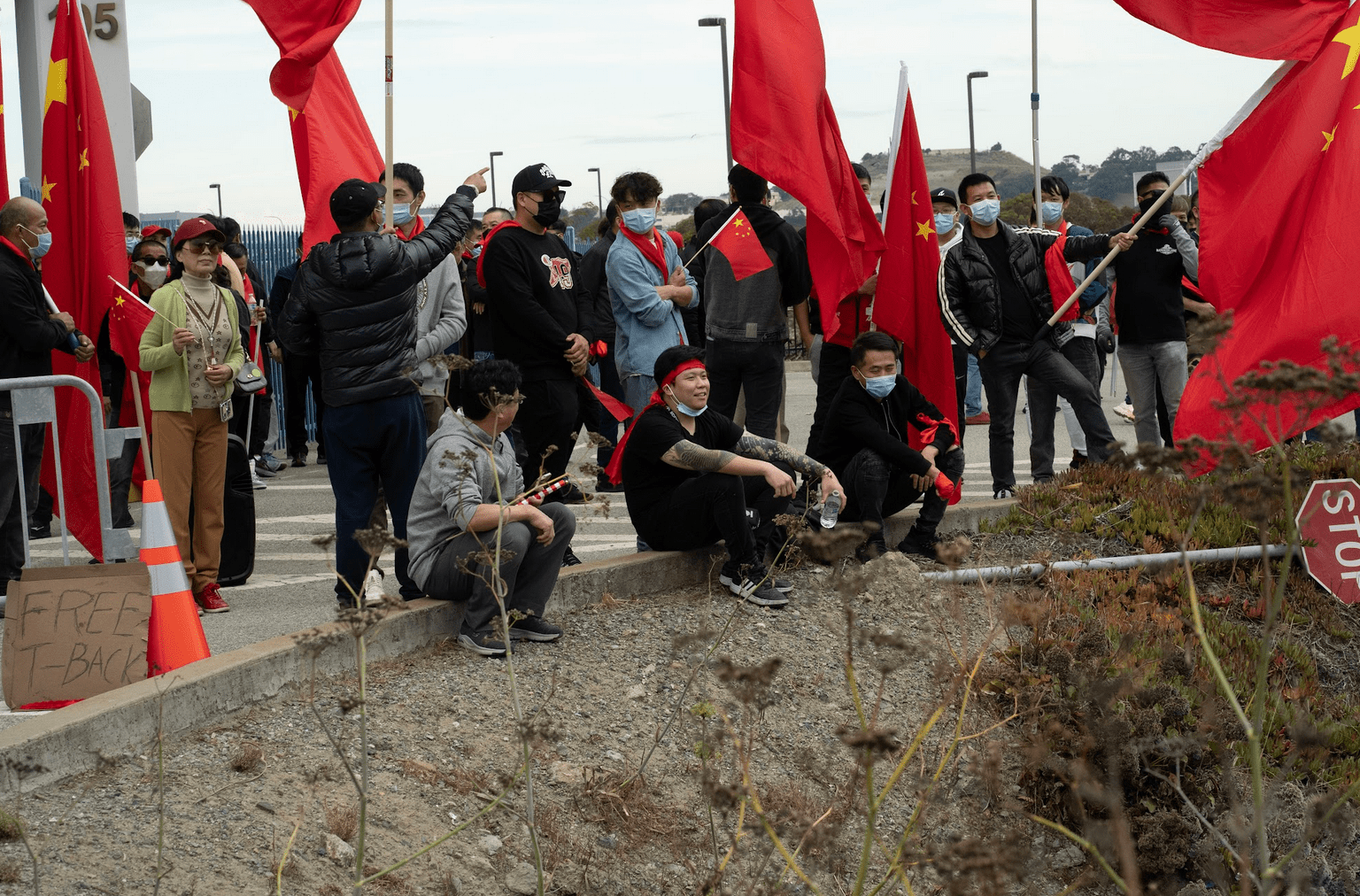
Hundreds, if not thousands, of CCP supporters were mobilized and transported to San Francisco to “welcome” Xi Jinping. Some came from the Bay Area, while others traveled from as far away as southern California; Portland, Oregon; Seattle; Philadelphia; and New York. It appears that their transport and accommodations were paid for. The mission of “welcoming Xi” was framed as a glorious patriotic duty. united front groups and their leaders were mobilized. Chinese students at universities in the Bay Area and in other areas of California were recruited through chapters of Chinese Students and Scholars Association with close ties to PRC consulates.

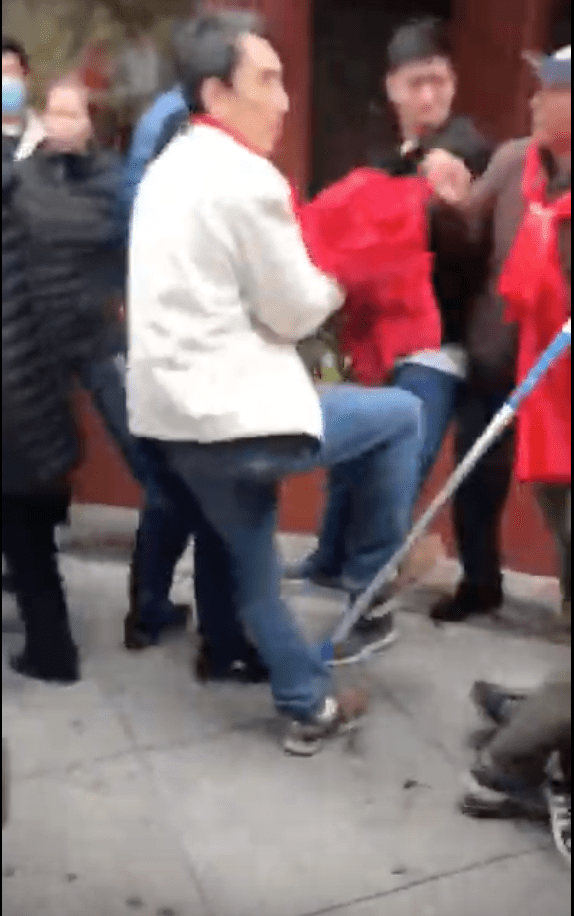
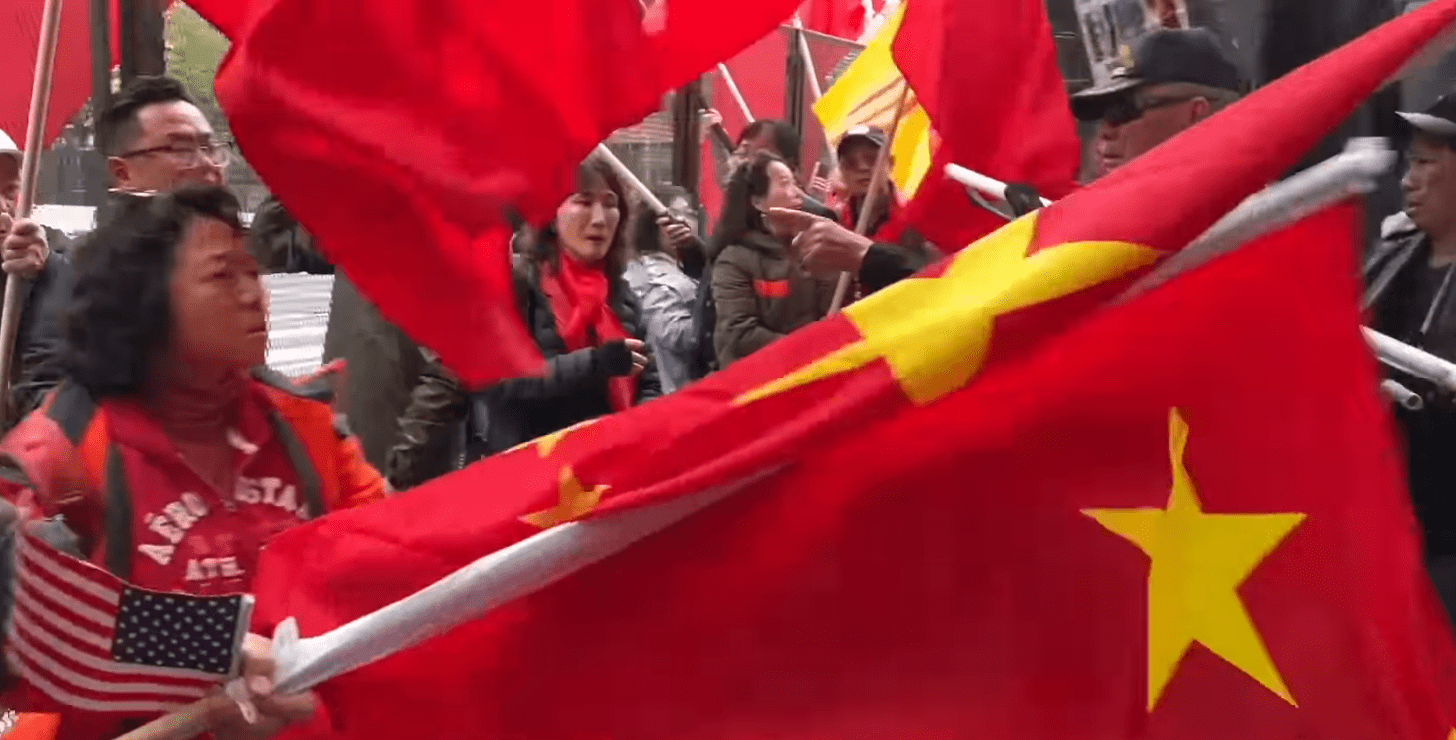
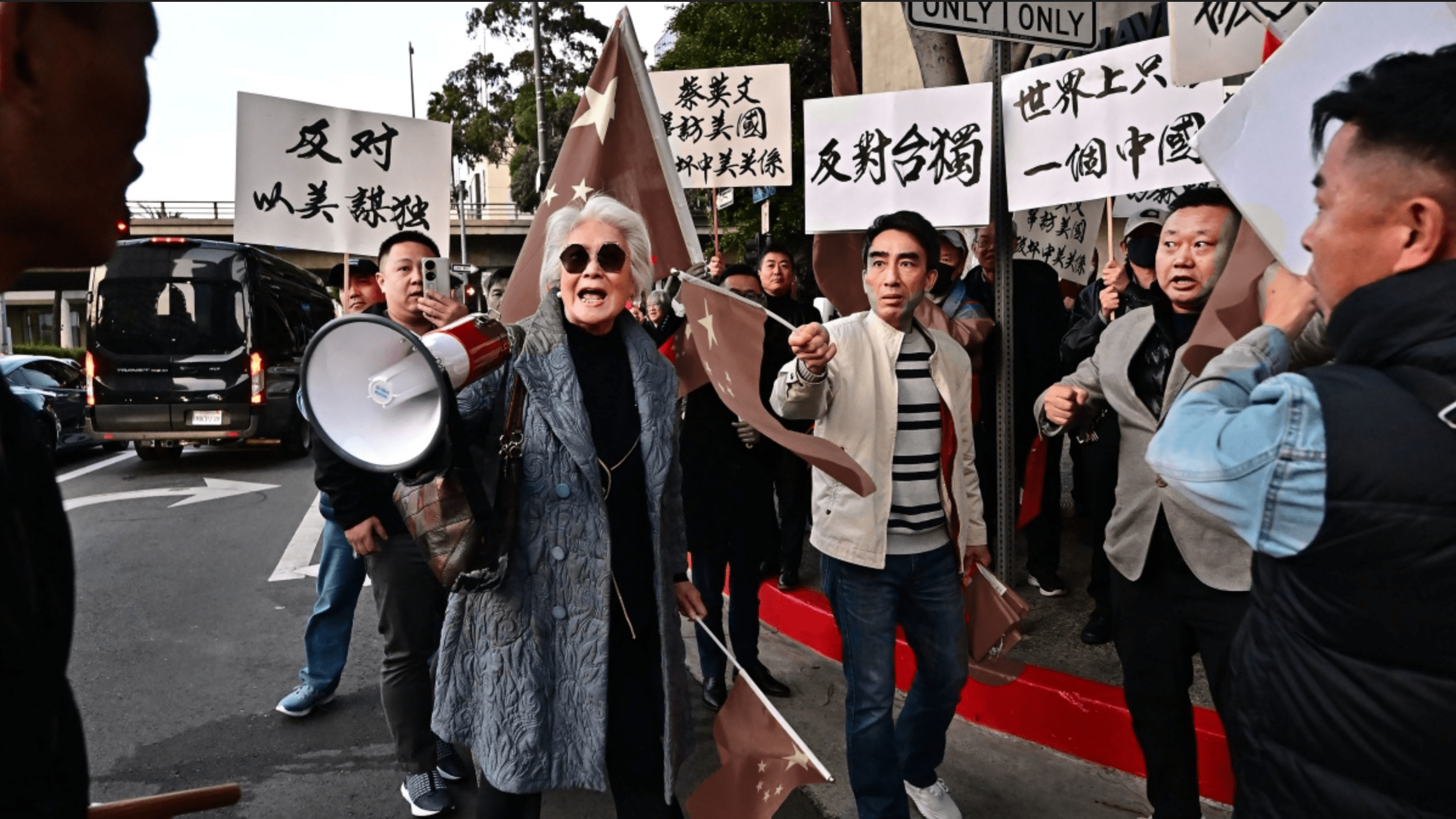
It appears that the purpose of the mobilization of large numbers of CCP supporters was twofold: firstly, to show strong support for Xi Jinping; and secondly, to obscure, neutralize, and, if possible, eliminate any sign of opposition. The ultimate aim was to present a “sea of red” to the “great leader.” Toward that end, the large numbers were crucial. They were used to crowd out and drown out protesters. Among the large numbers, those who would adopt more aggressive measures could blend in and hide. Ordinary items, especially flags and flagpoles, were deployed by some CCP supporters as weapons against protesters. Flags were regularly used to obscure protesters, both to prevent others from seeing them and to block views of assaults. Flagpoles were regularly used to stab and hit protesters. Protesters interviewed for this report frequently had the impression that the actions of CCP supporters were orchestrated and coordinated to a high degree.

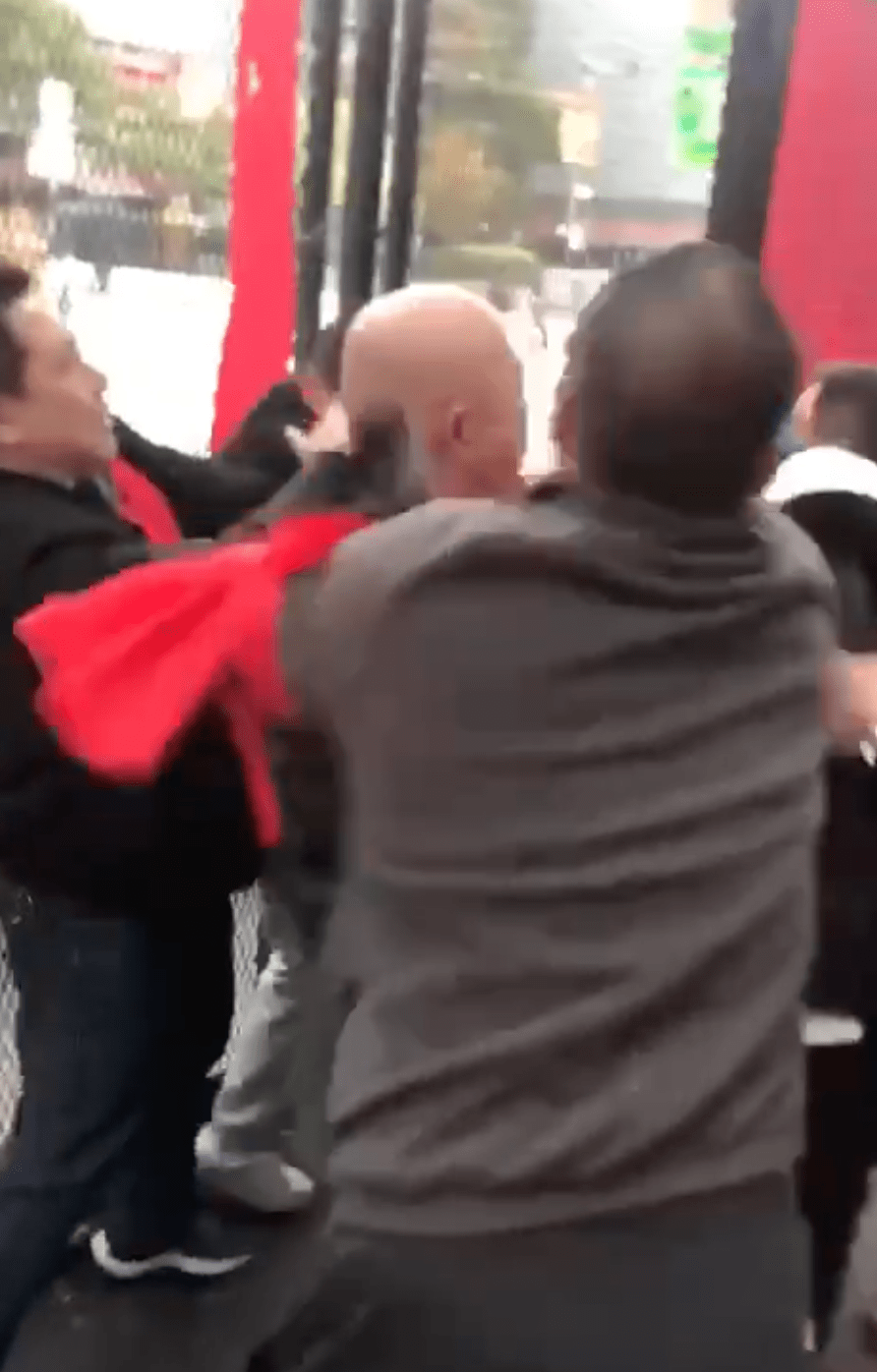
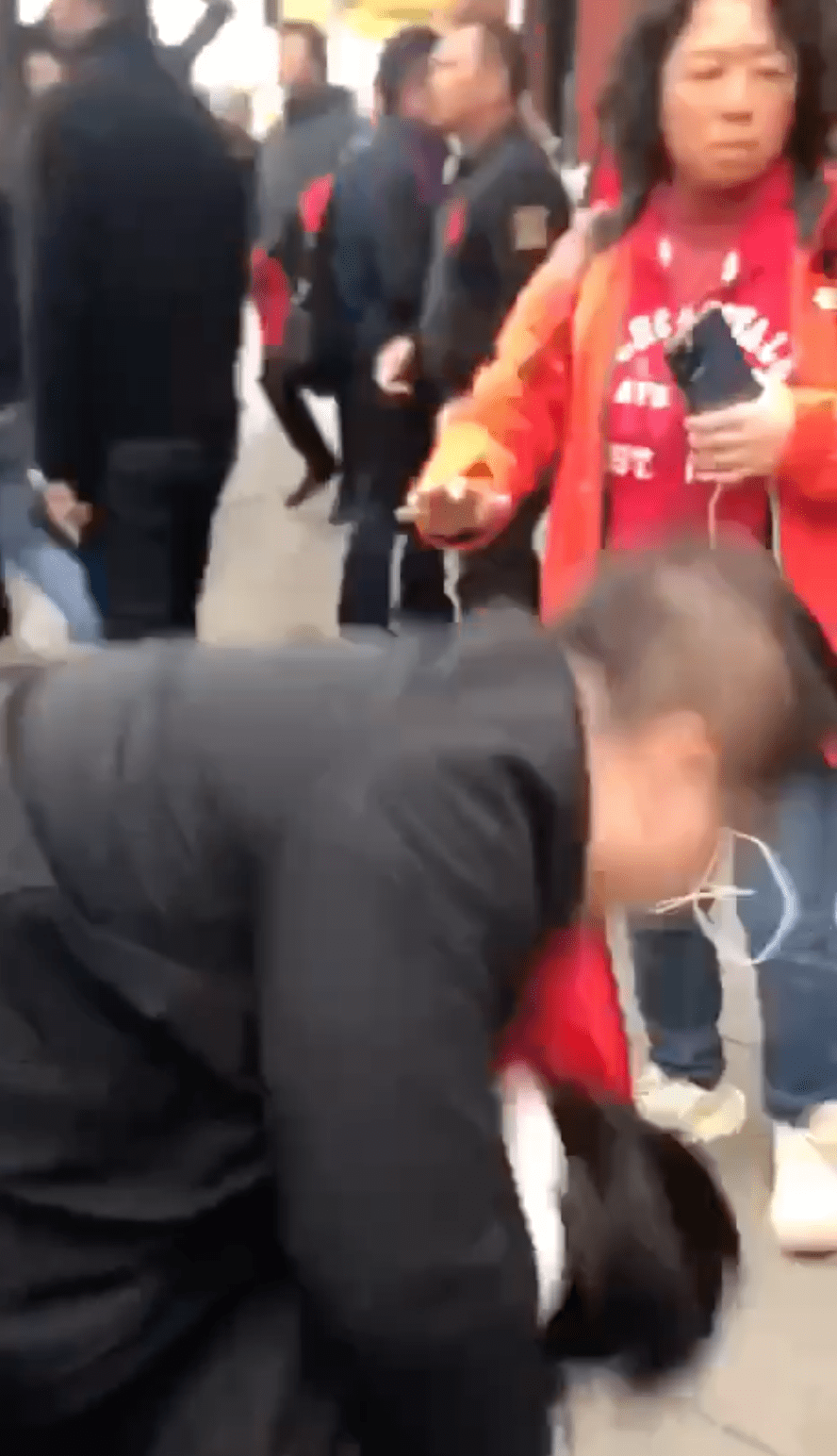
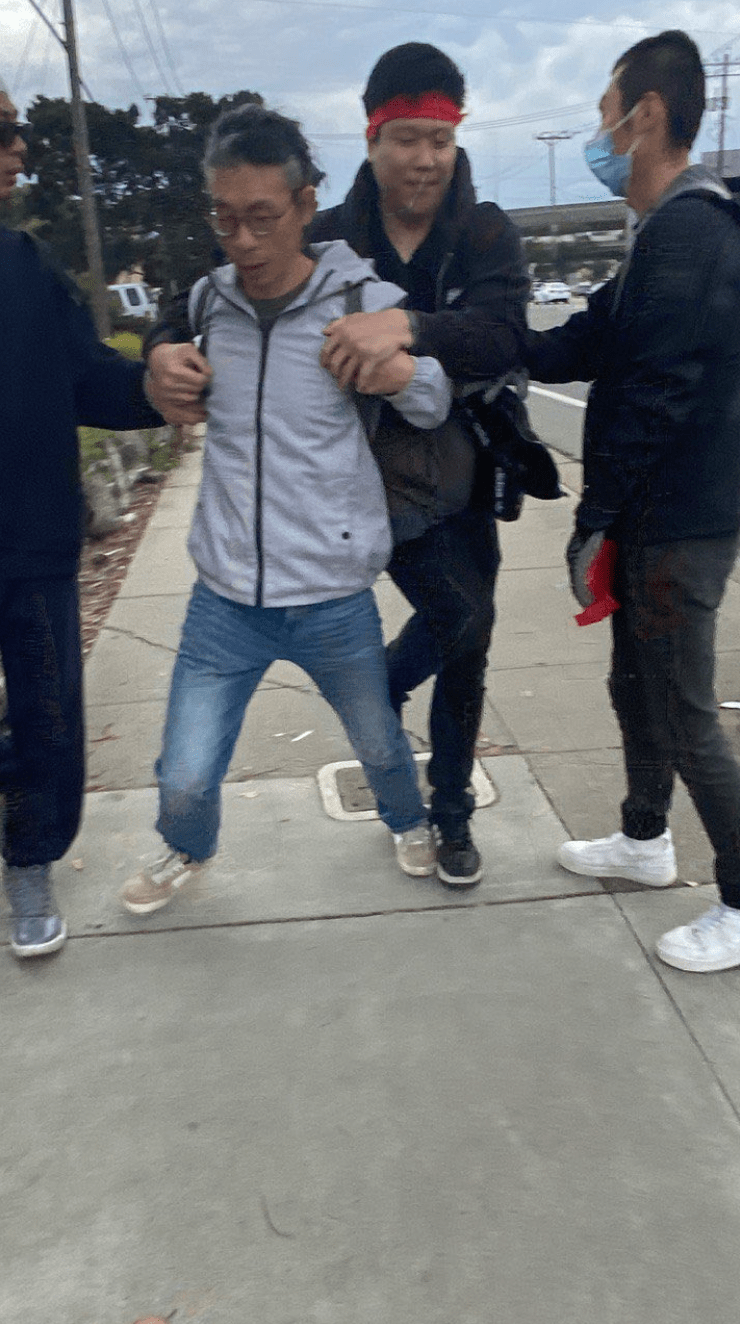
This report documents 34 cases of harassment and intimidation of and assault on protesters that occurred over the course of the four days (November 14–17, 2023) that Xi Jinping was in San Francisco . These actions include threats, attempts to prevent protest, physical attacks and beatings, thefts of cell phones, and incidents of stalking. Other incidents of harassment, intimidation, and assault were reported by the media and/or on social media and are mentioned in the report. The FBI’s definition of transnational repression—“when foreign governments stalk, intimidate, or assault people in the United States”—is certainly applicable in this instance, as many or all of these acts were perpetrated in San Francisco by people taking part in a coordinated mobilization campaign with links to the CCP.24

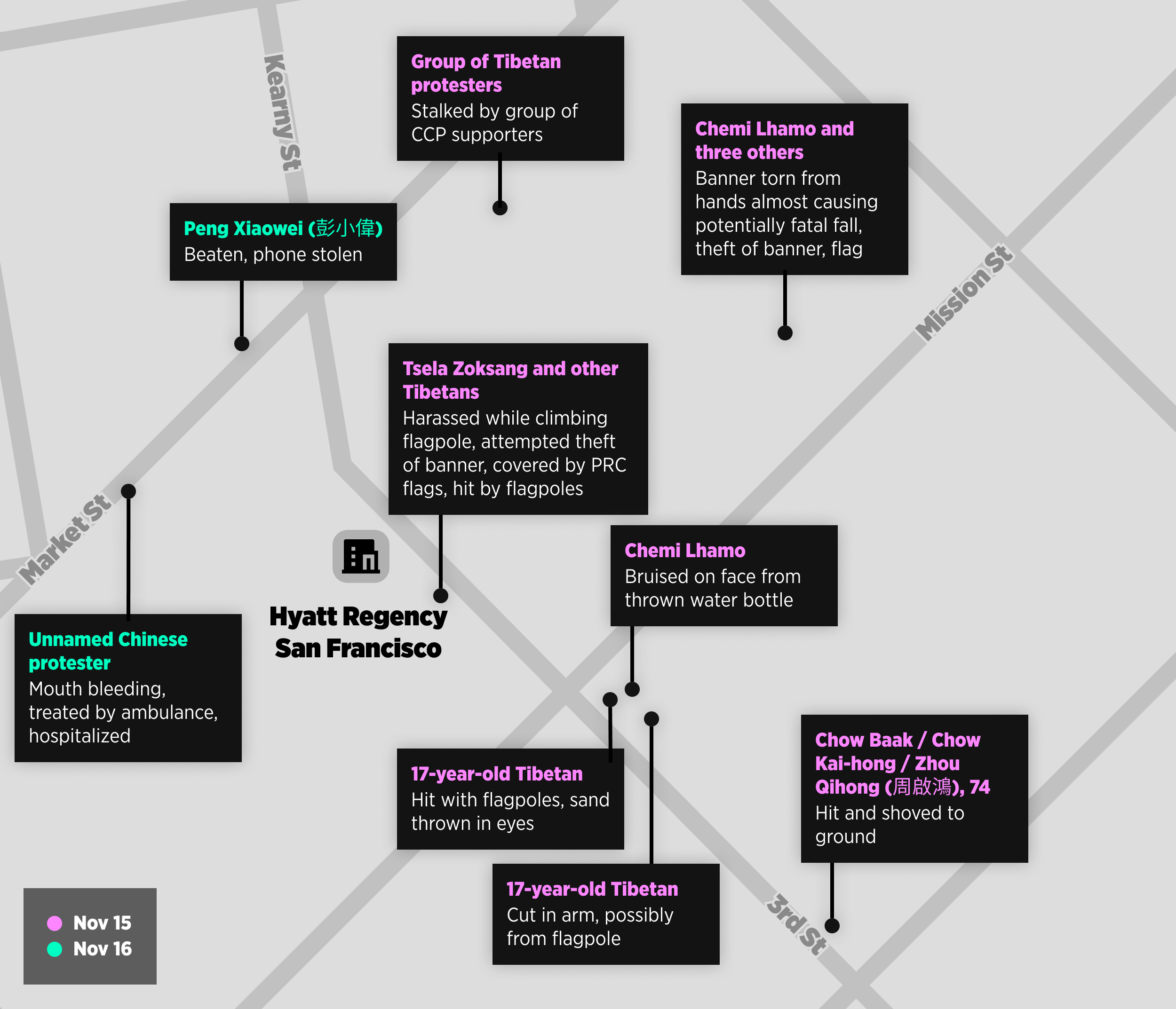
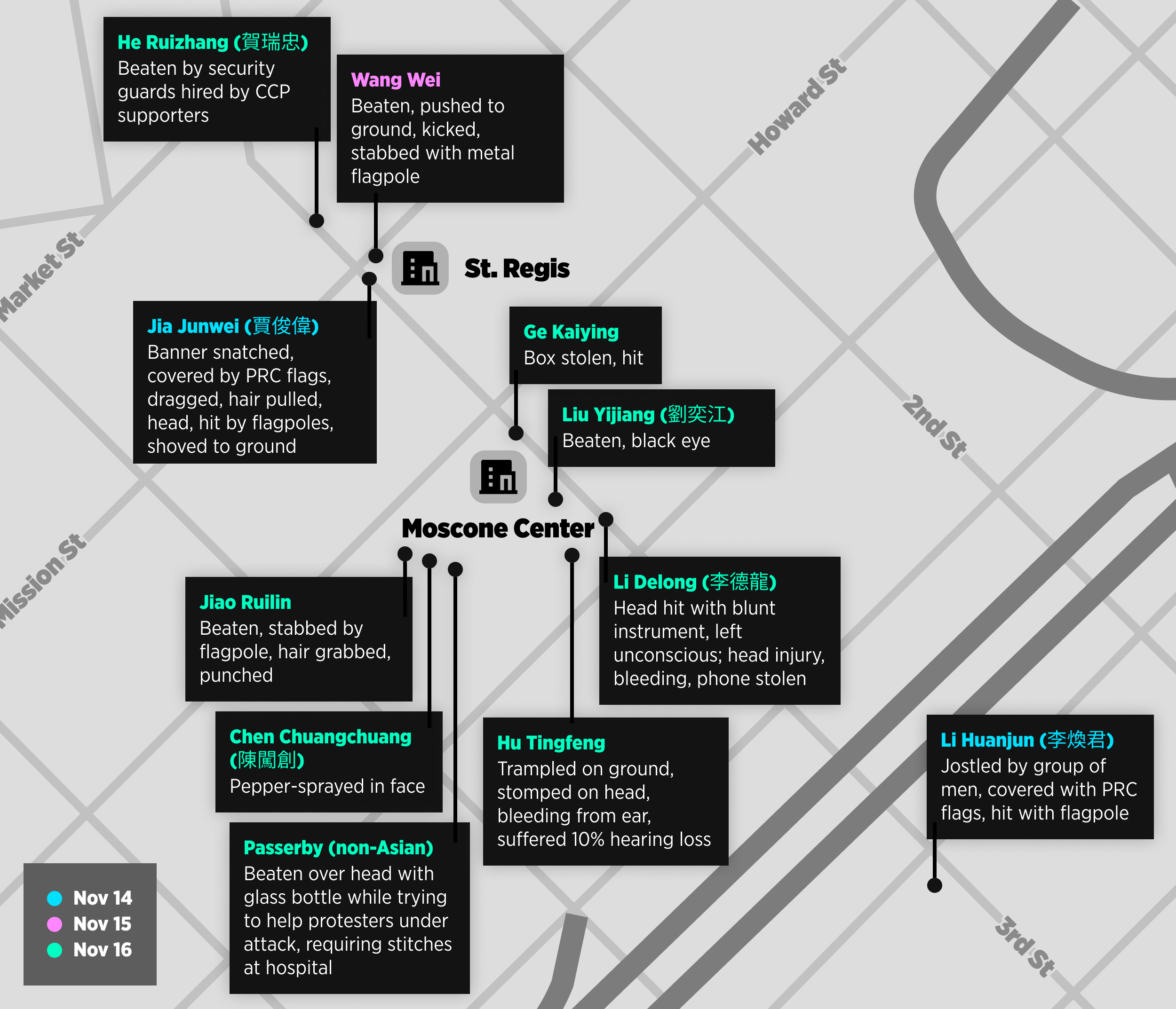
Significantly, most incidents of harassment, intimidation, and assault occurred at locations where Xi Jinping was present or expected to be—in particular, the San Francisco International Airport on his arrival on November 14 and his departure on November 17; and three places in downtown San Francisco: the St. Regis San Francisco Hotel, where the Chinese delegation was reported to be staying; the Hyatt Regency Hotel, where Xi attended a banquet held in his honor by US business groups; and the Moscone Center, venue of the APEC summit.

Generally, the actions taken by law enforcement authorities to prevent the attacks, to protect victims of the attacks, and to apprehend and hold accountable perpetrators of the attacks were inadequate. In some cases, police officers appear to have witnessed an attack but to have taken no action. In other cases, protesters reported the attacks to police officers either while they were ongoing or immediately after they took place, but police officers declined to take action. In still other cases, police officers attempted to separate the CCP supporters from the protesters, though they only did so in response to urgent requests from protesters. Where police continued to monitor the situation, the safety of the protesters improved; where they failed to do so, protesters were attacked in the very areas police had set up to protect them. While activists were threatened before Xi Jinping’s visit and law enforcement agencies were made aware of the threats, little to no preventive actions were taken. Police officers on the scene often appeared to have little awareness of the dynamics of what was happening before their eyes and appeared at times indifferent or even hostile and callous toward protesters’ appeals for protection. On only one occasion did anyone interviewed for this report witness a CCP supporter—a man who tried to cross a police barricade to approach protesters—being taken into custody by the police for an aggressive action toward protesters. The inadequate action by law enforcement authorities put protesters in the position of having to take their own precautions, without which, some protesters interviewed for this report believed, things would have been much worse.

The following section traces the incidents of harassment, intimidation, and assault in chronological order:

1.November 11: threats to activists before Xi Jinping’s arrival;

2.November 12 to 14: mobilization and transport of CCP supporters;

3.November 14: Xi Jinping’s arrival at the San Francisco International Airport; harassment and intimidation at the airport and along the expected route of his motorcade; an assault at the St. Regis, where the Chinese delegation is reported to be staying;

4.November 15: another assault at the St. Regis; multiple attacks at the Hyatt Regency, where a banquet for Xi Jinping is held;

5.November 16: multiple attacks near the Moscone Center where Xi attends the APEC summit; and

6.November 17: multiple attacks at the San Francisco International Airport when Xi Jinping departs.

Interspersed with accounts of the events as they unfolded are identifications and profiles of united front figures and groups that, to varying extents, were associated with and/or involved in the harassment and intimidation of and assaults on protesters.


Saturday, November 11

Three days before Xi’s arrival in San Francisco

Threats against activists were made even before Xi Jinping’s arrival on November 14.


Threat against Yao Cheng

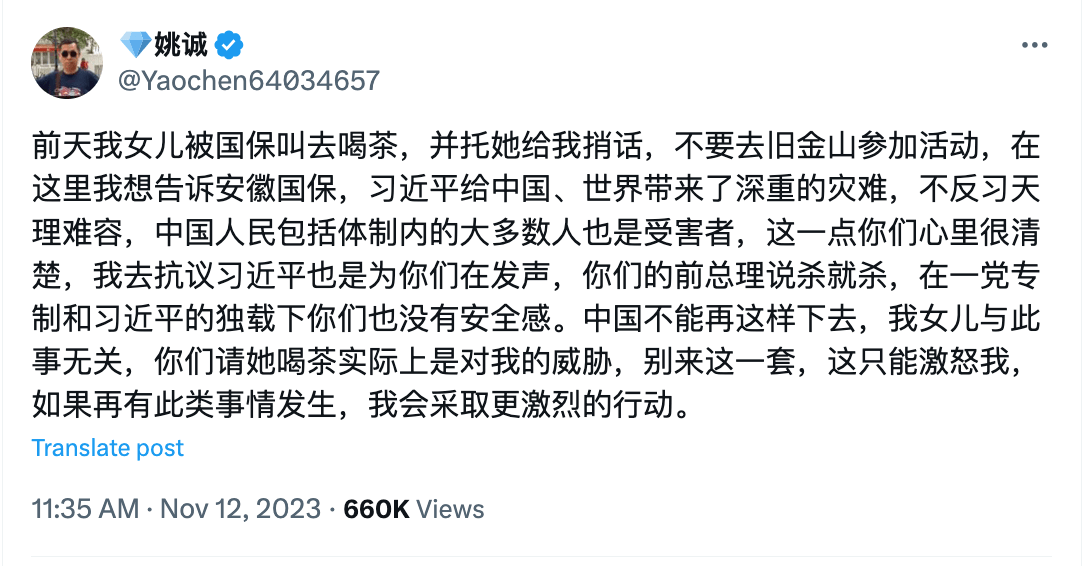
At least one Chinese activist residing in the United States, Yao Cheng (姚誠), reported that, on November 10, his daughter was summoned to a Ministry of Public Security office in Anhui Province and instructed to tell him not to go to San Francisco to participate in protests. Yao’s message to the Anhui PSB was, “You inviting her to tea [a common euphemism for interrogation in the PRC] is actually a threat to me.”25

image

Threats against Uyghurs

Uyghurs also reported cases of Uyghurs in East Turkestan and/or the PRC being contacted by PRC authorities and instructed to tell their relatives living in the United States not to attend any protests against Xi Jinping in San Francisco. A Uyghur leader in the US has confirmed these cases but has said that the Uyghurs in the US whose families were contacted in the PRC do not wish to go on the record about the incidents. The use of families in the PRC/East Turkestan to convey threats to Uyghurs in the diaspora is a well-documented tactic of the CCP.26

Threats against Anna Kwok

On the morning of November 11, Hong Kong Democracy Council Executive Director Anna Kwok announced on social media that she had arrived in San Francisco and was going to protest against Xi Jinping.27

In response, about 12 hours later, she was inundated with online threats. Some encouraged others to apprehend her. Others threatened kidnapping. One said, “Can somebody drop her unconscious body at the Chinese consulate/embassy?”28 The threats, all sent from what appear to be pseudonymous accounts, appeared to be coordinated. The accounts shared and commented on each other’s comments. Many used the same image: her face on a Hong Kong Police Force wanted poster that offered a bounty of HK$1 million for information or assistance leading to her arrest. The US Department of State and governmental authorities in other countries had already denounced the arrest warrants and bounties against Hong Kong activists in exile as transnational repression. 29


29


Kwok said, “All the comments appeared at once. Most of the comments encouraged others to act on the arrest warrant and bounty and hunt me down; they didn’t say they’d do it themselves. They sought to rile up lone wolf patriots who would be mad enough to do it. That way, [those who made the posts on social media] wouldn’t have to pay the legal consequences themselves. It was the same group of 10 or so accounts making the threats. I assume they were coordinated and instructed.”30

She reported the threats to the Federal Bureau of Investigation on the morning of November 12, sending screenshots as evidence. On November 14, an agent at the FBI’s San Francisco office contacted her. She was told to call 911 if she faced any life-threatening event. The agent told her that the FBI had contacted relevant authorities in San Francisco about the incident and provided San Francisco Police Department precincts with her name and photo.31

Over the following days, Kwok said, “There were multiple moments when I knew others were threatened and harassed. When I reached out to the FBI, likely because I was the one who had well-documented threats prior to the occasion, I was the ‘person of interest’ in the system. In other words, the process catered more toward my safety and well-being instead of protecting all protesters on site. When asked about actions they could take, the options are limited. The FBI could not intervene in the on-site command chain of local law enforcement. When I spoke to the police on site, they were not equipped with knowledge of the situation; nor did they understand that this was transnational repression happening before their eyes. Some of them were even unaware of the fact that there were two sides and one was intimidating the other. The FBI agents wanted to help but struggled to find the mechanisms to do so”.

November 12 to 14

and other days leading up to Xi Jinping’s arrival

In the days leading up to Xi Jinping’s arrival in San Francisco on November 14, reports began to emerge that large numbers of CCP supporters were being transported to San Francisco from southern California, New York, and Philadelphia. (Later, evidence of groups from Portland, Oregon; Seattle, Washington; and the San Francisco Bay Area itself also emerged.)

Mobilization of Chinese Students through CSSAs

Hundreds of Chinese students were bused in from California universities, including the University of California (UC) at San Diego, UC Santa Barbara, UC Los Angeles, and California State University, Northridge.32

Chinese Students and Scholars Association (中國學生學者聯合(誼)會) branches at California universities were used to recruit Chinese students to “welcome” Xi, as could be seen in messages circulating among students and scholars at California universities.

CSSAs have a record of surveilling and reporting on Chinese students. They are collectively overseen by the CCP’s united front Work Department and are often controlled, funded, and/or closely watched by Chinese embassies or consulates. The US Department of State says, “…the CCP created the Chinese Students and Scholars Association (CSSA) to monitor Chinese students and mobilize them against views that dissent from the CCP’s stance. That directive has not changed.”33 The United States-China Economic and Security Review Commission says CSSAs “receive guidance from the CCP through Chinese embassies and consulates—governmental ties the CSSAs frequently attempt to conceal—and are active in carrying out overseas Chinese work consistent with Beijing’s united front strategy.”34

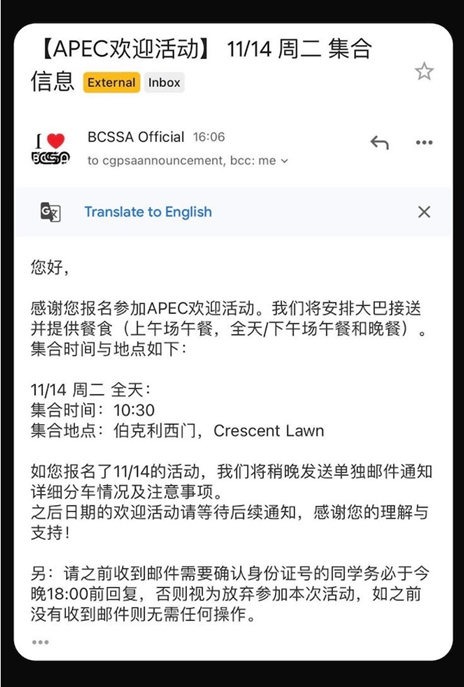
An email message from “BCSSA Official” at UC Berkeley told Chinese students that transport to welcoming events for Xi Jinping and meals would be arranged and provided.

Berkeley-CSSA-email-cropped.png


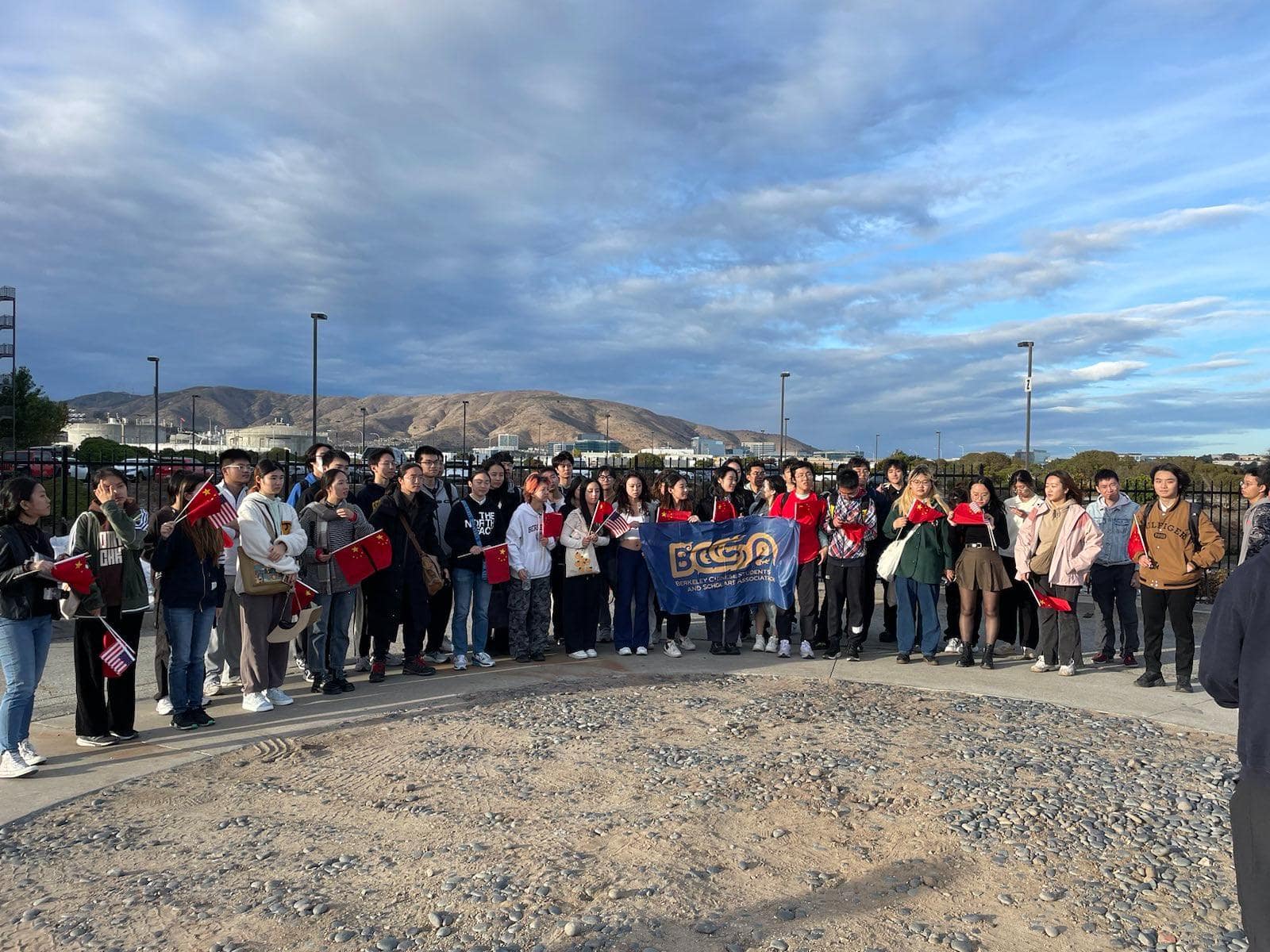
Berkeley CSSA students were later seen on November 14 at the “welcome” gathering for Xi Jinping near the San Francisco International Airport. As many as 45 students posed for group photos with the Berkeley CSSA banner.

UC-Berkeley-Chinese-students-5.jpeg


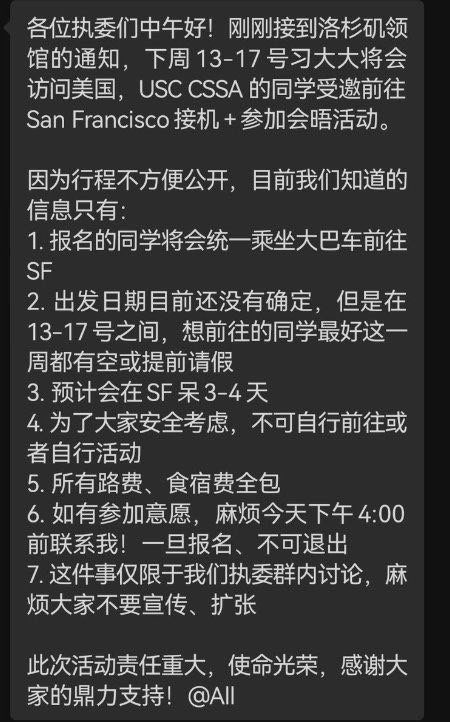
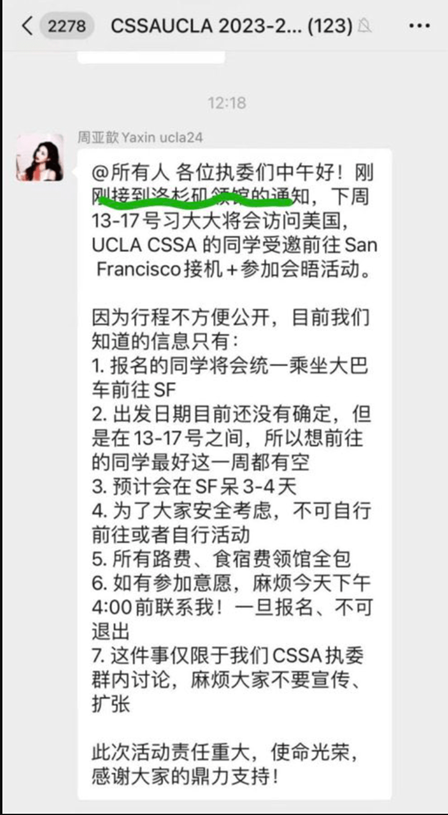
A message addressed to “executive committee members” said that CSSA representatives at University of Southern California were informed by the Chinese consulate in Los Angeles that Xi Jinping would be visiting and that students belonging to the USC CSSA were invited. Students were expected to stay in San Francisco for three or four days, the duration of Xi’s visit, and, “for everyone’s safety,” would not be allowed to go out on their own or engage in separate activities. This message also said that all travel, accommodation, and food expenses would be covered, notified students that this “glorious mission” was a significant duty, and advised addressees not to share the contents of the message with others. The message also said that once people signed up, they could not withdraw.

USC-CSSA-APEC-invite

The same message addressed to executive committee members of the USC CSSA was also sent to the UCLA CSSA executive committee members.


UCLA-CSSA


A video posted online by a Chinese student in the US confirms that, while the event was coordinated by CSSAs, the buses and meals were provided by the PRC Consulate.35 A Chinese student who traveled to San Francisco said the PRC Consulate paid for flight tickets from New York City and accommodations.36


It is highly likely that CSSAs at other California universities and in other states were used to mobilize Chinese students in a similar fashion.

Many young people who were presumably students were, in particular, gathered along the airport access road with PRC flags on November 14, the day of Xi Jinping’s arrival.


Mobilization and Transport of Other united front Groups

In fact, over the course of the four days of Xi Jinping’s visit to San Francisco, students in general did not appear to make up a large percentage of the CCP supporters at events and locations other than those at the airport on November 14. The majority of CCP supporters appeared to be associated with other united front groups.

It was reported by Chinese-language media with good relations with the CCP supporters that between 16 and 20 buses transported about 800 CCP supporters from southern California to San Francisco. The daily cost of each bus rental was at least $5,000. At least 400 rooms were reserved at five different hotels at a rate of at least $150 a night. The entire mobilization from southern California alone was said to have cost hundreds of thousands of dollars. Almost 1,000 CCP supporters from New York and other areas were transported to San Francisco. The report estimated that altogether as many as 10,000 CCP supporters from various regions would gather in San Francisco.37

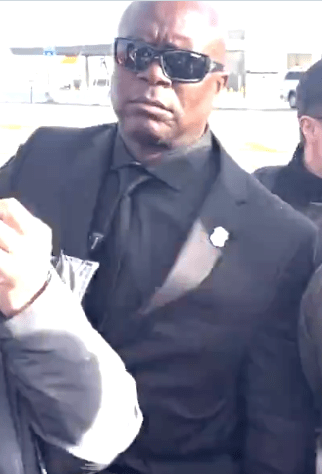
Overseas Chinese from southern California were also reported to have hired 10 armed, uniformed security guards to “maintain order on site.”38 Over the coming days, security guards who appeared to be associated with CCP supporters were present at all but one of the locations where protesters were harassed, intimidated, and assaulted. At least two private security firms were employed.39 The guards of one firm dressed in distinctive black suits that protesters came to recognize. The guards of the other wore uniforms, and many appeared strikingly young. (For more details on these security firms, see below). Apart from a united front leader from southern California who claimed to have hired the 10 guards mentioned above, it is unclear who exactly hired the security guards. In response to our query regarding who hired the security firms, a representative of one of the firms said, “I recommend contacting the Chinese consulate directly for the details you’re looking for.”40 The security guards were seen at times to be working with individuals who may have had direct ties to the PRC. The guards’ exact responsibilities and purpose often appeared unclear; at times, they themselves appeared not to know. Some protesters reported that the security guards acted aggressively towards them and asserted the authority to determine where they were and were not allowed to be, while other security guards appeared to have little idea of what they were doing or remained inactive in response to incidents of harassment, intimidation, and assault.

united front groups that traveled from southern California to San Francisco include the All American Chinese Association41 (南加華人華僑聯合總會/美國南加州華人華僑聯合總會), the Chinese American Unity Alliance (洛杉磯華埠大聯盟), and the Taishan Friendship Association of Southern California (南加台山聯誼會).42

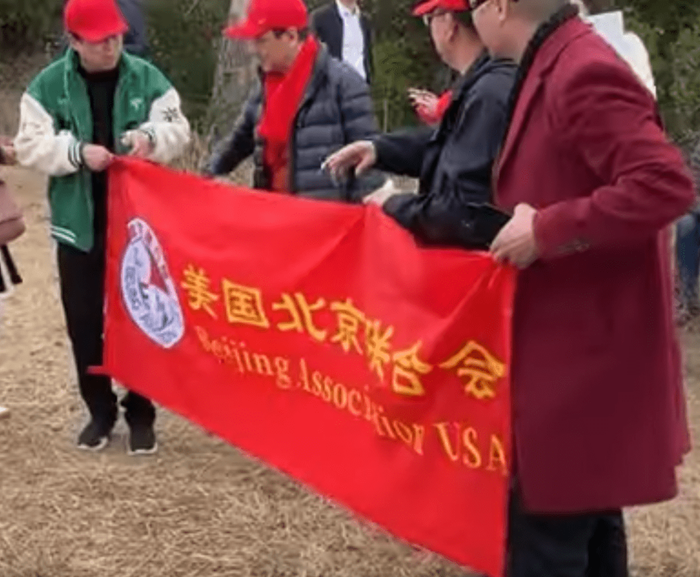
Other united front groups that traveled to San Francisco include the Philadelphia Fujian Association (費城福建同鄉會), the American Lianjiang Association (美國連江同鄉會; Lianjiang is a county in Fujian Province), the American Fujian Association (美國福建同鄉會), the North American Zhejiang Overseas Chinese Association (北美浙江華僑聯盟社團), and the Los Angeles-based Beijing Association USA (美國北京聯合會).43

While some united front groups seek to obscure their close links with CCP entities and officials, others proudly display them. For example, on the front page of Beijing Association USA’s website are two letters congratulating it. One is from the All-China Federation of Returned Overseas Chinese (中華全國歸國華僑聯合會), the top-level CCP united front group tasked with overseeing relations with overseas Chinese that is mentioned in the Introduction above. The other is from China Overseas Friendship Association (中華海外聯誼會), the external name of the 9th Bureau of the CCP’s united front Work Department, one of two UFWD bureaus tasked with overseeing overseas Chinese affairs.44

Beijing Association USA was one of many united front groups seen lining the route to the Filoli Estate where the meeting between Xi Jinping and President Biden took place on November 15.45

Screen-Shot-2024-02-12-at-10.16.41-AM

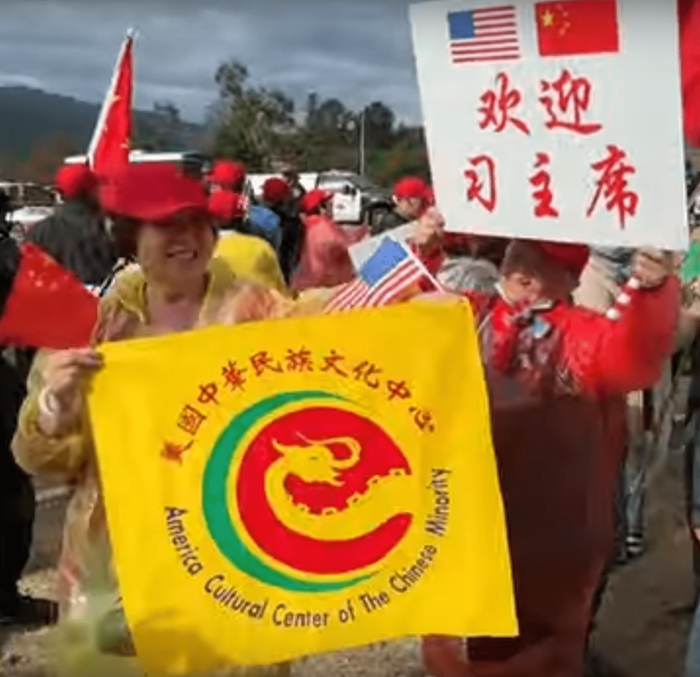
Another group present along the Filoli route on the 15th was the America Cultural Center Of Chinese Minorities (美國中華民族文化中心) based in Arcadia, California.46

Screen-Shot-2024-02-12-at-10.27.32-AM

Like many united front groups in the US, the America Cultural Center Of Chinese Minorities has a minimal public profile, but it is registered as a 501(c)(3) nonprofit.47


united front Leaders Who Organized Mobilization and Transport

Two individuals were prominent among united front leaders who organized the mobilization and transportation of CCP supporters to San Francisco.

One of these individuals is Charles Lu Qiang (鹿強). Chinese-language media outlets Sing Tao and World Journal reported that he organized the mobilization of CCP supporters from southern California. The other is John Chen Shanzhuang (陳善莊) who reportedly organized the mobilization of CCP supporters from New York.

Brief profiles of these two individuals reveal their ties to the CCP. Tracing these ties helps to indicate how the CCP uses united front groups to carry out its agenda abroad.

Charles Lu Qiang (鹿強), a travel agent based in the Los Angeles area, reportedly organized the transport of 16 to 20 buses of CCP supporters from southern California to San Francisco. Lu utilized the resources of his travel agency to secure transportation.48

As recently as September 2023, two months before Xi Jinping’s visit to San Francisco, Lu attended the 11th National Congress of Returned Overseas Chinese (第十一次全國歸僑僑眷代表大會) in Beijing, where Xi Jinping and other top CCP leaders spoke.49

Lu has served as an overseas committee member of the Shanghai Overseas Chinese Association (上海市僑聯), a local group of the All-China Federation of Returned Overseas Chinese (中華全國歸國華僑聯合會) in Shanghai. 50 ACFROC (中國僑聯 [簡稱]) is the top-level CCP united front group responsible for maintaining relations between the CCP and overseas Chinese.51

In 2015, Lu was one of 38 overseas Chinese invited to attend the main annual session of the Chinese People’s Political Consultative Conference (中國人民政治協商會議; CPPCC), the very highest united front organ of the CCP and an advisory body to the PRC government composed of some of the highest-profile CCP supporters. An invitation to an overseas Chinese to attend the annual session of the CPPCC is considered recognition of exceptional contributions to united front work abroad; only “well-known leaders in their host countries” are invited to attend. Lu claimed the conference had an especially good democratic atmosphere. The CPPCC session took place in the Great Hall of the People in Beijing.52

Lu is the honorary founding chairman of the Roundtable of Southern California Chinese-American Organizations (RCAO; 美國南加州華人社團聯合會[簡稱南華聯]). As of 2022, RCAO was a coalition made up of at least 170 member organizations. At a ceremony in 2022 inaugurating its 10th leadership team—of which Lu is part in his capacity as honorary founding chairman—Zhang Ping, the then-Consul General of the PRC consulate in Los Angeles, expressed admiration for the work of the RCAO as well as gratitude to its past and present leaders. Lu is prominent among them in photos of the event. In one, he stands next to Zhang Sujiu, daughter of General Zhang Zhizhong, whom Mao Zedong appointed to several high-ranking positions in the early decades of the PRC. Zhang herself is, like Lu, an honorary chair of RCAO.53

Lu is also reputed to be a major convener of “patriotic” gatherings of overseas Chinese in southern California to “oppose Taiwan and Hong Kong independence.”54

In addition to having transported 16 to 20 buses of CCP supporters to San Francisco, Lu Qiang himself, along with hundreds of other CCP supporters, was apparently present along the route to the Filoli Estate where the Xi-Biden meeting was held on November 15.55


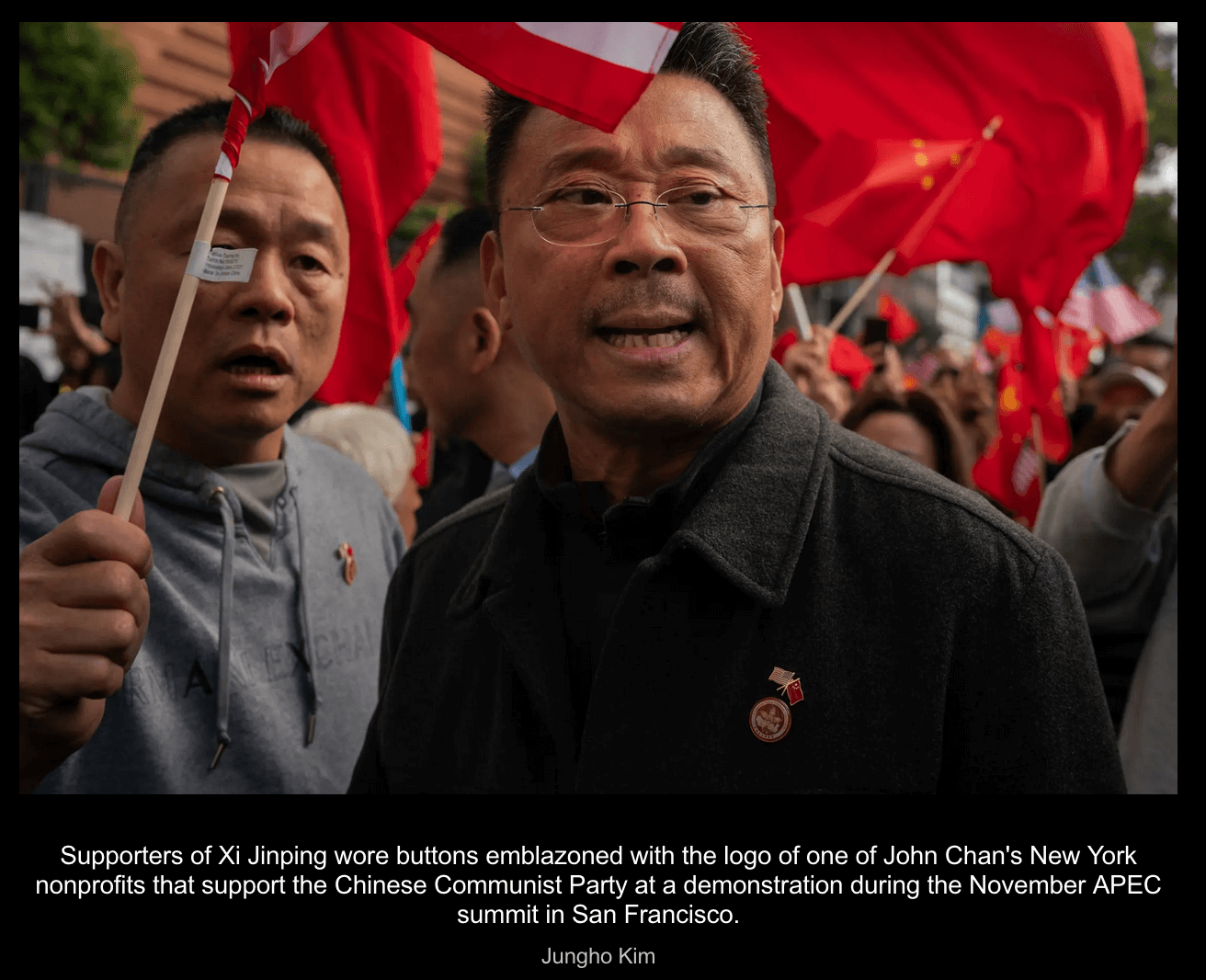
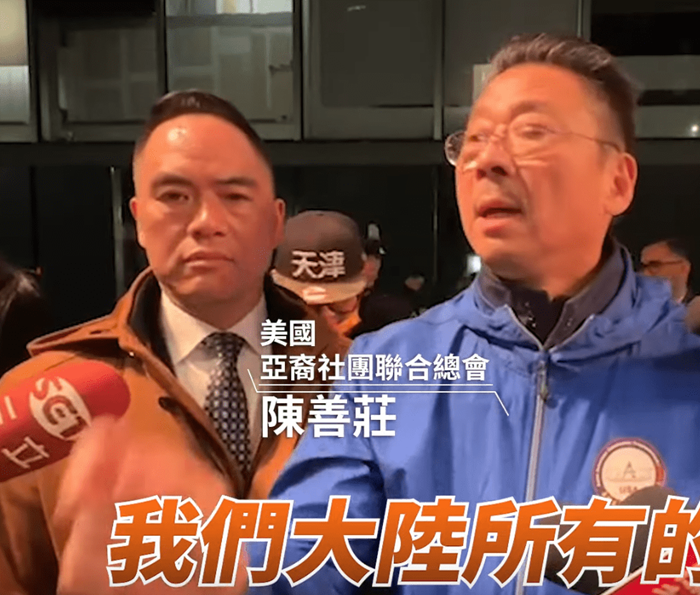
John Chen Shanzhuang (陳善莊), (sometimes spelled “John Chan” in English) reportedly played a leading role in mobilizing CCP supporters from New York. He is reported to be the chair of Asian American Community Empowerment (美國亞裔社團聯合總會).56 He was interviewed on the streets of San Francisco during Xi Jinping’s visit, and the accompanying photograph shows him wearing a lapel pin of the American Chinese Commerce Association (HK) (美國(香港)旅美華人總商會), another group of which he is the chair.57

Screen-Shot-2024-03-01-at-9.24.40-AM

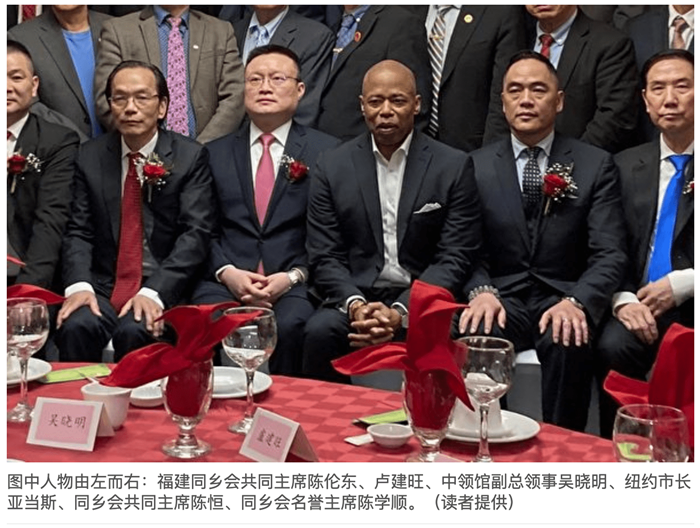
On November 8, only days before he led CCP supporters to San Francisco, Chen met Deputy Consul General Wu Xiaoming (吳曉明) of the PRC consulate in New York.58 The occasion was a ribbon-cutting ceremony for a new office for his organization, Asian American Community Empowerment. Wu publicly praised Chen, indicating a close relationship between PRC officials and Chen as a leader of united front groups.

Chen has been a leader of united front activities in New York City for upward of three decades, regularly organizing public gatherings to express support for PRC government positions on matters ranging from the US bombing of the PRC embassy in Belgrade in 1999 to the Falun Gong.59 In March 2023, Chen was prominent at a protest of CCP supporters in New York City against the visit to the US of the Taiwanese then-president Tsai Ing-wen.60

In 1999, he co-founded the American Fuzhou Langqi United Association (美國福州琅岐聯合總會). He is also listed as the chairman of the American Chinese Commerce Association (美華總商會會長), which shares a website with the American Chinese Commerce Association (Hong Kong) (美國(香港)旅美華人總商會), of which he is also president. Besides the organizations mentioned above, he is also reported to be the convener of an organization called Coalition of Asian-Americans for Civil Rights (CAACR) (亞裔維權大聯盟).61

In San Francisco, Chen led supporters in “welcoming” Xi outside the St. Regis Hotel, where the Chinese delegation was staying, on November 14. Some of them harassed and intimidated protesters.62


Besides united front figures like Lu Qiang and Chen Shanzhuang, who reportedly organized the mobilization and transport of CCP supporters to San Francisco from, respectively, southern California and New York, several other prominent united front leaders participated in the “welcoming” of Xi Jinping in San Francisco. They will be noted as they appear in the timeline of events below.

Patterns emerge that resemble previous mobilizations of the overseas united front to neutralize protesters going back to the Olympic torch relay in 2008:

–The united front groups have strong ties with the PRC government and are organized by individuals with a record of strong ties with the PRC government.

–Their mobilization is organized and transport and accommodations are provided.

–Those associated with united front groups, including Chinese students, are exhorted to fulfill their patriotic duty and take part in a “glorious mission.”


While a small percentage of CCP supporters who showed up on the streets of San Francisco directly engaged in acts of harassment of and assault on protesters, the mobilization of large numbers was meant to “flood the zone,” taking up space especially in locations where Xi was present. This was effected both to ensure support for Xi and to neutralize potential protests. The CCP supporters blasted patriotic songs and slogans on megaphones at high volume and sought to obscure any views of protesters and their banners and flags. Within the crowds of CCP supporters, many of whom were quite passive, were smaller numbers of people who were tasked or who took it upon themselves to more aggressively harass, intimidate, and even assault protesters. A number of those who did not directly take these more aggressive measures were nevertheless sometimes perceived as complicit with those who did, if they used, for example, their PRC flags to block any view of the harassment, intimidation, and assault. Kennedy Wong, a Hong Kong protester and member of Hong Kong Democracy Council, said, “I was quite frightened because we were outnumbered by CCP supporters; more importantly, some of them were very aggressive.”63

On several occasions, protesters changed their plans due to safety concerns. Tibetan and Uyghur groups had originally planned to march on November 15 to the Hyatt Regency, where Xi was the guest of honor at a banquet, but when they saw the large numbers of CCP supporters gathered outside the hotel and an absence of separate protest zones, they decided against this course of action as they feared it could lead to a potentially violent confrontation. Several dozen Tibetans proceeded to the area near the Hyatt Regency, but many Tibetan elders along with Tibetans with children left.64 (In fact, those protesters who did brave the crowds of CCP supporters were attacked, as shall be seen.) Once on site, protesters quickly developed protocols and strategies to ensure their safety. Often, the effort required of protesters to protect themselves from pro-CCP attackers distracted significant attention from their original objective, namely, protesting against Xi Jinping. All protesters interviewed for this report said they felt in significant danger and were on constant high alert for attacks, stalking, and other forms of harassment, intimidation, and violence. The mobilization of the united front as well as more aggressive agents affiliated with the CCP did, in fact, deter protest and create an unsafe environment for protest, thus interfering with protesters’ free speech rights as well as infringing their basic human right to freedom of peaceful assembly.


Tuesday, November 14

First day of Xi’s Visit to San Francisco

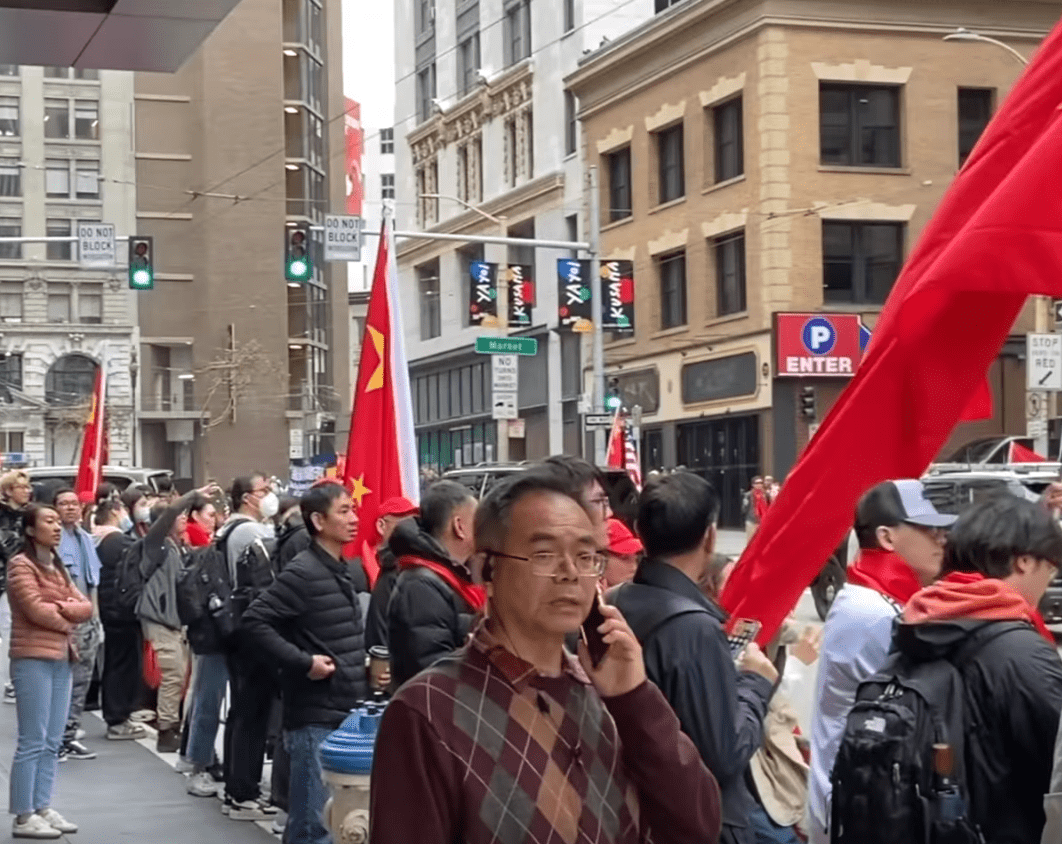
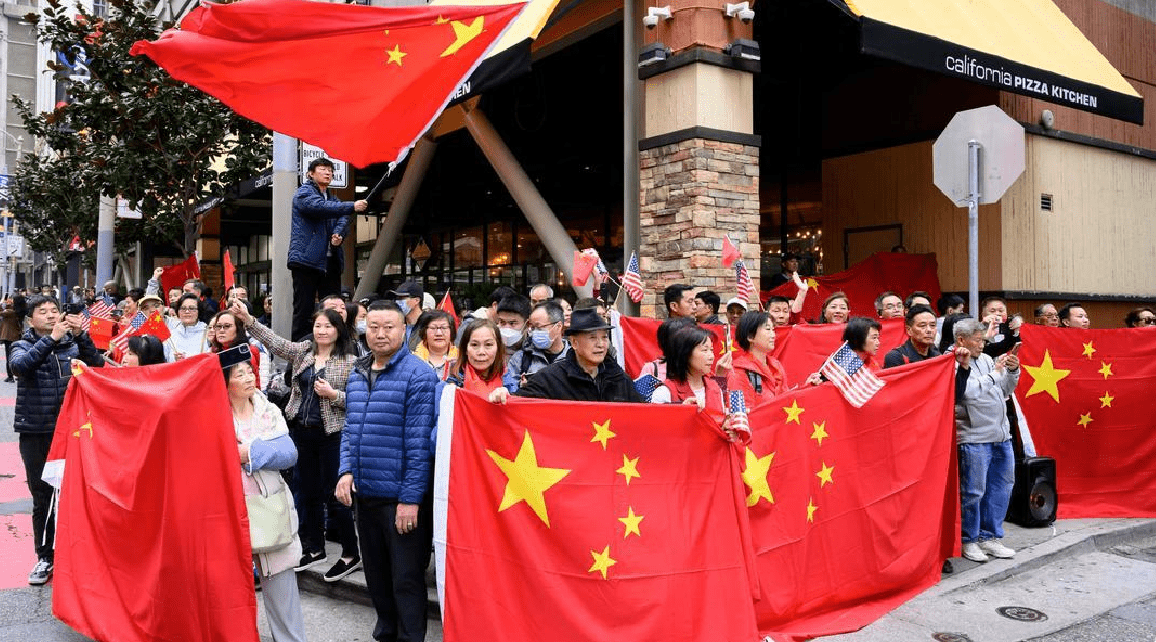
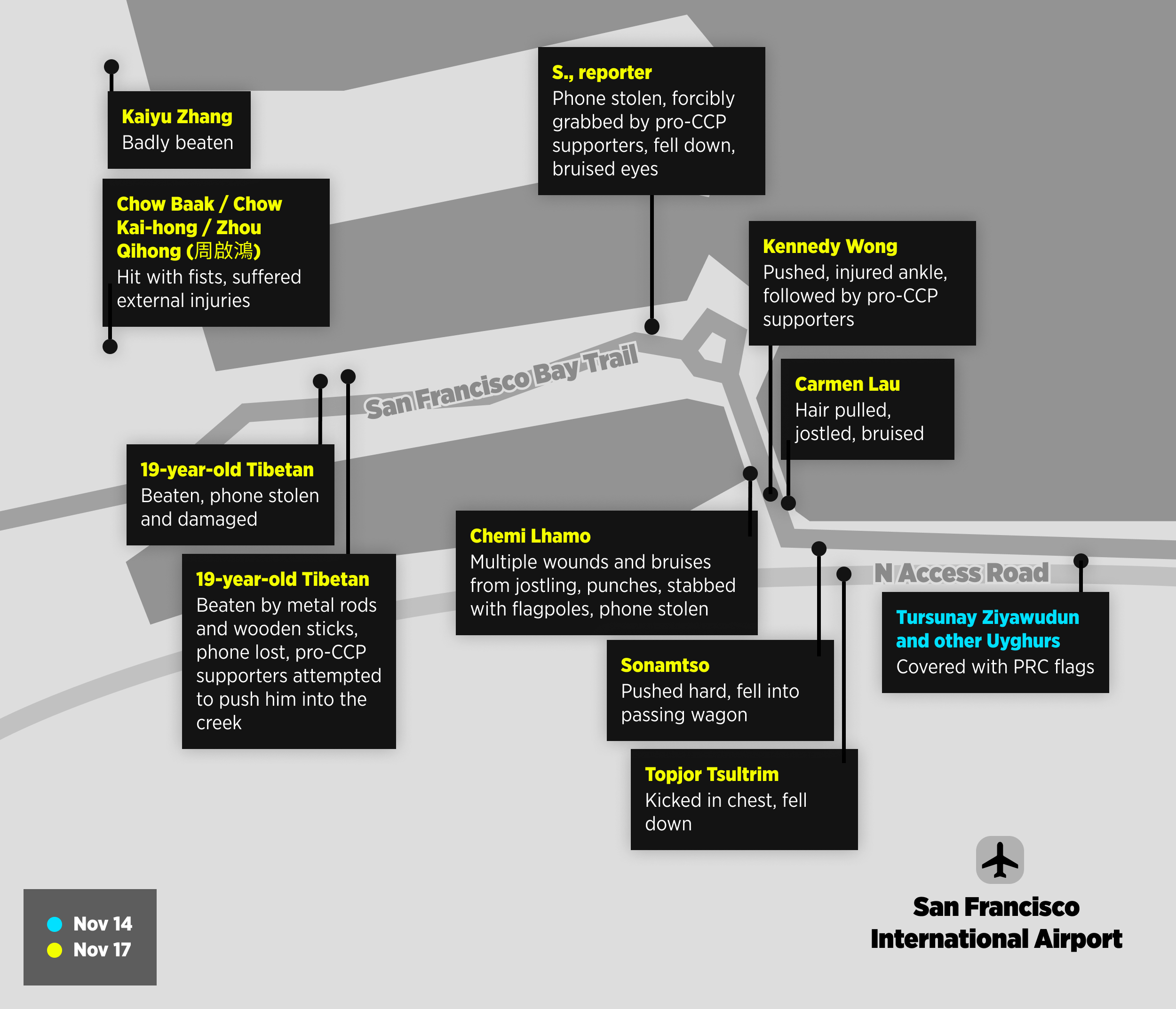
Xi Jinping arrived at the San Francisco International Airport. He and the Chinese delegation were rumored to be staying at the St. Regis hotel. Hundreds of CCP supporters lined the route from the airport to the hotel and also gathered near the hotel. Some protesters also went to the airport, a few were present along the route of Xi’s motorcade, and a few more were near the hotel. The first incidents of harassment, intimidation, and assault occurred on this day.
Among the serious incidents of the day were these:

–the harassment and intimidation of Uyghur camp survivor Tursunay Ziyawudun and other Uyghurs at the San Francisco International Airport;

–the harassment and intimidation of Chinese activist Li Huanjun on the route from the airport to the St. Regis;

–the assault on Chinese activist Jia Junwei outside the St. Regis.


Near San Francisco International Airport

Beginning in the morning, both CCP supporters and protesters gathered along the airport access road in anticipation of Xi’s arrival. They remained there until shortly after 3 p.m. when Xi was reported to have arrived. Many of the CCP supporters on the airport access road on this day appeared to be students, presumably recruited through CSSAs.65

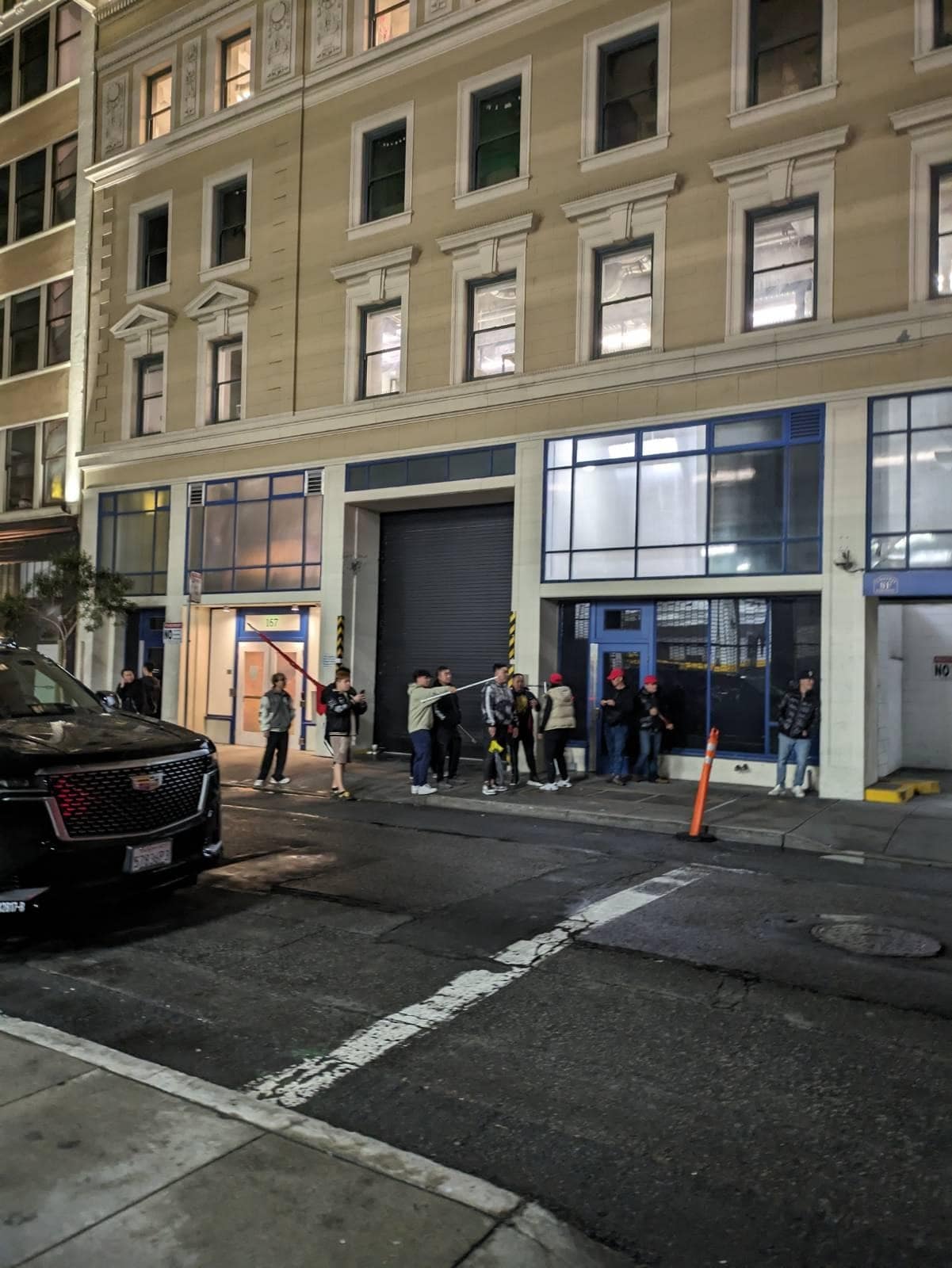
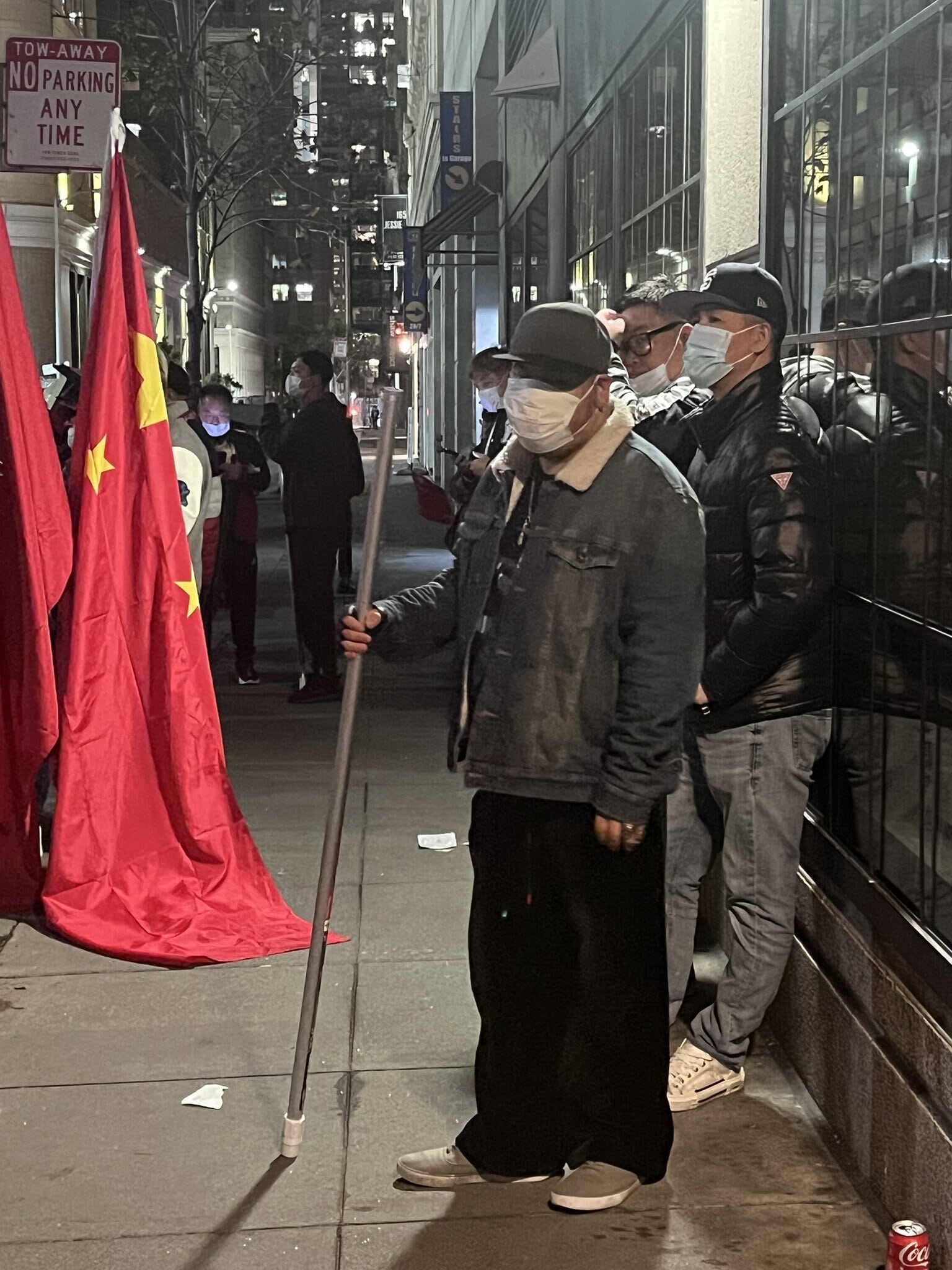
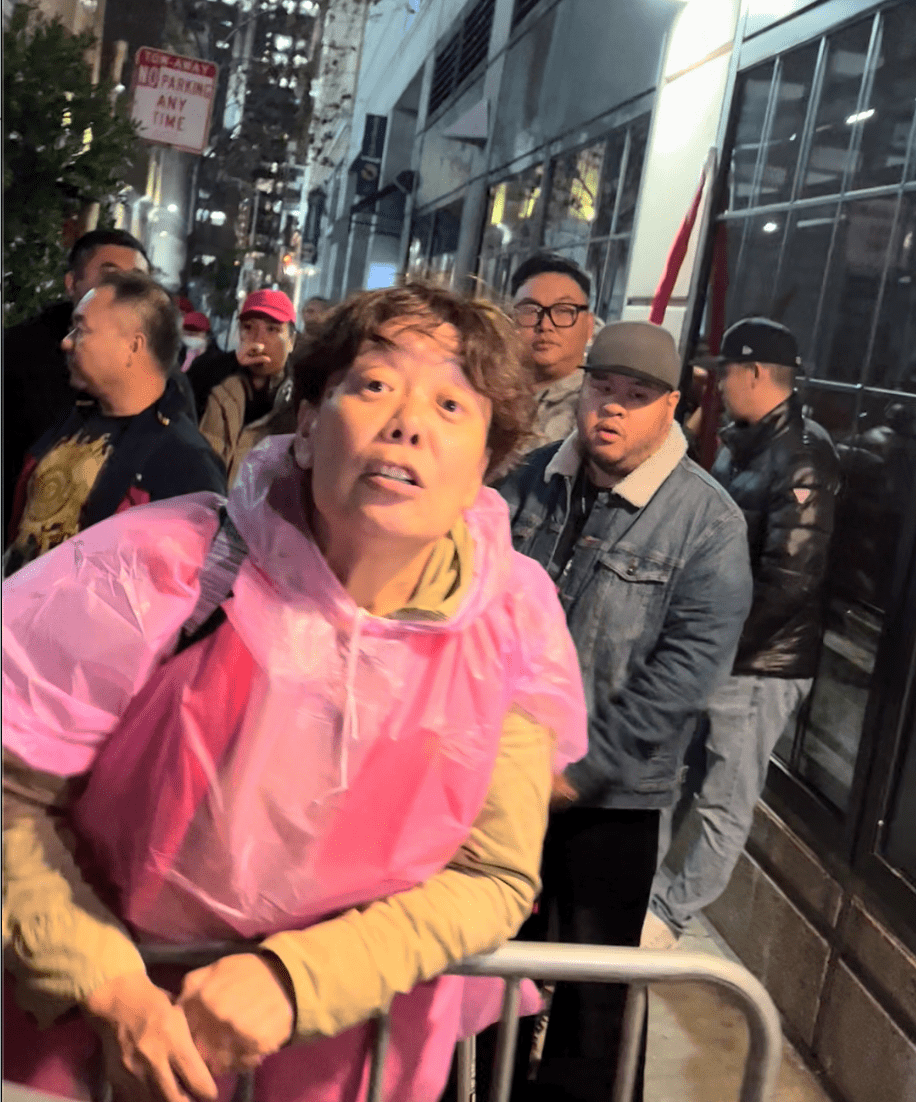
Elements appeared — intimidation by numbers and utilization of flags and flagpoles — that would become familiar in subsequent days. In particular, CCP supporters used their superior numbers to hound and crowd out protesters, attempting to block or obscure both protesters and their banners and flags from the road. Unmarked white trucks delivered massive flagpoles and PRC flags to the CCP supporters.66 While at first glance, use of flags and flagpoles may seem relatively mild as a form of repression, they were consistently singled out by protesters interviewed for this report as among the items most frequently used to harass, intimidate, and assault. The flags were often enormously large and used to cover protesters, both so that their protest could not be seen and so that assailants could not be seen attacking them. The flagpoles were used to hit and stab protesters. PRC flags and flagpoles appear to have been CCP supporters’ weapons of choice throughout Xi Jinping’s visit, presumably because their dual purpose provided a cloak of plausible deniability.

Topjor Tsultrim, Communications Coordinator at Students for a Free Tibet, reported that CCP supporters near the airport pushed into areas where protesters were gathered and surrounded them, apparently at the direction of their leaders or organizers. The CCP supporters attempted to unfurl a large banner in front of the protesters so as to block view of them from the road where Xi was expected to pass. They yelled at the protesters and blared megaphones in their faces. They did not chant slogans; they just had pre-recorded chants and patriotic songs blaring on a loop out of loudspeakers. They persistently tried to drape their flags over the protesters.67

Security guards on the side of the CCP supporters placed themselves in between the CCP supporters and the protesters and asserted, “This is our space,” “our” clearly referring to the CCP supporters. This was the first appearance of security guards. They would be seen wherever CCP supporters appeared in the coming days. They were dressed in all-black suits. (Other security guards employed by another firm would also be seen working for the CCP supporters at another location this same day.) One news report featured an interview with a security guard who was said to work for the Chinese consulate at the scene of confrontations between protesters and CCP supporters.68 Lu Qiang, the united front leader from southern California, told a Chinese-language publication that he had hired security guards.69

The security guards in all-black suits were employed by a firm called Critical Synthesis Security, apparently based in San Francisco.70 Several protesters were confused by these guards’ role in the streets during Xi Jinping’s visit. According to the reports of several protesters, the guards themselves appeared at times confused, or even unenthusiastic, about their role. Some protesters said some guards appeared to assert authority that went beyond anything they could conceivably be legally entitled to.

Screen Shot 2024-01-09 at 11.24.05 AM

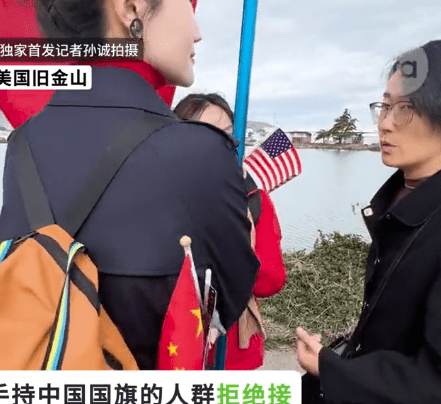
Another pattern seen at the airport that would recur in subsequent days was that, while protesters were happy and often eager to speak with journalists, CCP supporters more often than not declined to do so and were media-shy. They often appeared uncomfortable answering questions about their reasons for being at a public demonstration.71 Almost all reports that exist in which views of and information about CCP supporters are presented are in Chinese-language media with a pro-CCP slant.72


Harassment and Intimidation of Uyghur Camp Survivor Tursunay Ziyawudun and Other Uyghurs

Of particular note is the harassment of Uyghur camp survivor Tursunay Ziyawadun and other Uyghurs.73 CCP supporters attempted to surround her and use PRC flags to cover the flag of East Turkestan she was carrying.


This episode is redolent with ironic symbolism: having escaped from both a CCP concentration camp for Uyghurs and other Turkic Muslims and CCP-ruled East Turkestan, Tursunay found herself harassed once again by people loyal to the regime who had persecuted her, but this time on American soil. The CCP supporters who harassed her most likely had no idea of who she was or what she had been through. The feeling that they, as Uyghurs and other targeted peoples, had come to the US to escape persecution at the hands of PRC authorities and now here they were experiencing it again in the US was a sentiment shared by many of the protesters in San Francisco who were originally from China, East Turkestan, Hong Kong and Tibet.


On the Route from the San Francisco International Airport to the St. Regis Hotel

Along the route from the San Francisco International Airport to the St. Regis Hotel, where the Chinese delegation was rumored to be staying, many CCP supporters, as well as some protesters, awaited Xi’s motorcade.


Harassment and Intimidation of Li Huanjun

One protester in particular posted a video of herself being harassed and intimidated along the route on the afternoon of November 14.74 Her name is Li Huanjun (李煥君).75


Li Huanjun’s family were victims of forced demolition in the PRC. After years of advocating on their behalf and suffering persecution, Li went into exile.76 She had blocked Xi’s motorcade on two of his previous visits to the US.77

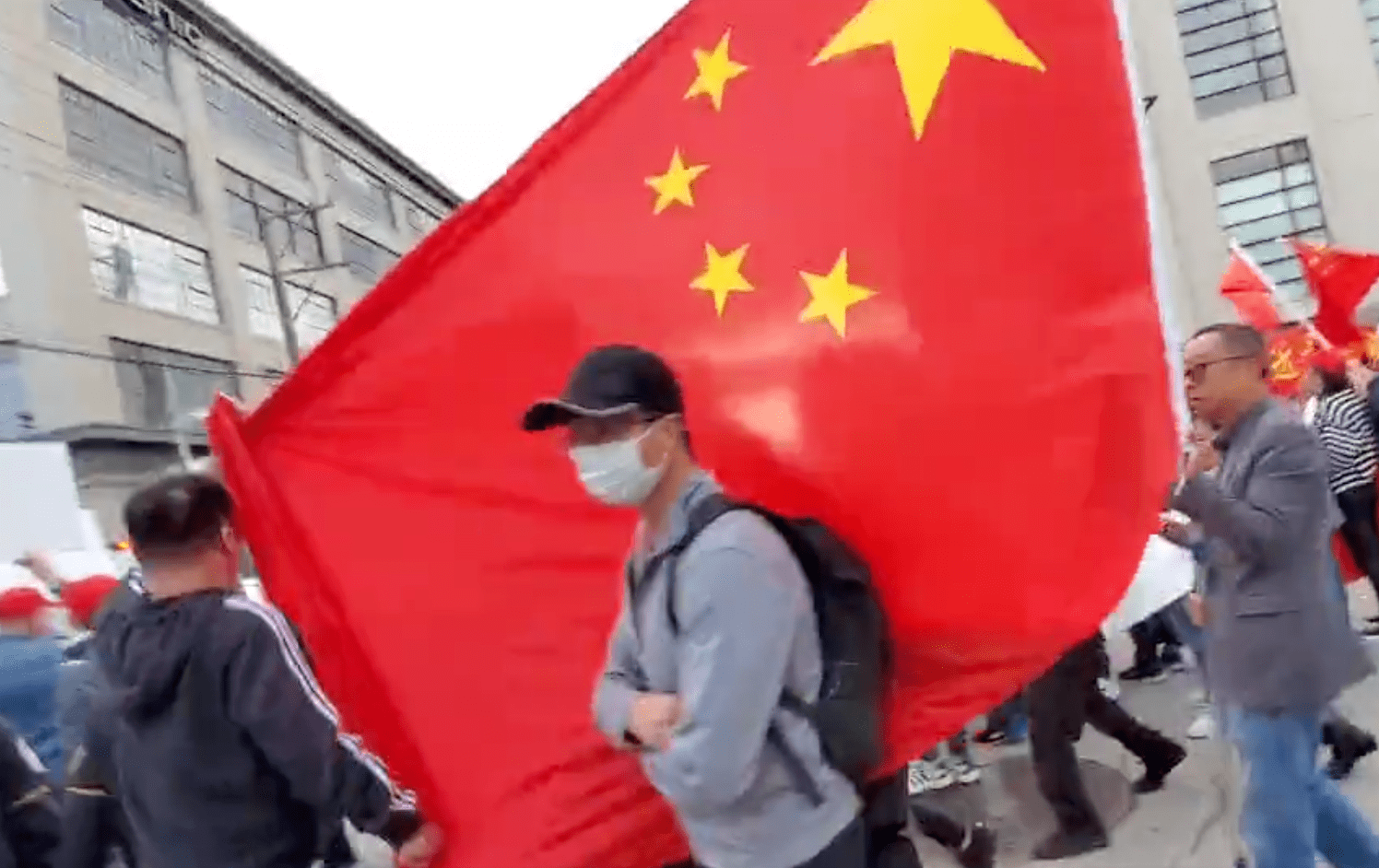
In the video she posted of events on November 14, Li Huanjun can be seen being jostled by CCP supporters. They repeatedly hold a large PRC flag in front of her to hide her from view. Whenever she attempts to get away from them, they follow her and continue to hold the flag in front of her. Near the end of the video, she is hit in the head with a flagpole. She says she was also pinched on the arms, waist, and other places multiple times.78

Here, then, is the already-familiar pattern of flags being used to obscure protesters, flagpoles being used as weapons, and the repeated jostling.

Several elements of united front operations, as well as some united front figures, can be seen in this video. For that reason, it is worth dwelling on some detail.

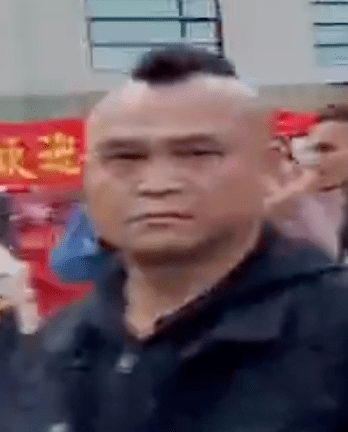
Near the end of the video (01:27), a man with a mohawk appears from behind a flag. He is Chen Longkui (陳隆魁), one of the people who held the flag that was used to cover Li Huanjun.


Chen LongkuiM

According to articles in Chinese-language pro-CCP publications, based on information provided by an official at the united front Work Department of Guilin City, Chen came from Guilin in the Guangxi Zhuang Autonomous Region in the PRC to the US in the 1980s to study, later settling there. As of September 2023, he was president of the Guilin Qiaozi Enterprise Federation (桂林僑資企業聯合會), board chair of the Guangxi Tourism Development Group (廣西景區通旅遊發展有限公司), and an overseas committee member of the All-China Federation of Returned Overseas Chinese (中國僑聯/中華全國歸國華僑聯合會/AFROC). AFROC is the same organization to which Lu Qiang (see above) belongs, the top-level united front group with overall responsibility for overseeing relations with overseas Chinese.79 In fact, Chen attended the same event as Lu, the 11th National Congress of Returned Overseas Chinese, in September 2023 in Beijing, just two months before Xi Jinping’s trip to San Francisco. Xi Jinping and other top CCP officials addressed this Congress, and Chen posed for a photo in the Great Hall of the People in Beijing.80


Another man who appears prominent and centrally in the video in which Li Huanjun is harassed and intimidated is also a united front leader.

Chen LongkuiM

His name is Jing Dongsheng (靖東升). He is reported to be the president of the united front group, Oregon Association for the Promotion of the Peaceful Unification of China (俄勒岡州中國統一促進會),81 Executive Chairman of the Oregon National Day Organizing Committee (俄勒岡州國慶籌委會),82 and the Honorary Chairman of the American Chinese United Association Oregon Chapter (美華總會俄勒岡州分會).83 Associations for China’s “peaceful unification” are prototypical united front groups affiliated with the China Council for the Promotion of Peaceful National Reunification, which was set up by the united front Work Department. In November 2019, Jing hosted a delegation from the China Council for the Promotion of Peaceful National Reunification led by its Deputy Secretary-General Sun Lingyan (孫凌雁), a meeting reported on by the Alliance for China’s Peaceful Reunification, USA.84 In August 2022, he hosted a banquet to welcome Zhang Jianmin, the Consul General of the PRC consulate in San Francisco (中國駐舊金山總領事張建敏), to Oregon.85


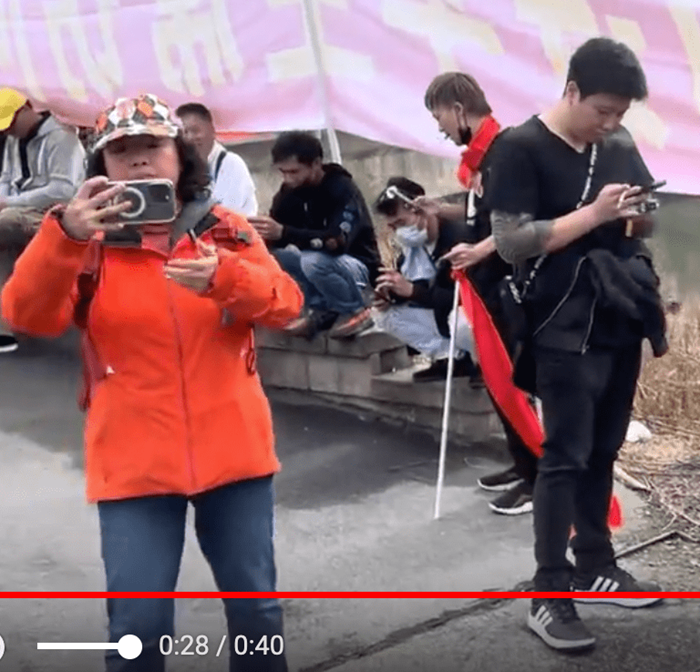
In addition to having participated in the harassment and intimidation of Li Huanjun, Jing Dongsheng appears also to have been a “scout,” one of the people apparently stationed at various “sensitive” locations where Xi’s delegation stayed or was expected to appear around San Francisco to keep a lookout for protesters. He appears in this video posted by Ma Yongtian (馬永田) photographing her with his camera in a taunting manner.86


Ma Yongtian is from Jilin Province. Her factory was forcibly seized in 2001, and since then, she has been seeking compensation. She was arrested in 2017 in Florida for blocking Xi Jinping’s motorcade.87 In San Francisco, she was searching for a place where she might do the same when she came across these scouts. Not only is Jing Dongsheng present, so are other recognizable united front figures. Two of them appear together with him in the same frame, as can be seen in the following photo:

images/Ma-Yongtian-video-2.png

These two were seen elsewhere on the streets of San Francisco as well. One is named Yu Yingqiang (余穎強; to the left in the above photo). He was seen acting as a lookout near the Hyatt Regency Hotel on November 15 and was among the crowd of CCP supporters that assaulted Tibetan protester Chemi Lhamo near the airport on November 17. On the evening of November 15, Yu assaulted an elderly Hong Kong protester near the Hyatt Regency where a banquet for Xi Jinping was being held (see below for details).88 The other man is Rong Junwu (容鈞武; in the middle of the above photo). He was part of a group of CCP supporters that assaulted several Chinese protesters near the Moscone Center on November 16 and at the San Francisco International Airport on November 17 (see below for details).


Moscone-Center-16nov23

It seems that, like Jing Dongsheng, both of these men are from the Portland, Oregon, area.89


Jing Dongsheng has also been seen at united front street demonstrations on other occasions. In March 2023, he was among the CCP supporters protesting against Taiwan’s then-president Tsai Ing-wen’s visit to Los Angeles. There he can be observed with the other two united front figures, He Konghua (何孔華) and Chen Zhaojin (陳兆進), both of whom showed up in San Francisco (see below for information about their activities in San Francisco during Xi Jinping’s visit), as well as with Rong Junwu.

Screen-Shot-2024-02-02-at-2.31.52-PM-min.png

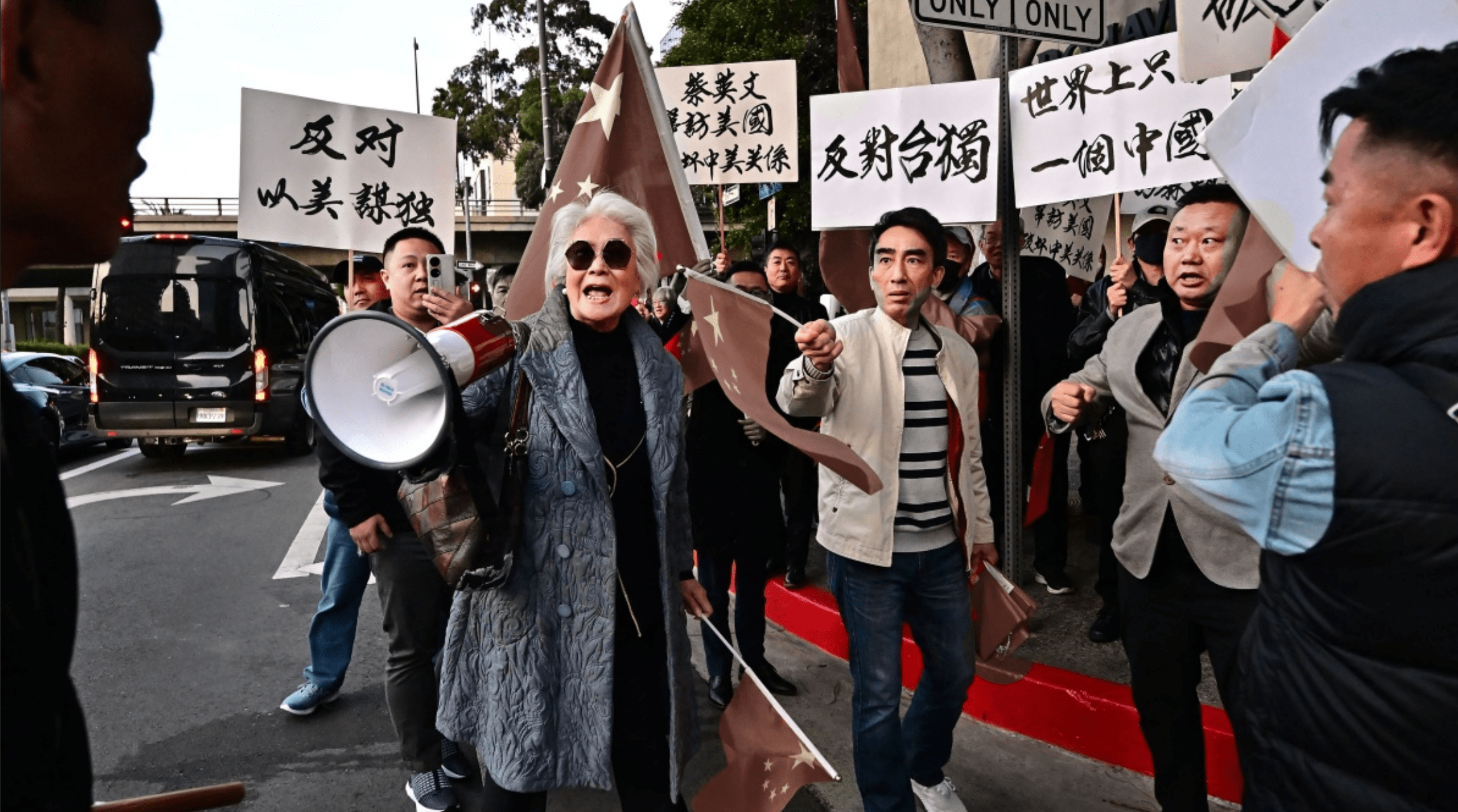
In this photo taken in Los Angeles, the woman in sunglasses and carrying a megaphone is He Konghua, the leader of the Beijing Association in San Francisco. The man to her left in the white jacket is Rong Junwu, who was scouting and also part of the group that assaulted Chinese protesters in San Francisco where he wore the same white jacket. The man to his left is Jing Dongsheng, and the man behind He Konghua and holding a phone is Chen Zhaojin, another united front figure from San Francisco. Newsweek reported that the pro-CCP demonstrators against Tsai were offered $400 each by Deputy Consul Li Chunlin of the Chinese consulate in Los Angeles for each day of the protest.90


Jing Dongsheng also attended a united front protest against Taiwan then-Vice President William Lai Ching-te’s visit to San Francisco in August 2023.91 Another united front figure, Yang Baohai (楊寶海; he also goes by the name, Liu Baohai/劉寶海) also attended. Yang would later be seen on November 15 among a group attacking Tibetan protesters outside the Hyatt Regency Hotel (see below).

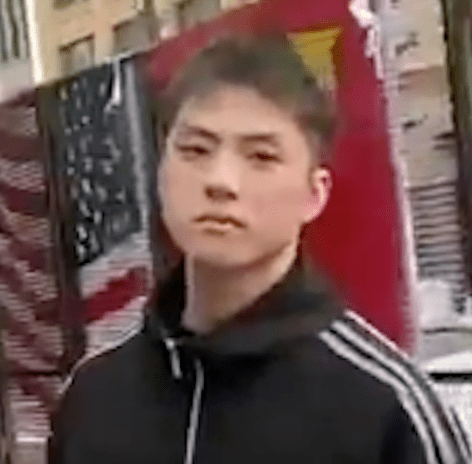
The other scouts in Ma Yongtian’s video are the men dressed in similar black tracksuits.

Screen Shot 2024-02-08 at 11.24.09 AM  Screen Shot 2024-02-08 at 11.21.23 AM

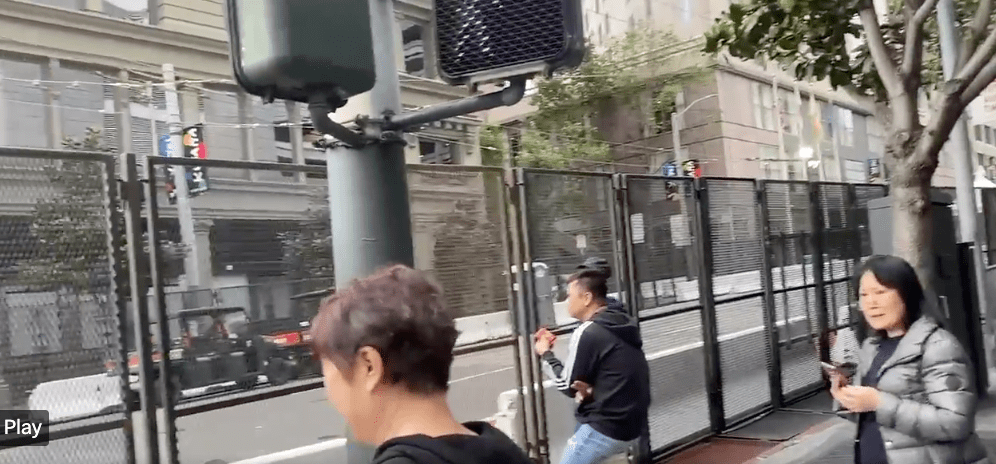
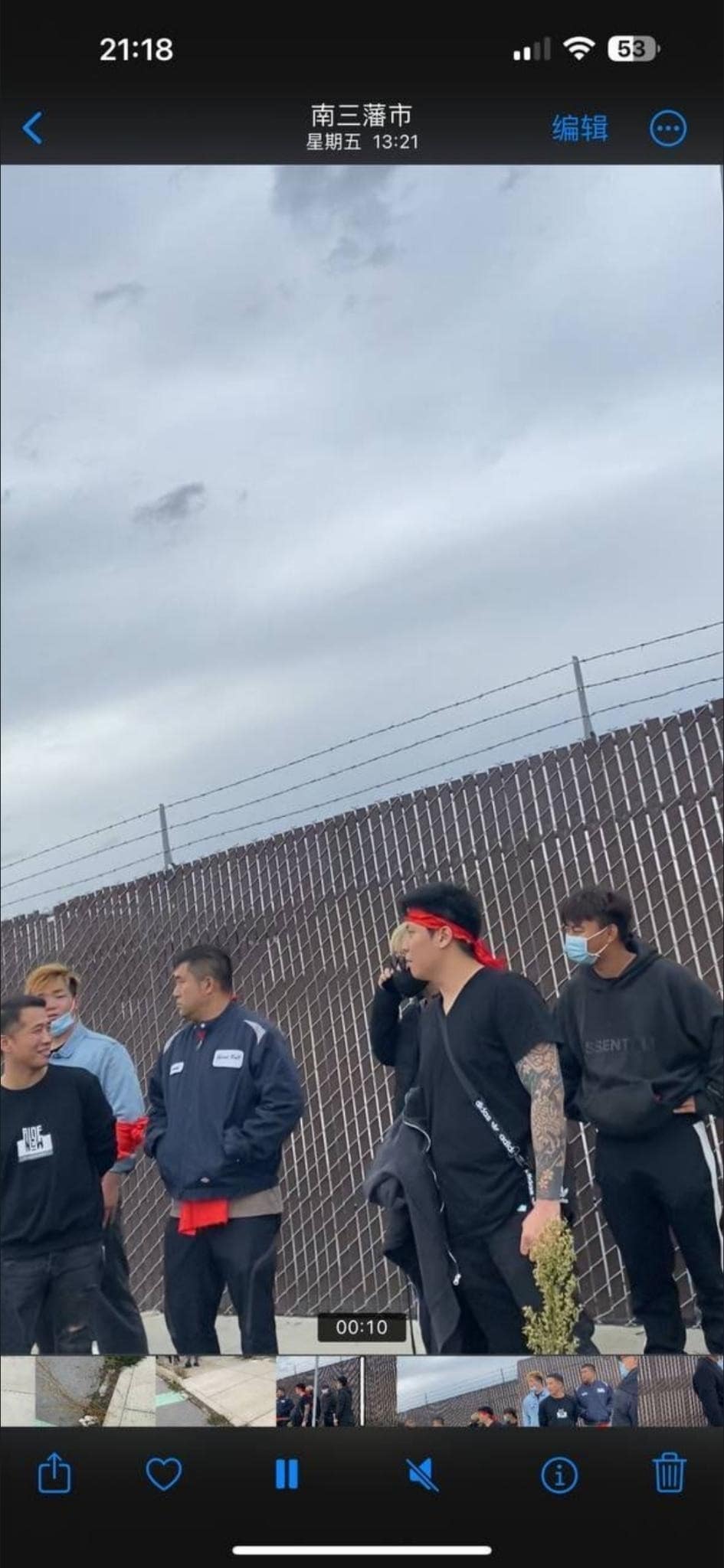
Men in black tracksuits were spotted repeatedly conducting similar scouting activities in the downtown San Francisco area during Xi Jinping’s visit.

Screen Shot 2024-02-07 at 1.01.59 PM

Several protesters suspected that these men had been assigned to look out for and report on “troublemakers.”


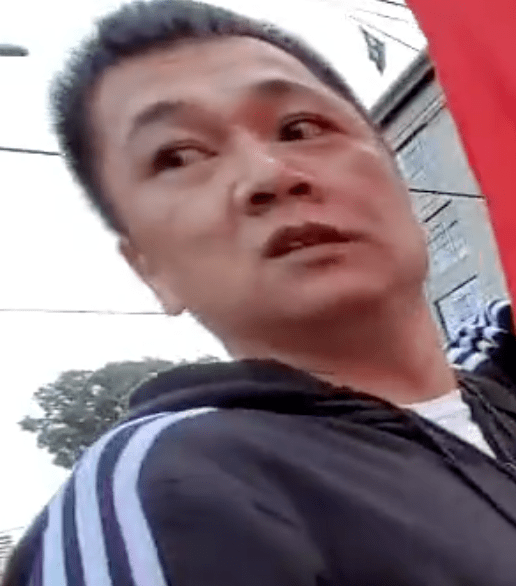
They did not always restrict themselves to scouting alone. Circling back to the video of the harassment and intimidation of Li Huanjun, a man in a black tracksuit top is holding the flag being used to cover Li.

Screen Shot 2024-02-08 at 12.53.08 PM

He turned and looked at Li (who was holding the camera):

Screen Shot 2024-02-08 at 12.59.55 PM

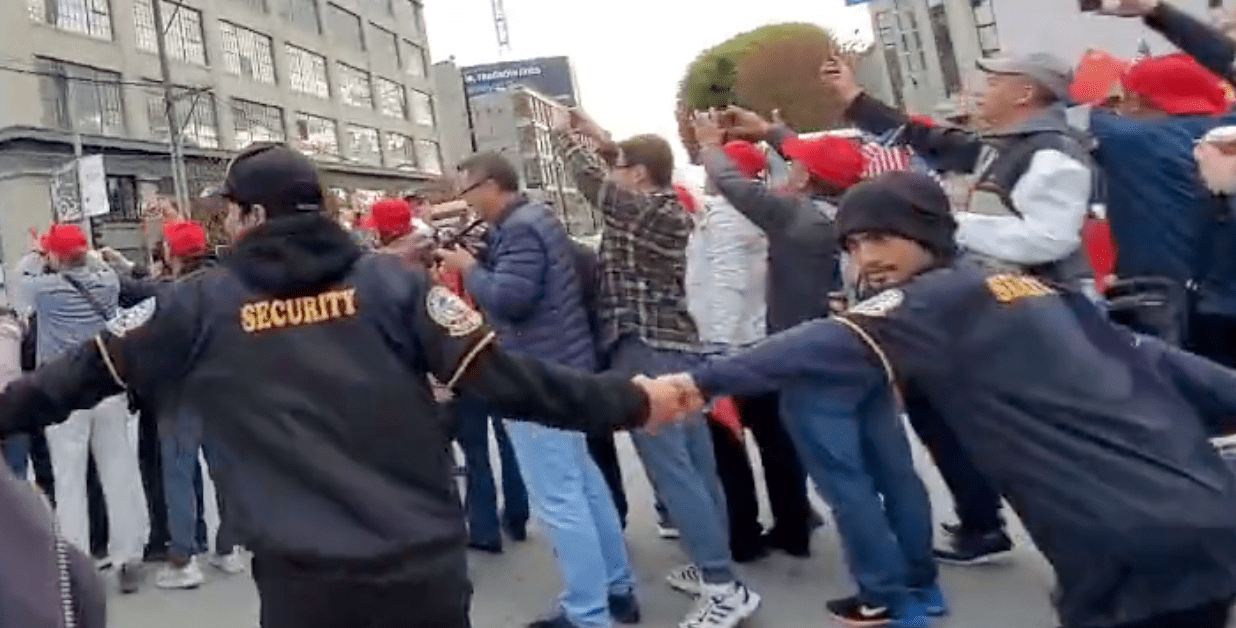
Also in that video, security guards can be seen cooperating with the CCP supporters. A group of security guards links hands with one another to prevent Li Huanjun from approaching the street.


Screen Shot 2024-02-08 at 12.57.32 PM

Judging by their uniforms and shoulder badges, these security guards work for a different company than those from Critical Synthesis, who dressed in black suits and could be seen at many incidents of harassment and intimidation of and assault on protesters on all days of Xi Jinping’s visit to San Francisco. These guards appear younger and wear the shoulder badge of the National Protective Service Private Security, a group that advertises itself as working in the San Francisco Bay Area.92

As in several other incidents of harassment and intimidation of and assault on protesters by CCP supporters, rather than intervene to protect the victim, the security guards assisted the perpetrators.


Near the St. Regis (125 3rd St, San Francisco)

The St. Regis San Francisco Hotel is where Xi Jinping and the PRC delegation were reported to be staying. For that reason, it attracted both CCP supporters and protesters.

Xi Jinping was reported to have touched down at San Francisco airport at 2:30 pm, and Xi was reported to have arrived at the St. Regis around 3:30 or 4 p.m. on November 14.93

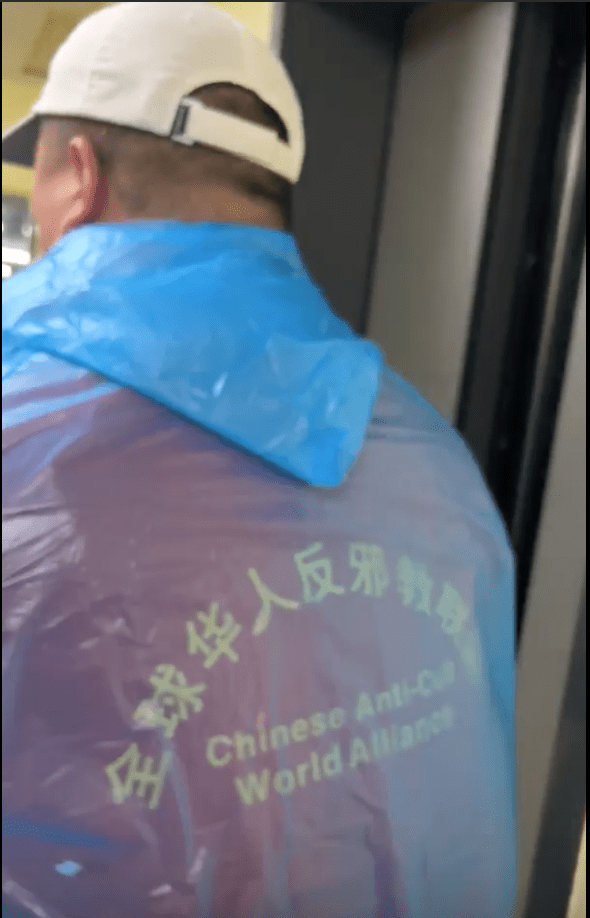
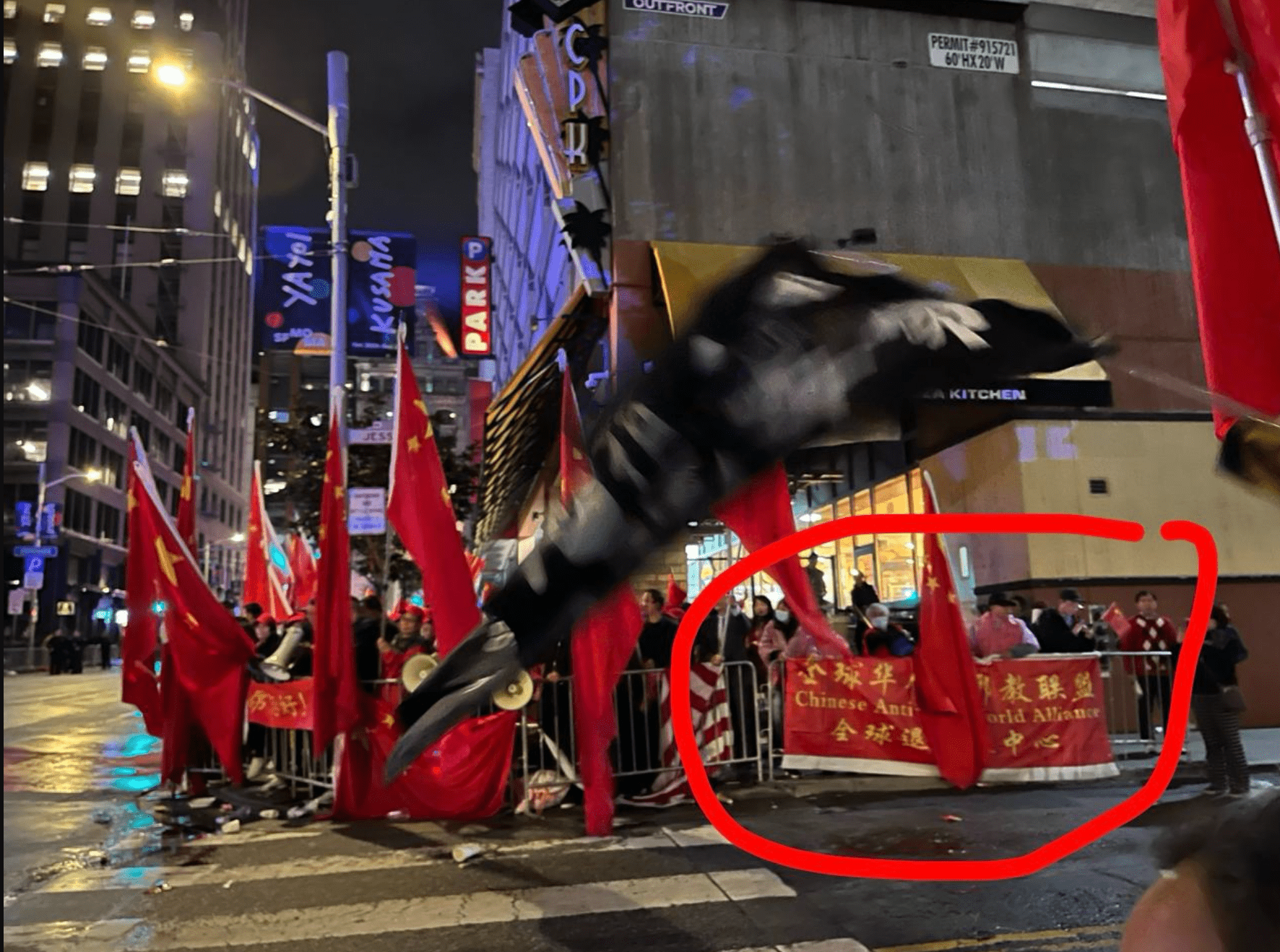
Trouble outside the hotel began earlier that afternoon. Large numbers of one CCP united front group, the American Chinese Commerce Association (Hong Kong) (ACCA (HK), 美國(香港)旅美華人總商會), as well as members of another united front group, Chinese Anti-Cult World Alliance (全球華人反邪教聯盟), were present. The chair of ACCA (HK), John Chen Shanzhuang (the united front leader profiled earlier in this report who organized the transport of many from New York) was present.94 CCP supporters blared the PRC national anthem on a loop on loudspeakers and attempted to outshout and sometimes surround the protesters with PRC flags.95 Most of the protesters were effectively harassed out of the area by Xi’s supporters.

Assault on Jia Junwei

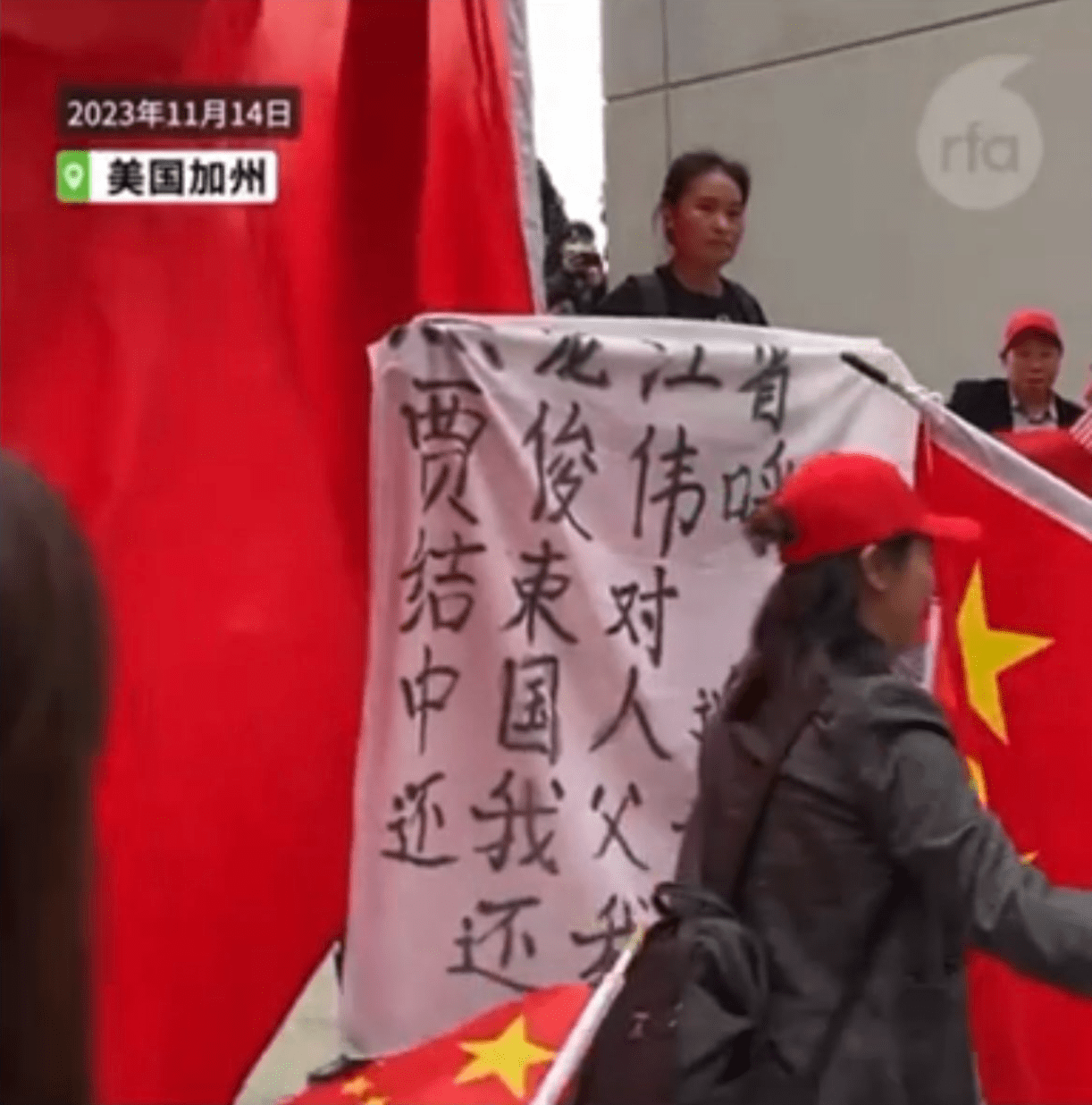
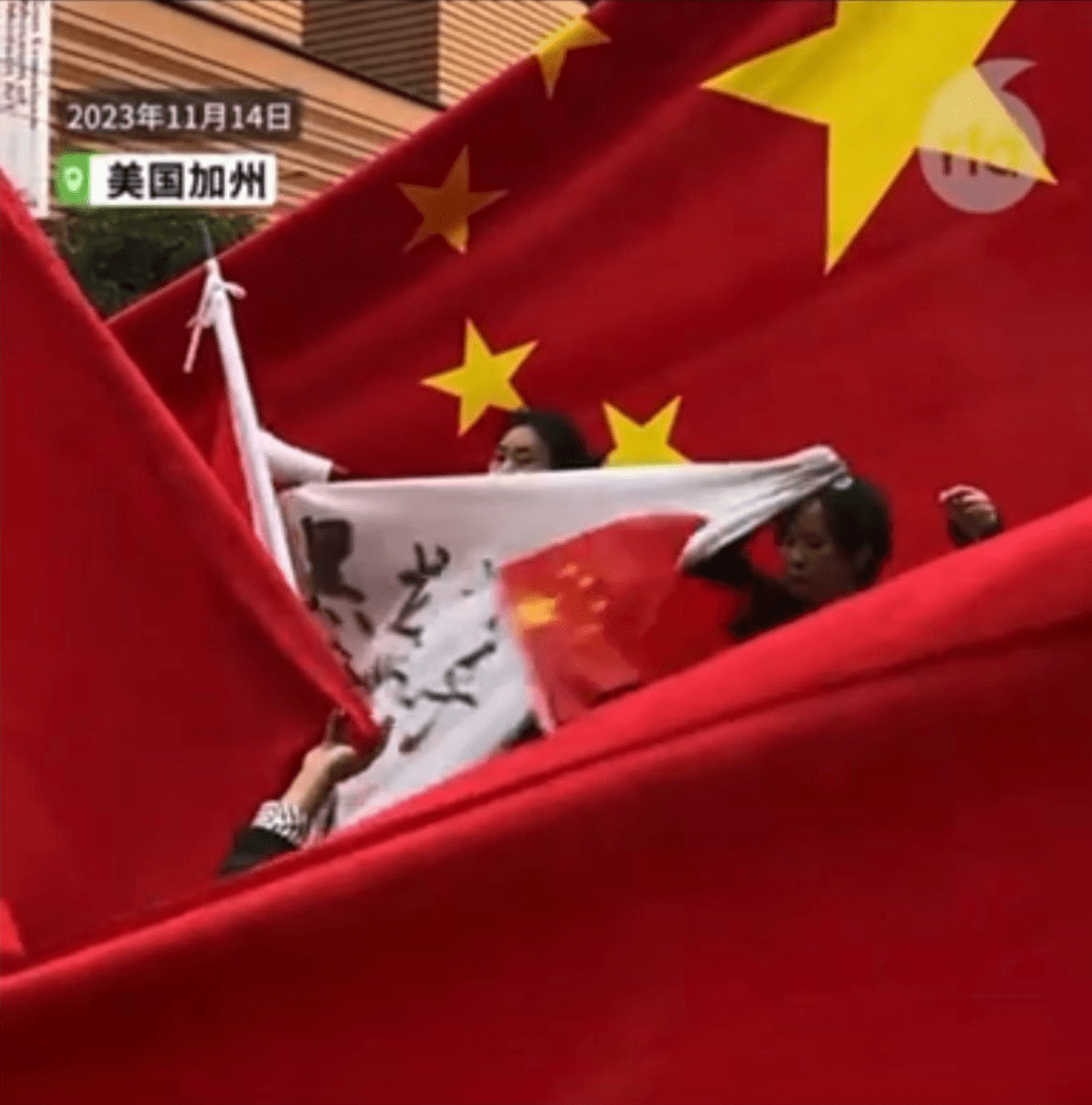
Around this time, a protester named Jia Junwei (賈俊偉) said she was attacked by a group of CCP supporters in the vicinity of the St. Regis Hotel. Jia said she was protesting because her home in the PRC had been demolished by corrupt elements (腐敗分子), and her father had been imprisoned and “persecuted to death” in custody. She held up a handmade banner that told this story.

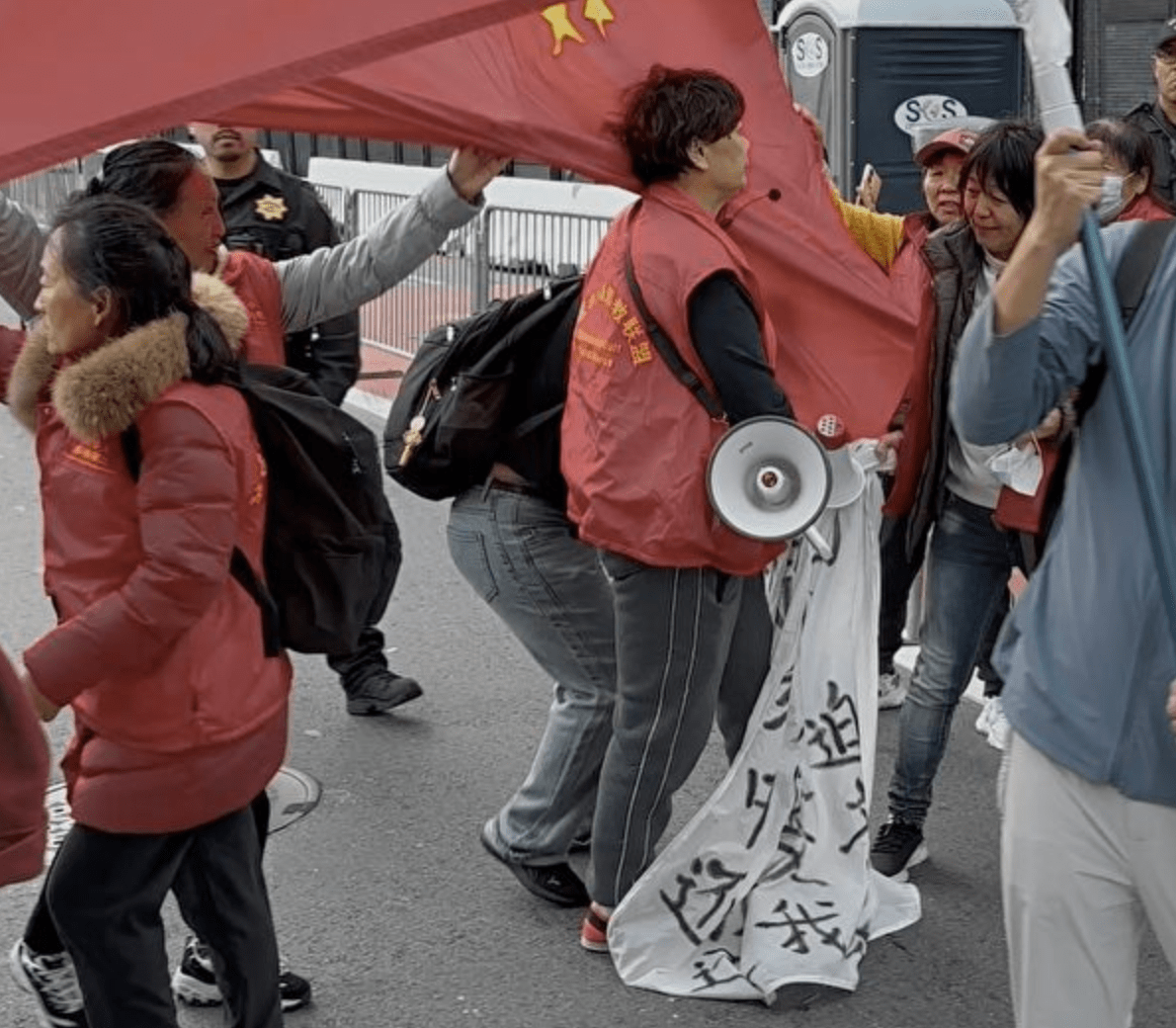
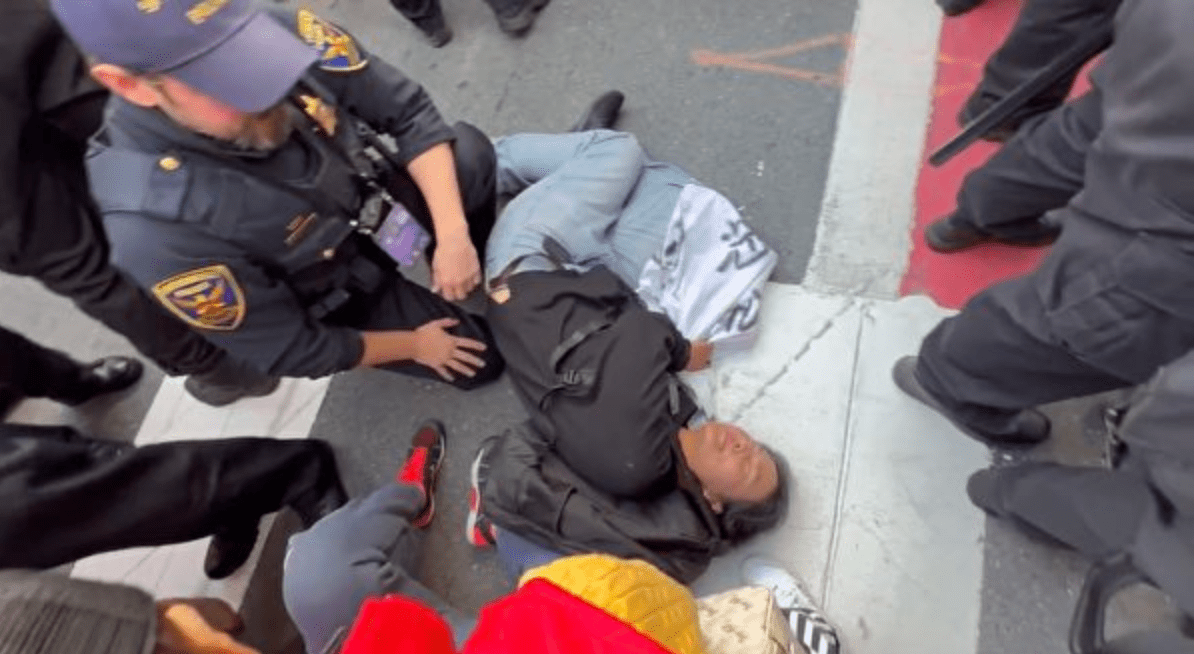
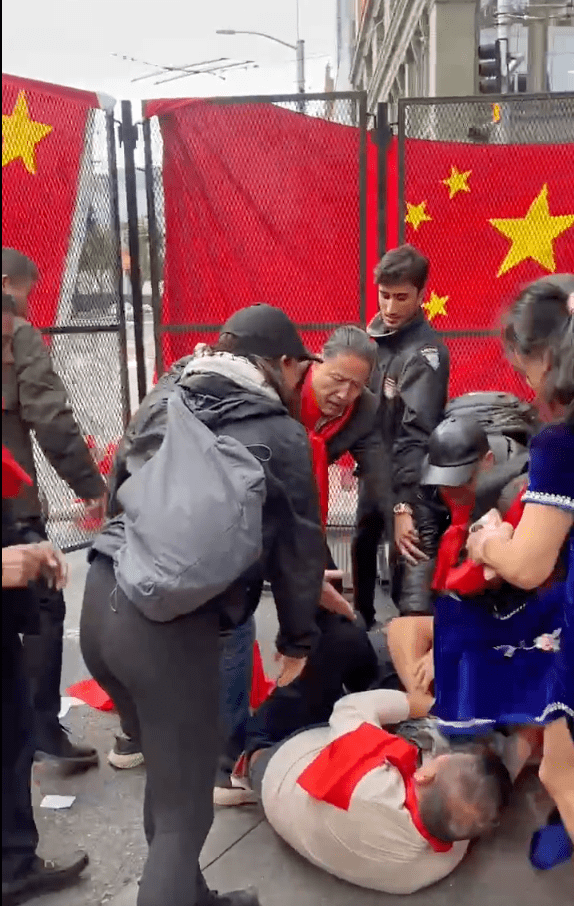
Jia said that a CCP supporter named Li Huahong snatched her banner, dragged her into an area surrounded by other CCP supporters who held up their large PRC flags so that no one could see what was happening, pulled her hair, and hit her in the head. She lost consciousness but could still feel that she was being hit in the head by what felt like flagpoles. She believed this was done to her because Xi Jinping’s motorcade was expected to arrive at the hotel, and the attackers didn’t want Xi to see her. Jia also believed the CCP supporters were ordered by members of the PRC Embassy to attack her. People she believed to be members of the PRC Embassy first took photos of her, then pointed and gestured at her. It was only after they pointed and gestured at her that the people with PRC flags came over and surrounded her. The apparent leader of the attack, Li Huahong, wore an earpiece and headphones and carried a loudspeaker. After Jia was attacked, an ambulance came to the scene, and first responders attended to her.96

In these photos, the CCP supporters can be seen surrounding Jia and attempting to block view of her with PRC flags.

Screen Shot 2024-02-08 at 12.21.54 PM  Screen Shot 2024-02-08 at 12.21.30 PM

In the following photo, CCP supporters have taken Jia ’s banner and are surrounding her. Jia is the one wearing the black backpack and gray pants. Strikingly, a police officer stands in a position from which he must have a view of what is occurring but does nothing to intervene.


attack on Jia Junwei 14nov23 St. Regis 希望之聲

Only after Jia has been knocked to the ground unconscious does a police officer come to her aid.

aJia Junwei on ground 13nov23 希望之聲

Six elements of this attack fit a pattern seen repeatedly over the days of Xi Jinping’s visit:


1.an attack on solitary and isolated protesters by a group of CCP supporters;

2.swarming of victim by multiple CCP supporters;

3.the use of PRC flags to obscure the attacks;

4.the use of flagpoles as weapons to hit and stab protesters;

5.heightened aggression and violence when Xi Jinping is believed to be in the vicinity so as to ensure that he cannot see any signs of protest; and

6.an apparent leader, often wearing an earpiece, who appears to be directing the CCP supporters.


After the attack, Jia said she was nauseated and had no appetite. She later went to Los Angeles where she visited a hospital and was diagnosed with symptoms “consistent with a concussion.” She was issued concussion discharge instructions and prescribed medication.97


Li Huahong, Prominent Leader of united front Group and an Alleged Assailant

The person whom Jia Junwei identified as her main attacker was Li Huahong (李華紅). Jia says Li snatched her banner, dragged her into the encirclement of PRC flags, pulled her hair, and hit her in the head. After Jia fell to the ground, Li kicked her in the waist. Jia claimed Li was the leader of the attack. She wore an earpiece and headphones and held a loudspeaker.98 She is the woman in the photo above with the white megaphone strapped to her shoulder.

Li was alleged to be involved in other attacks on subsequent days. On November 15, outside the Hyatt Regency Hotel where a banquet was held in Xi Jinping’s honor, she was among a group of CCP supporters, some of whom later attacked protesters.

IMG_6974 (1)

On November 16, Ge Kaiying (葛開英) reports that she was attacked at noon by Li Huahong on Fourth Street in downtown San Francisco. She was alone and said Li recognized her from her presence at protests on previous days. According to Ge, Li stepped on her feet, then grabbed a box from her. When Ge tried to recover her belongings, Li hit her.99


On November 16, China Democracy Party leader and protester Chen Chuangchuang (陳闖創) was pepper-sprayed in the face by an assailant who suddenly rushed at him (see below). Right before the incident, Chen had noticed Li Huahong, whom he recognized because they both live in Chinese communities in New York City.

Chen reports that, on November 15, Li was chatting with someone from Chen’s group, though she did not know that person was a protester. She told this person that she was being paid about $200 a day to be in San Francisco and, after “welcoming Xi” on November 14, had been treated to a lobster dinner.100

Li Huahong is a prominent united front figure. Since the founding of the Chinese Anti-Cult World Alliance (全球華人反邪教聯盟, CACWA), Li has represented herself as its chairperson.101 According to its mission statement in its Certificate of Incorporation in New York State, as a not-for-profit corporation, CACWA is dedicated to “expos[ing] Falun Gong as an evil and dangerous threat to society.” CACWA is a branch office or affiliate organization of the China Anti-Cult Association (中國反邪教協會, CACA). CACA is officially a private organization in the PRC, but it “has close ties with the CCP and is generally perceived as part of its apparatus.”102 CACA has created branch offices or affiliate organizations such as CACWA around the world to conduct “comprehensive suppression overseas.”

According to the Human Rights Law Foundation, “CACWA’s chairpersons and affiliates have…been implicated in numerous instances of violence, death threats, and property destruction targeting Falun Gong practitioners…”103

Both Li and other members of CACWA were convicted in 2013 of assaulting Falun Gong practitioners and people they suspected of being associated with Falun Gong in 2011 in New York City.104

Li Huahong was wearing a CACWA vest when she assaulted Jia Junwei on November 14 (see photo above). A man wearing a CACWA jacket was part of a group that attacked Tibetan protesters inside a parking garage across from the Hyatt Regency Hotel on November 15.

CACWA in parking garage

A CACWA banner was hung on a barricade near an attack on Tibetan and Hong Kong protesters on the street across from the Hyatt Regency on November 15.

Chinese Anti-Cult World Alliance banner

Wednesday, November 15

First day of Xi’s Visit to San Francisco

Xi Jinping arrived at the San Francisco International Airport. He and the Chinese delegation were rumored to be staying at the St. Regis hotel. Hundreds of CCP supporters lined the route from the airport to the hotel and also gathered near the hotel. Some protesters also went to the airport, a few were present along the route of Xi’s motorcade, and a few more were near the hotel. The first incidents of harassment, intimidation, and assault occurred on this day.
Among the serious incidents of the day were these:

–an assault on Chinese activist Wang Wei outside the St. Regis;

–harassment of Tibetan activist Tsela Zoksang and the Tibetan protesters accompanying her as she climbed a flagpole outside the Hyatt Regency;

–an attack on four Tibetan activists in a parking garage across from the Hyatt Regency by a group of 10 to 15 men;

–an attack on Hong Kong and Tibetan protesters at the designated protest area that had been set up for them by police across from the Hyatt Regency;

–an assault on an elderly Hong Kong protester near the Hyatt Regency and

–the stalking of Tibetan protesters by the same group of men who attacked the designated protest area as the protesters left the area near the Hyatt Regency at the end of the protest.


On the Route from Downtown San Francisco to the Filoli Estate

The route from downtown San Francisco to Filoli, where the Biden-Xi meeting took place, was lined with CCP supporters who were bused there from their accommodations. Their positioning along Cañada Road suggests that they were alerted to the route that Xi’s motorcade would take to reach Filoli, as there are two possible routes, and the attendees were all lined up along the route the motorcade eventually took. Some Chinese protesters also gathered there. Scuffles broke out among some CCP supporters and Chinese protesters as the CCP supporters used their numbers to try to deny space to the protesters, crowding them out, and attempting to ensure that they could not be viewed from vehicles passing on the road.105

Rally and March Protesting against Xi Jinping

In the morning, Chinese, Hong Kong, Tibetan, and Uyghur protesters gathered at the Chinese consulate of San Francisco for a rally. Afterwards, more than one thousand protesters marched through downtown San Francisco.106 The march was accompanied by police officers.

The rally and march were one of the few occasions during the days of Xi Jinping’s visit in San Francisco when protesters were not attacked, harassed, or intimidated by CCP supporters. This is primarily due to three factors:

  1. It did not go anywhere near where Xi Jinping was expected or scheduled to be.
  2. It was accompanied by a significant deployment of police officers.
  3. It was large.

Conversely, most of the incidents of harassment, intimidation, and assault occurred near locations where Xi Jinping was present or expected to be and where CCP supporters outnumbered protesters. At those locations, there were large deployments of police officers, but more often than not, police did not appear to regard the protection of citizens as their primary duty, and their apparent indifference signaled to CCP supporters that they would not be held accountable for their actions.

Only when arriving in downtown San Francisco, at Market and Third Streets, did the marching protesters meet CCP supporters who had already started to gather in large numbers in the vicinity of the Hyatt Regency Hotel, about one block away. The hotel was the venue of the banquet for Xi to be held that evening. The large contingent of Tibetans, hundreds strong, as well as a group of Uyghurs, had originally planned to go to the Hyatt Regency to protest in the evening, but a significant portion of them were dissuaded from doing so by the sight of the large number of CCP supporters already gathering there. The CCP supporters had formed a physical wall of people that appeared to block passage to the Hyatt Regency. They feared there might be confrontations, and, for the sake of the safety of the protesters, they decided it was best to avoid that possibility. Students for a Free Tibet Executive Director Pema Doma said, “We’d originally wanted 500 Tibetans marching toward Tsela’s flag-raising action [see more on that below], but, when we saw how many CCP supporters there were and how aggressively they behaved, we decided it was too confrontational to lead the large protest. This was around 4 or 5 p.m. We said to the Tibetans, anyone who feels unsafe can go home; anyone who wants to stay, we will continue to protest. Nearly all the elders and children decided to return home, and a small contingency of mostly young adults remained to have our voices heard.”107 A smaller group of Uyghurs also decided to leave for the sake of safety.108 This is a clear instance of the large numbers of CCP supporters, who had already harassed, intimidated, and assaulted a number of protesters, having a deterrent effect on protest. Some Hong Kong and Tibetan activists would later go to the Hyatt Regency to protest, and their experience would substantiate the fears of the Tibetans and Uyghurs who did not go.

Assault on Wang Wei

While the march was taking place, Chinese activist Wang Wei (王維) was assaulted near the St. Regis Hotel at about 11 a.m.109 Like Jia Junwei the day before, Wang was not accompanied by other protesters, and his isolation appears to have emboldened his attackers.

110


Wang Wei testified that he noticed some CCP supporters and started taking videos of them because he feared attack and thought filming them might act as a deterrent or at least provide evidence in case of attack. He wore a “Free China” sticker on his arm and believed this excited their animosity. He and they exchanged sharp words. Then the CCP supporters began attacking him. There were some middle-aged men and a woman wearing a blue cheongsam. She shoved Wang three times. He warned the group that if he was pushed again, he would take action. After another shove, he stuck out a leg, and the men surrounded him and started beating him. They pushed him to the ground. The attackers then surrounded him with their large PRC flags and continued to strike him. One of them stabbed him with the tip of a metal flagpole. Still lying prostrate on the ground and realizing he was all alone, Wang grabbed the leg of a person who tried to kick him. After he grabbed the leg, others began kicking him as well, and continued to punch him. Wang became disoriented and felt as if he were going to faint. Only later did he learn that he was able to escape due to two white women who broke things up. They placed themselves between Wang and his assailants. They asked him if he was okay and helped him to call the police. Later, an ambulance came and took Wang to the hospital, where he received treatment. He and friends had originally planned to return to Los Angeles, where he lives, that evening, but then discovered that one of the tires of his car had been punctured by two large screws. He didn’t know whether or not this was done deliberately.

In the video above, a young security guard from the National Protective Service Private Security, a company allied with the CCP supporters, makes a feeble attempt to intervene but almost immediately desists. He then turns to a police officer standing on the other side of the black metal fence separating the sidewalk from the road, apparently to point out the assault to him. The police officer takes no action.

Screen Shot 2024-03-21 at 10.52.07 PM   Screen Shot 2024-03-21 at 10.52.34 PM

On November 21, Wang returned to San Francisco to file a report about the assault with the police . As of February 1, 2024, when he was interviewed for this report, he had not heard back from the police about whether or not they had taken any action.111

Wang Wei identified the people in the following photographs as his attackers.

Screen Shot 2024-04-12 at 7.49.09 AM112

The attack on Wang Wei involved four united front leaders from the Seattle area. One of them, the woman dressed in the blue cheongsam who precipitated the attack on Wang, is named Zhuo Ma (卓瑪), also known as Wengxi Zhuoma (翁西卓瑪), also known as Youyong (游泳).113

She is President of the Sichuan Association of Washington State (美國華盛頓州四川同鄉總會), a united front group in the Seattle area. According to her bio on a pro-CCP website, she was born into a “revolutionary family” in China and came to the US in 2010. She “welcomed” Xi Jinping on a previous visit of his to the US in 2015 as part of the “special team” of Liang Guoyao (梁國堯), a prominent united front leader who holds multiple positions related to his place of origin, Guangdong Province.114

China Democracy Party (中國民主黨) leader Chen Chuangchuang (陳闖創), who would himself become a victim of assault by CCP supporters the following day, the 16th, said that Zhuo Ma confronted a group of protesters around 9 a.m. on the morning of the 15th, about two hours before the assault on Wang Wei, and, at that time, admitted that she was a member of the Chinese Communist Party.115

A second assailant of Wang Wei from the united front network in the Seattle area is Guo Jianwei (郭建偉).

Screen-Shot-2024-02-23-at-10.43.10-AM.png

In the video above, Guo can be seen punching Wang Wei (see 1:00).

He is president of the Henan Association of Washington State (華州河南同鄉會), a united front group in Seattle. In a speech given at an event celebrating the fourth anniversary of the Henan Association in March 2019, Guo boasted of his organization’s ties to the Henan Province Overseas Chinese Association (河南省僑聯), a united front group based in Henan Province, as well as to the Henan Province Zhi Gong Party (河南省致公黨).116 The China Zhi Gong Party is one of the eight minor parties of the PRC under the control of the united front Work Department. According to united front expert Anne-Marie Brady, “The Zhi Gong Party is a united front link to liaise with overseas Chinese communities…”117 It is a member of the Chinese People’s Political Consultative Conference, the top-level united front body.118 Guo was also present in Los Angeles at an April 2023 protest against Taiwan’s then-president Tsai Ing-wen’s visit to the US and can be seen standing alongside He Konghua (何孔華), a prominent San Francisco united front leader who also appeared among CCP supporters at the San Francisco International Airport on November 17, the day of Xi’s departure (see above and below).119 Also attending that protest against Tsai with Guo Jianwei and He Konghua, were two other united front figures, Jing Dongsheng and Rong Junwu, both of whom were active on the streets of San Francisco during Xi Jinping’s visit as well (see above). Guo also appears briefly in a video of the April 2023 Los Angeles protest against Tsai made by the satirical comic LeLe Farley.120

Screen-Shot-2024-02-23-at-11.16.49-AM.png

A third united front leader from the Seattle area involved in the assault on Wang Wei is Fang Weixia (方偉俠), chair of the Association for China’s Peaceful Reunification of Washington State (華盛頓州中國統一促進會會長). He can be seen punching (see 1:00) and kicking (see 1:13) Wang Wei in the video above.

In September 2019, Fang spoke at an event celebrating the 70th anniversary of the founding of the PRC. Zou Yonghong (鄒永紅), Deputy Consul General of the PRC consulate of San Francisco, also spoke at that event. Guo Jianwei (see above) was also present on that occasion.121 In June 2022, he met Consul General Zhang Jianmin at the PRC consulate in San Francisco. The latter recognized Fang’s work as head of the Association for China’s Peaceful Reunification of Washington State to promote US-China relations and China’s “peaceful reunification.”122

Lastly, a fourth united front leader involved in the assault on Wang Wei is Chen Wenshen (陳文深). He first appears at the 00:47 mark in the video above.

Screen-Shot-2024-01-09-at-12.35.36-PM.png

Chen is vice president of the Seattle-area Fujian Chamber of Commerce and Industry in Washington State (華州福建工商會). In March 2019, Zou Yonghong (鄒永紅), Deputy Consul General of the Chinese consulate of San Francisco, attended and spoke at the founding ceremony of the Chamber, as did other united front figures including Fang Weixia (方偉俠; see above), president of the Association for China’s Peaceful Reunification of Washington State (華州中國統一促進會會長), and Jing Dongsheng (靖東升; see above), president of the Oregon Association for China’s Peaceful Unification (俄勒岡州中國統一促進會).123

Bald-headed Chen was, according to protesters, probably the most ubiquitous and easily recognizable united front figure on the streets of San Francisco during Xi Jinping’s visit. He seemed to show up just about everywhere that protesters went. Chen was seen by protesters at the scenes of five incidents of harassment, intimidation, and assault in San Francisco during Xi Jinping’s visit.

CACWA in parking garage
At flagpole in front of Hyatt Regency, November 15
Kennedy-APEC week-K4
At the designated protest area near the Hyatt Regency, November 15
Chen Wenshen snatching End CCP placard 16nov23 Moscone Center
Attempting to snatch an “End CCP” placard near Moscone Center, November 16
Chen Wenshen and Guo Jianwei blocking Chen's companions 16nov23 Moscone Center
Together with Guo Jianwei preventing police and protesters from reaching Chen Chuangchuang’s assailant near Moscone Center, November 16
Screen Shot 2024-01-30 at 11.00.14 AM
Among the scrum of CCP supporters who assaulted Chemi Lhamo at the airport, November 17
alt=
At the bridge near the airport, November 17

In November 2019, Chen was among a group of united front figures in Seattle that welcomed a visiting delegation from the China Council for the Promotion of Peaceful National Reunification (中國和平統一促進會; CCPPNR) from Beijing at an event with the Association for China’s Peaceful Reunification of Washington State (華州中國統一促進會), the united front group of which Fang Weixia is the president.124125 The ACPR’s affiliation with the CCP and PRC was stated explicitly at the meeting by Sun Lingyan, the Deputy Secretary-General of the CCPPNR, who said that then-member of the Politburo Standing Committee of the Chinese Communist Party and then-Chair of the National Committee of the Chinese People’s Political Consultative Conference Wang Yang was its president and that the executive vice-president was the Minister of the united front Work Department.126127

At least six other people appear to have participated in the assault on Wang Wei (see video above).

Screen Shot 2024-02-23 at 10.37.02 AM Screen Shot 2024-02-23 at 10.42.26 AM Screen Shot 2024-02-23 at 10.44.39 AM
Screen Shot 2024-02-23 at 10.41.47 AMScreen Shot 2024-02-23 at 10.45.18 AM  Screen Shot 2024-02-23 at 10.41.27 AM


The Hyatt Regency Hotel

On the evening of November 15, the National Committee on United States-China Relations and the United States-China Business Council, in cooperation with the Asia Society, the Council on Foreign Relations, the United States Chamber of Commerce, and the China General Chamber of Commerce-USA,128 held a banquet for Xi Jinping at the Hyatt Regency Hotel in downtown San Francisco. Hundreds of CCP supporters gathered outside the hotel as well as dozens of Chinese, Hong Kong and Tibetan protesters. While US business and political elites feted Xi, at least eight protesters were assaulted by CCP supporters, several violent attacks occurred, and an atmosphere of intimidation was pervasive outside the hotel.

The banquet was attended by more than 300 US business executives129 as well as high-level political figures. Individual seats at the banquet went for $2,000 each, while companies could purchase eight seats at a table plus one seat at Xi Jinping’s table for $40,000.130 The host organizations are among those that have, for decades, been in the forefront of advocating a US policy of so-called “engagement” with China, which in practice has meant a prioritization of business, finance, and trade interests to the detriment of other important issues, such as national security and human rights. Unsurprisingly, no one spoke about the latter issues at the banquet, and no one advocating for human rights or a higher prioritization of national security was present.131

Xi Jinping received a standing ovation132 from the business executives and political leaders, a spectacle the PRC state propaganda organ CCTV covered with relish.133

The first speech of the evening was given by Marc Casper, who is both Chairman of the U.S.-China Business Council, and Chairman, President, and CEO of Thermo Fisher Scientific.134 Thermo Fisher has for years been criticized by human rights groups for selling DNA identification technology to repressive public security organs in China, Tibet, and Xinjiang.135 In fact, one of the institutional authors of this report, Students for a Free Tibet, has campaigned extensively against Thermo Fisher’s helping PRC authorities to steal Tibetan DNA.136 During the banquet, over which Caspar presided, SFT members were attacked by CCP supporters no more than several hundred yards away.

Among those attending the banquet were representatives of the host organizations as well as many prominent US business executives137 and California political elites.138 In accordance with the evening’s decorum, nothing controversial was mentioned.

Many of those interviewed for this report—especially, but not exclusively, those residing in California—believed the emphasis by high-profile and influential California politicians on “good relations” between California and the US on the one hand and China on the other has contributed to the complacent environment that led to authorities in San Francisco being unprepared for, and perhaps unconcerned about or indifferent to, the attacks perpetrated by CCP supporters on the city’s streets.

California Governor Gavin Newsom was among the first to greet Xi Jinping as the latter stepped off his jet at San Francisco International Airport on November 14.139

Screen Shot 2024-02-29 at 11.52.57 AM

Before the banquet for Xi at the Hyatt Regency, Newsom presented Xi with a Golden State Warriors jersey. This occurred while residents of his state were being beaten by Xi Jinping’s supporters outside.

Screen Shot 2024-02-29 at 11.54.29 AM

In October 2023, just weeks earlier, Newsom visited Hong Kong and China, where he met Xi. The visit was heavily criticized by 20 California-based groups representing Hong Kongers, Taiwanese, Tibetans and Uyghurs as well as 43 other Chinese, Hong Kong, Taiwanese, Tibetan, Uyghur, and human rights groups in a joint letter to Newsom.140 In the lead-up to Newsom’s trip, he ruled out discussing human rights with his counterparts in Hong Kong and China. Human Rights Watch called on him to do so.141 Eventually, after pressure from bipartisan political leaders and human rights groups, his office reported that he raised the issue, though it did not report specifically to whom he spoke or in what context.142 HKDC Executive Director Anna Kwok attempted to arrange a meeting with Newsom while both were in San Francisco during Xi Jinping’s visit. The meeting did not occur; instead, Newsom’s office sent her a link to its press statement about his trip to the PRC.143

To date, no California politicians–neither the mayor of San Francisco nor the governor of the state nor any other prominent political figures–have said anything about the harassment, intimidation, or assaults that were enacted by CCP supporters in San Francisco during Xi Jinping’s visit.144

Chair Mike Gallagher (R-WI) of the House Select Committee on the CCP wrote to the hosts of the banquet criticizing them and requesting information about the dinner, including a full guest list and breakdown of proceeds.145

Harassment, Intimidation, and Attempted Attack on a Flagpole Protester

Shortly after 3 p.m., before the start of the banquet, Students for a Free Tibet Grassroots Coordinator Tsela Zoksang and a group of young Tibetan protesters went to the front of the Hyatt Regency Hotel, where Tsela began to climb a flagpole. They had excited very little attention from the CCP supporters as they passed through the crowd, but once she began to climb the flagpole, the CCP supporters suddenly realized she and her companions were protesters and began attacking them.

According to Tsela, “When I first began to go up the flagpole, I spent about 30 to 45 minutes just hovering a bit above head level. I didn’t go further during that time because of technical difficulty with the webbing that took some time to troubleshoot. Most CCP supporters initially assumed I was one of them. But once I unfurled the banner reading, ‘Dictator Xi, Your Time Is Up,’ they began to get rowdy and the situation rapidly escalated. Like me, plenty of young Tibetans were ‘camouflaged,’ but once I began unfurling the banner, things descended into chaos. The CCP supporters began grabbing at the banner. It was held up by tent poles, which they got hold of and began wielding like weapons. They waved huge Chinese flags in my face and used their flagpoles like weapons. Because I was holding on to the banner, I was pulled every which way, and the CCP supporters grabbed at my legs. But CCP supporters were going after Tibetan protesters far more than they were going after me. Lots of young Tibetans were pushed and shoved to the ground. I saw one person shoved to the ground and two whacked in the face and poked in the eye with flagpoles. My banner was snatched away. But I had a flag. I resolved the technical issue with the webbing and began to climb up. I got to about 25 to 30 feet above the ground and took out the flag.”146

In this video, Tsela can be seen to have climbed to that height. The large PRC flags previously blocking her from view at a lower height can be seen below her.


Tsela would remain on the flagpole holding out the Tibetan flag from 3:15 p.m .to 8:45 p.m. while the banquet went on inside the hotel.


A 17-year-old Tibetan protester who went to the flagpole with Tsela and stood near its base as she scaled it said, “We were a group of about a dozen teenagers. CCP supporters pulled our shirts. I was pushed, shoved, and pulled.”147

Topjor Tsultrim, Communications Coordinator with Students for a Free Tibet, corroborated Tsela’s report that CCP supporters pulled at her legs and tried to cover her with huge PRC flags: “One grabbed my friend’s butt and groped her, then accused us of pushing him. A CCP supporter followed me with a loudspeaker blasting propaganda into my ear. His own security guard told him to back off. There were several men who seemed to be calling the shots. They had earpieces and tried to take [Tsela’s banner] and kept snatching at her.”

Topjor also singled out a woman in a purple jacket.148

After Tsela ascended the flagpole, this woman and her accompanying security guard tried to prevent Topjor from leaving the area near the base of the flagpole by repeatedly moving to stand in front of him and telling him he could not leave. Later in the evening, Topjor saw her at a checkpoint outside the Hyatt Regency. At this point, the police officers at the checkpoint were allowing only hotel workers and banquet guests to enter the hotel. The woman in the purple jacket told the police officers, “Let me through,” showed her badge, and was allowed to enter the hotel. This gave Topjor the impression that she may have been associated with, or even a part of, the Chinese delegation accompanying Xi Jinping at the banquet that evening. Topjor saw her also on the 14th of November near the airport when Xi was due to arrive in San Francisco and again on the 17th when he was to depart. Then, too, she was accompanied by security guards who appeared to be acting as her bodyguards. She was liaising with a police officer who appeared to be showing her his contact details, which she entered into her phone. Another man stepped in front of Topjor and instructed him that he was not allowed to videotape this interaction, despite it taking place on a public sidewalk and with an on-duty police officer.149 In both locations she was accompanied by what appeared to be her own personal security guard (for more on her at the San Francisco International Airport on November 17, see below).

Sonamtso, who is on the international board of directors for Students for a Free Tibet, was among those who accompanied Tsela. She said that, even after Tsela ascended the flagpole, Tibetans on the ground continued to be harassed and intimidated: “CCP supporters used giant flags and tried to tie them to the black metal fence the police had put up. One of us put up the Tibetan flag. They removed it. They tried to block us from public view. There was a woman in green constantly trying to obscure our view. She was really into this, like it was the only thing she was tasked with. She continued to shove the Chinese flag in front of us. That went on for some time. I tried to communicate with police about what was happening, and I pointed her out to them. I told the police, You have to do something. They’re all over, and we’re not allowed to move.” The police gave the Tibetans an ultimatum: Go to a designated protest zone on the other side of the street or leave. Sonamtso wanted the Tibetans to be safe but was afraid that moving away from Tsela would leave her more vulnerable. Eventually, the Tibetans agreed to move.150

Screen Shot 2024-02-28 at 10.45.53 AM

The woman in green can be seen incessantly hitting protesters with her small flags in the video below. Eventually, a police officer directs her to back away. The woman in purple, suspected of being affiliated with the Chinese consulate or delegation, meekly attempts to intercede on behalf of the woman in green.


The woman in green appears to be associated with the American Fujian Association (美國福建同鄉會; AFA, sometimes rendered into English—including by the group itself—as the Fukien American Association). She has appeared together with Chen Heng (陳恆), the chair of AFA, at AFA events. 151

In San Francisco, they also stood side by side, as can be seen in this screenshot:

Screen Shot 2024-02-28 at 10.49.46 AM

Chen himself was present at the flagpole, and, in fact, played a high-profile role, at one point attempting to snatch the “Dictator Xi, Your Time Is Up” banner from Tsela (at 00:15 in the video).


suspected-organizer-pulling-banner


Chen Heng is an associate of John Chen Shanzhuang, the united front leader from New York who was reported to be responsible for mobilizing and transporting CCP supporters from there to San Francisco to “welcome” Xi. Chen Heng appears in the background of this photo of Chen Shanzhuang outside the St. Regis.

John Chen St. Regis 14nov23 Jungho Kim The Standard CHEN HENG IN BACKGROUND

Chen Heng has appeared alongside Chen Shanzhuang on other occasions as well, such as at the CCP supporters’ protest against Taiwan’s then-president Tsai Ing-wen’s visit to New York in March 2023.John-Chen-&-Chen-Heng.pn

L—Chen Heng; R—John Chen Shanzhuang

Chen Heng is also an associate of Harry Lu Jianwang (盧建旺), who was arrested by the FBI in April 2023 for his role in operating an undeclared police station of the Chinese government in Chinatown in Manhattan.152 According to the complaint against Lu and a co-defendant, “the defendants worked together to establish the first known overseas police station in the United States on behalf of the Fuzhou branch of the MPS [Ministry of Public Security].” Lu is reported to be one of three co-chairs of the Fujian Association, along with Chen Heng and Chen Lundong. When asked by a reporter about Lu’s arrest, Chen Heng said he was surprised to learn of it.153 The complaint alleges that , since 2015, Lu “[has been] directed to assist the PRC government’s repressive activities on U.S. soil.” One of the examples given is this: “In 2015, during PRC President Xi Jinping’s visit to the United States, Lu participated in counterprotests in Washington, D.C. against members of a religion that is forbidden under PRC law.” That activity appears similar to what his Fujian Association Co-Chair Chen Heng was doing in San Francisco. In the following undated photo, Chen Heng is seen sitting to the right of the current Mayor of New York, Eric Adams. On Adams’ other side is Wu Xiaoming, Deputy Consul General of the Chinese consulate of New York City, and next to him, Harry Lu Jianwang.
Harry Lu PRC deputy consul NYC Eric Adams Chen Heng

Another figure from New York who can be seen in the video above (from 00:19 to 00:33) attempting to snatch the “Dictator Xi, Your Time Is Up” banner from Tsela is Shi Yong Wei (施雍偉). He does so right after Chen Heng makes the attempt, and, in fact, he gets a better grip on it than Chen Heng did, nearly managing to snatch it.

Screen Shot 2024-01-29 at 10.26.38 AM

Shi is reportedly a convicted felon. He was arrested by the FBI in September 2003 for extortion.154 According to his own account, published in his book, The Son Of Qinghua: Shi Yong Wei’s 15-Year Prison Saga After Being Falsely Convicted In The U.S. Federal Legal System, Shi spent 15 years in federal prison.155

Screen Shot 2024-01-29 at 11.15.13 AM

In October 2023, weeks before Xi Jinping’s visit to San Francisco, he appeared at an art exhibition standing behind Huang Ping (黄屏), the Consul General of the Chinese consulate in New York.156

Chen Heng also appears in a video (at 8:04) by the satirical vlogger LeLe Farley taken in front of the Hyatt Regency on the afternoon of November 15.157 That video shows another united front figure present at the scene, Wang Jianming (王建明). From 8:21 to 8:52, Wang comes into the frame holding a megaphone in his right hand and an American flag in his left. (Among CCP supporters in San Francisco, megaphones were typically held by organizers or leaders.) He is president of the Pennsylvania Association for China’s Peaceful Unification (賓州中國和平統一促進會).158 He may have led the delegation of CCP supporters from Philadelphia that was reported to be present in San Francisco during Xi Jinping’s visit.

Screen Shot 2024-02-07 at 1.08.44 PM

At the end of the evening, when Tibetan protester Tsela Zoksang came down after five hours of clinging to the flagpole, she was cited by the San Francisco police for “trespassing.” Police told her they did this at the behest of the Hyatt Regency. This is the only known law enforcement action taken in response to a suspected criminal offense outside of the Hyatt Regency on November 15.159

Parking Garage Attack

Tsela was still up the flagpole, about 25 to 30 feet in the air, when four Tibetan protesters were attacked in the Hearst Parking Center, a parking garage across from the Hyatt Regency. The protesters unfurled, from one of the higher floors, a large banner about 30’ x 15’ in size. It read, “Dictator Xi Jinping, Your Time Is Up! Free Tibet.”

signal-2024-04-12-103622_002.jpeg

Only minutes after unfurling the banner, protesters suddenly felt a violent tug on it from below. Because of the size and weight of the banner, it had special straps through which to put one’s hands in order to hold it up. The sudden violence of the tug was such that it lifted three of the four protesters off the ground. Because they had their hands through the straps, they could not immediately let go of the banner, and one of them was lifted off of the ground and almost pulled over the side of the building, which most likely would have resulted in a fatal fall. His hands were lacerated in the incident.

signal-2024-04-05-124419_003.jpeg  signal-2024-04-05-124419_002.jpeg


Later, when he had the opportunity to confront his attackers, he shouted at them, “I almost died because of you.” For the sake of safety, the protesters extracted their hands from the banner straps and let it fall. Then they went downstairs to look for it. They found it lying on a lower floor and tried to unfurl it again. As they did, they were attacked by about 15 masked men. The attackers ripped the banner out of the protesters’ hands and ran away. The protesters ran after them and took a video.160 The video begins the moment after the attackers ripped the banner from the protesters’ hands and shows them running to the elevator in the parking garage.

IMG_2673


IMG_2673


Still from IMG_2340 2.png

In the videos, approximately 10 attackers can be seen in the elevators, the doors of which the protesters were able to momentarily hold open with their feet in order to confront them and attempt to identify them.

In the lobby, the face of another attacker was caught on video.


Screen Shot 2024-01-25 at 2.44.22 PM.png

This is him in the elevator with his face masked, taken just before the above photo:

Still from IMG_2340 2.png

He was later seen outside among the CCP supporters standing right next to Li Huahong, the founder of the Chinese Anti-Cult World Alliance (CACWA) who led the attack on Jia Junwei outside the St. Regis on November 14.

signal-2024-04-05-131148_002

A third attacker in the parking garage wore a CACWA jacket.

CACWA in parking garage

The attackers eventually managed to close the elevator doors on the protesters who had been confronting them and disappear while a few other attackers descended a nearby spiral ramp intended for cars.

After that, one of the Tibetan protesters, Chemi Lhamo, Campaigns Director with Students for a Free Tibet, unfurled a Tibetan flag from the parking garage. As she did so, she was watched by a man in a green shirt who disappeared and then returned with two security guards employed by the parking garage. The security guards told her and the other Tibetan protesters to leave the parking garage. Chemi Lhamo said, “Why is he [the man in the green shirt] allowed to be here but not me? Didn’t you see we got attacked by 15 people?” One security guard took two of the Tibetan protesters and ushered them away. The other tried to take Chemi Lhamo. The man in the green shirt ripped the Tibetan flag out of Chemi Lhamo’s hands, though she warned him not to. The next day, November 16, Chemi Lhamo happened to encounter the man in the green shirt on the street near the Moscone Center, the main APEC venue, and took a video of him from which the following screenshot was taken:

Screen Shot 2024-04-12 at 2.26.08 PM

The security guard put Chemi Lhamo’s arms behind her back and pushed her to the elevator doors. She said, “Let go of me. You’re hurting me.” The security guard led her out of the parking garage through a California Pizza Kitchen restaurant on the ground floor and to the street, where Chemi Lhamo spotted some of the same men who had attacked her and the others in the parking garage. The men quickly fled, blending into the crowd of CCP supporters gathered there.


Chemi Lhamo says the group of men seemed trained and that they seemed to act with military discipline. Their faces were covered by masks. They clutched at their masks to make sure they stayed on and tried to avoid appearing on camera. They appeared to have gotten the parking garage security guards to carry out work on their behalf.

While the attack was occurring, Students for a Free Tibet Executive Director Pema Doma was outside on the street. One of the Tibetan protesters inside the garage called her on the phone and told her about the attack. She went to the police and told them that a group of men in the parking garage were assaulting her friends. She recalls the police officer replying that there had been fighting all day long there and the police didn’t care about breaking up fights. Pema Doma responded, “It’s not a fight. It’s a group of adults hurting four young people.” The police officer then said that the young people shouldn’t have gone into the parking garage in the first place. At that point, one of the Tibetan protesters who’d been attacked in the parking garage appeared and urgently asked the police for help, saying his friends were still inside but he had lost them and didn’t know where they were. The police replied that they couldn’t do anything. Several of those with SFT then managed on their own to find the other Tibetan protesters who had been inside the parking garage. The police took no action in response to the reports about the incident.161

At about 6:30 p.m., Hong Kong protesters were followed and photographed by a man in a suit whom they suspected of being affiliated with CCP authorities. This occurred near the intersection of Market and Third Streets in San Francisco and lasted for about five minutes.162

Kennedy-APEC week-K1

When one Hong Kong protester tried taking a photo of the man in response to his surveillance, the man moved his phone away from them, apparently to avoid being photographed, but then moments later again began filming them. This pattern repeated itself three times. Only when one Hong Kong protester stepped toward him did he turn away and walk off, though he turned back repeatedly to look at them. The man has been identified as He Yong (何勇), a Communist Party branch secretary, and the vice-chair and secretary general of China Zhongguancun Precision Medicine Science and Technology Foundation (中關村精準醫學基金).163 By definition, as a party secretary, he would be a member of the CCP. The foundation describes itself as a charitable organization but emphasizes that it “adheres to the overall leadership” of the CCP and “establishes grassroots organizations of the Party…strictly enforcing political discipline, political rules and organizational discipline, and gives full play to its political core role.”164 He also appears to be the president of the Beijing Huaxian Chamber of Commerce (北京滑縣企業商會會長).165 It is unclear what role He Yong was playing on the streets of San Francisco, but the Hong Kong protesters regarded him as acting suspiciously and perhaps surveilling them.

A united front figure who was seen in the crowd of CCP supporters near the Hyatt Regency on the 15th and whom protesters suspected of being an organizer or coordinator is Chen Zhaojin (陳兆進).

accused of being onsite commander

On the following day, the 16th, he was involved in a scuffle with Chinese protesters near the Moscone Center, where several assaults occurred. In a screenshot of a video of the scuffle, he can be seen wearing what appears to be a walkie-talkie on his belt.

signal-2024-04-09-122858_002166

This increased the suspicion of some protesters that he had an organizing or coordinating role among CCP supporters.

Chen Zhaojin is reportedly the vice-president of the San Francisco Bay Area Association for the Peaceful Reunification of China (旧金山湾区中国统一促进会第一副会长).167 He is also reportedly a member of the Youth Committee of the All-China Federation of Returned Overseas Chinese (中国侨联青年委员会委员).168

In these official capacities, he has toured various places in the PRC, including Guangdong, Tianjin, Xiamen and even Xinjiang. In Guangdong, he met CPPCC officials.169 In Xiamen, he met a local representative of ACFROC.170 As leader of a delegation from the San Francisco Bay Area Association for the Peaceful Reunification of China, he met the deputy director of the Liaison Department of ACFROC.171 In Xinjiang, he was part of a delegation of “overseas Chinese.” They were exhorted to return to their countries of residence and counter accusations of genocide and gross human rights abuses. About the visit, Chen Zhaojin said, “The local people have a high evaluation of the Chinese Communist Party. They know that a good life comes from the strong leadership of the Chinese Communist Party and the strong support of the country.” He hoped he could get more people to visit Xinjiang and see for themselves.172 These visits were reported on the official websites of the All-China Federation of Returned Overseas Chinese, its local branches, and the Xinjiang branch of the united front Work Department.

On August 31, 2023, just a little over two months before Xi’s visit to San Francisco, Chen Zhaojin attended the 2023 New Generation of Overseas Chinese Guangzhou Roundtable (2023年新生代海外僑胞廣州圓桌會) where he was among seven “representative individuals” from the new generation of overseas Chinese to give a speech.173 His speech is published on the website of the Guangdong Provincial Committee of the China Zhi Gong Party (中國致公黨廣東省委員會), the united front political party which is used to maintain relations with united front figures abroad.174 In it, he mentions that he is a native of Guangzhou and lives in the Bay Area and that he has participated in “a series of patriotic activities” of overseas Chinese since the age of 19. Chen also attended some of the same pro-CCP protests in 2023 against Taiwan political leaders as other united front figures from the west coast.175

Barricade Attack

The next attack occurred later that evening, between 7:30 and 8 p.m. Its target was the Hong Kong and Tibetan protesters gathered in the designated protest zone that had been set up by the police on the corner of Third and Jessie Streets to separate the CCP supporters and protesters gathered around the flagpole. The attack was carried out by a group of about a dozen CCP supporters and appears to have been premeditated. The group was photographed creeping up Jessie Street toward Third armed with metal poles that looked like flagpoles.

signal-2024-01-25-194608_002

One of the attackers can be seen in this video holding at least five poles. This same man was seen later with only one pole. Later, some other CCP supporters around the area also had poles with them.


CACWA in parking garage
Photo taken from the protest zone

As the group of CCP supporters came to the corner of Third and Jessie Streets, where the designated protest zone was demarcated by metal barriers, they confronted the protesters.


HKDC Executive Director Anna Kwok, who was in the designated protest zone, said that police lined Third Street, separating both protesters and CCP supporters from the Hyatt Regency, and that, originally, there was a small group of police officers at the intersection of Third and Jessie Streets, between the Hong Kong and Tibetan protesters on one side of Jessie and the CCP supporters on the other side. But, after a while, those police officers disappeared, and “things went downhill after that. Thugs appeared between 7:30 to 7:50 p.m. and tried to provoke violence.”176

About ten minutes before they attacked, around 7:20 p.m., a single person, coming along Third Street from the other direction, entered the designated protest zone, where he was seen taking photos of protesters at close range. He was confronted by Hong Kong protesters, at which time, he fled.


As he was fleeing, other men prevented protesters from giving chase. One of those men was the bald-headed Chen Wenshen, vice-president of the Fujian Chamber of Commerce and Industry of Washington State (華州福建工商會) in the Seattle area (see above), who had been present at the attack on Wang Wei outside the St. Regis Hotel earlier that day, as well as near the flagpole at the Hyatt Regency, and would again be seen near the Moscone Center on the 16th and at the San Francisco airport on the 17th, all locations where incidents of harassment, intimidation, and assault occurred.

Kennedy-APEC week-K4


About 10 to 15 minutes after that, the attackers attempted to enter the designated protest area. Some videos of the incident appear to show what might be characterized as a “melee” or “scuffle” involving both CCP supporters and protesters, but as the sequence here shows, it was the CCP supporters who attempted to violently encroach upon the designated protest zone set up by the police, and, while the attackers were armed, the protesters were not. Once attacked, some young Tibetan protesters attempted to defend the protest zone, pushing back against the attackers. In interviews, they said their reason for doing so was that some of the people in the protest zone were women and others were older, including some parents, and they wanted to protect them. They were also aware of death threats having been made against HKDC Executive Director Anna Kwok and were intent on protecting her.177 Kwok, in turn, was aware of their solicitude: “Tibetans and others surrounded me to protect me; due to the threats, we prepared for the possibility of targeted kidnapping.”178


The attackers used umbrellas and metal poles to hit protesters and stab at them. One man can be seen in the video trying to separate his flagpole from its flag, presumably so as to better use it as a weapon. They also threw water bottles full of water as well as sand.

SFT Campaigns Director Chemi Lhamo, who had just been attacked in the parking garage, was bruised by a flying water bottle full of water that hit her on the chin.179 The following photo, taken on November 20, five days after the incident, shows the bruise on Chemi Lhamo’s chin.

Screen-Shot-2024-04-12-at-2.17.54-PM.png

A 17-year-old Tibetan was cut in the arm with a sharp object.

Screen Shot 2024-03-04 at 1.25.21 PM

In an interview, another 17-year-old Tibetan said, “I got hit in the head three to four times by metal flagpoles. I got sand thrown in my eyes. I was blinded for about five minutes. They started hitting us. We backed up. They put a big flag in front of my face. Then I got hit again. A lot of people got hit, not just me. Another person was hit four times.”180

HKDC Executive Director Anna Kwok said, “The police… on Third Street were reluctant to move. They didn’t want to leave their positions. We screamed and shouted at them, but none paid us any attention…. I contacted the FBI and said there was danger.181 They asked if anyone called the police. I said the police officers on site were no help. They asked if I had means to leave the area. I said, ‘I cannot leave other people behind, we want to stay and peacefully protest without violence or fear.’ They said they wanted to see if a plan could be put in place if it became more dangerous. In the end, we relied on ourselves to continue through the night.”182

The attackers who came up Jessie Street appear to have been joined by some who came across Jessie Street from the other side, where a banner for the Chinese Anti-Cult World Alliance had been hung.

Chinese Anti-Cult World Alliance banner

In fact, while none of those who crept up Jessie Street and then attacked the protesters were dressed in CACWA attire, at least two CACWA-attired CCP supporters can be seen involved in the attack on protesters in the designated protest zone.

CACWA founder and leader Li Huahong herself was present at the scene and a part of the group that carried out the attack.

Screen Shot 2024-04-12 at 2.30.02 PM

She had already participated in the attack on Jia Junwei on November 14 (see above) and had earlier on November 15 taunted protesters in the designated protest zone while standing next to a man who had been involved in the attack on Tibetan protesters in the parking garage (see above).

Unlike in the parking garage attack earlier, many of those who attacked protesters in the designated protest zone did not wear masks.

Screen Shot 2024-02-28 at 3.08.16 PMScreen Shot 2024-01-25 at 9.14.35 PM Screen Shot 2024-01-28 at 4.05.40 PM copy Screen Shot 2024-01-25 at 9.15.08 PM

Screen Shot 2024-03-06 at 9.48.48 AM Screen Shot 2024-01-25 at 9.11.12 PM

Screen Shot 2024-03-01 at 11.41.15 AM

One of the attackers is Yang Baohai (楊寶海; he also goes by the name, Liu Baohai/劉寶海), who was seen elsewhere on the streets of San Francisco during Xi Jinping’s visit..

Screen Shot 2024-01-25 at 9.14.58 PM

One of the victims of an attack by pro-CCP supporters submitted this photo, taken earlier in the day, and identified both figures in it as involved in the attacks. The one on the left is Yang Baohai.

Liu Baohai and one other

Yang Baohai is also pictured near the flagpole that Tsela climbed in front of the Hyatt Regency. In this photo, he is nearly swallowed up by the huge PRC flag being used to block the view of Tsela.

AP11_16_2023_000510A

He was also seen near the San Francisco International Airport on November 17.

Screen Shot 2024-03-01 at 11.40.57 AM


Yang Baohai is reportedly the president of the Bay Area Fujian Ren Association (福建人在灣區聯誼會), a united front group in the San Francisco Bay area.183 In April 2021, Yang Baohai met Chen Heng, vice-chair of the Fukien American Association, in New York City at an event that was videotaped and posted online.184 Chen Heng was also present on the streets of San Francisco, attempting to snatch the banner from the Tibetan protester on the flagpole outside the Hyatt Regency on the 15th.

Yang Baohai has appeared at various pro-CCP demonstrations together with other united front figures.

Yang was photographed by a Chinese-language media outlet at a protest against the visit of then-vice president of Taiwan William Lai Ching-te (賴清德) to San Francisco on August 16, 2023.185 The outlet reports that Yang held a megaphone and led CCP supporters in chanting slogans. He told the publication that he is Fujianese. The publication reported that “nearly 100” CCP supporters protested outside the Hyatt Regency.186 The united front leader from Oregon, Jing Dongsheng was also at that protest. During Xi Jinping’s stay in San Francisco, Jing participated in the harassment and intimidation of one protester and appeared to act as a scout on the lookout for protesters as well (see above).

Yang also participated in a united front protest against the visit of then-president of Taiwan Tsai Ing-wen to Los Angeles in April 2023. There, he’s pictured with a united front figure from San Francisco, He Konghua (何孔華), who was at the airport on November 17, the day of Xi’s departure (see below). Two other united front figures, Jing Dongsheng and Chen Zhaojin, were also on the streets of San Francisco and attended that anti-Tsai protest. CCP supporters were reportedly paid $400 each to demonstrate against Tsai.187

On August 20, 2019, Yang Baohai organized a demonstration against Hong Kong solidarity protests in San Francisco in support of the mass pro-democracy protests in Hong Kong going on at that time. On May 27, 2021, members of his group tried to bar Hong Kong protesters from participating in an “anti-Asian hate” rally in San Francisco that Yang was involved in organizing. The following sentences need to be separated by a period: “The Hong Kongers held signs reading, “Liberate Hong Kong,” “Free Uyghurs,” and “CCP is the real racist.” The attempt by members of Yang’s group to prevent Hong Kongers from joining the anti-Asian hate rally led to verbal and even physical altercations.188

Yang also participated in the planning of the premiere of the film, “My Motherland and Me,” to celebrate the 70th anniversary of the founding of the PRC in October 2019,189 and participated in a Lunar New Year celebration in San Francisco together with Deputy Consul General Zou Yonghong, Director Wang Yiming, and Consul Song Yutong of the PRC Consulate General in San Francisco.190

Stalking Incident

After the protest ended, some of the protesters who left the designated protest zone were stalked by the same group of people who had attacked them there. A little more than a dozen attackers followed them for blocks down Market Street. There were about a dozen Tibetan protesters altogether: some women in their twenties, including SFT Campaigns Director Chemi Lhamo, along with some older people and teenagers. While many protesters were leaving the area at about the same time, the stalkers chose to target the youngest Tibetan protesters. As the group of protesters passed an alleyway, they saw the CCP supporters who had attacked them. When the CCP supporters saw them, one of them threw down his cigarette and led the others in following the protesters, which gave the protesters the impression the CCP supporters had been waiting for them to pass. The CCP supporters dragged their metal poles on the ground, making a scraping noise that the protesters believed was intended to intimidate them. When they were certain the CCP supporters were following them, the protesters began videoing them.


A number of the stalkers are clearly recognizable from the photos and videos of the attack in the designated protest zone. Because of the harassment and attacks at the Hyatt Regency, the Tibetan protesters had heightened their vigilance, and this group of protesters had made arrangements to chaperone some in the group to the subway and others to a van waiting to pick them up. The CCP supporters smirked and laughed at the protesters as they followed them.

Screen Shot 2024-03-05 at 12.44.53 PM Screen Shot 2024-03-05 at 12.45.10 PM Screen Shot 2024-03-05 at 12.46.57 PM

Stills from the above video

At one point, Chemi Lhamo told a bystander they were being followed, hoping that the bystander might assist them.

IMG_0284

The bystander did not initially appear to be part of the group of stalkers nor did he appear to be East Asian, according to Chemi. The bystander said he was with “them,” referring to the stalkers. He then joined the group of stalkers. Chemi said it was a strange and inexplicable incident that gave her the impression that the stalkers were from the area and perhaps part of a gang or other local organization.

The protesters reported the stalking to two police officers who were standing on the street.

Screen Shot 2024-03-05 at 12.51.08 PMScreen Shot 2024-03-05 at 12.53.02 PM

One officer replied that, since it was a free country, the police couldn’t


just stop people on the street.191 Chemi also informed the officers that the people following them “have been assaulting people.” The officers failed to act. The stalkers passed the officers and walked in front of the protesters. Because of this and the officers’ inaction, the protesters decided to turn around and walk in the opposite direction of where they had intended to go. They communicated by phone with the other Tibetan protesters they had planned to rendezvous with and arranged to be picked up at a different location.192

SFT Executive Director Pema Doma was in communication with the group by phone and arranged to have them picked up. She said, “Those involved experienced this as a very scary incident. It was most traumatic for the young people. It causes long-lasting fear: Is somebody following me still?”193

Assault on Chow Kai-hong

Also near the Hyatt Regency on the evening of the 15th, a 74-year-old Hong Kong protester named Chow Kai-hong / Zhou Qihong (周啟鴻; also commonly referred to as Chow Baak 周伯, 伯 meaning “uncle”) was assaulted. The attack occurred outside The Hearst Building on Third Street near its intersection with Market Street and just down the block from the Hyatt Regency. At least five men were involved in the attack. One man shoved Chow to the ground.


194

Chow says that, throughout the incident, he tried his best to protect his head and chest He had a pacemaker and didn’t want the assailants to damage it. His right shoulder, right hand, left shoulder, and right leg were injured in the attack.195

The man who pushed Chow to the ground has been identified as Yu Yingqiang (余穎強; in English, he appears to go by Wing Yu).

Wing Yu attacks Chow Bo video still 2 Wing Yu attacks Chow Bo video still


Yu appeared elsewhere on the streets of San Francisco, including at the encounter between united front leader Jing Dongsheng and protester Ma Yongtian (see above)…

Ma Yongtian video 2196

…and earlier on the 15th near Market Street, about one block from the Hyatt Regency, among CCP supporters…

Screen Shot 2024-01-09 at 10.30.56 AM

…as well as at the corner of Third and Jessie, across the street from the Hyatt Regency, where he appeared again in the company of Jing Dongsheng, perhaps with the group that had traveled from Oregon…

Yu Yingqiang w Jing Dongsheng at 3rd & Jessie 15 nov 23

…and again at the airport on November 17 among the scrum of CCP supporters that assaulted Chemi Lhamo (see below)…

Yu Yingqiang at airport 17nov23

Protesters suspected Yu of playing either a coordinating or scouting role or both, as he was viewed on two occasions wearing earpieces, frequently communicating on his phone, and apparently being on the lookout.

Yu appears to be based in the Portland, Oregon, area. Unlike many of the other identified harassers, intimidators, and assailants, he does not appear to have a history of involvement with united front organizations.197 It is unclear how such a previously unassuming person with no apparent history of united front involvement found himself playing a fairly active role, including assaulting a protester, on the streets of San Francisco. It is possible he was recruited by Jing Dongsheng, also of Portland, with whom he appears in Ma Yongtian’s video and in the photo taken in front of the Hyatt Regency.

Chow would be assaulted again by CCP supporters on November 17 near the airport when he was in the company of Kaiyu Zhang, the victim of one of the most brutal incidents of assault during Xi Jinping’s visit (see below). On November 21, Chow filed a report with police in regard to both assaults: the one on the 15th and the one on the 17th.198

Thursday, November 16

Third day of Xi Jinping’s visit to San Francisco

Xi Jinping took part in APEC meetings held at the Moscone Center, only blocks away from two other locations mentioned frequently in this report, the Hyatt Regency Hotel and the St. Regis Hotel. Because there was no event in which Xi was featured, such as the Biden-Xi meeting or the banquet in honor of Xi, no large-scale protests against Xi were called in advance. There were a number of serious incidents of harassment, intimidation, and assault. Most occurred in the vicinity of the Moscone Center, and most were against Chinese protesters.
Among the serious incidents of the day were assaults on:


–Chinese protester Peng Xiaowei, whose phone was stolen and tracked to Hong Kong, then China; and

–Chinese protester Chen Chuangchuang, who was pepper-sprayed.


Several other reports of assaults appeared in the media and on social media, and some were made to us. These shall also be noted in this section.

Assault on Peng Xiaowei outside the Hyatt Regency Hotel

The circumstances of the assault on Peng Xiaowei (彭小偉) were similar to those in other situations in which assaults occurred: he was surrounded and outnumbered by CCP supporters, and his phone was stolen. This was the first reported theft of a protester’s phone in San Francisco during Xi Jinping’s visit. There would be several more phone thefts, especially the following day, the 17th, near the airport. This suggests that CCP supporters may have become more aware that photos and videos of them could potentially lead to their identification. Peng believes the assailants were deliberately targeting him for his phone and appeared to be cooperating to steal it.

Peng was together with two others who held protest signs. Peng was filming, aware of the possibility of attack and wanting evidence. His companions’ placards were snatched away. Then someone behind Peng snatched his phone. He turned around and saw the person who took his phone throw it to someone else who quickly ran away. Peng wanted to pursue him but someone grabbed Peng by his clothes and pulled him back. Four or five others surrounded him and beat him on the head and various parts of his body. Police quickly intervened and removed Peng from the group. His backpack had also disappeared, but police helped him to recover it.199

On November 17, the next day, Peng searched from a connected device for the photos and videos he’d taken on his phone, but he discovered that all photos and videos from the 16th had been deleted. The phone’s locator showed that it was in San Francisco.

Screen Shot 2024-02-07 at 8.16.44 AM

By November 22, the phone’s locator showed it was in Hong Kong.

A week later, the phone was in Shenzhen, Guangdong province, PRC.

Screen Shot 2024-02-07 at 8.17.41 AM Screen Shot 2024-02-07 at 8.18.30 AM


On November 22, Peng Xiaowei’s sister in the PRC told him that police in their hometown visited her on that date and interrogated her about Peng. Among other questions, they asked her when he had gone to the US, what he was doing there, and when he would return to China. It is possible that the police interrogation was related to the theft of the phone, but Peng Xiaowei is also active on social media and documented his presence in San Francisco on his X/Twitter account, including the attack on him.

Peng said he provided a video of the assault as well as the locations of his phone after its theft to the San Francisco Police Department. As of February 4, 2024, he had received no information from the SFPD regarding the status of the investigation into the incident.200 Peng also provided the locations of his phone to the FBI.

Assault on Chen Chuangchuang, near the Moscone Center

Chen Chuangchuang (陳闖創), a lawyer and one of the leaders of the China Democracy Party, was attacked between 12 noon and 1 p.m. He said he arrived near the Moscone Center, the APEC venue, along with several other protesters. At the corner of Fourth and Mission Streets, they found themselves outnumbered by CCP supporters.

The attack occurred during a confrontation between CCP supporters and protesters. CCP supporters were pushing protesters away from the temporary security fence put up in front of the Moscone Center, and thus, away from view from the center. They cornered some of the protesters in the entryway of a building. At that point, police intervened and attempted to separate the parties. As they were doing so, Chen was pepper-sprayed in the face by a CCP supporter. Chen’s glasses had been broken by CCP supporters the day before, the 15th, and when he was pepper-sprayed, he didn’t even realize at first what had happened until his eyes started burning.201

202  


This is the person Chen identified as the perpetrator of the pepper-spray attack.

Screen Shot 2024-04-12 at 6.40.58 PM

203

The actual moment when Chen was pepper-sprayed cannot itself be seen in the video above . But seconds before the attack occurs, the bluish green shirt of another man can be seen close to Chen. The man can also be seen at other points in the video:

Joe Ma Zuolin 馬作林 at scene


This man’s name is Joe Ma Zuolin (馬作林). In the still photo above, it can be seen that, on his belt, he wears an empty holster that could be used to hold a can of pepper spray.

He is the prominent chairman of the East Bay Toishan Association (東灣台山同鄉會; also sometimes referred to in English as the Toishan Benevolent Association) based in nearby Oakland. Ironically, one of his most publicized initiatives in recent years was a Chinatown Patrol Team that purportedly sought to reduce crime in Oakland’s Chinatown and was associated in the media with countering anti-Asian hate crimes; yet here he was, on the streets of San Francisco across the bay, involved with a group that was carrying out attacks against other Asians.204

The man whom Chen identified as the person who pepper-sprayed him is apparently an associate of Ma. He appeared with Ma at an event held in January 2024 with the purpose of improving relations betweens Oakland’s Black and Asian communities.205 The man appears to be regularly involved with the East Bay Toishan Association, as can be concluded from his attendance at its Lunar New Year events in 2019, 2020, and 2023.206

The East Bay Toishan Association has had a cordial relationship with the PRC consulate of San Francisco and appears to align itself with CCP priorities. Wang Kun (王昆), an official at the consulate (as of 2023, Deputy Director of Overseas Chinese Affairs207), spoke at the East Bay Toishan Association’s 22nd and 23rd anniversary celebrations in 2023 and 2024 and praised the association for its collaboration with “patriotic overseas groups.” He also noted that the association’s founding mission includes “supporting the motherland’s development” and “working toward China’s unification.”208 In 2022, members of the association, including Joe Ma, celebrated the 73rd anniversary of the PRC.209 The association displayed the PRC flag alongside the US flag, a visual pairing frequently used by CCP supporters in San Francisco and by united front groups in general.210

In the video of the assault above, as Chen pleads with the police to arrest the man he identified as the culprit and says he wants to file a police report, his companions suddenly see the alleged assailant in the crowd and rush toward him (1:42). At this point, CCP supporters intercede, stepping between the culprit and the onrushing protesters followed by the police. The assailant can barely be seen in the left-hand side of the video around 1:50:

Chen Chuangchuang assailant in RFA video

As fellow CCP supporters stand between him and Chen’s companions, the suspect recedes into the background. Among those blocking the approach to him are Chen Wenshen (陳文深), the bald-headed man who enters the video frame at 1:52.

At ChenChuangchuang attack 16nov23 Moscone Center

As noted previously, Chen Wenshen was at the scene of several attacks. Indeed, he was last seen on the evening of November 15 near the Hyatt Regency Hotel playing the same role he played on this occasion, namely, preventing protesters from following the person they believed to be the culprit (see above). Earlier in the video (00:17), he can be seen aggressively going after a man holding an “End CCP” placard and attempting to snatch it from him.

Chen Wenshen snatching End CCP placard 16nov23 Moscone Center

Another person blocking the approach to the man accused of pepper-spraying Chen is Guo Jianwei (郭建伟), seen standing to the left of Chen Wenshen at 1:57.

Chen Wenshen Guo Jianwei blocking Chen's companions 16nov23 Moscone CenterGuo Jianwei blocking Chen's companions 16nov23 Moscone Center


Like Chen, Guo was also involved in the attack on Wang Wei on the 15th, throwing a punch at him as he lay on the ground (see above).

The photo below shows Chen Chuangchuang making a report to the police after the attack. As of January 31, 2024, Chen had received no information from the San Francisco Police Department regarding the status of their investigation into the attack.211

Screen Shot 2024-04-12 at 6.53.59 PM212

Three Chinese protesters and one non-Asian passerby were assaulted outside the Moscone Center, not far from where Chen Chuangchaung was pepper-sprayed. The three Chinese protesters were Liu Yijiang, Jiao Ruilin and Hu Tingfeng. The passerby attempted to intervene to protect the protesters under attack. He was hit over the head with a glass bottle. There was significant bleeding, and the inch-and-a-half-long cut required stitches, which were done later at the hospital.213

One of the CCP supporters present at the scene, an older man, was identified by victims as having had a role in the attacks, perhaps directing the others.

suspected organizer (Liu Yijiang)

The man on the right in the above photo is Zhu Jiemei (朱介眉), a united front leader from the Portland, Oregon, area, reported to be chair of the Oregon Overseas Chinese Association (俄勒岡華人聯合會), vice chair (or in some cases, vice president) of the US Association for China’s Peaceful Unification (美洲和平統一促進聯合會), and chair of the US Suey Sing Association (美洲萃勝工商會波特蘭, a traditional chamber of commerce dating back to the early days of Chinese immigrant presence in the US). All of the above is according to a report about Zhu’s April 2023 visit to the Shaanxi Federation of Returned Overseas Chinese (陝西省歸國華僑聯合會), a united front group in Shaanxi Province, PRC.214 The source of the report is a sign that the visit was official and made in coordination with Party authorities. On that visit, Zhu wore the same black fedora hat he wore in San Francisco. Other sources refer to him as chair of the Oregon Association for China’s Peaceful Reunification (俄勒岡州促進中國統一促進會)215 and a founding member ( 元老) of the Portland Suey Sing Chamber of Labor & Commerce (砵崙萃勝工商会).216

Zhu was also present at the August 2023 pro-CCP demonstration against the visit of then-vice president of Taiwan William Lai Ching-te to San Francisco.217 The RFA article in which he is quoted refers to Zhu as the chair of the Oregon Overseas Chinese Association. Several local Associations for the Peaceful Reunification of China were present at the demonstration, including the one from Oregon he has been reported to chair. Jing Dongsheng (靖東升), another united front leader from Portland, also appeared at that August 2023 protest, and he appeared on the streets of San Francisco participating in the harassment and intimidation of Li Huanjun and apparently acting as a scout (see above).

In September 2023, Zhu gave a speech at an event celebrating the 74th anniversary of the PRC that was attended by top officials of the PRC consulate in San Francisco.218 In March 2019, he also gave a speech at an event celebrating 40 years of “Reform and Opening.” This event was also attended by top officials of the PRC consulate in San Francisco as well as Jing Dongsheng.

Zhu was also pictured holding a PRC flag on the corner of Third and Jessie Streets, across from the Hyatt Regency, along with Jing Dongsheng and Yu Yingqiang, the man who attacked the 74-year-old Hong Kong protester on the 15th (see above).

Yu Yingqiang w Jing Dongsheng at 3rd & Jessie 15 nov 23

Another united front figure from the Portland area, Rong Junwu (容鈞武), was also on the scene, dressed in a white jacket.

Moscone Center 16nov23

219

He was also present at the assault on Wang Wei on the 15th, and he was one of the scouts, along with Jing Dongsheng and Yu Yingqiang, in Ma Yongtian’s video (see above). Along with Jing Dongsheng, He Konghua, and Chen Zhaojin, he also attended the April 2023 protest against Taiwan’s then-president Tsai Ing-wen’s visit to Los Angeles.220 Rong Junwu is associated with the Portland Suey Sing Chamber of Commerce & Industry, acting as its vice-president and consultant in 2022, president in 2023, and consultant in 2024.221

Screen Shot 2024-02-02 at 2.31.04 PM Screen Shot 2024-02-02 at 2.31.52 PMThe bald-headed Chen Wenshen (陳文深) was also present during the attacks at the Moscone Center, as he had been just a short time before when Chen Chuangchuang was pepper-sprayed as well as on other occasions, including the assault on Wang Wei near the St. Regis Hotel on the 15th, near the barricade attack on Hong Kong and Tibetan protesters near the Hyatt Regency Hotel on the 15th (see above), and at the airport on the 17th (see below).


Chen Wenshen Moscone Center 16nov23-min.pngLiu Baohai and one other.jpeg


Liu Yijiang also identified Yang Baohai (楊寶海; he also goes by the name, Liu Baohai / 劉寶海) (left) and the man standing next to him as having been involved in the attacks.


Yang Baohai was also involved in the attack on Tibetan protesters at the designated protest zone across from the Hyatt Regency on the 15th, and he has been seen at other pro-CCP events in the past (see above).

Prior to the attacks on Chinese protesters near the Moscone Center, a group of Vietnamese protesters had been gathered at the same location. Some members of the China Democracy Party joined them. One of the Vietnamese protesters had a placard depicting Xi Jinping. This appeared to be the reason the CCP supporters began attacking the Vietnamese protesters. In fact, the Vietnamese protesters had been on the scene first, along with a handful of Chinese protesters. The CCP supporters appeared to attempt to supplant them, mixing in with them and covering their flags and posters with PRC flags. Yang Baohai was also involved in that incident.


222


A united front leader from San Francisco was also present during the harassment and intimidation of the Vietnamese and Chinese protesters. Her name is Jennifer Cheung/Chung (張藍真/張蘭真; also sometimes referred to in Pinyin as Zhang Lanzhen). She can also be seen in the video above. In the photo below, she holds a long flagpole with a PRC flag on it, pointing it toward the protesters in a threatening manner:


Jennifer Cheung Moscone Center 16nov23 3


Cheung is chair of the Rape of Nanking Redress Coalition (南京大屠殺索賠聯盟)223 and President of the Global Alliance for Preserving the History of WWII in Asia (世界抗日戰爭史實維護聯合會; the literal translation is “Global Alliance for Safeguarding the Historical Truth of the Anti-Japan War”), the latter as reported on the Alliance for China’s Peaceful Reunification website.224


On the 17th, she was at the San Francisco International Airport, where she played a key role (see below for more on that and for other information about her united front activities and network).

Both Chen Wenshen and Jennifer Cheung can be seen briefly in a video of the assault on Hu Tingfeng (with the assaults on Liu Yijiang and Jiao Ruilin occurring nearby). The following are screenshots from the video.


Screen Shot 2024-04-12 at 7.39.18 PM Screen Shot 2024-04-12 at 7.39.54 PM

225

Chen in particular appears to have actively participated in the assault.

Chinese protester Li Delong (李德龍) was attacked near the Moscone Center. He said that he was knocked unconscious, that his head and mouth were bleeding, that he was sent to the hospital by ambulance for treatment, and that he filed a report with the San Francisco Police Department on November 21.226

Other assaults on November 16 were reported in the media or on social media, including the following: Chinese protester He Ruizhong (賀瑞忠) reported being beaten by several security guards working with CCP supporters on the sidewalk outside Oren’s Hummus restaurant across the street from the Hyatt Regency.227 Chinese protester Ge Kaiying (葛開英) reported being attacked around noon around Fourth Street near the Moscone Center. She said the attacker stepped on her feet, stole a box she was carrying, and then hit her. She identified the attacker as Li Huahong, the head of the Chinese Anti-Cult World Alliance who was also involved in the assault on Jia Junwei near the St. Regis on the 14th and the attack on the designated protest area across the street from the Hyatt Regency on the 15th (see above).228 A Chinese protester named Victor Yuen as well as Chinese protester Chen Weiming (陳維明) reported the beating of another China Democracy Party member who was taken away in an ambulance for treatment. This occurred near the Hyatt Regency.229


Friday, November 17

Fourth day of Xi Jinping’s visit to San Francisco

Xi Jinping was scheduled to depart San Francisco International Airport. Beginning in the morning, crowds of CCP supporters as well as protesters gathered along the airport’s North Access Road. Most protesters and CCP supporters parked their cars in the Costco Wholesale parking lot nearby. All of the incidents of harassment, intimidation, and assault on the 17th occurred in this general area.
Among the serious incidents of the day were the following:

  • Tibetan protester Chemi Lhamo was surrounded, harassed, intimidated, and assaulted, and her phone was stolen.
  • Tibetan protester Topjor Tsultrim was assaulted.
  • Hong Kong protester Carmen Lau was assaulted.
  • Hong Kong protester Kennedy Wong was assaulted.
  • Two Tibetan 19-year-olds were assaulted, one phone was stolen and damaged, and one phone was lost
  • San Francisco-based KTSF Channel 26 reporter S. was intimidated and his phone was stolen.
  • Chinese protester Kaiyu Zhang and Hong Kong protester Chow Kai-hong were assaulted.

Compared to the 14th, the day of Xi Jinping’s arrival at the San Francisco International Airport, a larger number of CCP supporters gathered earlier on the 17th. By 9 a.m., when protesters began to arrive, approximately 1,000 CCP supporters were already there. As Topjor Tsultrim put it, “They had learned their lesson to come early and take up all the space.” Indeed, denying any space to protesters, and, in particular, preventing protesters from assembling anywhere they could be viewed from the road where Xi Jinping was expected to pass, appeared to be the primary mission. Red scarves and flags were handed out to CCP supporters. Many of the supporters wore red hats and held PRC flags. Topjor also noted that there were fewer Chinese students than there had been on the 14th and that the majority of CCP supporters appeared to be the groups who had been seen in downtown San Francisco on previous days. In spite of the large number of CCP supporters already gathered, there was no discernible police presence. Only when some Tibetan protesters walked down and reached the end of the footpath running along the North Access Road did they see one police car and a few police officers.230


Pema Doma said she spoke with the police at this point. She told them she wanted everyone to have the right to peacefully protest and asked for barricades to separate the opposing groups. One police officer told her that there were no barricades and that the entire city of San Francisco was out of barricades.

While Tibetan protest leaders had difficulty liaising with law enforcement officers on the scene and received a variety of different and sometimes contradictory responses ranging from hostile to indifferent to sympathetic, police officers seemed to have more respectful and direct relations with at least one person who appeared to represent CCP supporters. In the following video, a police officer can be seen apparently sharing information (perhaps his contact information) on his phone with the woman accompanied by security guards, three of whom appear to be from the private company Critical Synthesis.


Security guards from the same company were seen accompanying CCP supporters that same day at the scenes of incidents of harassment, intimidation, and assault. On some occasions, they attempted to intervene to prevent the CCP supporters from further harming the protesters; on others, they stood and watched.

The woman in the video was also seen on the 15th outside the Hyatt Regency Hotel playing a similar role (see the “woman in purple” above).231 And on the 14th, she was filmed near the San Francisco International Airport conferring with people who appeared to be CCP supporters who had turned out to “welcome” Xi.

Screenshot-2024-05-03-at-1.18.17 PM-min232

Soon after his arrival at the airport together with a handful of other protesters, Topjor said that they became the subject of attention of the CCP supporters. One man dressed all in black got on his phone, and Topjor could hear him talking about “xizangren” (Mandarin for “Tibetans”).

suspected organizer.jpeg

The Tibetan protesters were photographed, videoed, and followed, though they had yet to show Tibetan flags or banners or shout slogans.

On the 14th, the day of Xi’s arrival, a parking garage near the road was open, but on the 17th, attendants said the whole garage had been booked up for the day and no one could enter. Protesters suspected that the Chinese consulate or united front organizers had arranged this. It meant that those who came had to park in a more distant area and cross the bridge to reach the roadside. The parking garage was mostly vacant, but two men in black jackets were stationed on one of the floors, overlooking and surveilling the protesters, who believed the men to be associated with the PRC.233

A bridge near the access road became an early flashpoint. According to Topjor, when he arrived only a few Tibetans were standing there and in between nearby hedges bordering the road. They were getting yelled at by CCP supporters. He said it was an extremely hostile environment. He went with Tsela Zoksang to find police and warn them that things could turn violent. According to Topjor, the police officer they spoke with, surnamed Tam, seemed uncooperative and could be perceived as “deliberately unhelpful.”234

Harassment and Intimidation of and Assault on Chemi Lhamo

According to Topjor, by the time he returned to the bridge, Tibetan protester Chemi Lhamo was fully encircled by CCP supporters. A Tibetan woman was praying near Chemi. CCP supporters were shoving the Tibetan woman. Topjor put his arms around the Tibetan woman. An older CCP supporter who appeared to be in his fifties or sixties shoved Topjor and then kicked him in the chest. Topjor fell to the ground. When he got up, he went directly to the police and said, “I got assaulted. I want to file a police report.” The police responded by saying that dealing with the current situation was a higher priority. Topjor identified the man in the following photo as his assailant.

Screenshot-2024-04-10-at-11.01.32-AM-min.jpg

Sonamtso, a member of the Board of Directors of Students for a Free Tibet and SFT’s police liaison at the airport, was pushed so hard that she fell into a passing wagon.235

On the bridge, Chemi Lhamo was pushed by Chinese women from both sides. She grabbed the railing. They covered her with their PRC flags and yelled at her.236

A large security guard wearing a black suit and who was affiliated with the CCP supporters stationed himself on the bridge and told people who could cross and who could not. He would not let Pema Doma cross the bridge to get to Chemi Lhamo and yelled aggressively at her. There were three to four guards on the bridge protecting the CCP supporters and two to three others standing nearby.237 All of these security guards wore the same pin that denoted their affiliation with the Critical Synthesis security firm.

Chemi Lhamo called Pema Doma on the phone and asked if Pema Doma wanted her to leave the bridge. Pema Doma told her, “Only if you don’t feel safe.” Chemi said, “I want to stay here.”

Chemi Lhamo reported that at least three CCP supporters told her to leave. Another told her she wasn’t supposed to be there. The woman next to Chemi Lhamo had a flagpole and kept stabbing Chemi Lhamo’s left hand and arm with it while Chemi Lhamo continued to hold on to the bridge railing. One security guard told her to leave. Chemi Lhamo told him it was public property. The guard said it was better for her to leave. Chemi Lhamo said she wasn’t leaving.

More and more people arrived. There was no space. Chemi Lhamo was surrounded by people with PRC flags. She was elbowed in the breast and rib cage. She began to feel crushed. A woman behind her was screaming. The paint on the railing of the bridge was scratched off by a woman who was grinding a flagpole against it, and it was because of this scraped area that Chemi Lhamo was able to gauge just how much the woman had encroached on her space. Men came and told her to leave. Chemi Lhamo said, “You guys stole my country; I’m not going to leave.”

The CCP supporters put a big banner in front of Chemi Lhamo. By then, she could not be seen from any angle—she was covered by flags behind her as well. She was pushed and shoved. She stood her ground. She could see Tibetans “three layers away” trying to get to her. She told them she was okay and would stay until she was no longer safe. But they couldn’t see her, and she could no longer see anyone else. She kept shouting that she was okay. The woman next to Chemi Lhamo disappeared; her place was taken by male CCP supporters.


Chen Wenshen, the bald man who had been present at many other incidents in the previous days, was there (see video above from 00:20).

Screen Shot 2024-01-30 at 11.00.14 AM.png

Yu Yingqiang, who had attacked Chow Kai-hong on the 15th near the Hyatt Regency and acted as a scout, was also present (see video above at 00:30).

Yu Yingqiang at airport 17nov23.png

The video gives a sense of just how crowded the bridge was, how much jostling was going on, and how little could be seen even at close range.

Another familiar united front figure who appeared in the scrum on the bridge was Jennifer Cheung (see above at Moscone Center on November 16 and below in relation to the case of attack on reporter S.).

Screenshot 2024-04-10 at 11.00.05 AM.jpg

In the photo above, Chemi Lhamo can be seen directly behind Cheung.

At this point, Chemi Lhamo thought it was starting to get dangerous. She used her phone to keep the CCP supporters away from her since she knew they didn’t want to be filmed. Chen Wenshen smiled at Chemi Lhamo and gave her the peace sign. She felt chills down her spine.

Someone knocked her phone out of her hands. It fell over the bridge and landed in a muddy area. Chemi Lhamo could see it. Though she asked some other Tibetans to retrieve it, they couldn’t, and she was later told by a witness that a CCP supporter had gone down there and thrown the phone —a brand new iPhone 15 Pro—into the water.

To recap: Chemi Lhamo had had her phone stolen; she was being shoved; she was entirely surrounded and covered by PRC flags; she was repeatedly stabbed by a flagpole; she was being kneed in the legs; and male CCP supporters kept telling her to leave.

A security guard tried to hold a hand between Chemi Lhamo and the woman who kept stabbing her in the arm and hand. Chemi Lhamo held his arm for protection, but he couldn’t insert his body between them, only his arm. He started getting pushed. A second security guard came to help him. She reported, “I thanked the first [man] who said he’d make sure I was all right.”

Then the police came. An officer told Chemi Lhamo the situation was getting out of hand and ordered her to step away and come talk to him. Chemi replied that she could talk to him from where she stood. The officer asked Chemi Lhamo if she was willing to move. She said no. He said she needed to move. She insisted she had a right to be there and that it was public property, and then she reported that she was being attacked. The officer left.

At this point, around 10 a.m., Hong Kong protesters arrived. They tried to cross the bridge. They noticed Chemi Lhamo was in distress and wanted to help her. As they were crossing the bridge, Carmen Lau, one of the Hong Kong protesters, had her hair pulled. Another, Kennedy Wong, was pushed twice. He fell to the ground and injured his ankle.238

Carmen Lau came away from the encounter with bruises on her legs.

Carmen bruises from APEC 1.jpeg Carmen bruises from APEC 2.jpeg

The photos of the injuries give an idea of how rough things were.

In the meantime, Tibetan protesters had managed to find more helpful police and were liaising with them. Eventually, the officers said that a separate protest zone could be created and that the protesters could go there. When one protester informed Chemi Lhamo of that, she thought it was a good time to leave. Due to the chaos and violence, protest organizers requested that police provide her with an escort, but the organizers were told that police had already offered that once, and, since it had been her choice to stay, they wouldn’t go back in there for her again.

Chemi Lhamo said she hadn’t realized how dangerous it would be to attempt to exit the bridge area. She told the CCP supporters to make space. They said they would, but the moment she let go of the railing, her hair was pulled very hard, and she felt hard punches on the back of her head. A nearby Tibetan held out his hand. She grabbed hold of it, and he pulled her away. As another woman in a purple jacket pulled Chemi Lhamo’s hair, she tried to push her away while continuing to feel punches. Looking up, Chemi Lhamo saw flagpoles hitting her. The punches kept coming from different directions. The Tibetan held his arm around Chemi Lhamo’s head to shield it from the blows. That was the first time, she said, that she felt safe, though she was still being punched in the body. The Tibetan man pulled Chemi Lhamo out of the crowd. She said that if it hadn’t been for him, she wouldn’t be alive. She said it was mostly men who hit her while the women pushed her and pulled her hair.

Afterwards, she had marks on her left elbow and wrist from being stabbed by the flagpole. Because she was mostly hit on the top and sides of her head, she didn’t notice any bruises.

By the end of the assault on Chemi Lhamo, many police had arrived. The Hong Kong and Tibetan protesters were able to move to the protest zone created by the police. Some Chinese protesters also joined them there. After that, the CCP supporters were not allowed to enter the designated protest area, though they continued to take photos of the protesters with telephoto lenses and others, who appeared more thuggish, taunted protesters from a distance.

Assault on Two Tibetan Youths

At one point, a sobbing Tibetan woman tried to leave the protest zone together with her teenage daughter. The police raised their batons and told her to back up. Pema Doma asked the police to put away their batons. The police lowered them but did not put them away. The woman’s teenage son had called her to say he and his teenage cousin were getting attacked nearby on his way to the protest . She was trying to reach them.

Pema Doma asked the police to go and help the young men. The police said they wouldn’t break their formation unless it was a life-threatening injury. Pema Doma told them that two teenagers were being attacked by adults. She asked if they could call for backup. The police said there was no backup available. Pema Doma told the mothers of the young men who were being beaten to call 911. The police told them not to. Pema Doma insisted they needed police. The police told her they were police. “But you’re not doing anything,” she said. Eventually, the police allowed an older Tibetan man to exit the protest zone to search for the young men.

The two Tibetan youths were both 19 years old. They had been in school that day and had not planned to go to the protest, but one of them received a call from one of the Tibetans at the airport who told him that someone was trying to hit his mother. That was when the two decided to go to the airport. They arrived around noon. As they approached, they were stopped at the infamous bridge where Chemi Lhamo and the others had been assaulted. A woman recognized by one of the young men from a previous day’s protest had recognized him as well and alerted other CCP supporters to the young men’s presence. All the young men wished to do was to go and meet the other Tibetans in the protest zone. About 20 people blocked the two Tibetan men at the mouth of the bridge. Ten to 15 others were standing off to the side. Both of the young men took out their cameras and began filming the situation “for our safety,” as one put it. One of the Tibetan youths was standing behind the other. One of the CCP supporters tried to punch the youth who was in back, but he ducked the punch. Another knocked the phone out of his hand.239 The video below shows what the youth had been filming when the CCP supporter knocked the phone out of his hand.

Lhawang-video-leading-to-attack   (see the link)


According to the interview with one of the Tibetan youths, moments before the phone was knocked out of the other’s hand, the CCP supporters had put up their flags to block views of the incident and had begun to play loud music. Then a CCP supporter tried to hit the Tibetan youth in the front and missed. Other CCP supporters grabbed his jacket, and he lost his balance and fell over, dropping his phone. From the ground, he could see it in the middle of the walkway. A woman was jumping up and down on it. He got up to retrieve it. The other Tibetan youth also tried to get the phone. CCP supporters hit him with sticks. The first Tibetan youth went to the aid of his companion. CCP supporters pulled his hoodie over his face. He felt them trying to pick him up. He swung wildly so as to keep them at bay and felt many punches. The other youth said that the attackers tried to throw him over the bridge and into the water below. He grabbed onto a tree to prevent that from happening. One of the youths estimates that, in all, there were about 50 people attacking them, more or less 25 on each of them. Three security guards on the bridge stood and watched the attack, but another security guard, dressed in a black suit, intervened. Then other security guards arrived and the CCP supporters scattered. The Tibetan youth whose phone was smashed managed to retrieve it; the other Tibetan youth noticed his phone was gone but didn’t know what had happened to it.

The security guards brought the two youths to the police not far from the designated protest zone. The youths told the police what had happened and said they wanted to file a police report. Protest organizers had called for an ambulance and also requested that a police report be filed.240 The police asked the youths to tell them what happened and gave them a case number. One of the youths saw the CCP supporters taunting them and making faces at them from a distance. The two pointed out to the police the CCP supporters who had attacked them. The police went over to the CCP supporters. The youths couldn’t see what then occurred but were later told by someone who did see that the police made the suspects take off their masks and took photos of them.

The youth who had lost his phone during the attack was able to locate it via the ‘Find My’ GPS tracker app from a linked device. He told the police where it was and asked for their help, but the police told him they couldn’t take him to its location due to safety concerns. Instead, they insisted that he fill out a form. The youth said he could show the police exactly where the phone was right then. The police repeated that he had to fill out a form. The police later allowed a protest organizer to cross over to the area with a police escort to search for the phone, but it was nowhere to be seen. It was likely in someone’s bag or pocket, not lying on the ground. Later, the phone disappeared from the tracker.

In the ambulance, the paramedics examined the youths, checking blood levels and eyes and asking questions to make sure they were thinking clearly. They recommended that the youths go to the hospital for further examination, but the youths declined. The police refused to escort the young men to the designated protest area, instead dropping them off a block away, where they were immediately confronted by about seven CCP supporters. They crossed the street and were followed by the CCP supporters. They crossed the street again and asked police for help, saying they had just been attacked. One of the officers told them it was because of their attitude and it was no wonder they had been attacked. It was then that Pema Doma and the mother of one of the youths arrived.

One of the youths said his ear was purple and he had scrapes from the concrete where he’d fallen down. The other had bruises on the right side of his head and the back of his head from being hit with poles and sticks. He was worried he might have a concussion, as he had minor headaches for some time after the attack. Both had facial injuries. The following photo was taken immediately after the assault.

19yo Tibetan assaulted at airport 17nov23-min

On their way home, the two Tibetan youths stopped at the hospital to be examined. The following photos were taken at Redwood City Medical Center at 3:45 p.m. on the same day.241

 signal-2024-04-10-102845_004-min signal-2024-04-10-102845_005-minsignal-2024-04-10-102845_002-min signal-2024-04-10-102845_003-min


Sometime later, a detective contacted one of the youths and asked whether he wished to press charges. The detective said doing so would be really difficult. This made the youth feel disheartened and uncertain, so he didn’t follow up.242

After the assault, one of the Tibetan youths identified a man in this photo as among those who assaulted them.

Yoenten identified guy on curb in middle as one of his assailants.png

He identified the man in the middle sitting on the curb and wearing a red headband as one of his assailants. The man can be seen in the video above that was taken on the phone that had been whacked from one of the Tibetans’ hands, and also in this still from that video.

also suspected of beating up Kaiyu-min.png

That man would later be identified as having been involved in the theft of a phone from a reporter and in one of the most violent assaults that occurred over the four days of Xi Jinping’s visit to San Francisco. He can be seen in the photo below standing next to others accused of participating in that assault…

Thugs who attacked Sherman and Kaiyu 3.jpeg

…and in this still in the act of beating up Kaiyu Zhang.

2024-02-08-j.png

The man was also among the group that stalked Tibetan protesters after the end of the protest outside the Hyatt Regency on the 15th. The following photo is a still from the video that appears above in the description of that incident. He was wearing the same Adidas shoulder bag as he wore on the 17th in the photo above.

signal-2024-04-09-103111_002.jpg

Theft of Reporter’s Phone

Only a short time after the attack on the two Tibetan youths, reporter S. from the television station KTSF Channel 26 was attempting to find CCP supporters to interview as part of a report he was working on for the station. He reported that an “auntie,” who was herself a CCP supporter, suggested that he film in a particular area where the CCP supporters were. He took her advice and went over there. He was almost immediately surrounded and held, and his phone was taken. This happened between 1:06 and 1:08 p.m. The CCP supporters demanded to know what he was filming. He tried to get his phone back, but it was thrown into the water. He was wearing a press pass and had clearly identified himself as a news reporter. He ran away from them and fell down. He believed his life was threatened. A police officer on the scene assisted him and instructed him to visit the police station when the protest was over.

He then went to the “auntie” who had suggested he film there and said, “You told me to interview your people. Now look what they’ve done.” She apologized and said it was an accident and that they were on high alert because “people on your side have infiltrated our side.” S. responded that such behavior was unacceptable and couldn’t be tolerated in the United States. She then gave him her telephone number, told him her name was Jennifer, and suggested that compensation could be discussed, perhaps later that afternoon.

He went to the San Francisco Police Department Airport Bureau to file a report, but waited for over an hour without receiving assistance. He eventually submitted a report online. He noted in his report to the police that he believed the incident constituted transnational repression and a violation of press freedom.243

The woman who identified herself as Jennifer was Jennifer Cheung or Chung (張藍真/張蘭真; sometimes referred to as Zhang Lanzhen in Pinyin).

She had appeared at the scene of the assault on several Chinese protesters the day before, the 16th, as well as on the bridge near the airport where Chemi Lhamo had been assaulted earlier on the 17th (see above).

As already noted, she is chair of the Rape of Nanking Redress Coalition (南京大屠殺索賠聯盟) and President of the Global Alliance for Preserving the History of WWII in Asia (世界抗日戰爭史實維護聯合會; the literal translation is the “Global Alliance for Safeguarding the Historical Truth of the Anti-Japan War”). She has also participated in the activities of the Alliance for China’s Peaceful Unification; in activities carried out by the united front group, the Hong Kong and Macau Fellowship Association of Shenzhen; and, together with Chen Longkui (陳隆魁) and Chen Zhaojin (陳兆進), two united front figures involved in attacks on protesters in San Francisco, in activities carried out by the Federation of Returned Overseas Chinese Limited (see above).244 In 2020, she participated in the Bay Area Association for Peaceful Unification of China’s online ceremony to celebrate the 71st anniversary of the PRC, singing a patriotic song as a member of the chorus.245 In 2022, she held a commemoration of the Nanjing Massacre attended by Zhang Jianmin, Consul General of the PRC consulate of San Francisco.246 And, in 2023, she held another commemoration of the Nanjing Massacre, this one attended by Zou Yonghong, the Deputy Consul General of the PRC consulate of San Francisco.247

Retired San Francisco judge Julie Tang (鄧孟詩) attended both of the ceremonies celebrating the 71st anniversary of the PRC and commemorating the Nanjing Massacre. She was also present among CCP supporters at the airport on November 17, where, in an interview given to pro-CCP media, she thanked Xi Jinping for improving US-China relations and encouraged Chinese in the US to unite and promote win-win situations.248 In 1997, along with Lillian Sing, another retired San Francisco judge, Julie Tang co-founded the Rape of Nanking Redress Coalition—the group now led by Jennifer Chung.249 Julie Tang also co-founded Pivot to Peace250 and allies with US anti-war activists such as No Cold War and Code Pink in campaigning for a softer stance from the US government on China. Jennifer Cheung and Julie Tang work together on campaigns for Korean Comfort Women. They are often seen together with Lillian Sing. Lillian Sing and Julie Tang are on the advisory board of Comfort Women Action for Redress and Education.251 At one of their events, the three figures, Jennifer Chung, Julie Tang, and Lilian Sing can be seen sitting next to one another.252

He Konghua (何孔華) is yet another united front leader from the Bay Area who was present at the airport on the 17th. She was identified by protesters as an apparent organizer or leader.


He Konghua at airport 17 nov 23.jpeg

He Konghua has been reported to be president of the North California Beijing Association (北京同鄉會會長)253, executive chair of the San Francisco, South Bay, and Silicon Valley National Day Committee (舊金山南灣矽谷國慶委員會執行主席),254 and an overseas member of the All-China Federation of Returned Overseas Chinese (中國僑聯海外委員), the top-level united front group in the PRC.255 In September 2022, she hosted an event in Santa Clara, California, to celebrate the 73rd anniversary of the PRC. That same month, Zou Yonghong, Deputy Consul General of the PRC consulate in San Francisco, presented He with a congratulatory certificate.256 In February 2023, she participated in an event in San Francisco’s Chinatown with Zhang Jianmin, Consul General of the PRC consulate in San Francisco (中國駐舊金山總領事張建敏).257

On April 6, 2023, holding a loudspeaker and leading chants, she was prominent in a pro-CCP protest against the visit of then-president of Taiwan Tsai Ing-wen to southern California. In the following photo, she can be seen together at the protest with several united front figures identified in this report, including, on the left,Chen Zhaojin (holding a white phone), Rong Junwu ( wearing his white jacket), Guo Jingwei (in the background), and, on the right, Jing Dongsheng (in a gray suit). Covered by the PRC flag that Rong Junwu is holding is Yang Baohai, yet another united front figure who appeared in multiple locations in San Francisco.

Chen Zhaojin with He Konghua from NTDTV258

At a certain point toward the end of the afternoon, a CCP supporter attempted to cross a police barricade and invade the protest zone.259 He was thrown to the ground by police, handcuffed, and led away. He was the only CCP supporter that protesters ever saw being taken into police custody.


When the protesters left the designated protest zone at the end of the protest in the late afternoon, they had to negotiate with police to provide an escort to take them past the CCP supporters. Tibetans who had gone out of the protest area reported to the other protesters that they’d seen CCP supporters holding poles lined up along the road. Some suspected they were planning to launch an attack on protesters as they left.260 The police initially said they wouldn’t help the protesters to leave, but then some of them agreed to do so.

The protesters lined up in rows of two to be escorted away. CCP supporters lined the road along which the protesters passed. Some acted in a threatening manner, and some followed the protesters. According to Sonamtso, the fear level was high.261 Seasoned protester Topjor Tsultrim said it was scary.262 Protesters could see men they recognized as attackers lining the route.

Once the group of protesters escorted by the police arrived at the Costco parking lot, they split up. Hong Kong protesters Anna Kwok, Alex Chow, and Carmen Lau, and Tibetan protester Pema Doma were followed by three masked men as they tried to get to the rendezvous point for their ride. Anna Kwok asked nearby police officers to stay with them until their ride arrived. She asked in English, but a police officer responded in Cantonese. He asked where the stalkers were and said he didn’t see them. The other police officers walked away. Then the Cantonese-speaking police officer saw the masked men, but he insisted that nothing like what Anna was implying could happen in America. He said he would go talk to them. When he came back, he said he could stop them for a while and told the protesters to keep walking, suggesting they go to the McDonald’s two blocks away. They started walking toward the McDonald’s. After they had gone one block, the police let the three men following them go. The Hong Kong protesters were able to meet their ride before reaching the McDonald’s. As their ride passed the McDonald’s to which the police officer had directed them, they saw that the franchise was thronged by CCP supporters. Fifteen seconds after their ride had left, another Tibetan protester, who was on the phone with Pema Doma, witnessed at least a dozen aggressive CCP supporters with poles show up at the McDonald’s.263

Assault on Kaiyu Zhang

The vigilance of the protesters in leaving the protest area proved sadly justified. One of the most brutal assaults of the day, indeed of the several days of Xi Jinping’s visit to San Francisco, occurred near the Costco parking lot where many of the protesters had parked their vehicles. The victims were Chinese protester Kaiyu Zhang and 74-year-old Hong Kong protester Chow Kai-hong, who was also assaulted on the 15th near the Hyatt Regency (see above). Of the two, it was Kaiyu Zhang who was beaten far worse. Li Delong, who was assaulted on the 16th, was accompanying Kaiyu Zhang and Chow Kai-hong. Ironically, when they were attacked, they were on their way to the police station to file reports about the assaults they had endured on previous days.

264 

According to Kaiyu Zhang, “When we were halfway to the Costco parking lot, we saw a dozen young Chinese men who blocked the entire sidewalk in front of us. They were standing there gazing around, wearing red headbands or with red scarves in their jackets.


“We instantly knew we were in danger, as we had heard of many cases of assault during APEC, including Chow Baak’s and Li Delong’s.

“We tried to keep as far away as possible from them when we passed, but the entire group of young men started following us at an intimidatingly close distance and repeatedly insulted us: ‘Fuck Hong Kongers! Fuck you old shits.’ I realized we were being targeted because they heard Chow Baak and me speaking Cantonese with one another…. I thought our right to free speech was protected by the Constitution and we should not be intimidated by CCP supporters on American soil, so I responded, ‘Fuck the CCP, fuck Xi Jinping.’….


265


“Meanwhile, I saw another group of young men, also wearing red scarves, heading toward us. It all happened so fast after that. I was tackled from behind. I was pinned down. I only recall these men above me beating me violently. I lost consciousness in no time. When I regained consciousness, I found myself lying on the grass. A woman nearby was calling the police. It took a long time before a police officer arrived. Chow Baak and I were sent to the hospital soon after. I was in [the] ER until 2 a.m. the following day.”266

This is how Kaiyu Zhang looked after the attack:

 2024-02-08-h.png 2024-02-08-i.png

This is Kaiyu Zhang giving his name to the police directly after the assault:

267


This shows Kaiyu Zhang being brought to the ambulance after the attack. According to the time on the tweet, 2:47 p.m., this occurred 45 minutes to one hour after the assault.


268


These are photos of the people identified as his assailants:

Screen Shot 2024-02-06 at 3.00.53 PM.png Screen Shot 2024-02-07 at 10.55.18 AM.pngScreen Shot 2024-02-06 at 2.59.14 PM.png
Screen Shot 2024-02-06 at 2.59.20 PM.png Screen Shot 2024-02-06 at 2.59.25 PM.png Screen Shot 2024-02-07 at 10.55.04 AM.png
   Screen Shot 2024-01-29 at 12.12.12 PM.png  Screen Shot 2024-01-29 at 12.13.33 PM.pngScreen Shot 2024-02-07 at 10.50.15 AM.png   Screen Shot 2024-02-07 at 10.49.42 AM.png


Kaiyu Zhang continues: “Almost every one of the assailants was caught on video. The police were given the footage on the same day as the assault. Two days later, on November 19, an officer told me that, in spite of all their efforts, the police had been unable to identify any of the assailants. I then shared the footage on social media, seeking help and support. Many people who sympathized with me helped to spread the footage. An anonymous tipster informed me of the identity of one of the assailants. I phoned my contact officer and provided this information then emailed him at 3:18 p.m. on November 24, but since then, I haven’t been able to reach him by email or phone. On November 29, I called a press conference in front of the South San Francisco police station to pressure the police to make progress on my case. AP, Fox News, NBC, VOA, Radio Free Asia, Epoch Times and KTSF reported on it.269 My contact officer was not on duty that day. Another officer was assigned to handle my case but he knew nothing about it. As of December 10, I have heard nothing from the police…. I escaped from Shanghai to the US in March 2023. I believed I was secure and had utter protection to voice my opinions in the US. I was a peaceful protester…. Since the assault, I have been suffering from serious headaches, nightmares, pain in my eye, and horrible ringing in my ears. I’ve become afraid of going outside because I fear CCP agents may track me down and attack me again… I don’t feel safe anymore, even in the US, which was unthinkable before the assault.”270

Kaiyu Zhang said he was interviewed for about an hour by the FBI. As of May 15, 2024, the South San Francisco Police Department has not responded to our query regarding the status of its investigation.

That was the last reported assault during Xi Jinping’s visit to San Francisco. He would depart from San Francisco International Airport later that day.

Reactions and Responses

The harassment and intimidation of and assaults on protesters against Xi Jinping and the Chinese Communist Party during Xi’s visit to San Francisco elicited a variety of reactions and responses from protesters, members of Congress, and the PRC embassy, though it elicited silence from other institutions and politicians. Below, a few of those reactions are highlighted.

Some protesters spoke of the physical and psychological effects the attacks had on them.

A Chinese protester who initially spoke out publicly about the assault on him said: I am suffering from deep depression. Things are not going well with me. My best friend, whom I knew for 20 years and who is a US citizen, began distancing himself from me after I spoke out publicly. I seem to be a plague that can endanger anyone close to me. Now I have to cut off all my friends and connections from my past, including my family. Suddenly all my past becomes irrelevant, which is devastating. This is what happens in the Chinese community, at least in my experience. The Chinese people are just so scared of the CCP, even when they are living in the US.271

Students for a Free Tibet Campaigns Director Chemi Lhamo said: I didn’t get a chance to go to a doctor. I felt mildly concussed. I was light-headed; I couldn’t eat much; it was hard to rest. This lasted for weeks. My health since APEC has deteriorated so much. Prior to that, I was very fit and rarely had a cold. Since APEC, I have been sick and had a long-lasting cough. The cough is so bad, it makes me purge and vomit. I got an x-ray of my chest. This is all new to me. I’m sure there’s been a psychological impact. Before APEC, I’d experienced long-arm tactics of the CCP. But the level of violence we experienced in San Francisco was the actualization of fear. The CCP’s been emboldened so much by the inaction and complacency of the US and the rest of the world. Now they no longer just intimidate but actually turn violent. In the past, I’ve been targeted for being Tibetan. Tibetan identity was the target. They couldn’t stand a Tibetan taking up public space and attention. I received death threats and threats of violence. In San Francisco, I actually experienced the violence. This has only confirmed what I warned the American and Canadian governments about in 2019. I feel ever more committed to the movement.272

Many protesters had observations regarding law enforcement. From their point of view, law enforcement authorities often appeared unprepared, did not take action, took insufficient or belated action, or appeared unaware and indifferent, and sometimes even hostile and callous.

Hong Kong Democracy Council Executive Director Anna Kwok said: My perception of the United States being relatively safe for advocacy work on the CCP has changed. I saw and experienced moments that reminded me of the 2019 protests in Hong Kong. I saw protesters being beaten up while police officers stood only feet away. On the streets of San Francisco, we had to cover up our protest t-shirts and hide our signs, in case some CCP supporters and thugs walked by and decided to come after us. When I returned to DC to continue my advocacy work with Congress and the administration, it almost felt like a parallel universe from the streets of San Francisco, where violence seeped into every part of our brief stay. The system failed to respond and protect us despite prior warning from the threats we received. It gave me new perspectives on my advocacy on TNR.273

Exiled activist and former elected District Councillor in Hong Kong, Carmen Lau said: It was emotionally intense. It reminded me of being harassed and shadowed in Hong Kong.274 I saw parallels between the inadequate police response I encountered in San Francisco and the infamous “Yuen Long July 21” incident in Hong Kong during the 2019 mass protests when police failed to respond to citizens’ urgent calls for protection from pro-CCP thugs. The lack of protection in San Francisco made me realize that, even in the US, law enforcement might not only fail to safeguard individuals but might also inadvertently become a facilitator of TNR. There is an urgent need for proactive measures to address TNR, including, but not limited to, communication strategies to enhance awareness in society in general, specialized training for law enforcement to identify signs of TNR, and strengthened communication and engagement with affected diasporic communities.

In fact, many protesters who had recently sought refuge from repression in China, East Turkestan, Hong Kong or Tibet in the “land of the free” were dismayed to encounter, in a major US city, persecution and violence that reminded them of what they had experienced at home.

Students for a Free Tibet Grassroots Coordinator Tsela Zoksang said: I don’t have high expectations of law enforcement and what they are willing to do [to protect citizens and uphold the law]. But I thought, just to save their own backs, they would be more proactive. In the case of Chemi Lhamo, for example, they were so slow to respond. They weren’t really enforcing anything. They weren’t prepared for that level of escalation. I was surprised they were so hands-off once things escalated. Their response time was so slow. One cop who was approached twice said, “We’ll do everything in our power to protect people and enforce the law, but our hands are tied until something happens….” [The attacks in San Francisco] signaled China’s growing encroachment in democratic societies. The repression was evidently orchestrated; it wasn’t random or arbitrary. I expected pushback and aggression—that’s inevitable given the sheer CCP network of support. But I didn’t expect that level of aggression or orchestration and coordination or the length to which they were willing to go. In San Francisco, the CCP sought to target our young people. It reminded me of what they’re doing in Tibet: putting one million children in boarding schools. Of course, it’s far more repressive there, but the pattern is the same: attack children because they are the future. What the CCP had hoped was that the attacks in San Francisco would have a chilling effect. Their strategy was to frighten the parents who would see their children beaten and bruised—they wouldn’t want to send them out to protest anymore because it is too dangerous. But I think it had the opposite effect: people are more committed to resistance.275

Students for a Free Tibet Communications Coordinator Topjor Tsultrim said: A lot of the attacks targeted Tibetans. They seemed to be targeting young people. When protesters left the Hyatt Regency on the 15th, the thugs could have followed any of the groups, but they chose to follow the Tibetan young people. Their intention was to target our community, and our youth in particular, so as to deter us from protesting in the future. A lot of us were born in the US. We were shocked that China [could] act with impunity to stop us from protesting. We worry about the chilling effect on the Tibetan movement in exile, especially in the US. If the government can’t protect us, they’re just conceding ground to the Chinese government.

Sonamtso, member of the Board of Directors of Students for a Free Tibet and, at times, SFT’s police liaison during the protests in San Francisco, said: My gut feeling is that many individual police officers wanted to help us but something was stopping them. Some were supportive. Some were definitely not. There was no systemic support, just individual officers who were on the side of decency. If they were really serious about upholding the law, they would have arrested people and stationed officers strategically in locations so they could monitor. Most were either completely apathetic or perhaps ordered not to get involved. The reactions of Tibetans have been various. For some, the attacks and fear at APEC made their convictions stronger. But for some, it increased their awareness of the level of intimidation. Some of the people who were there in 2008 [at the Beijing Olympics global torch relay when it came through San Francisco] said, “We’ve never seen it get this bad.” Now everyone’s on their toes, everyone knows we have to take extra precautions to stay safe.276

One Tibetan teenager who protested said: [The whole experience] was very overwhelming. I knew this kind of thing happened in Tibet, but didn’t know it could happen to us on the streets of a city in the US. I was surprised the police didn’t intervene more strongly. I suspect the close relations between the governor [of California] and Xi Jinping meant the police were disinclined to get involved. Before the protests, I didn’t really understand the effect China [had] on the US and that it can still control things here. It impacted me personally. The experience was like a roller coaster. At first it was very intimidating. But the audacity of the CCP supporters motivated me and showed me we were doing the right thing. The fact that our protest was a cross-movement action [Chinese, Hong Kongers, Tibetans, and Uyghurs] gave me a sense of how widespread the oppression is everywhere the CCP controls. It felt great to stand hand in hand. Tursunay [the Uyghur camp survivor who was harassed and intimidated on November 14 at the airport—see above] was very motivating. She gave me a chance to reflect upon myself.277

A Tibetan teenager who sustained a deep cut in his arm from an attack by CCP supporters said: Every time I look down at my arm, I can’t believe that happened. There is still a faint mark from the cut. A lot of innocent people got dragged into the violence. The experience has increased my motivation to do activism. I want to go to every protest.278

The San Francisco Police Department has not commented in response to numerous requests for comment and information. On February 2, 2023, the authors of this report sent the SFPD a list of questions relating to the harassment and intimidation of and assaults on protesters against Xi Jinping in San Francisco during APEC as well as to SFPD policy and training on transnational repression. On February 23, an SFPD spokesperson responded, “Based on the information you provided, we are unable to locate any incident related to your request.” In response to that, on February 27, 2024, this report provided a detailed list of 10 victims of assault and/or phone theft who filed reports with the police, a list of other incidents in which no reports were filed but to which police officers responded on the scene, and a list of general questions in regard to SFPD policies and training on transnational repression. We informed the SFPD that, especially because of complaints we had received, we believed it was important to get its perspective and information. As of March 24, 2024, there has been no further response.279

At least two other law enforcement agencies were involved. The Chinese protester Kaiyu Zhang reported his assault to the South San Francisco Police Department. One of the Tibetan youths who was assaulted near the airport was apparently contacted by the San Mateo Sheriff’s Office. As of May 15, 2024, neither agency has responded to our queries regarding the status of their investigations into these assaults.

The Federal Bureau of Investigation, as a matter of policy, does not comment on any matter related to investigations. Three people interviewed for this report said they had spoken with the FBI and that the FBI had questioned them about what had happened to them in San Francisco.

To our knowledge, no San Francisco or California political leader has spoken publicly about the harassment and intimidation of and assaults on protesters. A few offices of political leaders representing California at the federal level are receptive to requests for meetings and welcome more information.

No agencies within the executive branch of government have said anything publicly about the harassment and intimidation of and assaults on protesters. President Biden met Xi Jinping in San Francisco, but the White House has not said anything. The Department of Justice has a strategy for countering nation-state threats and has received queries from members of Congress (see below) regarding what happened in San Francisco but has not responded publicly.

While the Department of State has spoken out strongly against the transnational repression directed against Hong Kongers for whom the Hong Kong national security police have put out arrest warrants and bounties, it did not say anything about the TNR in San Francisco. In fact, when the Hong Kong government announced a second round of arrest warrants and bounties targeting exiled Hong Kong activists, the State Department issued a strong rebuke on December 15, 2023, clearly labeling the act as a case of TNR.280 This was much appreciated by the Hong Kong community in the United States, but the Department of State did not take that opportunity to make any mention of the TNR in San Francisco.

It is the impression of some protesters that most political authorities at federal, state, and local levels appear most concerned with portraying APEC and the Biden-Xi meeting as generally positive and successful, and do not wish to acknowledge occurrences that may complicate that portrayal. Some also suspect that protection of exiles, activists, and protesters takes relatively low priority in relations with the PRC.

While the executive branch has been silent, the legislative has been quite vocal.

The Congressional-Executive Commission on China put out a statement on November 28, 2023 titled “Chairs Condemn Violence Against China Human Rights Advocates in the United States.” 281 On December 12, 2023, the CECC held a Press Conference to Highlight Victims of Violence and Harassment at the APEC Summit. Chairman Chris Smith spoke out strongly against CCP transnational repression in San Francisco and mentioned that he and Senator Merkley, CECC co-chair, have introduced the Transnational Repression Policy Act in both the House and Senate.282 The CECC invited four protesters from San Francisco—Pema Doma, Elfidar Iltebir, Anna Kwok and Kaiyu Zhang— to speak at the press conference, as well as HRIC Executive Director Zhou Fengsuo. On December 17, 2023, the CECC chairs sent a letter to the Attorney General seeking an investigation of violence during the APEC summit.283 On January 30, 2024, the Office of the Assistant Attorney General responded, acknowledging receipt of the CECC letter and stating, “Longstanding Department policy and practice prevent us from commenting on or confirming the existence of any pending investigations.”

The House Select Committee on the Strategic Competition between the United States and the Chinese Communist Party sent a letter to the Department of Justice on November 29, 2023, requesting “a briefing regarding the recent attacks on peaceful pro-democracy protesters at the APEC Summit and steps the DOJ is taking to ensure their safety at future protests as soon as possible but no later than December 13, 2023.”284 During Xi Jinping’s visit to San Francisco, the Select Committee also called out the hypocrisy of US business leaders holding a banquet for Xi Jinping at the Hyatt Regency Hotel on November 15 and wrote to the banquet’s hosts, U.S.-China Business Council and the National Committee on U.S.-China Relations, requesting a list of guests who paid to attend.285 The Select Committee also held a hearing on December 13, 2023 titled “CCP Transnational Repression: The Party’s Effort to Silence and Coerce Critics Overseas.”286 While the hearing was not in direct response to the APEC attacks and was wider in focus, one of the witnesses who testified was HKDC Executive Director Anna Kwok. Of the effects of CCP TNR on her—the arrest warrants and bounties coupled with the online threats she received before APEC—she said, “I’ve been walking around the United States with a huge target on my back. Even though I’m in the land of the free, I am not free. I’m trapped in this constant fear of being hunted. And this is the CCP’s goal. They want to cripple me and cripple my ability to advocate for Hong Kong… with… online threats…. People who planned to join the APEC protests alongside me began to hesitate. Even though the comments were directed at me, the impact rippled through the Hong Kong community…. What if they got beaten at the protests? What if their families back home got harassed for their participation in protests here on American soil?”

It appears that, while members of Congress who are concerned about the Chinese Communist Party’s human rights record immediately recognized the significance of the events in San Francisco and addressed them, other political leaders and law enforcement officials either did not or chose to remain silent about it.

The PRC embassy put out a statement from the Ambassador in December 2023 about what happened in San Francisco: “Xi Jinping was invited to San Francisco for a summit meeting with President Joe Biden and the APEC meetings. Chinese communities across the United States voluntarily traveled to San Francisco to welcome President Xi, expressing their support for the stabilization and sound development of China-U.S. relations. I believe this is welcomed by anyone with good will for the bilateral relationship. However, during that period of time, multiple incidents of provocations and violent attacks against the Chinese welcoming communities took place, causing over 60 injuries to various degrees, including women and the elderly. Some of the victims were knocked out, others were beaten which resulted in headaches and nose bleeds still others got hurt in the sternum and ribs. Some of the violent rioters were arrested on site and indicted with criminal prosecutions by US law enforcement agencies. The Chinese Embassy strongly condemns these violent acts. We have asked the US side to investigate the incidents, bring to justice the perpetrators at an early date, and safeguard the legitimate rights and interests of the victims.”

The PRC Embassy statement was an attempt to counter the emerging narrative of attacks on protesters.287 We wrote to the embassy and asked for information in regard to its allegations as well as any other form of elaboration on the statement it would like to make. As of May 15, 2024, no response has been received.

Analysis

CCP supporters were mobilized and transported from across the US to San Francisco. It appears that their primary intentions were to provide the impression of a massive “welcome” to and support of Xi Jinping as well as to neutralize any show of opposition to Xi or the CCP. In regard to the first intention, they were, for the most part, within their rights; in regard to the second, it appears some of them may have transgressed the law and interfered with the free speech rights of protesters as well as infringing their universal human right to freedom of peaceful assembly.

There appeared to be a hierarchical order and coordination in their planning and carrying out of operations. There were many patterns in their harassment and intimidation of and assault on protesters including:

— the threats made to activists and their relatives before the protests;

— the use of large PRC flags to block protesters from public view and to cover up harassment, intimidation, and assault;

— the use of flagpoles as weapons to hit and stab protesters;

-the use of megaphones to drown out protesters’ chanting of slogans;

–heightened aggression and targeting of protesters in areas where Xi Jinping was present or expected to be, especially the San Francisco International Airport, the St. Regis Hotel, the Hyatt Regency Hotel, and the Moscone Center;

–the theft of protesters’ phones, particularly on the final two days, the 16th and 17th, presumably with the intention of preventing or destroying the collection of video and photographic evidence;

–the presence of recognized united front leaders at the scene of many of the incidents of harassment, intimidation, and assault;

–the apparent scouting and surveillance by CCP supporters for signs of protest;

–the employment of private security guards whose responsibilities and authority appeared unclear, even to themselves; and

–the stalking of protesters leaving protests, as on the 15th and the 17th.


Some CCP supporters may have engaged in a conspiracy to violate protesters’ constitutionally guaranteed civil rights. The actions of some CCP supporters apparently violated laws prohibiting assault and theft. Other laws may have been violated, including anti-stalking statutes and anti-hate crime statutes.

Because of the involvement of individuals and groups of CCP supporters closely associated with the CCP, these violations and possible crimes constitute transnational repression. CCP supporters were not just expressing their political opinion on the streets of San Francisco but acting on behalf of the CCP in attempting, often violently, to prevent others from doing so. In the words of the FBI, it is considered transnational repression “when foreign governments stalk, intimidate, or assault people in the United States.” This is exactly what happened on the streets of a major American city, not in secret or disguise but flagrantly and in full view, and not just once or twice but repeatedly over the course of four days.

The actions of the CCP supporters should have triggered a strong response from federal agencies that have identified transnational repression and nation-state threats as priorities, including the National Security Agency, the Department of Justice, the Federal Bureau of Investigation, and the Department of State. Yet it has not. It is possible that these agencies are taking actions behind the scenes, but they have remained publicly silent. To date, more than eight months after the incidents detailed in this report, no substantial investigations or actions have come to light. No one in the Biden administration has so much as publicly acknowledged that they even occurred.

Silence and lack of action will surely signal to the CCP that it has “gotten away with it” and simply encourage it to continue to pursue its objectives to silence, intimidate, and inflict violence on those it perceives as its enemies abroad. And given that the US is widely considered to be among the countries that take CCP TNR most seriously, its failure to acknowledge or respond to CCP TNR on the streets of one of its major cities will surely discourage those who want to see the US succeed and lead the way. At best, it leaves those who live in the United States and advocate for freedom and human rights in East Turkestan Hong Kong, the PRC, and Tibet uncertain and skeptical that US authorities will protect them when the CCP seeks to come after them, and, at worst, fearful and intimidated in the “land of the free.”

Apart from taking action in response to the CCP TNR after it occurred, federal agencies as well as local law enforcement agencies should have also adopted a proactive strategy before Xi Jinping’s visit, so as to be prepared to counter expected and predicted transnational repression. As this report lays out, the CCP has a track record of mobilizing the united front abroad to counter perceived enemies at public events seen as central to its interests. That alone should have been sufficient to motivate relevant law enforcement agencies to prepare for Xi Jinping’s visit to San Francisco long in advance. But if not that, then surely reports of threats against activists before Xi’s visit should have alerted federal and local authorities and provoked them to take action. Unfortunately, law enforcement agencies did not sufficiently protect and defend the rights of protesters or seek to prevent predictable acts of harassment, intimidation, and assault from occurring.

The FBI and local law enforcement authorities appeared unprepared or under-prepared as well as under-resourced. To the extent that they may have been aware of the potential for transnational repression on the streets of San Francisco, they seemed to adopt a highly reactive approach.

Local law enforcement authorities appeared generally unaware of what they were facing and unable or unwilling to recognize it as an instance of TNR. They did not seem to fully understand the different groups they were dealing with or the dynamics and conflicts between them. For this reason, they took little or no preventive or pre-emptive action, such as planning and providing designated protest zones or warning CCP supporters against aggression against protesters.

A question which the US government, local governments, and federal and local law enforcement authorities may need to confront is whether the CCP united front groups and individuals are essentially acting as unregistered foreign agents, in which case they may be in breach of the law. They are certainly within their rights to maintain contact with people and even the governments of their places of origin and to do so formally through organizations and associations, but united front groups in particular have strong ties to the Chinese state and CCP and often appear to be carrying out the CCP’s errands and agenda on US soil.

Freedom House, which monitors transnational repression worldwide, identifies these as best practices in addressing TNR: recognition of the threat, law enforcement awareness, and proactive protection. The US government clearly recognizes the threat, but it appears there is far less recognition at the local levels of government that have authority where TNR actually occurs. Likewise, the DOJ and FBI are aware of TNR, but the SFPD is probably similar to most local law enforcement authorities in having what appears to be little or no awareness of TNR. In the area of proactive protection, both federal and local government and law enforcement authorities failed in San Francisco.

Among the worst practices in dealing with TNR, Freedom House identifies “cooperating with perpetrators.” Understandably, the US government had to cooperate with many different governments, including the PRC government, to organize the APEC meetings and the Biden-Xi meeting in San Francisco. That also includes coordination in regard to providing security for visiting foreign dignitaries and delegations. But a large number of business and political elites went out of their way to curry favor with Xi Jinping, especially at the banquet held on November 15. And law enforcement authorities often appeared exclusively, or at least more, concerned with providing security to Xi Jinping and the Chinese delegation than with protecting ordinary citizens, including protesters on the street. In the eyes of protesters who were harassed, intimidated, assaulted, and often rebuffed when they reached out to police for cooperation and protection, this could appear to be dangerously close to a policy of “protect the dictator, not the people.”288

The attacks in San Francisco are difficult to cover in part because they may be seen by outside observers as taking place within what is typically termed the Asian American, Native Hawaiian, and Pacific Islander (AANHPI) community in America, or even as a dispute within San Francisco’s so-called “Chinese community.” This is further compounded by the fact that organizations engaged in transnational repression on behalf of the CCP will often claim to speak for AANHPI communities in America or Chinese-Americans writ large, though their activities and political stances cannot genuinely represent the diversity of views within these groups. In the future, government authorities, civil society actors, and journalists reporting or commenting on the incidents presented here should take care to note the diversity of peoples, national origins, and political views represented within AANHPI communities in the United States.

In general, more attention must be paid to the fact that, though many of the individuals involved–both those subject to transnational repression and those carrying it out–were Chinese Americans, there were also many groups present at the APEC protests representing a broader set of identities within the AANHPI label: Hong Kongers, Tibetans, Uyghurs, and others who may not identify as Chinese. HKDC and SFT strongly encourage greater efforts to acknowledge the diversity of different AANHPI communities, such as efforts by think tanks and Asian American organizations to urge state, local, and federal authorities to disaggregate various AANHPI groups when collecting data. In fact, the White House’s 2023 National Strategy to Advance Equity, Justice, and Opportunity for Asian American, Native Hawaiian, and Pacific Islander Communities notes that greater awareness of the differences between different groups within the AANHPI label should be “the norm across the federal government.”289 In our view, this awareness should be the norm not just across federal, state, and local government organizations, but also at the level of civil society and media discourse.

Recommendations

Recommendations to the White House and the Department of State:

— Raise transnational repression publicly in future diplomatic engagements with the PRC.

— Publicly acknowledge specific cases of CCP-related TNR committed on US soil.

–Impose targeted sanctions against foreign individuals who direct or engage in TNR.

–Offer protection to groups on US soil subject to TNR, including by expediting asylum cases and upgrading the existing Deferred Enforced Departure program for Hong Kongers to a Temporary Protected Status (TPS) designation.

–Implement additional vetting for diplomatic visas issued to PRC applicants, screening for applicants connected to TNR activities.


Recommendations to the Department of Justice:

–Investigate whether united front groups in the US are acting as unregistered foreign agents of the PRC in violation of the Foreign Agents Registration Act.

–Explore the potential criminal liabilities of individuals and groups engaged in TNR.


Recommendations to the Department of Homeland Security:

–Offer TNR-related training to state and local law enforcement through the Federal Law Enforcement Training Centers’ State, Local, and Tribal Division.


Recommendations to the Office of the Director of National Intelligence:

–Include TNR-related coverage in the Foreign Malign Influence Center’s analysis of data related to foreign threat networks and foreign influence campaigns.


Recommendations to Congress:

–Pass legislation creating resources to combat TNR, such as the Transnational Repression Policy Act (H.R. 3654/S.831), the Stop Transnational Repression Act (H.R. 5907), the Combating Transnational Repression Act of 2024 (H.R. 7443), the Law Enforcement Support and Transnational Repression Hotline Act (H.R. 7433), and the Strengthening State and Local Efforts to Combat Transnational Repression Act (H.R. 7439).

–Pass legislation offering protection to groups subject to TNR, including by granting these groups TPS, designating them as Priority 2 refugees of special humanitarian concern, or otherwise creating humanitarian pathways for qualifying groups and individuals.

–Pass legislation imposing sanctions on foreign individuals directing or engaging in TNR.


Recommendations to state and local authorities:

–Maintain relations with a diversity of AANHPI groups representing different political views and identities and conduct due diligence on these groups’ backgrounds.

–Promote awareness of TNR by publicly acknowledging and condemning TNR incidents.

–Adopt preventive plans to address potential TNR ahead of public events where anti-CCP protests are likely to occur (e.g., visits by PRC or Taiwan officials and anti-CCP protests).

–Task local law enforcement with proactively investigating reported instances of TNR.


Recommendations to the United Nations:

–Acknowledge TNR as a distinct human rights threat, and formulate norms for multilateral responses to transnational repression.

–Appoint a UN Special Rapporteur on Transnational Repression.


Acknowledgments

We thank the protesters against Xi Jinping and the CCP in San Francisco for going out to protest, for persevering in the face of harassment, intimidation, and assault, and for entrusting us with their accounts. This report would not have been possible without their cooperation.

We thank the Uyghur American Association and Human Rights in China. UAA was a co-organizer of the Rise Up Against Xi protest on November 15 along with HKDC and SFT, and it contributed to this report. HRIC was one of the first to come out with an account of the attacks in San Francisco and brought the message to the world. Both are partners in the struggle.

We thank the many volunteers and others who have contributed to this report in various ways. Again, it would not have been possible without their assistance.

We thank the external reviewers and others who helped to ensure the quality and accuracy of the report.


Appendices

Appendix 1:

Timeline of key events related to Xi Jinping’s visit to San Francisco

Below are the events covered in detail in the report. This is intended to provide an overview.

The key locations mentioned are these: the San Francisco International Airport, the St. Regis San Francisco Hotel, the Hyatt Regency Hotel, and the Moscone Center. These are the main places Xi Jinping frequented during the course of his stay in San Francisco from November 14 to 17. Almost all of the cases of harassment, intimidation, and assault occurred near these locations while Xi Jinping was present there.

DATE MAIN EVENTS
Before Xi Jinping’s arrival In the days leading up to his arrival, a Chinese activist reports that his daughter was visited by the police in China and told to tell her father not to protest in San Francisco. The same happens to Uyghur families in China. One Hong Kong activist receives a multitude of online threats of kidnapping and physical harm.
Tuesday, November 14 Xi Jinping arrives at SFO airport. Large numbers of CCP supporters as well as smaller numbers of protesters gather nearby. One case of harassment and intimidation occurs. CCP supporters line the expected route of Xi’s motorcade to the city; they harass and intimidate one protester. Another protester is assaulted near the St. Regis Hotel, where the Chinese delegation is reported to be staying.
Wednesday, November 15 In the afternoon, Xi and Biden meet at Filoli, outside of the city. CCP supporters line the route to the estate. Hong Kongers, Tibetans, and Uyghurs hold a march from the Chinese consulate to downtown San Francisco that passes without attack. Large numbers of CCP supporters gather near the Hyatt Regency Hotel where US business groups hold an evening banquet in honor of Xi Jinping. A Tibetan who climbs the flagpole outside the hotel in protest is harassed and intimidated as are the Tibetans accompanying her. Four Tibetans who unfurl a protest banner from a parking garage across the street are attacked and their banner stolen. After police set up a separate designated protest area for protesters, it is attacked by CCP supporters. Protesters are stalked while leaving the protest that evening. In all, six cases of assault are reported, and dozens are harassed and intimidated.
Thursday, November 16 Xi attends APEC events at the Moscone Center. Most of the assaults reported on this day occur near there. Most of the protesters on this day are Chinese, and all but one of the victims of harassment, intimidation, and assault are Chinese. Two phones are reported stolen.
Friday, November 17 Xi Jinping departs San Francisco from the airport. Large numbers of CCP supporters line the airport access road from morning to afternoon. Ten assaults are reported as well as the thefts of two phones, the damage of another, and the loss of another.

Appendix 2:

Map of locations in central San Francisco where incidents of harassment, intimidation, and assault occurred

(Other incidents of harassment, intimidation, and assault occurred near the San Francisco International Airport, which lies outside of the city and is not included in the map below.)

Img 1
Img 2
Img 3

Appendix 3:

List of cases of harassment, intimidation, and assault documented in this report

In addition to the cases of harassment, intimidation, and assault documented in this report, eight other cases were reported, are noted in the report, and appear in the list below, marked by an asterisk.


Date Location Victim Notes
Days leading up to Xi Jinping’s visit to San Francisco China Uyghurs in the US Relatives visited, told to tell Uyghurs in US not to go to San Francisco
November 10 China Yao Cheng (姚誠) Daughter visited by Public Security Bureau in the PRCre: Yao’s plans for San Francisco
November 11 online Anna Kwok Threatened with kidnapping, bodily harm
November 14 near airport Tursunay Ziyawudun and other Uyghurs Covered with PRC flags
November 14 near St. Regis Jia Junwei (賈俊偉) Banner snatched, covered by PRC flags, dragged, hair pulled, head hit, hit by flagpoles, shoved to ground
November 14 on expected route of Xi Jinping’s motorcade from airport to St. Regis Li Huanjun (李煥君) Jostled by group of men, covered with PRC flags, hit with flagpole
November 15 near St. Regis Wang Wei Beaten, pushed to ground, kicked, stabbed with metal flagpole
November 15 outside Hyatt Regency Tsela Zoksang and other Tibetans Harassed while climbing flagpole, attempted theft of banner, covered by PRC flags, hit by flagpoles
November 15 in parking garage near Hyatt Regency Chemi Lhamo and three others Banner torn from hands almost causing potentially fatal fall, theft of banner, flag
November 15 near Hyatt Regency Chemi Lhamo Bruised on face from thrown water bottle
November 15 near Hyatt Regency 17-year-old Tibetan Hit with flagpoles, sand thrown in eyes
November 15 near Hyatt Regency 17-year-old Tibetan Cut in arm, possibly from flagpole
November 15 near Hyatt Regency Chow Baak / Chow Kai-hong / Zhou Qihong (周啟鴻), 74 Hit and shoved to ground
November 15 Market Street, near Hyatt Regency Group of Tibetan protesters Stalked by group of CCP supporters
November 16 near Hyatt Regency Peng Xiaowei (彭小偉) Beaten, phone stolen
November 16 outside Moscone Center Chen Chuangchuang (陳闖創) Pepper-sprayed in face
November 16 outside Moscone Center Liu Yijiang (劉奕江)* Beaten, black eye
November 16 outside Moscone Center Passerby (non-Asian)* Beaten over head with glass bottle while trying to help protesters under attack requiring stitches at hospital
November 16 outside Moscone Center Jiao Ruilin* Beaten, stabbed by flagpole, hair grabbed, punched
November 16 outside Moscone Center Hu Tingfeng* Trampled on ground, stomped on head, bleeding from ear, suffered 10% hearing loss
November 16


sidewalk outside Oren’s Hummus, Third Street between St. Regis and Hyatt Regency He Ruizhang *

(賀瑞忠)

Beaten by security guards hired by CCP supporters
November 16 near Moscone Center Li Delong*

(李德龍)

Head hit with blunt instrument, left unconscious, head injury, bleeding, phone stolen
November 16 near Moscone Center Ge Kaiying * Box stolen, hit
November 16


near Hyatt Regency Unnamed Chinese protester * Mouth bleeding, treated by ambulance, hospitalized
November 17 near airport Chemi Lhamo Multiple wounds and bruises from jostling, punches, stabbed with flagpoles, phone stolen
November 17 near airport Sonamtso Pushed hard, fell into passing wagon
November 17 near airport Kennedy Wong Pushed, injured ankle, followed by pro-CCP supporters
November 17 near airport Topjor Tsultrim Kicked in chest, fell down
November 17 near airport Carmen Lau Hair pulled, jostled, bruised
November 17 near airport S., reporter Phone stolen, forcibly grabbed by pro-CCP supporters, fell down, bruised eyes,
November 17 near airport 19-year-old Tibetan Beaten, phone stolen and damaged
November 17 near airport 19-year-old Tibetan Beaten by metal rods and wooden sticks, phone lost, pro-CCP supporters attempted to push him into the creek
November 17 near airport Kaiyu Zhang Badly beaten
November 17 near airport Chow Baak / Chow Kai-hong / Zhou Qihong (周啟鴻) Hit with fists, suffered external injuries


ENDNOTES

Footnotes

  1. A note on terminology: In this report, when we refer to the region, we use “East Turkestan,” and when we refer to the people, we use “Uyghurs.” ↩
  2. A note on terminology: In this report, people who came out in San Francisco to “welcome” Xi Jinping are referred to as “CCP supporters,” and people who came out to protest against Xi Jinping and the Chinese Communist Party are referred to as “protesters.” The People’s Republic of China is referred to as the PRC. The ruling power of the PRC is referred to as the Chinese Communist Party or CCP for short. united front entities that are formally a part of the CCP structure within the PRC are referred to with initial capitals (united front), while overseas groups that are associated with such entities but are not formally part of any CCP structures are referred to with lowercase initial letters (united front groups). ↩
  3. Much of this section is based on the work of James Jiann Hua To in his book Qiaowu: Extra-Territorial Policies for the Overseas Chinese (Leiden; Boston: Brill, 2014), as well as that of Anne-Marie Brady and Alex Joske (specific citations below). ↩
  4. Alex Joske, “Reorganizing the united front Work Department: New Structures for a New Era of Diaspora and Religious Affairs Work,” The Jamestown Foundation, 9 May 2019, https://jamestown.org/program/reorganizing-the-united-front-work-department-new-structures-for-a-new-era-of-diaspora-and-religious-affairs-work/. ↩
  5. Anne-Marie Brady, “Magic Weapons: China’s political influence activities under Xi Jinping,” Wilson Center, 18 Sept. 2017: 22, https://www.wilsoncenter.org/sites/default/files/media/documents/article/magic\_weapons.pdf. ↩
  6. Ibid. ↩
  7. For example, in 2021, the US Department of State designated 14 Chinese state-run media outlets as “foreign missions” and the US Department of Justice compelled privately-owned-but-CCP-loyalist Singtao operations in the US to register as “foreign agents.” See “Designation of Additional Chinese Media Entities as Foreign Missions,” United States Department of State, 22 June 2020, https://2017-2021.state.gov/designation-of-additional-chinese-media-entities-as-foreign-missions/, and Lachlan Markay, “DOJ brands Chinese-owned U.S. newspaper a foreign agent,” Axios, 25 Aug 2021, https://www.axios.com/2021/08/25/doj-chinese-owned-sing-tao-newspaper-foreign-agent. ↩
  8. That is not to say that the 2008 Olympic torch relay was the first time that elements of the template were employed. Rather, 2008 represents the moment when those elements were consolidated. The CCP afterward used its response to the Olympic torch relay as a model for dealing with overseas public events that included any element of opposition to its rule. ↩
  9. James Jiann Hua To, Qiaowu: Extra-Territorial Policies for the Overseas Chinese (Leiden; Boston: Brill, 2014) 33. ↩
  10. Alliance Canada Hong Kong, “National Security and Chinese State Influence: Pro-Hong Kong Democracy Events During August 16-19, 2019,” 17 Aug 2020, https://alliancecanadahk.com/report-national-security-chinese-state-influence-august-16-august-19-pro-hong-kong-democracy-events/. ↩
  11. Lok Lee, Elsa Maishman, “Hong Kong protester dragged into Manchester Chinese consulate grounds and beaten up,” BBC, 17 Oct 2022, https://www.bbc.com/news/uk-63280519. ↩
  12. Tibetan Centre for Human Rights and Democracy, “Chinese Transnational Repression of Diaspora Communities”, 6 Feb 2024, https://tchrd.org/report-reveals-chinese-transnational-repression-spreading-fear-and-disempowering-exiled-tibetans/; Uyghur Human Rights Project and Oxus Society for Central Asian Affairs, “No Space Left to Run: China’s Transnational Repression of Uyghurs,” 24 June 2021, https://uhrp.org/report/no-space-left-to-run-chinas-transnational-repression-of-uyghurs/; Uyghur Human Rights Project and Oxus Society for Central Asian Affairs, “‘Your Family Will Suffer’: How China is Hacking, Surveilling, and Intimidating Uyghurs in Liberal Democracies,” 10 Nov 2021, https://uhrp.org/report/your-family-will-suffer-how-china-is-hacking-surveilling-and-intimidating-uyghurs-in-liberal-democracies/. ↩
  13. Freedom House, “China: Transnational Repression Origin Country Case Study,” 2021, https://freedomhouse.org/report/transnational-repression/china. ↩
  14. The White House, National Security Strategy, Oct 2022, https://www.whitehouse.gov/wp-content/uploads/2022/10/Biden-Harris-Administrations-National-Security-Strategy-10.2022.pdf. ↩
  15. “Declaration of Principles to Combat Transnational Repression,” Summit for Democracy, Freedom House, https://freedomhouse.org/2023/summit-for-democracy-transnational-repression. ↩
  16. For example, see “2022 Country Reports on Human Rights Practices: China (Includes Hong Kong, Macau, and Tibet) – Tibet,” Department of State, https://www.state.gov/reports/2022-country-reports-on-human-rights-practices/china/tibet/#:~:text=Transnational%20Repression,-The%20PRC%20engaged&text=Threats%2C%20Harassment%2C%20Surveillance%2C%20and,out%20by%20the%20PRC%20government. ↩
  17. See “Questions submitted in advance,” Universal Periodic Review-China, Fourth cycle, 23 Jan 2024, https://www.ohchr.org/en/hr-bodies/upr/cn-index. ↩
  18. Antony J. Blinken, Secretary of State, “Promoting Accountability for Transnational Repression Committed by People’s Republic of China (PRC) Officials,” United States Department of State, 21 Mar 2022, https://www.state.gov/promoting-accountability-for-transnational-repression-committed-by-peoples-republic-of-china-prc-officials/. ↩
  19. Matthew Miller, Department Spokesperson, “Hong Kong’s Extra-Territorial Application of the National Security Law,” United States Department of State, 3 July 2023, https://www.state.gov/hong-kongs-extra-territorial-application-of-the-national-security-law/; Matthew Miller, Department Spokesperson, “Hong Kong Authorities’ Ongoing Harassment Campaign,” United States Department of State, 25 Aug 2023; https://www.state.gov/hong-kong-authorities-ongoing-harassment-campaign/; Antony J. Blinken, Secretary of State, “On Hong Kong Authorities’ Transnational Repression,” 15 Dec 2023, https://www.state.gov/on-hong-kong-authorities-transnational-repression/. ↩
  20. United States Department of Justice, “Assistant Attorney General Matthew Olsen Delivers Remarks on Countering Nation-State Threats,” 23 Feb 2022, https://www.justice.gov/opa/speech/assistant-attorney-general-matthew-olsen-delivers-remarks-countering-nation-state-threats. ↩
  21. United States Federal Bureau of Investigation, Transnational Repression, https://www.fbi.gov/investigate/counterintelligence/transnational-repression. ↩
  22. For a full overview of the cases as well as details, see United States Federal Bureau of Investigation, Transnational Repression, https://www.fbi.gov/investigate/counterintelligence/transnational-repression. ↩
  23. United States Government Accountability Office, “Agency Actions Needed to Address Harassment of Dissidents and Other Tactics of Transnational Repression in the U.S.,” Oct 2023,https://www.gao.gov/assets/gao-24-106183.pdf. See also Joe Davidson, “U.S. fails to combat nations that attack dissidents abroad, report warns,” Washington Post, 13 Oct 2023, https://www.washingtonpost.com/politics/2023/10/13/transnational-repression-china-turkey-america-gao/ ↩
  24. For the FBI’s definition of TNR, see the above section, or United States Federal Bureau of Investigation, Transnational Repression, https://www.fbi.gov/investigate/counterintelligence/transnational-repression. ↩
  25. Post by 姚诚, 12 Nov 2023, https://x.com/Yaochen64034657/status/1723741233565286804?s=20. Full text: 前天我女儿被国保叫去喝茶,并托她给我捎话,不要去旧金山参加活动,在这里我想告诉安徽国保,习近平给中国、世界带来了深重的灾难,不反习天理难容,中国人民包括体制内的大多数人也是受害者,这一点你们心里很清楚,我去抗议习近平也是为你们在发声,你们的前总理说杀就杀,在一党专制和习近平的独载下你们也没有安全感。中国不能再这样下去,我女儿与此事无关,你们请她喝茶实际上是对我的威胁,别来这一套,这只能激怒我,如果再有此类事情发生,我会采取更激烈的行动。See also Ching Fung, Gigi Lee, Chen Zifei, “Hong Kong activist to go ahead with APEC protest despite threats,” Radio Free Asia, 14 Nov 2023, https://www.rfa.org/english/news/china/apec-protest-kwok-11142023113816.html. ↩
  26. See in particular: Uyghur Human Rights Project and Oxus Society for Central Asian Affairs, “No Space Left to Run: China’s Transnational Repression of Uyghurs,” 24 June 2021, https://uhrp.org/report/no-space-left-to-run-chinas-transnational-repression-of-uyghurs/; Uyghur Human Rights Project and Oxus Society for Central Asian Affairs, “‘Your Family Will Suffer’: How China is Hacking, Surveilling, and Intimidating Uyghurs in Liberal Democracies,” 10 Nov 2021, https://uhrp.org/report/your-family-will-suffer-how-china-is-hacking-surveilling-and-intimidating-uyghurs-in-liberal-democracies/. ↩
  27. Post by Anna Kwok, 11 Nov 2023, https://x.com/AnnaKwokFY/status/1723423634684047661?s=20 ↩
  28. Post by Anna Kwok, 12 Nov 2023, https://x.com/AnnaKwokFY/status/1723772927751950490 ↩
  29. Anna Kwok 郭鳳儀 (@AnnaKwokFY), 12 Nov 2023, https://x.com/AnnaKwokFY/status/1723772927751950490. ↩
  30. Interview with Anna Kwok, conducted 11 Jan 2024. Information in the following paragraphs also comes from the interview. ↩
  31. It is unclear whether this meant the US Department of State’s Bureau of Diplomatic Security’s Field Office in San Francisco, the US Secret Service, which was in charge of security planning for APEC,or some other entity. ↩
  32. 星島日報, “南加州華人華僑近千人 赴三藩市迎接習近平到訪,” 15 Nov 2023, https://www.singtaousa.com/2023-11-15/%E5%8D%97%E5%8A%A0%E5%B7%9E%E8%8F%AF%E4%BA%BA%E8%8F%AF%E5%83%91%E8%BF%91%E5%8D%83%E4%BA%BA%E2%80%82%E8%B5%B4%E4%B8%89%E8%97%A9%E5%B8%82%E8%BF%8E%E6%8E%A5%E7%BF%92%E8%BF%91%E5%B9%B3%E5%88%B0%E8%A8%AA/4667950; and 世界日報, “僑界赴金山挺習近平 組千人巴士團 保安荷槍實彈護航,” 15 Nov 2023, https://www.worldjournal.com/wj/story/121359/7575395. For an English-language article partly based on the above articles in Chinese, see Philip Lenczycki, “Organizer with Deep CCP Ties Helped Bus Hundreds into San Francisco to Welcome Chinese Dictator,” The Daily Caller, 15 Nov 2023, https://dailycaller.com/2023/11/15/ccp-ties-china-xi-san-francisco/. ↩
  33. United States Department of State, “The Chinese Communist Party on Campus: Opportunities and Risks,” https://www.state.gov/wp-content/uploads/2020/09/CCP-on-campus-FINAL.pdf. ↩
  34. Alexander Bowe, “China’s Overseas united front Work: Background and Implications for the United States,” United States-China Economic and Security Review Commission, 24 Aug 2018, 10. https://www.uscc.gov/sites/default/files/Research/China%27s%20Overseas%20United%20Front%20Work%20-%20Background%20and%20Implications%20for%20US_final_0.pdf. ↩
  35. At 1:39 in the following video: 王志安, “独家镜头:我在旧金山欢迎习近平,吃到了 20 美刀的盒饭,” 19 Nov 2023, https://www.youtube.com/watch?v=m6UczVMadJg. ↩
  36. Human Rights in China, “PRESS RELEASE: HRIC Statement on CCP-Organized Attacks and SFPD Inaction During APEC Meeting in San Francisco,” 20 Nov 2023, https://hrichina.substack.com/p/press-release-hric-statement-on-ccp?utm_source=post-email-title&publication_id=1775744&post_id=139019153&utm_campaign=email-post-title&isFreemail=true&r=mngv&utm_medium=email. ↩
  37. 世界日報, “僑界赴金山挺習近平 組千人巴士團 保安荷槍實彈護航,” 15 Nov 2023, https://www.worldjournal.com/wj/story/121359/7575395. ↩
  38. Ibid. ↩
  39. See below for more information on the two security firms. ↩
  40. Correspondence with a representative of National Protective Service Private Security. ↩
  41. While this group is often rendered in English as the All American Chinese Association, a more literal translation would be the All American Chinese Association of Southern California. It appears in Chinese both as 南加華人華僑聯合總會 and 美國南加州華人華僑聯合總會. ↩
  42. 星島日報, “南加州華人華僑近千人 赴三藩市迎接習近平到訪,” 15 Nov 2023, https://www.singtaousa.com/2023-11-15/%E5%8D%97%E5%8A%A0%E5%B7%9E%E8%8F%AF%E4%BA%BA%E8%8F%AF%E5%83%91%E8%BF%91%E5%8D%83%E4%BA%BA%E2%80%82%E8%B5%B4%E4%B8%89%E8%97%A9%E5%B8%82%E8%BF%8E%E6%8E%A5%E7%BF%92%E8%BF%91%E5%B9%B3%E5%88%B0%E8%A8%AA/4667950; and 世界日報, “僑界赴金山挺習近平 組千人巴士團 保安荷槍實彈護航,” 15 Nov 2023, https://www.worldjournal.com/wj/story/121359/7575395. ↩
  43. 世界日報, “習近平抵金山 全美上千僑胞趕赴歡迎,” 15 November 2023;https://www.worldjournal.com/wj/story/121519/7575468; 星島日報, “亞太峰會成為關注焦點 金山華埠生意略顯冷清,” 16 Nov 2023, https://www.singtaousa.com/2023-11-16/%e4%ba%9e%e5%a4%aa%e5%b3%b0%e6%9c%83%e6%88%90%e7%82%ba%e9%97%9c%e6%b3%a8%e7%84%a6%e9%bb%9e-%e9%87%91%e5%b1%b1%e8%8f%af%e5%9f%a0%e7%94%9f%e6%84%8f%e7%95%a5%e9%a1%af%e5%86%b7%e6%b8%85/4669536#page2. Beijing Association USA’s website is https://beijingassociationusa.org/index.html. ↩
  44. The letters could be viewed on the front page of Beijing Association USA’s website as of 20 Mar 2024, https://www.beijingassociationusa.org/index.html. The website appeared to be inoperative as of 2 May 2024. Screenshots of the letters have been saved, and the front page of the website is archived at https://web.archive.org/web/20230111211524/https://www.beijingassociationusa.org/index.html where the letters can also be seen. ↩
  45. The screenshot is from the 30:00 mark in ABC7 News Bay Area’s report “Dueling protests clash during Biden-Xi summit in CA,” 15 Nov 23, https://youtu.be/TbOWC4fRYcM?si=aAeoa65v6UDzKviD. ↩
  46. The screenshot is from the 45:00 mark in ABC7 News Bay Area’s report “Dueling protests clash during Biden-Xi summit in CA,” 15 Nov 23, https://youtu.be/TbOWC4fRYcM?si=aAeoa65v6UDzKviD. ↩
  47. Propublica Nonprofit Explorer, America Cultural Center Of Chinese Minorities, https://projects.propublica.org/nonprofits/organizations/270167038. There is a small discrepancy between the English name on its banner in San Francisco, America Cultural Center of the Chinese Minority, and the name under which it is registered as a 501(c)3 nonprofit, America Cultural Center of Chinese Minorities. It appears that the same organization may have been previously registered as America Cultural Center of the Chinese Minorities (see opencorporates, https://opencorporates.com/companies/us_ca/2771780). Because the registrations do not provide the Chinese name of the organization, it is difficult to know for certain whether or not all three are the same organization. Both registrations were at southern California addresses in Arcadia and San Gabriel. ↩
  48. 世界日報, “僑界赴金山挺習近平 組千人巴士團 保安荷槍實彈護航,” 15 Nov 2023, https://www.worldjournal.com/wj/story/121359/7575395; 星島日報, “南加州華人華僑近千人 赴三藩市迎接習近平到訪,” 15 Nov 2023, https://www.singtaousa.com/2023-11-15/%E5%8D%97%E5%8A%A0%E5%B7%9E%E8%8F%AF%E4%BA%BA%E8%8F%AF%E5%83%91%E8%BF%91%E5%8D%83%E4%BA%BA%E2%80%82%E8%B5%B4%E4%B8%89%E8%97%A9%E5%B8%82%E8%BF%8E%E6%8E%A5%E7%BF%92%E8%BF%91%E5%B9%B3%E5%88%B0%E8%A8%AA/4667950. ↩
  49. 华联社(华人联合通讯社), ”第十一次全国归侨侨眷代表大会圆满落幕 南加州华人代表备受鼓舞,” 5 Sep 2023, https://huarenone.com/2023/09/05/%E7%AC%AC%E5%8D%81%E4%B8%80%E6%AC%A1%E5%85%A8%E5%9B%BD%E5%BD%92%E4%BE%A8%E4%BE%A8%E7%9C%B7%E4%BB%A3%E8%A1%A8%E5%A4%A7%E4%BC%9A%E5%9C%86%E6%BB%A1%E8%90%BD%E5%B9%95-%E5%8D%97%E5%8A%A0%E5%B7%9E%E5%8D%8E/. ↩
  50. “上海市侨联第十届委员会有关名单,” 6 Jan 2015, https://www.shanghaiql.org/detailpage/qlwy-131897d9-c146-11ec-b566-7c8ae163e649.html; “上海市侨联第十一届委员会有关名单”,” 4 July 2018,https://www.shanghaiql.org/detailpage/qlwy-12efa4f3-c146-11ec-bb14-7c8ae163e649.html.. ↩
  51. Alex Joske, “Reorganizing the united front Work Department: New Structures for a New Era of Diaspora and Religious Affairs Work,” The Jamestown Foundation, 9 May 2019, https://jamestown.org/program/reorganizing-the-united-front-work-department-new-structures-for-a-new-era-of-diaspora-and-religious-affairs-work/. ↩
  52. 中国侨网版, “‘海外列席侨胞“两会印象’:收获一生难忘,” 13 Mar 2015, http://www.chinaqw.com/hqhr/2015/03-13/41377.shtml. ↩
  53. Chinese News USA, “美國南加州華人社團聯合會舉行第十屆領導機構就職典禮,” 30 Apr 2022, http://www.chinesenewsusa.com/news/show-35367.html. ↩
  54. US-China Restaurant Alliance entry on 鹿强/Charles Lu, https://u-cra.com/profile/%E9%B9%BF%E5%BC%BAcharles-lu/ ↩
  55. 世界日報, “拜習會外傳武鬥 「皇帝」毆打示威者,” 16 Nov 2023, https://www.worldjournal.com/wj/story/121519/7578092. ↩
  56. See New Tang Dynasty Television, “APEC峰會中共僱凶打人 幕後黑手身分曝光,” 18 Nov 2023, https://www.ntdtv.com/b5/2023/11/18/a103827274.html ↩
  57. In this short video clip, Chen Shanzhuang can be seen leading a crowd of CCP supporters in San Francisco. He is also interviewed herein, and the badge of the American Chinese Commerce Association (Hong Kong) can be clearly seen on his chest: 不那么快讯 post, 27 Nov 2023, https://x.com/Soh_Shorts/status/1729298341354438661?s=20. The Facebook page of the American Chinese Commerce Assocation (Hong Kong) appears to have fallen into disuse: https://www.facebook.com/p/%E7%BE%8E%E5%9C%8B%E9%A6%99%E6%B8%AF%E6%97%85%E7%BE%8E%E8%8F%AF%E4%BA%BA%E7%B8%BD%E5%95%86%E6%9C%83-American-Chinese-Commerce-AssociationHK-100069852020888/. ↩
  58. 星島日報, “亞總會8大道新辦公室剪綵,” 9 Nov 2023, https://www.singtaousa.com/2023-11-09/%E4%BA%9E%E7%B8%BD%E6%9C%838%E5%A4%A7%E9%81%93%E6%96%B0%E8%BE%A6%E5%85%AC%E5%AE%A4%E5%89%AA%E7%B6%B5/4661708#page3. ↩
  59. See American Chinese Commerce Association (Hong Kong)/美國(香港)旅美華人總商會, “會長 陳善莊 John Chan,” http://www.accahk97.org/%E4%BC%9A%E5%B1%95/%E7%8F%BE%E4%BB%BB%E6%9C%83%E9%95%B7-%E9%99%B3%E5%96%84%E8%8E%8A-john-chan/, and Embassy of the People’s Republic of China in the Republic of Singapore, “美国纽约侨界揭批“法轮功,” 5 Feb, 2001, http://sg.china-embassy.gov.cn/zt_0/jpflg_132920/202302/t20230201_11017597.htm. ↩
  60. 鏡新聞, “亞總會主席陳善莊爆氣槓上台灣媒體 稱人民擁護習近平連任 被問到「投票權」一度語塞|鏡速報,” 31 Mar 2023, https://youtu.be/vTlz63TW3d8?feature=shared ↩
  61. 陳善莊, https://zh.wikipedia.org/zh-hant/%E9%99%B3%E5%96%84%E8%8E%8A. See also “會長 陳善莊 John Chan,” http://www.accahk97.org/%E4%BC%9A%E5%B1%95/%e7%8f%be%e4%bb%bb%e6%9c%83%e9%95%b7-%e9%99%b3%e5%96%84%e8%8e%8a-john-chan/ for the website shared by both the American Chinese Commerce Association and the American Chinese Commerce Association (Hong Kong), and 星島日報, “現場激情澎湃人人一臉幸福,” 15 Nov 2023, https://www.singtaousa.com/2023-11-15/%e7%8f%be%e5%a0%b4%e6%bf%80%e6%83%85%e6%be%8e%e6%b9%83%e4%ba%ba%e4%ba%ba%e4%b8%80%e8%87%89%e5%b9%b8%e7%a6%8f/4668161#page3 for mention of Chen as convener of the Coalition of Asian-Americans for Civil Rights (亞裔維權大聯盟). ↩
  62. From 不那么快讯 (@Soh_shorts), 27 Nov 2023, https://x.com/Soh_Shorts/status/1729298341354438661. ↩
  63. Testimony of Kennedy Wong. ↩
  64. Interviews with Pema Doma and Elfidar Iltebir. ↩
  65. For scenes from the area near the airport earlier on the 14th, see the following video from 30” onward: 追新聞 The Chaser, “APEC峯會|習近平專機抵三藩市 示威者租飛機展示「End CCP Free China Free HK Free Tibet Free Uighur」,” 14 Nov 23, https://youtu.be/zSUjIkJ\_fiA?feature=shared. ↩
  66. Interview with Topjor Tsultrim. ↩
  67. Ibid. ↩
  68. Chloe Shrager, “Bloody clashes erupt between pro-, anti-China demonstrators at APEC,” San Francisco Chronicle, 17 Nov 2023, https://www.sfchronicle.com/bayarea/article/fights-erupt-pro-china-anti-china-demonstrators-18497480.php. ↩
  69. 世界電子報, “僑界赴金山挺習近平 組千人巴士團 保安荷槍實彈護航,” 15 Nov 2023, https://www.worldjournal.com/wj/story/121359/7575395. ↩
  70. The security guards wore pins on their lapels with the name of their company, Critical Synthesis. One of the protesters was told by a security guard wearing such a pin on his lapel that it was a private company hired for the event. ↩
  71. See this video for a typical example of a CCP supporter declining to answer a reporter’s questions (30”), as well as for a scene of scuffling that occurred due to incursions of CCP supporters into protesters’ area: 自由亚洲电台 post, 14 Nov 2023, https://x.com/RFA\_Chinese/status/1724634964891976030?s=20. ↩
  72. An exception is Zack Lee, a student at UC Davis, one of the few CCP supporters quoted in English-language mainstream media by name. Katherine Li, “S.F.’s APEC is causing a reckoning for AAPI communities,” San Francisco Chronicle, 16 Nov 2023, https://www.sfchronicle.com/bayarea/article/apec-aapi-protests-18491983.php. ↩
  73. For Tursunay Ziyawudun’s story, see Noor Greene, “Concentration Camp Survivor Tursunay Ziyawudun on Her Imprisonment in Xinjiang,” Reason, Feb 2022, https://reason.com/2022/01/08/the-only-crime-of-most-of-us-was-that-we-were-uyghur-muslims/, and Xinjiang Victims Database, Entry 2322, https://shahit.biz/eng/2322/. ↩
  74. Besides Li Huanjun’s post, the harassment of her was also reported by VOA: 周星晨, “习近平访美期间众多抗议人士被围殴,人权组织推动国会举行听证,” 22 Nov 2023, https://www.voachinese.com/a/congress-urged-to-probe-attacks-on-chinese-dissidents-in-xi-jinping-protest-20231121/7364581.html?utm\_source=twitter&utm\_medium=social&utm\_campaign=dlvr.it. ↩
  75. 李焕君2021转世3号 (@Goodday79333767), 14 Nov 2023, https://x.com/Goodday79333767/status/1724612135723106556. ↩
  76. 自由亚洲电台, “李焕君母亲欲赴美照顾女儿 在北京机场被阻, 8 Apr 2016, https://www.rfa.org/mandarin/yataibaodao/renquanfazhi/ql1-04082016100901.html. ↩
  77. Goh Fung, Qiao Long, “Activists Plan Protests Ahead of Chinese President’s Mar-a-Lago Summit With Trump,” Radio Free Asia, 3 April 2017, https://www.rfa.org/english/news/china/activists-04032017125832.html. ↩
  78. 李焕君 post, 14 Nov 2023, https://x.com/Goodday79333767/status/1724612135723106556?s=20 : “年11月14日旧金山下午,李焕君被中国大使馆的不紧张性骚扰(李焕君多次被掐胳膊掐腰部等部位),被一个带帽子的拿旗杆打了头部.” ↩
  79. 侨网, “广西侨界国庆观礼代表感言:祖国强大华侨自豪骄傲,” 8 Oct 2019, https://www.chinaqw.com/hqhr/2019/10-08/233339.shtml and 搜狐, “美籍华人陈隆魁捐建的“隆魁楼”交付使用,” 31 May 2023, https://www.sohu.com/a/680758834_120998630. ↩
  80. 华联社(华人联合通讯社), “第十一次全国归侨侨眷代表大会圆满落幕 南加州华人代表备受鼓舞,” 5 Sep 2023, https://huarenone.com/2023/09/05/%E7%AC%AC%E5%8D%81%E4%B8%80%E6%AC%A1%E5%85%A8%E5%9B%BD%E5%BD%92%E4%BE%A8%E4%BE%A8%E7%9C%B7%E4%BB%A3%E8%A1%A8%E5%A4%A7%E4%BC%9A%E5%9C%86%E6%BB%A1%E8%90%BD%E5%B9%95-%E5%8D%97%E5%8A%A0%E5%B7%9E%E5%8D%8E/ Additional information on Chen Longkui: In October 2019, he was present in Tiananmen Square to attend the military parade marking the 70th anniversary of the founding of the PRC. A profile of Chen based on information provided by the Guilin UFWD states that, as president of the Guilin Federation of Overseas Chinese Enterprises, “[h]e is committed to the cause of the peaceful reunification of the motherland and has a firm stand. He spares no effort to oppose and resist acts of splitting the motherland and actively safeguards the reunification of the motherland.” See 侨网, “广西侨界国庆观礼代表感言:祖国强大华侨自豪骄傲,” 8 Oct 2019, https://www.chinaqw.com/hqhr/2019/10-08/233339.shtml. ↩
  81. 世界日報, “賴清德過境金山 中國百位僑民抗議:賴破壞兩岸關係,” 16 Aug 2023, https://www.worldjournal.com/wj/story/121472/7375409; Alliance for China’s Peaceful Reunification, USA, “俄勒冈州统促会接待中国统促会代表团,” 8 Nov 2019, https://acprusa.com/news/11032019CA.html. ↩
  82. 波特蘭新聞, “俄勒岡州國慶籌委會執行主席靖東升主持本次活動,” https://portlandchinesetimes.com/en/%E4%BF%84%E5%8B%92%E5%B2%A1%E5%B7%9E%E5%9C%8B%E6%85%B6%E7%B1%8C%E5%A7%94%E6%9C%83%E5%9F%B7%E8%A1%8C%E4%B8%BB%E5%B8%AD%E9%9D%96%E6%9D%B1%E5%8D%87%E4%B8%BB%E6%8C%81%E6%9C%AC%E6%AC%A1%E6%B4%BB%E5%8B%95-2/. ↩
  83. He is also a leader of Portland Suey Sing Chamber of Labor & Commerce, along with two other figures identified in this report, Rong Junwu and Zhu Jiemei. See Portland Suey Sing Chamber of Labor & Commerce list of ranking officers, http://www.sueysingportland.com/32887217292151737636.html. ↩
  84. Alliance for China’s Peaceful Reunification, USA, “俄勒冈州统促会接待中国统促会代表团,” 8 Nov 2019, https://acprusa.com/news/11032019CA.html. ↩
  85. 波特蘭新聞, “俄勒岡州僑界隆重舉行欢迎宴會 中國駐舊金山總領事張建敏出席並作致辭,” https://portlandchinesetimes.com/%E4%BF%84%E5%8B%92%E5%B2%A1%E5%B7%9E%E5%83%91%E7%95%8C%E9%9A%86%E9%87%8D%E8%88%89%E8%A1%8C%E6%AC%A2%E8%BF%8E%E5%AE%B4%E6%9C%83-%E4%B8%AD%E5%9C%8B%E9%A7%90%E8%88%8A%E9%87%91%E5%B1%B1%E7%B8%BD%E9%A0%98/ and 波特蘭新聞, 26 Aug 2022, A4, https://www.pctprintanddesign.com/uploads/5/0/4/6/50460347/109024-a.pdf. Additional information on Jing Dingsheng: Jing also appeared at a united front event held in the Seattle area on March 16, 2019, to celebrate the founding of the Washington Fujian Chamber of Commerce and Industry (WFCCI) (华州福建工商会). Deputy Consul General Zou Yonghong and Consul Chen Di of the Chinese Consulate General in San Francisco attended the meeting to congratulate the organization on its founding. A message was read out from the Overseas Chinese Affairs Office (OCAO) of Fujian Province. OCAO is an external name for the CCP’s united front Work Department. The vice president of WFCCI, Chen Wenshen (陈文深), was also present at that event. To many protesters in San Francisco, Chen was recognizable as the bald-headed man who was seen at many incidents of intimidation, harassment, and assault during Xi Jinping’s visit (see below for more on Chen Wenshen).See 华盛顿艺术, “华州福建工商会成立庆典,” 18 Mar 2019, http://arthundred.com/index.php?a=shows&catid=21&id=917 and 西雅图中文电台 Chinese Radio Seattle, “华州福建工商会举行成立庆典,” 18 Mar 2019, https://chineseradioseattle.com/2019/03/18/wa_fujian_business_association/. ↩
  86. 马永田 post, 10 Dec 2023, https://x.com/mayongtian/status/1733862846272839898?s=20. ↩
  87. Eliot Kleinberg, “Details of 6 Chinese protesters charged during President Xi visit,” The Palm Beach Post, 15 Apr 2017, https://www.palmbeachpoStcom/story/news/politics/2017/04/15/exclusive-details-6-chinese-protesters/6961953007/. For specific information about Ma Yongtian’s blocking of Xi Jinping’s motorcade, see Daphne Duret, “Chinese protester tells tale behind desperate act near Trump summit,” The Palm Beach Post, 20 June 2017, https://www.palmbeachpoStcom/story/news/politics/2017/06/20/video-chinese-protester-tells-tale/7362869007/. ↩
  88. The following video shows the assault. Rock & Roar News telegram channel, 18 Nov 2023, https://t.me/rocknroarnews. Details are also given below under the heading, “Assault on Chow Kai-hong.” ↩
  89. See below for information about Yu Yingqiang. The other man, the “man in a white jacket,” appeared at a Chingming event in Salem, Oregon, less than an hour from Portland, on April 1, 2023: Les Zaitz, “Salem pauses to honor Chinese ancestors during Qingming ceremony,” Salem Reporter, 3 Apr 2023, https://www.salemreporter.com/2023/04/03/salem-pauses-to-honor-chinese-ancestors-during-qingming-ceremony/ His name is Rong Junwu. He is affiliated with the Portland Suey Sing Chamber of Commerce & Industry, acting as its vice-president and consultant in 2022, president in 2023, and consultant in 2024. See Portland Suey Sing Chamber of Commerce & Industry list of ranking officers, http://www.sueysingportland.com/32887217292151737636.html and, for evidence of his role as president in 2023, see Malldone, “波特兰萃胜工商会举行春宴,旧金山总领馆领导出席!,” 14 Feb 2023, https://malldone.com/sueysingportland-2023-2-11/. Jing Dongsheng is also listed as chair of the Portland Suey Sing Chamber of Commerce & Industry in 2024. ↩
  90. New Tang Dynasty Television, “中共雇人抗议蔡英文 被曝克扣佣金,” 7 Apr 2023, https://cn.ntdtv.com/b5/2023/04/06/a103684674.html; am730, “京嚴詞抗議 蔡英文洛杉磯見美眾院議長,” 6 Apr 2023, https://www.am730.com.hk/%E4%B8%AD%E5%9C%8B/%E5%8C%97%E4%BA%AC%E5%9A%B4%E8%A9%9E%E6%8A%97%E8%AD%B0-%E8%94%A1%E8%8B%B1%E6%96%87%E6%B4%9B%E6%9D%89%E7%A3%AF%E8%A6%8B%E7%BE%8E%E7%9C%BE%E9%99%A2%E8%AD%B0%E9%95%B7/370153; Newsweek, “China Offers Protesters $400 Each to Disrupt McCarthy-Tsai Meet—Report,” 5 Apr 2023, https://www.newsweek.com/taiwan-tsai-ing-wen-kevin-mccarthy-california-china-protest-1792615; New Tang Dynasty Television, “蔡英文加州会麦卡锡 传中共加价400美金雇人搅局,” 4 Apr 2023, https://www.ntdtv.com/gb/2023/04/05/a103683836.html. ↩
  91. 世界日報, “賴清德過境金山 中國百位僑民抗議:賴破壞兩岸關係,” 16 Aug 2023, https://www.worldjournal.com/wj/story/121472/7375409. ↩
  92. National Protective Service website, https://www.nationalprotectiveservice.com/. ↩
  93. 聯合新聞網, “習近平下榻瑞吉酒店 金山市中心安保再升級,” 15 Nov 2023, https://udn.com/news/story/123822/7575664. ↩
  94. David Sjostedt, “San Francisco APEC Sees Dueling Protests Before Xi’s Arrival,” The San Francisco Standard, 14 Nov 2023, https://sfstandard.com/2023/11/14/apec-dueling-protests/. ↩
  95. Alex Willemyns, “Xi and Biden reinstate direct military talks,” Radio Free Asia, 15 Nov 2023, https://www.rfa.org/english/news/china/san-francisco-xi-11152023115850.html. ↩
  96. 大紀元時報, “訪民指證:親共分子李華紅在舊金山打人,” 17 Nov 2023, https://www.epochtimes.com/b5/23/11/17/n14118222.htm. ↩
  97. Ibid. Detailed accounts of the assault on Jia Junwei can be found in these two articles: 大紀元時報, “訪民指證:親共分子李華紅在舊金山打人,” 17 Nov 2023, https://www.epochtimes.com/b5/23/11/17/n14118222.htm; 大紀元時報, “親共分子李華紅滿口髒話 在APEC毆打中國訪民,” 25 Nov 2023, https://www.epochtimes.com/b5/23/11/25/n14123796.htm. See also the following video interview with Jia: 自由亚洲电台, “【黑龙江访民受迫害】【举横幅表达诉求遭袭击】,” 15 Nov 2023, https://www.youtube.com/watch?v=He8QFPzVR4k. ↩
  98. Ibid. ↩
  99. 大紀元時報, “訪民指證:親共分子李華紅在舊金山打人,” 17 Nov 2023, https://www.epochtimes.com/b5/23/11/17/n14118222.htm. ↩
  100. Interview with Chen Chuangchuang. ↩
  101. HRLF Staff, “Overseas Influence Operations of the Chinese Communist Party: Furthering the Crackdown on Falun Gong in the United States,” Human Rights Law Foundation, 12 Sep 2022, 6, https://hrlf.net/wp-content/uploads/2022/09/2022-Overseas-Influence-Operations-of-the-Chinese-Communist-Party-Furthering-the-Crackdown-on-Falun-Gong-in-the-United-States.pdf. ↩
  102. Bitter Winter, “China Anti-Xie Jiao Association,” https://bitterwinter.org/Vocabulary/china-anti-xie-jiao-association/. ↩
  103. HRLF Staff, “Overseas Influence Operations of the Chinese Communist Party: Furthering the Crackdown on Falun Gong in the United States,” Human Rights Law Foundation, 12 Sep 2022, https://hrlf.net/wp-content/uploads/2022/09/2022-Overseas-Influence-Operations-of-the-Chinese-Communist-Party-Furthering-the-Crackdown-on-Falun-Gong-in-the-United-States.pdf. ↩
  104. Corey Kilgannon, “A Battle for Chinese Hearts and Minds in Flushing,” New York Times, 7 Mar 2011, https://archive.nytimes.com/cityroom.blogs.nytimes.com/2011/03/07/a-battle-for-chinese-hearts-and-minds-in-flushing/. See also 大紀元時報, “周永康嫡系特工李華紅打人案 紐約法院定罪,” 12 Jan 2013, https://www.epochtimes.com/b5/13/1/11/n3773946.htm. ↩
  105. 自由亚洲电台 post, 15 Nov 2023, https://x.com/RFA\_Chinese/status/1724916230698807630?s=20; ABC7 News Bay Area, “Dueling protests clash during Biden-Xi summit in CA,” 15 Nov 2023, https://youtu.be/TbOWC4fRYcM?si=2lRRpWfZa4NMW1J-. ↩
  106. Katherine Li, “S.F.’s APEC is causing a reckoning for AAPI communities,” San Francisco Chronicle, 16 Nov 2023, https://www.sfchronicle.com/bayarea/article/apec-aapi-protests-18491983.php#photo-24456559. ↩
  107. Interview with Pema Doma. ↩
  108. Interview with Uyghur American Association President Elfidar Iltebir. ↩
  109. Interview with Wang Wei. ↩
  110. Bin Xie (@bxieus), 15 Nov 2023 https://x.com/bxieus/status/1724977747938742313?s=20. ↩
  111. Separately, this report lodged an inquiry with the San Francisco Police Department about the case of Wang Wei and others who reported having filed reports with the SFPD. As of March 21, 2024, the SFPD has neither provided information about the status of the reports nor whether any investigations have taken place. ↩
  112. 权利运动-王维 (@chinahrc), 18 Nov 2023, https://x.com/chinahrc/status/1725991133690687597?s=20. Full text: 征集图片里人的信息,我们要起诉这些殴打我的人, @1957spirit 陈闯创律师一直在收集证据起诉,欢迎社会各界人士私信,这里是美国,不能让他们就这样拿着共产党的钱打人后还逍遥法外! ↩
  113. 华盛顿艺术, “华州四川同乡总会在西雅图成立庆典,” 10 June 2019, http://www.arthundred.com/index.php?a=shows&catid=21&id=1004. ↩
  114. This bio lists him as founding president of the Cantonese People’s Association of Washington State (美国华盛顿州广府会; translated by China Daily, the English-language newspaper owned by the Central Propaganda Department of the CCP, as the Guangzhou Association of Washington State: https://www.chinadaily.com.cn/newsrepublic/2016-10/07/content_26984159.htm) as well as Secretary-General of the First North American Cantonese People’s Conference (首届北美广府人联谊大会秘书长)—see 广州市侨联, “海外侨团动态丨首届北美广府人联谊大会召开,” 26 Aug 2022, https://mp.weixin.qq.com/s?__biz=MzIwNzU3NDM3Mw==&mid=2247520821&idx=2&sn=f72da3cd8e8fc7fd5ac87f10da291171&chksm=9712963fa0651f29f3c97ba9e5629d5aee50284767c56c4a8ed9e12171525f04aa8b8e80fe81&scene=27; Founding President of the American Zhaoqing Association (美国肇庆同乡会创会会长), and Honorary Chairman of the Ninth Committee of the Zhaoqing Overseas Chinese Federation (肇庆市侨联第九届委员会荣誉主席)—see Guangdong Province Federation of Returned Overseas Chinese, 5 June 2023, https://baike.baidu.com/reference/60140026/533aYdO6cr3_z3kATP2JmP_2ZHzCM9-lt-KGUuZzzqIP0XOpX5nyFI828dtx8eVgWgjF_5Z7L8cNmPHlWRQbqqJONfJ1HfZm8nf_VTvEy7f4p51sxg. Liang Guoyao led a delegation to visit Zhaoqing, Guangzhou, on May 29, 2023, where he took part in a meeting of “returned overseas Chinese” leaders from around the world convened to study and praise the outcomes of the Sixth Plenary Session of the 19th Central Committee of the Chinese Communist Party. Liang was quoted as being “particularly touched by a sentence” that “the party led the people to successfully embark on the path of Chinese-style modernization. He believes that this path taken by the Chinese Communist Party conforms to the common aspiration of the people of all ethnic groups in the country to pursue peace and stability as well as national security and prosperity, creates a new form of human civilization, expands the path for developing countries to modernize, and provides a solution to major human problems, contributing Chinese wisdom and Chinese solutions.” See 深圳市前海深港现代服务业合作区管理局, “广东侨界热议中共十九届六中全会精神,” 15 Dec 2021, http://qh.sz.gov.cn/sygnan/qhzx/dtzx/content/post_9448368.html and 梁国尧, https://baike.baidu.com/item/%E6%A2%81%E5%9B%BD%E5%B0%A7/60140026. ↩
  115. Interview with Chen Chuangchuang. ↩
  116. 西雅图中文电台 Chinese Radio Seattle, “2019华州河南同乡会、河南商会春季联谊活动圆满结束,” 25 Mar 2019, https://chineseradioseattle.com/2019/03/25/henan_tongxianghui_2019/. ↩
  117. Anne-Marie Brady, “Magic Weapons: China’s political influence activities under Xi Jinping,” Wilson Center, 18 Sept. 2017: 22, https://www.wilsoncenter.org/sites/default/files/media/documents/article/magic_weapons.pdf. ↩
  118. The National Committee of the Chinese People’s Political Consultative Conference, “China Zhi Gong Party convenes 16th national congress,” Xinhua, 13 Dec 2022, http://en.cppcc.gov.cn/2022-12/13/c_839382.htm. ↩
  119. 今日新闻, “国防部宣布备战?如果台海战争打响,中国将面临四大压力,” 24 May 2023, https://www.newstoday.cc/E0pAGpL.html#gsc.tab=0. ↩
  120. LeLe Farley, “我去了蔡英文與麥卡錫LA會面現場,混入了小粉紅抗議者內部,偷偷問他們…,” 6 Apr 2023, https://youtu.be/YyA-Sl3BesA?si=k1Wmc42wv5x9fvCg. ↩
  121. 西雅图中文电台 Chinese Radio Seattle, “华州全侨举行庆祝中国国庆70周年升旗仪式以及游行等活动,” 9 Sep 2019, https://chineseradioseattle.com/2019/09/09/prc_70th_guoqing_wa/. ↩
  122. Consulate-General of the People’s Republic of China in San Francisco, “张建敏总领事会见华盛顿州中国统一促进会理事长方伟侠,” 26 Jun 2022, http://sanfrancisco.china-consulate.gov.cn/tpxw/202206/t20220627_10710283.htm. Chen Wenshen also appeared at that meeting. ↩
  123. 西雅图中文电台 Chinese Radio Seattle, “华州福建工商会举行成立庆典,” 18 Mar 2019, https://chineseradioseattle.com/2019/03/18/wa_fujian_business_association/. See also 华盛顿艺术, “华州福建工商会成立庆典,” 18 Mar 2019, http://arthundred.com/index.php?a=shows&catid=21&id=917. ↩
  124. 西雅图中文电台 Chinese Radio Seattle, “中国和平统一促进会代表团访问西雅图 ,” 6 Nov 2019, https://chineseradioseattle.com/2019/11/06/zhongguotongyicujinhui_seattle_2019/. Chen can be seen attending the meeting at the 14:33 mark in the following video: Chinese Radio Seattle 西雅图中文电台, “中国和平统一促进会访问西雅图,” 6 Nov 2019, https://youtu.be/s9Ap9uIzGFg?si=vqEeqYFRaxxpuBSb. ↩
  125. As noted above, in 2020, the US Department of State designated the umbrella organization for state and local APCR/US, the Association for China’s Peaceful Unification as a Foreign Mission of the PRC, stating, “The united front Work Department (UFWD) is the Chinese Communist Party (CCP) organ tasked with co-opting and neutralizing threats to the party’s rule and spreading its influence and propaganda overseas. The CCP regards this party apparatus as a “magic weapon” to advance Beijing’s policies. Today, the Department of State designated a UFWD-controlled organization – the National Association for China’s Peaceful Unification (NACPU) – as a foreign mission of the PRC under the U.S. Foreign Missions Act. The goal of this action is to shine a light on this organization and make clear that their messages come from Beijing.” The State Department says, “Authentic people-to-people exchanges are crucial for establishing understanding between cultures, but the UFWD is not a vehicle for people-to-people exchange. Instead, it uses front organizations like the NACPU to advance the PRC’s propaganda and malign influence. Our actions today move us a step closer toward a relationship with the PRC based on transparency and reciprocity.” See Michael R. Pompeo, Secretary of State, “Designation of the National Association for China’s Peaceful Unification (NACPU) as a Foreign Mission of the PRC,” US Department of State, 28 Oct 2020, https://2017-2021.state.gov/designation-of-the-national-association-for-chinas-peaceful-unification-nacpu-as-a-foreign-mission-of-the-prc/. ↩
  126. “孙凌雁副秘书长在欢迎晚宴上指出,中国和平统一促进会是由全国政协主席汪洋担任会长、国家统战部部长担任执行副会长的社会组织.” From 西雅图中文电台 Chinese Radio Seattle, “中国和平统一促进会代表团访问西雅图,” 6 Nov 2019, https://chineseradioseattle.com/2019/11/06/zhongguotongyicujinhui_seattle_2019/. ↩
  127. The man suspected of carrying out a shooting in a California church attended primarily by people of Taiwanese background on May 15, 2022, was associated with the Las Vegas Association for China’s Peaceful Unification and reportedly attended its founding meeting on April 2, 2019, where he introduced a banner that called for the “eradication of pro-independence demons.” (See Hwang Chun-mei, “California church shooter in Taiwan ‘peaceful reunification’ group linked to Beijing,” Radio Free Asia, https://www.rfa.org/english/news/china/shooter-05172022104957.html) He was charged with 98 counts of federal hate crimes and weapons and explosives offenses, including the murder of one person and attempted murder of 44 others. (See US Department of Justice, “Nevada Man Charged with Federal Hate Crimes for Irvine Taiwanese Presbyterian Church Shooting,” 11 May 2023, https://www.justice.gov/opa/pr/nevada-man-charged-federal-hate-crimes-irvine-taiwanese-presbyterian-church-shooting.) It is unclear the extent to which the federal criminal investigation has looked into the suspect’s ties with the Las Vegas ACPU and any role those may have played in the crimes committed or the ties between all ACPUs in the US and the CCP’s China Council for the Promotion of Peaceful National Reunification. If this has not been done, doing so may be key to the prevention of further violence in general and political violence specifically. ↩
  128. National Committee on U.S.-China Relations, “NCUSCR-USCBC host event to welcome Chinese President Xi Jinping,”https://www.ncuscr.org/ncuscr-uscbc-joint-statement-following-event-to-welcome-president-xi-jinping/. ↩
  129. Ana Swanson, “Pandas, Ping-Pong and Profits: Chinese Leader Woos U.S. C.E.O.s,” New York Times, 16 Nov 2023, https://www.nytimes.com/2023/11/16/business/economy/china-us-business-xi-jinping-ceos.html. ↩
  130. Ana Swanson, “Xi Jinping to Address U.S. Business Leaders Amid Rising Skepticism of China Ties,” New York Times, 8 Nov 2023, https://www.nytimes.com/2023/11/08/business/economy/xi-jinping-american-business-leaders-dinner.html. Official invitation to the banquet: https://www.politico.com/f/?id=0000018b-aa47-deac-a19b-eacf0f160000. ↩
  131. Full video of those who spoke at the banquet as well as a transcript of their speeches: National Committee on U.S.-China Relations, “A Reception and Dinner Honoring His Excellency President Xi Jinping,” https://www.ncuscr.org/video/xi-jinping-dinner/. ↩
  132. Miranda Nazzaro, “Chinese leader Xi gets standing ovation at banquet with US executives,” The Hill, 16 Nov 2023, https://thehill.com/policy/international/4313668-xi-gets-standing-ovation-at-banquet-with-us-executives/. ↩
  133. CCTV Video News Agency, “Xi Addresses Welcome Dinner by Friendly Organizations in U.S.,” 16 Nov 2023, https://youtu.be/sBBbIHCb1Rk?si=GgCSqNGnCBivRzfV. ↩
  134. See Caspar’s speech at the National Committee on U.S.-China Relations, “A Reception and Dinner Honoring His Excellency President Xi Jinping,” https://www.ncuscr.org/video/xi-jinping-dinner/. ↩
  135. Maya Wang, “US Company Must Stop Supplying China’s Regime with DNA Surveillance Tech,” Human Rights Watch, 30 Jan 2024. https://www.hrw.org/news/2024/01/30/us-company-must-stop-supplying-chinas-regime-dna-surveillance-tech. ↩
  136. Students for a Free Tibet, “ThermoFisher: Don’t Help China Steal Tibetan DNA,” https://studentsforafreetibet.org/our-work/thermofisher-dont-help-china-steal-tibetan-dna/. ↩
  137. Representatives of the host organizations in attendance included Evan Greenberg, Chair, National Committee on U.S.-China Relations as well as Chairman and Chief Executive Officer of Chubb; Craig Allen, President, US-China Business Council; Stephen A. Orlins, President, National Committee on U.S.-China Relations; John L. Thornton, Co-Chair, Asia Society; Michael Froman, President, Council on Foreign Relations; and Suzanne P. Clark, President and CEO, U.S. Chamber of Commerce. Business executives in attendance included Tim Cook, the chief executive of Apple; LaurenceFink, CEO of BlackRock; Marc Benioff, Salesforce CEO; Milind Pant, CEO, Amway; Stephen Schwarzman, CEO and Chairman, Blackstone; Stanley A. Deal, Executive Vice President, The Boeing Company and President and CEO, Boeing Commercial Airplanes; Hock Tan, President and CEO, Broadcom Inc; Ming Hsieh, Chairman and CEO, Fulgent Genetics; Daniel O’Day, Chairman and CEO, Gilead Sciences; Darius Adamczyk, Executive Chairman, Honeywell; Robert G. Goldstein, Chairman and Chief Executive Officer, Las Vegas Sands; Joseph Y. Bae, Co-Chief Executive Officer, KKR; Merit Janow, Chair, Mastercard; Elon Musk, Head of Tesla; and executives from Pfizer, Nike, FedEx, and Qualcomm. This incomplete guest list was compiled from the Select Committee on the Chinese Communist Party post, 16 Nov 2023, https://x.com/committeeonccp/status/1725125452447068249?s=20; Ana Swanson, “Pandas, Ping-Pong and Profits: Chinese Leader Woos U.S. C.E.O.s,” New York Times, 16 Nov 2023, https://www.nytimes.com/2023/11/16/business/economy/china-us-business-xi-jinping-ceos.html; and Lingling Wei, Charles Hutzler, “U.S. Executives Get No Reassurance From Xi on Tougher China Business Environment,” Wall Street Journal, 16 Nov 2023, https://www.wsj.com/world/china/chinas-xi-draws-standing-ovation-from-u-s-business-leadersand-some-doubts-13fc3ad2. ↩
  138. California political elites in attendance included Jerry Brown, the former governor of California; Wille Brown, former mayor of San Francisco and former governor of California; Gavin Newsom, former mayor of San Francisco and current governor of California; and Fiona Ma, current California State Treasurer, all of whom have embraced the policy of so-called “engagement” with China. Near the entrance to the venue, just yards from where protesters were being assaulted, Fiona Ma, who had just posed with Xi Jinping, said, “Our relationships with China are very important here in California. We really do need to cooperate, have mutual cooperation, especially when it comes to climate because we only have one earth.” Willie Brown asserted: “Having a good relationship with China serves the world really in a wonderful way. After all, we are the two largest producers of anything and everything.” For a clip of Fiona Ma and Wllie Brown speaking about the event and US-China relations, see KTVU Fox 2 San Francisco, “Chinese President Xi Jinping’s APEC welcome reception met with protests,” 16 Nov 2023, https://youtu.be/O1HdvPVDh7E?si=LySfpjRu\_ZAty9LZ. For a sense of Jerry Brown’s views on US-PRC relations, see Jerry Brown, “Washington’s Crackpot Realism,” New York Review of Books, 24 Mar 2022, https://www.nybooks.com/articles/2022/03/24/washingtons-crackpot-realism-jerry-brown/. ↩
  139. CGTN, “Xi arrives in San Francisco, received by senior U.S. officials at the airport,” 15 Nov 2023, https://news.cgtn.com/news/2023-11-15/Xi-arrives-in-San-Francisco-for-talks-with-Biden-APEC-meeting-1oKk0e1vgXu/index.html. CGTN is a PRC state-owned media outlet. ↩
  140. “Californian Human-Rights Advocates Criticize Gov. Gavin Newsom’s Trip to Hong Kong and mainland China,” A joint statement by Hong Kongers, Chinese, Taiwanese, Tibetans, Uyghurs, and allies, 20 Oct 2023, https://docs.google.com/document/d/e/2PACX-1vRsswuKtYTfeVPkTL1RMKZBijeWhR5fQ7O7ob2zG9J_MSUZtxm1AyfObFWDEEsBVqswYl711tC5xu-A/pub. ↩
  141. Maya Wang, “California’s Governor Should Raise Rights Along with Climate in China,” Human Rights Watch, 19 Oct 2023, https://www.hrw.org/news/2023/10/19/californias-governor-should-raise-rights-along-climate-china. ↩
  142. Office of Governor Gavin Newsom, ”Governor Newsom Meets with Chinese President Xi Jinping,” 25 Oct 2023, https://www.gov.ca.gov/2023/10/25/governor-newsom-meets-with-chinese-president-xi-jinping/. ↩
  143. Interview with Anna Kwok. ↩
  144. While Xi Jinping was in San Francisco, he invited San Francisco Mayor London Breed to visit the PRC. She was to make that visit in April 2024. See “Mayor Breed to Travel to China with API Delegation to Strengthen Economic Connections and Bolster Cultural Ties,” Office of the Mayor, 10 Apr 2024, https://www.sf.gov/news/mayor-breed-travel-china-api-delegation-strengthen-economic-connections-and-bolster-cultural. ↩
  145. The Select Committee on the CCP, “Gallagher: ‘Unconscionable that American Companies Pay Thousands for Dinner with Xi’,” 14 Nov 2023, https://selectcommitteeontheccp.house.gov/media/press-releases/gallagher-unconscionable-american-companies-pay-thousands-dinner-xi. ↩
  146. Interview with Tsela Zoksang. ↩
  147. Interview with a 17-year-old Tibetan. ↩
  148. Interview with Topjor Tsultrim. ↩
  149. Interview with Topjor Tsultrim. ↩
  150. Interview with Sonamtso. ↩
  151. At one event in 2022 in New York “celebrating” the 25th anniversary of the handover of Hong Kong by the United Kingdom to the PRC, the two appeared together with a host of other united front organizations, including the United Fujianese American Women’s Friendship Association, Houfu Association of America, American Shang Gan Lin’s Association, American Fu Qi Association, Changle Gaoan Association of USA, American Fujian ChangXian Association, and Yang Yu Townsmen Association. See MGM Media Wei Wei Talk, “福建同乡会庆祝香港活动25周年暨美国国庆活动盛大举行(视频图文),” 2 July 2022, http://weiwei-tv.com/index.php/%E5%8D%8E%E4%BA%BA%E7%83%AD%E7%82%B9/1062-%E7%A6%8F%E5%BB%BA%E5%90%8C%E4%B9%A1%E4%BC%9A%E5%BA%86%E7%A5%9D%E9%A6%99%E6%B8%AF%E6%B4%BB%E5%8A%A825%E5%91%A8%E5%B9%B4%E6%9A%A8%E7%BE%8E%E5%9B%BD%E5%9B%BD%E5%BA%86%E6%B4%BB%E5%8A%A8%E7%9B%9B%E5%A4%A7%E4%B8%BE%E8%A1%8C%EF%BC%88%E8%A7%86%E9%A2%91%E5%9B%BE%E6%96%87%EF%BC%89. ↩
  152. United States Attorney’s Office, Eastern District of New York, “Two Individuals Arrested for Operating Undeclared Police Station of the Chinese Government in Chinatown in Manhattan,” 17 Apr 2023, https://www.justice.gov/usao-edny/pr/two-individuals-arrested-operating-undeclared-police-station-chinese-government. ↩
  153. April Xu, “After FBI Arrests, Chinatown Leaders Deny ‘Secret Police Station’ Allegations,” documented, 19 Apr 2023, https://documentedny.com/2023/04/19/chinatown-association-president-and-community-leaders-deny-secret-police-station-allegations/; 大紀元, ”涉中共纽约警站 卢建旺与陈金平遭逮 福建侨领称不知情,” 18 Apr 2023, https://cn.epochtimes.com/gb/23/4/18/n13975436.htm. ↩
  154. Michael Wilson, “F.B.I. Says Souvenir Seller Used a Hard Sell, With Fists,” New York Times, 25 Sep 2003, https://www.nytimes.com/2003/09/25/nyregion/fbi-says-souvenir-seller-used-a-hard-sell-with-fists.html. ↩
  155. Shi Yong Wei, The Son Of Qinghua: Shi Yong Wei’s 15-Year Prison Saga After Being Falsely Convicted In The U.S. Federal Legal System, 23 Jan 2019, https://www.amazon.com/Son-Qinghua-15-Year-Falsely-Convicted/dp/1794676872/ref=sr_1_2?dib=eyJ2IjoiMSJ9._xJPjM8-L5iuZUaj6j802qsMbzpq1SJD8QhQqOSnnYFyxPNOv2wo0zpNC0M1f8Xcm8vw3RP7jjHJCG0_HANQE7OQoxI8iDlzO6xAzd3mXQLjSLBjinCaJomhqB5MRieSnFaF9uX0nt-J3izxxkZJppdvpPQphnrIt1Z-7MZieBDGOSbmCHasQVcw6X5uRsvJrlO-w1R96frkp8XWz8CBJhtd87Ol3MZMRGCYbS6PNaUNo1WbPn3pavhOAqOgf5xbBUTzKAav4gOpPvlt_X6fBP99bOWFlxQITsgVSZkyZVI.qpIVwRZ17kXyvKBc2k9IWBtoICsb5FtLJyboO-6gtsc&dib_tag=se&keywords=shi+yong+wei&qid=1709234263&sr=8-2. ↩
  156. 世界日報, “古銑賢畫展開幕 黃屏到場支持,” 28 Oct 2023, https://www.worldjournal.com/wj/story/121382/7535909?from=wj_catelistnews. ↩
  157. LeLe Farley, “Deep Penetration into Communist Party Propaganda! Protester Apathy for Xi’s Biggest Day,” 18 Nov 2023, https://youtu.be/U9lttMNO758?feature=shared . ↩
  158. 世界日報, “費城福建同鄉聯合會、賓州中國和平統一促進會中秋聯歡 喜相聚 慶團圓,” 30 Nov 2023, https://www.worldjournal.com/wj/story/121388/7474546?from=wj_referralnews . ↩
  159. Interview with Tsela Zoksang. ↩
  160. Interviews with Chemi Lhamo and two of the other Tibetans attacked in the parking garage. ↩
  161. Interview with Pema Doma. ↩
  162. Testimony of Kennedy Wong. ↩
  163. 中关村精准医学基金, “中基会党支部组织党史学习教育活动,” 2 Apr 2021, https://cpm010.org.cn/index.php?m=content&c=index&a=show&catid=57&id=980. ↩
  164. 中关村精准医学基金, “机构简介,” https://www.cpm010.org.cn/list-37-1.html. 基金会坚持中国共产党的全面领导,根据中国共产党章程的规定,设立党的基层组织,同时成立健全了共青团、工会、妇女联合会等群众组织。党组织履行党的政治责任,严肃组织生活,严明政治纪律、政治规矩和组织纪律,充分发挥政治核心作用。 ↩
  165. 中国互联网视听节目服务自律公约, “2024年北京滑县企业商会新春团拜会在京举行,” 22 Jan 2024, https://hs.china.com.cn/zixun/125727.html. ↩
  166. The still photo is from 刘奕江 (@uconnyijiangliu), 16 Nov 2023, https://x.com/uconnyijiangliu/status/1725363879008727127 . ↩
  167. He is also sometimes referred to as the “first vice-president” of the San Francisco Bay Area Association for the Peaceful Reunification of China. It appears that prior to assuming this position, he was leader of the organization’s youth group. See 天津市归国华侨联合会 / Tianjin Federation of Returned Overseas Chinese, “中国侨联青年委员会委员访津团一行盛赞天津发展,” 22 Nov 2019, http://www.tjql.org.cn/system/2019/11/22/020021393.shtml; 委中商报, “广东侨界热议中国共产党十九届六中全会精神(一),” 13 Nov 2021, http://accv.vc/index.php/Home/infor/detail/id/5621.html; and 阿根廷洪门协会, “尤震:同贺历史盛事 共担复兴使命—海外侨胞、港澳台同胞热议中共二十大胜利召开,” 22 Oct 2022, https://www.argchina.com/league/show-1396.html. ↩
  168. 中华全国归国华侨联合会 / All-China Federation of Returned Overseas Chinese, “侨领企业家访问团考察怀集县产业投资环境,” 25 Feb 2023, http://www.chinaql.org/n1/2023/0225/c419650-32631085.html ↩
  169. 中华全国归国华侨联合会 / All-China Federation of Returned Overseas Chinese, “侨领企业家访问团考察怀集县产业投资环境,” 25 Feb 2023, http://www.chinaql.org/n1/2023/0225/c419650-32631085.html. ↩
  170. 厦门市归国华侨联合会 / Xiamen Federation of Returned Overseas Chinese, “旧金山湾区中国统一促进会到访厦门市侨联,” 7 Nov 2018, http://112.48.134.142:8085/wwwroot/xmsgghqlhh/qlyw/3430212.htm. ↩
  171. 中华全国归国华侨联合会 / All-China Federation of Returned Overseas Chinese, “联谊联络部副部长朱柳会见旧金山湾区中国统一促进会中青年访问团,” 1 Nov 2018, http://www.chinaql.org/n1/2018/1101/c419654-30376848.html. ↩
  172. 172.中共新疆维吾尔自治区委员会统一战线工作部 / united front Work Department of the Xinjiang Autonomous Region CCP Committee, ““新疆的明天会更美好”——海外侨胞在疆参观访问侧记,” 2 Aug 2021. ↩
  173. 173.中国致公党广东省委员会, “【侨海新声】陈兆进:汇聚侨胞融通力量,发挥侨胞三跨优势,” 20 Sep 2023, https://www.gdzgd.cn/dwll/qjdt/content/post_47632.html. ↩
  174. Anne-Marie Brady, “Magic Weapons: China’s political influence activities under Xi Jinping,” Wilson Center, 18 Sept. 2017: 22, https://www.wilsoncenter.org/sites/default/files/media/documents/article/magic_weapons.pdf. ↩
  175. In August 2023, Chen Zhaojin attended the same pro-CCP protest against the visit of then-Taiwan Vice-President William Lai Ching-te as did Yang Baohai (who also goes by the name, Liu Baohai).There he held a megaphone and led the CCP supporters in chants. See photos of Chen at the protest in 文匯報, “北京消息人士:郭台銘若「獨立參選」 等同保送賴清德上台,” 28 Aug 2023, https://www.wenweipo.com/a/202308/28/AP64ebed01e4b0fb87b54408ed.html; and Han Li, “Taiwan’s vice president makes controversial visit to Bay Area amid protests,” San Francisco Standard, 16 Aug 2023, https://sfstandard.com/2023/08/16/taiwan-vp-lai-sf/. He also attended the same pro-CCP protest against the visit of Taiwan’s then-president Tsai Ing-wen to Los Angeles in April 2023 as did several united front figures including He Konghua, Yang Baohai (who also goes by the name, Liu Baohai), Rong Junwu (the man in the white jacket), and Jing Dongsheng. For photo, see 新唐人電視台, “中共雇人抗议蔡英文 被曝克扣佣金, 7 Apr 2023, https://www.ntdtv.com/b5/2023/04/06/a103684674.html. ↩
  176. Interview with Anna Kwok. ↩
  177. Interviews with two Tibetan 17-year-olds. ↩
  178. Interview with Anna Kwok. ↩
  179. Interview with Chemi Lhamo. ↩
  180. Interview with a 17-year-old Tibetan. ↩
  181. Anna had previously been in contact with the FBI about the arrest warrant and bounty issued for her by the Hong Kong government and the online threats against her in the days leading up to Xi Jinping’s visit to San Francisco. ↩
  182. Interview with Anna Kwok. ↩
  183. 夏芳, “中国福建周”非遗文化展示活动走进旧金山社区,” Fjsen.com, 28 Oct 2023, http://overseas.fjsen.com/2023-10/28/content_31447423.htm. Other sources refer to Yang as the “founding president” (創會會長) or “founder,” “initiator,” or “organizer” of Bay Area Fujian Ren Association. See 星島日報, “福建人在灣區]舉行慶祝中秋暨換 大會聯歡晚宴,” 19 Sep 21, https://www.singtaousa.com/2021-09-19/%e7%a6%8f%e5%bb%ba%e4%ba%ba%e5%9c%a8%e7%81%a3%e5%8d%80%e8%88%89%e8%a1%8c%e6%85%b6%e7%a5%9d%e4%b8%ad%e7%a7%8b%e6%9a%a8%e6%8f%9b-%e5%a4%a7%e6%9c%83%e8%81%af%e6%ad%a1%e6%99%9a%e5%ae%b4/3645686#page6, and Harvard Han, “反暴力!反仇视亚裔!旧金山3千人大游行, 城市新闻网icitynews, https://icitynews.com/?p=300960. ↩
  184. eStarTV第一直播, “Live 4/14 纽约曼哈顿 美国福建同乡会美西湾区杨宝海会长 率代表团莅临纽约慰问郑勇遗孀 美国福建同乡会陈学端主席接待并讲话 第一副主席 陈恒也出席并讲话 出席会议的还有…..,” 14 Apr 2021, https://www.youtube.com/live/nSmbgqY-sNY?feature=shared. ↩
  185. 世界日報,“賴清德過境金山 中國百位僑民抗議:賴破壞兩岸關係,” 16 Aug 2023, https://www.worldjournal.com/wj/story/121472/7375409?from=wj_referralnews. ↩
  186. Yang Sheng, Wang Qi, ”Lai’s relying on US for ‘Taiwan independence’ cold-shouldered; Mainland has enough options to counter secessionist moves: analyst,” Global Times, 17 Aug 2023, https://www.globaltimes.cn/page/202308/1296511.shtml. ↩
  187. Photos of CCP supporters’ protest against Tsai Ing-wen’s visit outside the Westin Bonaventure Hotel in Los Angeles, https://johnsonwkchoicom.files.wordpress.com/2023/04/img_2936.jpg. ↩
  188. 孙诚, “旧金山亚裔反歧视游行 因香港维吾尔人权问题内部起冲突,” 28 Mar 2021, 自由亚洲电台, 28 Mar 2021, https://www.rfa.org/mandarin/yataibaodao/gangtai/sc-03282021200223.html. ↩
  189. Ibid. ↩
  190. 美国中文广播电视-格TV, “福建人在湾区联谊会新春庆会,” 19 Feb 2024, https://youtu.be/iqjg8wHnlUY?feature=shared. Yang Baohai gives a speech starting at 00:27 in the video. He is followed by representatives of the PRC consulate. ↩
  191. The officer appeared to be either unaware of or indifferent to the fact that the California Penal Code (Section 646.9) criminalizes stalking, making it illegal to follow, harass, or threaten another person. ↩
  192. Interview with Chemi Lhamo. ↩
  193. Interview with Pema Doma. ↩
  194. Rock & Roar News telegram channel, 18 Nov 2023, https://t.me/rocknroarnews. ↩
  195. Testimony of Chow Kai-hong. ↩
  196. 马永田mayongtian (@mayongtian), 10 Dec 2023, https://x.com/mayongtian/status/1733862846272839898?s=20. ↩
  197. Yu served as a committee member of the Portland Yee Fung Toy Family Association. He was involved in the founding a new Yee Fung Toy Family Association chapter in Portland and participated in a ceremony to celebrate the opening of its new location in December 2023. (See 波特蘭新聞, “砵崙余風采堂新址正式開幕 眾宗親為族務發展捐款相助,” 5 Jan 2024, https://portlandchinesetimes.com/%E7%A0%B5%E5%B4%99%E4%BD%99%E9%A2%A8%E9%87%87%E5%A0%82%E6%96%B0%E5%9D%80%E6%AD%A3%E5%BC%8F%E9%96%8B%E5%B9%95-%E7%9C%BE%E5%AE%97%E8%A6%AA%.and E7%82%BA%E6%97%8F%E5%8B%99%E7%99%BC%E5%B1%95%E6%8D%90%E6%AC%BE/. See also here for pdf of print version of above article: https://www.pctprintanddesign.com/uploads/5/0/4/6/50460347/109095-a.pdf. ) He participated in a Yee Fung Toy event in Seattle in April 2023. (See photo: http://seattle.yeefungtoy.org/2023_Reports_files/2023.04.23-24.png.) Yee Fung Toy is a clan association dating back to the late nineteenth century in the US. Like other clan associations, it predates the inception of united front groups in the US. When the CCP began its big push to introduce united front influences in the Chinese diaspora, some pre-existing organizations were all but taken over, but clan associations in general are not considered to be strongly influenced or controlled by united front forces. In Chinese, the character for Yee is the same as that for Yu: 余. The family appears to have originated in southern China and Yee/Yu family associations can be found throughout southeast Asia as well as the US and other countries. ↩
  198. 周星晨, “习近平访美期间众多抗议人士被围殴,人权组织推动国会举行听证,” 22 Nov 2023, https://www.voachinese.com/a/congress-urged-to-probe-attacks-on-chinese-dissidents-in-xi-jinping-protest-20231121/7364581.html?utm_source=twitter&utm_medium=social&utm_campaign=dlvr.it. ↩
  199. Interview with Peng Xiaowei. A video of the assault can be viewed at 彭小伟 (@XiaoweiPeng5), 18 Nov 2023, https://x.com/XiaoweiPeng5/status/1725780808835973235. ↩
  200. The writers of this report made an inquiry with the SFPD regarding the assault and theft as well as several other incidents. As of March 22, 2024, we had received no response. ↩
  201. Interview with Chen Chuangchuang. ↩
  202. 自由亚洲电台 (@RFA_Chinese), 16 Nov 2023, https://x.com/RFA_Chinese/status/1725321156092219839?s=20. A full HD version of the video can be found at https://www.youtube.com/watch?v=oH7rA14NoNc&ab_channel=%E8%87%AA%E7%94%B1%E4%BA%9A%E6%B4%B2%E7%94%B5%E5%8F%B0. ↩
  203. 陈闯创律师 (@1957spirit), 16 Nov 2023, https://x.com/1957spirit/status/1725285525534458149. ↩
  204. For reports on Ma Zuolin’s efforts to combat anti-Asian hate and crime, see CBS News Bay Area, “Bay Area Community Leaders Say Many Attacks on Asians Go Unreported,” 12 Mar 2020, https://www.cbsnews.com/sanfrancisco/news/bay-area-community-leaders-say-many-attacks-on-asian-americans-go-unreported/; Dion Lim, “Oakland Chinatown patrol group expands hours in response to recent break-ins and crime,” ABC7 News, 26 Dec 2022, https://abc7news.com/oakland-chinatown-crime-patrol-increase/12612005/; NBC Bay Area, “San Mateo Girl Organizes Rally to Denounce Hate Crimes Against Asian Community,” 28 Feb 2021, https://www.nbcbayarea.com/news/local/san-mateo-girl-organizes-rally-to-denounce-hate-crimes-against-asian-community/2479576/. ↩
  205. Anser Hassan, “Oakland meeting calls for unity between Black and Asian communities in wake of Officer Le killing,” ABC7 News, 14 Jan 2024, https://abc7news.com/oakland-police-officer-tuan-le-oaklan-black-community-asian-unity-meeting/14321879/. For a photo of the two together at the event see https://invidious.seediqbale.xyz/watch?v=err4UzmTcO4&listen=false and https://cdn.abcotvs.com/dip/images/14322124_011324-kgo-oakland-unity-img.jpg. ↩
  206. Jane Tyska, “Photos: Lunar New Year’s celebration in Oakland’s Chinatown,” The Mercury News, 7 Feb 2019, https://www.mercurynews.com/2019/02/07/photos-lunar-new-years-celebration-in-oaklands-chinatown/; Doug Duran, “Photos: Oakland’s annual Lunar New Year Bazaar,” East Bay Times, 11 Jan 2020, https://www.eastbaytimes.com/2020/01/11/photos-oaklands-annual-lunar-new-year-bazaar/ (for photo in question, see: https://www.eastbaytimes.com/wp-content/uploads/2020/01/EBT-L-OAKLUNAR-0112-5.jpg?w=1860); Han Li, “Oakland’s Lunar New Year parade finally returns, brings joy to grieving community,” San Francisco Standard, 29 Jan 2023*, https://sfstandard.com/2023/01/29/oaklands-lunar-new-year-parade-finally-returns-brings-joy-to-grieving-community/* (for photo in question, see https://content.sfstandard.com/wp-content/uploads/2023/01/OakLunarNewYear01272023-026.jpg?w=1200&q=75. ↩
  207. 星島日報, “中領館王昆領事及英端首長.僑社領袖出席盛會屋崙英端工商分會春節聯歡晚會喜慶滿堂,” 2 Apr 2023, https://www.singtaousa.com/2023-04-02/%E4%B8%AD%E9%A0%98%E9%A4%A8%E7%8E%8B%E6%98%86%E9%A0%98%E4%BA%8B%E5%8F%8A%E8%8B%B1%E7%AB%AF%E9%A6%96%E9%95%B7%EF%BC%8E%E5%83%91%E7%A4%BE%E9%A0%98%E8%A2%96%E5%87%BA%E5%B8%AD%E7%9B%9B%E6%9C%83%E5%B1%8B/4456960. ↩
  208. 劉先進, “東灣台山同鄉會成立22周年 春宴歡慶,” 世界日報, 7 Feb 2023, https://www.worldjournal.com/wj/story/121368/6955439?from=wj_referralnews. 王子涵, “東灣台山同鄉會春宴 回顧23年來時路,” 世界日報, 1 Mar 2024, https://www.worldjournal.com/wj/story/121368/7802224; 星島日報, “東灣台山同鄉會春宴暨成立23周年慶會盛大舉行,” 3 Mar 2024, https://www.singtaousa.com/2024-03-03/%e6%9d%b1%e7%81%a3%e5%8f%b0%e5%b1%b1%e5%90%8c%e9%84%89%e6%9c%83%e6%98%a5%e5%ae%b4%e6%9a%a8%e6%88%90%e7%ab%8b23%e5%91%a8%e5%b9%b4%e6%85%b6%e6%9c%83%e7%9b%9b%e5%a4%a7%e8%88%89%e8%a1%8c/4780075#page2. ↩
  209. See photo: https://uc.udn.com.tw/photo/wj/realtime/2022/09/08/18549800.jpeg. ↩
  210. See photo: https://oaklandnorth.net/wp-content/uploads/2018/02/20180218_MAYORTOUR_Lee_Photo8.jpg. ↩
  211. This report made an inquiry to the SFPD about this incident and several others. As of March 24, 2024, no response had been received. ↩
  212. 大紀元爆料平台 (@china_epoch), 16 Nov 2023, https://x.com/china_epoch/status/1725259367937876045 . ↩
  213. Chloe Shrager, “Bloody clashes erupt between pro-, anti-China demonstrators at APEC,” San Francisco Chronicle, 17 Nov 2023, https://www.sfchronicle.com/bayarea/article/fights-erupt-pro-china-anti-china-demonstrators-18497480.php. In the article, Hu Tingfeng’s name was misspelled as Huting Feng. Liu Yijiang, Jiao Ruilin and Hu Tingfeng were also interviewed for this report and showed photos of the injuries they sustained as a result of the assaults. ↩
  214. 陕西省归国华侨联合会, “省侨联邀请侨领朱介眉先生 到大力滩村观摩乡村振兴工作,” 11 Apr 2023, https://sxql.org.cn/detaile/23041116ux9Sc . ↩
  215. 星島日報, “舊金山灣區中國統一促進會舉行慶祝香港回歸祖國25周年慶會,” 7 Jul 2022, https://www.singtaousa.com/2022-07-07/%E8%88%8A%E9%87%91%E5%B1%B1%E7%81%A3%E5%8D%80%E4%B8%AD%E5%9C%8B%E7%B5%B1%E4%B8%80%E4%BF%83%E9%80%B2%E6%9C%83%E8%88%89%E8%A1%8C%E6%85%B6%E7%A5%9D%E9%A6%99%E6%B8%AF%E5%9B%9E%E6%AD%B8%E7%A5%96%E5%9C%8B25/4161917#page5. In other contexts, he is called the vice-president of the US Association for China’s Peaceful Unification (美洲和平統一促進聯合會). ↩
  216. Portland Suey Sing Chamber of Labor & Commerce list of ranking officers, http://www.sueysingportland.com/32887217292151737636.html. Jing Dongsheng and Rong Junwu, two other united front figures from the Portland area who appeared on the streets of San Francisco, are also ranking officers in the Portland Suey Sing. ↩
  217. 自由亚洲电台, “赖清德过境旧金山发表演说 欢迎与抗议场面同时出现,” 17 Aug 2023, https://www.rfa.org/mandarin/yataibaodao/gangtai/sc-08172023061900.html ↩
  218. Malldone 摩登时讯, “波特兰华人华侨热烈庆祝中华人民共和国成立74周年!同唱《今天是你的生日我的中国》, 20 Sep 2023, https://malldone.com/celebrate-the-74th-anniversary-of-the-founding-of-the-peoples-republic-of-china/. ↩
  219. From 刘奕江 (@uconnyijiangliu), 16 Nov 2023, https://x.com/uconnyijiangliu/status/1725363879008727127. Rong Junwu, the man in the white jacket, can be seen in the video from 0:22 to 0:25. ↩
  220. 新唐人電視台, “中共雇人抗议蔡英文 被曝克扣佣金,” 7 Apr 2023, https://www.ntdtv.com/b5/2023/04/06/a103684674.html. ↩
  221. See Portland Suey Sing Chamber of Commerce & Industry list of ranking officers, http://www.sueysingportland.com/32887217292151737636.html and, for evidence of his role as president in 2023, see Malldone, “波特兰萃胜工商会举行春宴,旧金山总领馆领导出席!,” 14 Feb 2023, https://malldone.com/sueysingportland-2023-2-11/. Jing Dongsheng is also listed as chair of the Portland Suey Sing Chamber of Commerce & Industry in 2024. ↩
  222. SBTN Official, “Người Việt Quốc Gia Yêu Nước Biểu Tình Tại APEC , San Francisco,” 18 Nov 2023, https://youtu.be/O2KDsGEkygk?si=QOi8gakuo39c165 j. Yang Baohai (who also goes by the name, Liu Baohai) can be seen at 00:10 to 00:14 and elsewhere in the video. ↩
  223. 世界電子報, “南京大屠杀86周年 湾区华人公祭 追索日本战争罪行,” 11 Dec 2023, https://www.worldjournal.com/wj/story/121519/7632866?from=wj_referralnews&zh-cn. The group is sometimes referred to in English as Rape of Nanking Redress Committee (instead of Coalition). ↩
  224. Alliance for China’s Peaceful Reunification, 旧金山湾区统促会贺党二十大胜利召开 办九二共识座谈, 22 Oct, 2022, https://acprusa.com/news/News2022/102322Wanqu.html ↩
  225. The screenshots come from a video sent by Hu Tingfeng to the authors of the report. ↩
  226. For footage of the assault, see 自由亚洲电台 (@RFA_Chinese), 16 Nov 2023, https://x.com/RFA_Chinese/status/1725323598972522724?s=20. The assault is mentioned in this report: 周星晨, “习近平访美期间众多抗议人士被围殴,人权组织推动国会举行听证,” VOA, 22 Nov 2023, https://www.voachinese.com/a/congress-urged-to-probe-attacks-on-chinese-dissidents-in-xi-jinping-protest-20231121/7364581.html. Li Delong gave an account of the assault in this post: 李德龙 post, 17 Nov 2023, https://x.com/china_epoch/status/1725394248424431859?s=20 ↩
  227. 周星晨, “习近平访美期间众多抗议人士被围殴,人权组织推动国会举行听证,” VOA, 22 Nov 2023, https://www.voachinese.com/a/congress-urged-to-probe-attacks-on-chinese-dissidents-in-xi-jinping-protest-20231121/7364581.html. ↩
  228. 大紀元時報, “訪民指證:親共分子李華紅在舊金山打人,” 17 Nov 2023, https://www.epochtimes.com/b5/23/11/17/n14118222.htm. ↩
  229. 狐魂野魅, 16 Nov 2023, https://x.com/victoryuan19/status/1725324373387891040?s=20. See also 陈维明Weiming Chen, 16 Nov 2023, https://x.com/CHENWEIMING2017/status/1725292837003211100. ↩
  230. Interviews with Topjor Tsultrim, Pema Doma, and Chemi Lhamo. ↩
  231. On that occasion, she was accompanied by one security guard. She was later seen entering the Hyatt Regency after presenting an ID badge to police officers at a checkpoint. Officers had blocked all pedestrians from accessing the sidewalk in front of the Hyatt, but she was allowed to pass after showing her ID, which action raised suspicions among protesters that she was a member of the Chinese delegation. ↩
  232. 自由亚洲电台 (@RFA_Chinese), 14 Nov 2023, https://x.com/RFA\_Chinese/status/1724634964891976030. ↩
  233. Interview with Pema Doma and subsequent elaboration. ↩
  234. Interview with Topjor Tsultrim with subsequent elaboration. ↩
  235. Interview with Sonamtso. ↩
  236. Interview with Chemi Lhamo. ↩
  237. Interview with Pema Doma with subsequent elaboration. ↩
  238. Interview with Carmen Lau and testimony of Kennedy Wong with subsequent elaboration. ↩
  239. Interview with the two 19-year-old Tibetans. ↩
  240. Interview with Pema Doma with subsequent elaboration. ↩
  241. Interview with Topjor Tsultrim with subsequent elaboration. ↩
  242. Interviews with two 19-year-old Tibetans. The detective appears to have been from the San Mateo Sheriff’s Office. As of May 15, 2024, the office has not responded to our query regarding the status of its investigation. ↩
  243. Based on a report S. made to the San Francisco Police Department as well as a video interview he gave immediately following the incident. S. requested anonymity for this report. ↩
  244. Hong Kong and Macau Fellowship Association of Shenzhen, Federation of Returned Overseas Chinese Limited website: https://www.hkmoc.com.hk/zh/. The photo in which Jennifer Cheung can be seen with Chen Longkui and Jing Dongsheng can be found here: https://www.hkmoc.com.hk/wp-content/uploads/2018/09/S301.jpg. ↩
  245. Alliance for China’s Peaceful Reunification, “加州湾区统促会主办美国北加州华人庆祝新中国成立七十一周年云端联欢会,” https://acprusa.com/news/News2020/10012020CASF.html. ↩
  246. 星島日報, ”紀念大屠殺85周年 南京祭三藩市舉行, 12 Dec 2022, https://www.singtaousa.com/2022-12-12/%e7%b4%80%e5%bf%b5%e5%a4%a7%e5%b1%a0%e6%ae%ba85%e5%91%a8%e5%b9%b4-%e5%8d%97%e4%ba%ac%e7%a5%ad%e4%b8%89%e8%97%a9%e5%b8%82%e8%88%89%e8%a1%8c/4355443#page3%20https://www.worldjournal.com/wj/story/121519/6832712?from=wj_referralnews. ↩
  247. 世界日報, “南京大屠杀86周年 湾区华人公祭 追索日本战争罪行,” 11 Dec 2023, https://www.worldjournal.com/wj/story/121519/7632866?zh-cn. ↩
  248. 星島日報, “APEC現場直播|鄧孟詩感謝習近平改善美中關係促和平 在美華人應團結促雙贏,” 17 Nov 2023, https://www.singtaousa.com/2023-11-17/apec%e7%8f%be%e5%a0%b4%e7%9b%b4%e6%92%ad%ef%bd%9c%e9%84%a7%e5%ad%9f%e8%a9%a9%e6%84%9f%e8%ac%9d%e7%bf%92%e8%bf%91%e5%b9%b3%e6%94%b9%e5%96%84%e7%be%8e%e4%b8%ad%e9%97%9c%e4%bf%82%e4%bf%83%e5%92%8c/4671194. See also singtaotv, “APEC現場直播|三藩市退休華裔法官鄧孟詩感謝習近平改善美中關係促和平 呼籲在美華人應團結促雙贏,” 17 Nov 2023, https://youtu.be/7eU2eyZMaQg?feature=shared. The interview was published by an organization called Chinese Information Radio on behalf of Sing Tao US, which, in 2021, was compelled by the US Department of Justice to register as a foreign agent under the Foreign Agents Registration Act. (See Lachlan Markay, “DOJ brands Chinese-owned U.S. newspaper a foreign agent,” Axios, 25 Aug 2021, https://www.axios.com/2021/08/25/doj-chinese-owned-sing-tao-newspaper-foreign-agent.) No listings could be found for Chinese Information Radio, which may or may not be Chinese Radio International (中国国际广播电台), which is controlled by the Central Propaganda Department of the Chinese Communist Party and, in 2020, was designated by the US Department of State as a “foreign mission.” (See Morgan Ortagus, Department Spokesperson, “Designation of Additional PRC Propaganda Outlets as Foreign Missions,” US Department of State, 21 Oct 2020, https://2017-2021.state.gov/designation-of-additional-prc-propaganda-outlets-as-foreign-missions/.) ↩
  249. Comfort Women Action for Redress and Education, About Us, https://comfortwomenaction.org/about-us/. ↩
  250. See No Cold War, “A New Cold War against China is against the interests of humanity,” https://nocoldwar.org/statement. ↩
  251. Ibid. While concern about the Nanjing Massacre and Comfort Women is entirely legitimate, in the case of Cheung, Tang and Sing, it also aligns with CCP propaganda that seeks to stoke nationalist grievances and resentment against Japan. ↩
  252. See the photo: https://comfortwomenaction.org/wp-content/uploads/photo-gallery/11-1.-Special-guests-Jennifer-Chung-Lillian-Sing-Julie-Tang.jpg?bwg=1691390716. The photo is from an event in 2022 marking the 10th anniversary of the Glendale peace monument (https://comfortwomenaction.org/2023/08/06/report-from-the-10th-anniversary-celebration). ↩
  253. 星島日報, “北加江蘇同鄉會 慶十年華誕暨新春聯誼,” 1 Feb 2024, https://www.singtaousa.com/2024-02-01/%E5%8C%97%E5%8A%A0%E6%B1%9F%E8%98%87%E5%90%8C%E9%84%89%E6%9C%83-%E6%85%B6%E5%8D%81%E5%B9%B4%E8%8F%AF%E8%AA%95%E6%9A%A8%E6%96%B0%E6%98%A5%E8%81%AF%E8%AA%BC/4748093#page3. ↩
  254. 星島日報, “苗比達, “慶祝十一南灣開盛宴 僑胞歡聚賀祖國繁榮,” 24 Sep 2022, https://www.singtaousa.com/2022-09-24/%e6%85%b6%e7%a5%9d%e5%8d%81%e4%b8%80%e5%8d%97%e7%81%a3%e9%96%8b%e7%9b%9b%e5%ae%b4%e5%83%91%e8%83%9e%e6%ad%a1%e8%81%9a%e8%b3%80%e7%a5%96%e5%9c%8b%e7%b9%81%e6%a6%ae/4277004 . ↩
  255. SFPA旧金山摄影师联盟, “中国之夜,共渡美丽时光,” 18 Sep 2022, https://www.meipian.cn/4ef5maba. ↩
  256. .Ibid ↩
  257. 星島日報, “北加江蘇同鄉會 慶十年華誕暨新春聯誼,” 1 Feb 2024, https://www.singtaousa.com/2024-02-01/%E5%8C%97%E5%8A%A0%E6%B1%9F%E8%98%87%E5%90%8C%E9%84%89%E6%9C%83-%E6%85%B6%E5%8D%81%E5%B9%B4%E8%8F%AF%E8%AA%95%E6%9A%A8%E6%96%B0%E6%98%A5%E8%81%AF%E8%AA%BC/4748093#page3. ↩
  258. 新唐人電視台, “中共雇人抗议蔡英文 被曝克扣佣金,” 7 Apr 2023,https://cn.ntdtv.com/b5/2023/04/06/a103684674.html. ↩
  259. Interview with Topjor Tsultrim with subsequent elaboration. ↩
  260. Interview with Anna Kwok. ↩
  261. Interview with Sonamtso. ↩
  262. Interview with Topjor Tsultrim; also, interview with Pema Doma about the overall situation and atmosphere. ↩
  263. Interview with Anna Kwok. ↩
  264. Various videos of the assault can be found online. This particular one was edited by Rock & Roar, which added subtitles. It can be found on Rock & Roar’s Telegram channel at https://t.me/rocknroarnews/81 . ↩
  265. From 直接民主 (@ROBERTCAN16), 20 Nov 2023, https://x.com/ROBERTCAN16/status/1726486496335855919?s=20. ↩
  266. Testimony of Kaiyu Zhang. ↩
  267. From 黑龙江贾俊伟 (@JunweiJia888), 17 Nov 2023, https://x.com/JunweiJia888/status/1725658316049903766?s=20. ↩
  268. From 不那么快讯 (@Soh_Shorts), 20 Nov 2023, https://x.com/Soh\_Shorts/status/1726736710967709915?s=20. ↩
  269. See also: Olga R. Rodriguez and Haven Daley, “Assaults against anti-China protesters decried at APEC summit,” Associated Press / Honolulu Star Advertiser, 29 Nov 2023, https://www.staradvertiser.com/2023/11/29/hawaii-news/assaults-against-anti-china-protesters-decried-at-apec-summit/. ↩
  270. Testimony of Kaiyu Zhang. ↩
  271. Testimony of a Chinese protester. ↩
  272. Interview with Chemi Lhamo. ↩
  273. Interview with Anna Kwok. ↩
  274. Interview with Carmen Lau. ↩
  275. Interview with Tsela Zoksang. ↩
  276. Interview with Sonamtso. ↩
  277. Interview with a 17-year-old Tibetan. ↩
  278. Interview with a 17-year-old Tibetan. ↩
  279. Email correspondence and telephone calls with the San Francisco Police Department. ↩
  280. For the United State Department of State’s three statements in 2023 on TNR against Hong Kong exiles, see Matthew Miller, Department of State Spokesperson, “Hong Kong’s Extra-Territorial Application of the National Security Law,” United States Department of State, 3 July 2023, https://www.state.gov/hong-kongs-extra-territorial-application-of-the-national-security-law/; Matthew Miller, Department of state Spokesperson, “Hong Kong Authorities’ Ongoing Harassment Campaign,” United States Department of State, 25 Aug 2023; https://www.state.gov/hong-kong-authorities-ongoing-harassment-campaign/; Antony J. Blinken, Secretary of State, “On Hong Kong Authorities’ Transnational Repression,” 15 Dec 2023, https://www.state.gov/on-hong-kong-authorities-transnational-repression/. ↩
  281. Congressional-Executive Commission on China, “Chairs Condemn Violence Against China Human Rights Advocates in the United States,” 28 Nov 2023, https://www.cecc.gov/media-center/press-releases/chairs-condemn-violence-against-china-human-rights-advocates-in-the. ↩
  282. Congressonal-Executive Commission on China, “Media Advisory: Press Conference to Highlight Victims of Violence and Harassment at the APEC Summit,” 12 Dec 2023, https://www.cecc.gov/media-center/press-releases/media-advisory-press-conference-to-highlight-victims-of-violence-and. For video, see: Congressional-Executive Commission on China, “CECC Press Conference”, 12 Dec 2023, https://www.youtube.com/watch?v=COzXFbRDCL4&ab\_channel=Congressional-ExecutiveCommissiononChina. ↩
  283. Congressional-Executive Commission on China, “Chairs Send Letter to Attorney General Seeking Investigation of Violence at APEC Summit,” 18 Dec 2023, https://www.cecc.gov/media-center/press-releases/chairs-send-letter-to-attorney-general-seeking-investigation-of-violence. ↩
  284. The House Select Committee on the Strategic Competition between the United States and the Chinese Communist Party, “Gallagher, Krishnamoorthi Request DOJ Take Action Following Pro-CCP Violence Against Protestors,” 30 Nov, 2023, https://selectcommitteeontheccp.house.gov/media/press-releases/gallagher-krishnamoorthi-request-doj-take-action-following-pro-ccp-violence. ↩
  285. The House Select Committee on the Strategic Competition between the United States and the Chinese Communist Party, “Gallagher: ‘Unconscionable that American Companies Pay Thousands for Dinner with Xi’,” 14 Nov 2023, https://selectcommitteeontheccp.house.gov/media/press-releases/gallagher-unconscionable-american-companies-pay-thousands-dinner-xi. ↩
  286. The House Select Committee on the Strategic Competition between the United States and the Chinese Communist Party, “Hearing Notice: CCP Transnational Repression: The Party’s Effort to Silence and Coerce Critics Overseas,” 13 Dec 2023, https://selectcommitteeontheccp.house.gov/committee-activity/hearings/hearing-notice-ccp-transnational-repression-partys-effort-silence-and. ↩
  287. Phelim Kine, “Those elusive U.S.-China military ties,” Politico China Watcher, 7 Dec 2023, https://www.politico.eu/newsletter/china-watcher/those-elusive-u-s-china-military-ties/. ↩
  288. Freedom House, “Best and Worst Responses to Transnational Repression,” Transnational Repression: Understanding and Responding to Global Authoritarian Reach, 2023, “https://freedomhouse.org/report/transnational-repression#TNRWatch. ↩
  289. The White House, “National Strategy to Advance Equity, Justice, and Opportunity for Asian American, Native Hawaiian, and Pacific Islander Communities,” January 2023, 22, https://www.whitehouse.gov/wp-content/uploads/2023/01/WHIAANHPI-2023-Report-to-the-President-FINAL.pdf. ↩


2022 Country Reports on Human Rights Practices: China (Includes Hong Kong, Macau, and Tibet)

U.S Department of State                      03-20-2023


Read a Section: China

BUREAU OF DEMOCRACY, HUMAN RIGHTS, AND LABOR


EXECUTIVE SUMMARY

The People’s Republic of China is an authoritarian state in which the Chinese Communist Party is the paramount authority. Communist Party members hold almost all top government and security apparatus positions. Ultimate authority rests with the Communist Party Central Committee’s 24-member Political Bureau (Politburo) and its seven-member Standing Committee. Xi Jinping continued to hold the three most powerful positions as party general secretary, state president, and chairman of the Central Military Commission.


The main domestic security agencies include the Ministry of State Security, the Ministry of Public Security, and the People’s Armed Police. The People’s Armed Police continue to be under the dual authority of the Central Committee of the Communist Party and the Central Military Commission. The People’s Liberation Army is primarily responsible for external security but also has some domestic security responsibilities. Local jurisdictions also frequently use civilian municipal security forces, known as “urban management” officials, to enforce administrative measures. Civilian authorities maintained effective control of the security forces. There were reports that members of the security forces committed serious and pervasive abuses.


Genocide and crimes against humanity occurred during the year against predominantly Muslim Uyghurs and members of other ethnic and religious minority groups in Xinjiang. These crimes were continuing and included: the arbitrary imprisonment or other severe deprivation of physical liberty of more than one million civilians; forced sterilization, coerced abortions, and more restrictive application of the country’s birth control policies; rape and other forms of sexual and gender-based violence; torture of a large number of those arbitrarily detained; and persecution including forced labor and draconian restrictions on freedom of religion or belief, freedom of expression, and freedom of movement.


Significant human rights issues included credible reports of: arbitrary or unlawful killings by the government; forced disappearances by the government; torture by the government; harsh and life-threatening prison and detention conditions; arbitrary arrest and detention by the government including since 2017 of more than one million Uyghurs and members of other predominantly Muslim minority groups in extrajudicial internment camps, prisons, and an additional unknown number subjected to daytime-only “re-education” training; political prisoners; transnational repression against individuals in other countries; the lack of an independent judiciary and Communist Party control over the judicial and legal system; arbitrary interference with privacy including pervasive and intrusive technical surveillance and monitoring including the use of COVID-19 tracking apps for nonpublic-health purposes; punishment of family members for offenses allegedly committed by an individual; serious restrictions on free expression and media, including physical attacks on and criminal prosecution of journalists, lawyers, writers, bloggers, dissidents, petitioners, and others; serious restrictions on internet freedom, including site blocking; substantial interference with the freedom of peaceful assembly and freedom of association, including overly restrictive laws that apply to foreign and domestic nongovernmental organizations; severe restrictions and suppression of religious freedom; substantial restrictions on freedom of movement; refoulement of asylum seekers to North Korea, where they have a well-founded fear of persecution, including torture and sexual violence; the inability of citizens to change their government peacefully through free and fair elections; serious restrictions on political participation; serious government corruption; serious government restrictions on or harassment of domestic and international human rights organizations; forced sterilization and coerced abortions; violence targeting members of national, racial, and ethnic minority groups; trafficking in persons, including forced labor; severe restrictions on labor rights, including a ban on workers organizing or joining unions of their own choosing; and child labor.


Government officials and the security services often committed human rights abuses with impunity. Authorities often announced investigations following cases of reported killings by police but did not announce results or findings of police malfeasance or disciplinary action. Enforcement of laws on corruption was inconsistent and not transparent, and corruption was widespread.


Human rights activist He Fangmei and her husband were sentenced. Their three underage children were detained in a mental hospital, of which their youngest daughter was born and raised in a mental hospital and is still in an adult mental hospital. (photos from He Fangmei’s Sister)


Section 1. Respect for the Integrity of the Person


A.  ARBITRARY DEPRIVATION OF LIFE AND OTHER UNLAWFUL OR POLITICALLY MOTIVATED KILLINGS

There were numerous reports that the government or its agents committed arbitrary or unlawful killings. In many instances few or no details were available. In a March 29 report, Amnesty International declared that the country “remained the world’s leading executioner, although figures on executions and death sentences remained a state secret.”


In Xinjiang there were reports of custodial deaths related to detentions in the internment camps. In August the Office of the UN High Commissioner for Human Rights (OHCHR) released an assessment that the People’s Republic of China (PRC) committed “serious human rights violations” some of which may “constitute international crimes, in particular crimes against humanity.”


There were multiple reports from Uyghur family members who discovered their relatives had died while in internment camps or within weeks of their release. In May, Radio Free Asia (RFA) reported that Yaqup Hesen died on April 20, days after authorities released him from a prison in Ghulja. An anonymous source said that “there are many” Uyghurs who died after being released from the nearby prisons and camps.


In March RFA reported Zeynebhan Memtimin died in prison in 2020 from unknown causes while serving a 10-year sentence for avoiding a forced abortion, and that Abdureshid Obul also died in prison in 2020, where he had been held after helping his wife escape from authorities to avoid undergoing a forced abortion.


On July 30, human rights nongovernmental organization (NGO) Rights Protection Network (RPN) reported that Lin Tianming was killed on June 28 in Fuzhou, Fujian Province, after submitting a petition at the Fujian People’s Government Petition Office to contest the forced demolition of his home. According to RPN, security personnel forced him into a van and later pushed him out of the moving vehicle, causing his death.


B.  DISAPPEARANCE

Disappearances through multiple means continued at a nationwide, systemic scale.


The primary means by which authorities disappeared individuals for sustained periods of time is known as “Residential Surveillance at a Designated Location” (RSDL). RSDL codifies in law the long-standing practice of the detention and removal from the public eye of individuals the state deems a risk to national security or intends to use as hostages. The primary disappearance mechanism for public functionaries is known as liuzhi. Per numerous reports, individuals disappeared by RSDL and liuzhi were subject to numerous abuses including but not limited to physical and psychological abuse, humiliation, rape, torture, starvation, isolation, and forced confessions. According to an April 27 report by human rights NGO Safeguard Defenders, between 55,977 and 113,407 persons were placed into RSDL (and later faced trial) from 2015 to 2021.


Since 2017 the government has conducted mass arbitrary detention of Uyghurs, ethnic Kazakhs, Kyrgyz, and members of other Muslim and ethnic minority groups in Xinjiang. Amnesty International, Human Rights Watch, and other NGOs alleged these detentions amounted to enforced disappearance, since families were often not provided information concerning the length or location of the detention. The August Xinjiang assessment by OHCHR stated, “the onus remains on the Government to urgently clarify the fate and whereabouts of missing family members and to facilitate safe contacts and reunification.”


RFA reported in April that high school principal Dilmurat Abdurehim was missing since May 2021 after he left his home during the religious holiday of Eid al-Fitr. According to the report, municipal education officials confirmed in April that authorities had detained Abdurehim in Ghulja City, northwest of Urumqi. An education official told RFA he was unaware of how long Abdurehim had been detained and what the charges were and would not confirm whether he was being held in a prison or a re-education internment camp.


On May 24, RFA reported that Shandong-based petitioner Li Yu disappeared. Her friends and family reported that they were not able to reach her and that she may have been detained and placed under police surveillance. In the past Li made public statements contesting the government’s seizure of her home and farmland and served a six-year prison term for commemorating the 1989 Tiananmen Square protests.


Ye Hongwen disappeared after lighting a candle display at People’s Square in Shantou, Guangdong, on June 4 to commemorate the 33rd anniversary of the Tiananmen Square massacre, according to Civil Rights and Livelihood Watch, a Chinese human rights news website. Ye’s friends were unable to contact him after several days attempting to do so, leading NGOs to suspect police had detained him.


In June media reported that Ding Yan was forcibly disappeared after posting an open letter on May 11 that criticized Xi Jinping, the government’s zero-COVID policy, and the citywide lockdown of Shanghai. She was reportedly committed to a psychiatric hospital and set to be released on June 1, but friends and family were unable to contact her.


According to RPN, former lawyer Tang Jitian continued to be held. Authorities took Tang into custody in December 2021 when he was due to attend a Human Rights Day gathering organized by the European Union in Beijing. RPN said Tang was held in a poorly ventilated room without windows, was beaten and subjected to rounds of sleep deprivation, was deprived of adequate medical care, and fell in a bathroom, suffering a concussion.


On March 24, RPN reported that He Fangmei remained forcibly disappeared since 2020, when she was seven months pregnant. Authorities told He’s family members that they planned to prosecute her for “bigamy.” According to Frontline Defenders, He’s daughter was paralyzed after receiving a defective vaccine; He protested frequently and called for government accountability on behalf of children and families affected by faulty vaccines. On June 17, RPN reported that He’s husband, Li Xin, a journalist and former editor of nandu.com (a news site), was arrested and sentenced to five years in prison with unknown charges. The whereabouts of their three children were unknown.


On May 12, media reported that Wang Debang, a former student leader and one of the first cosigners of the dissident Charter 08 petition, and his wife remained forcibly disappeared from their home in Guilin, Guangxi Autonomous Region. RFA reported that Wang, detained several times in the past for his advocacy, and his wife were traveling in Hebei Province when they were detained.


The government still had not provided a comprehensive, credible accounting of all those killed, missing, or detained in connection with the violent suppression of the 1989 Tiananmen Square demonstrations. Many activists who were involved in the 1989 demonstrations and their family members continued to suffer official harassment. The government made no efforts to prevent, investigate, or punish such harassment.


C.  TORTURE AND OTHER CRUEL, INHUMAN, OR DEGRADING TREATMENT OR PUNISHMENT, AND OTHER RELATED ABUSES

The law prohibits the physical abuse and mistreatment of detainees and forbids prison guards from coercing confessions, insulting prisoners’ dignity, and beating or encouraging others to beat prisoners.  The law excludes evidence obtained through illegal means, including coerced confessions, in certain categories of criminal cases.  There were credible reports that authorities routinely ignored prohibitions against torture, especially in politically sensitive cases.


Former prisoners and detainees reported they were beaten, raped, subjected to electric shock, forced to sit on stools for hours on end, hung by the wrists, deprived of sleep, force-fed, forced to take medication against their will, and otherwise subjected to physical and psychological abuse.  Although prison authorities abused ordinary prisoners, they reportedly singled out political and religious dissidents for particularly harsh treatment.


Zhang Zhan, sentenced to four years’ imprisonment in 2020 for her activities as a citizen journalist during the COVID-19 outbreak in Wuhan, was not allowed family visits or access to a lawyer by Shanghai prison authorities.  When Zhang went on a hunger strike in 2021, prison officials force-fed her, tying and chaining her arms, torso, and feet.


At a May 10 press conference, Taiwan prodemocracy activist Lee Ming-Che said he was subjected to forced labor and inhuman treatment while imprisoned in Chishan Prison in Hunan Province; he was forced to shower in cold water, to eat spoiled food, and subjected to psychological abuse including extended solitary confinement.  Lee, convicted of “subverting state power” in 2017 and sentenced to five years in prison, was released in April and returned to Taipei.


On June 1, RFA published a letter from Cheng Yuan, a human rights defender and member of the antidiscrimination NGO Changsha Funeng, imprisoned in Chishan Prison after his 2019 arrest and conviction for “subverting state power.”  According to RFA, Cheng arrived at the prison in January and for the first three months was held incommunicado in a small dark room.  In the letter he confirmed that he was subjected to forced labor, poor food and living conditions, and mental and physical abuse.  His wife revealed that he had to work up to 15 hours a day and was exposed to harmful gases without protection.


On July 29, RPN reported that Yang Shaozheng, a former economics professor, was tried behind closed doors for “subversion of state power.”  Previously Yang’s lawyer filed a complaint citing mistreatment in prison and the use of torture to coerce a confession.  Yang reportedly fainted several times in prison and lost approximately 50 percent of his body weight.


On August 10, RFA reported that Sun Daluo, formerly known as Sun Zhiming, was tortured while held at Shenyang No. 1 Detention Center.  He was forced to wear heavy shackles and was not permitted to speak, read, or buy food.  Sun was detained in December 2021 on suspicion of “picking quarrels and provoking trouble” after he wrote and published a book called History of Xi Jinping’s Powers and Techniques.


Members of the minority Uyghur ethnic group reported systematic torture and other degrading treatment by law enforcement officers and officials working within the penal system and the internment camps.  Survivors stated that authorities subjected individuals in custody to electric shock, waterboarding, beatings, rape, forced sterilization, forced prostitution, stress positions, forced administration of unknown medication, and cold cells (see section 6, Systemic Racial or Ethnic Violence and Discrimination).


The August Xinjiang assessment by OHCHR (which included interviews with 26 former detainees) stated, “Descriptions of detentions in the VETCs [vocational and educational training centers] in the period between 2017 and 2019 gathered by OHCHR were marked by patterns of torture or other forms of cruel, inhuman or degrading treatment or punishment, other violations of the right of persons deprived of their liberty to be treated humanely and with dignity, as well as violations of the right to health.”  OHCHR interviewed detainees who were subjected to periods of beatings with batons, electrical torture, hours strapped to a “tiger chair,” water boarding, and solitary confinement.  Allegations were also made of instances of sexual and gender-based violence (SGBV) in VETC facilities, including of rape, which also appear credible and would in themselves amount to acts of torture or other forms of ill-treatment.  OHCHR added that “the Government’s blanket denials of all allegations, as well as its gendered and humiliating attacks on those who have come forward to share their experiences, have added to the indignity and suffering of survivors.”


The treatment and abuse of detainees under the liuzhi detention system, which operates outside the judicial system as a legal tool for the government and the Chinese Communist Party (CCP) to investigate corruption and other offenses, featured custodial treatment such as extended solitary confinement, sleep deprivation, beatings, and forced standing or sitting in uncomfortable positions for hours and sometimes days, according to press reports.


The law states psychiatric treatment and hospitalization should be “on a voluntary basis,” but the law also allows authorities and family members to commit persons to psychiatric facilities against their will and fails to provide meaningful legal protections for persons sent to psychiatric facilities.  The law does not provide for the right to a lawyer and restricts a person’s right to communicate with those outside the psychiatric institution.


Official media reported the Ministry of Public Security directly administered 23 psychiatric hospitals for the criminally insane.  While many of those committed to mental health facilities were convicted of murder and other violent crimes, there were also reports of activists, religious or spiritual adherents, and petitioners involuntarily subjected to psychiatric treatment for political reasons.  Public security officials may commit individuals to psychiatric facilities and force treatment for “conditions” that have no basis in psychiatry.


On August 16, Safeguard Defenders published a report on police-run psychiatric prisons called ankang (peace and health), recounting how persons critical of the regime were involuntarily confined in psychiatric wards and forcibly medicated.  Safeguard Defenders found records indicating that ankang facilities in 21 provinces forcibly confined 99 individuals, some of them on multiple occasions and in some cases for more than a decade.


Impunity was a significant problem in the security forces, including the Ministry of Public Security, the Ministry of State Security, and the Ministry of Justice, which manages the prison system.


Prison and Detention Center Conditions

Conditions in penal institutions for both political prisoners and criminal offenders were generally harsh and often life threatening or degrading.


Abusive Physical Conditions:  Authorities regularly held prisoners and detainees in overcrowded conditions with poor sanitation.  Food often was inadequate and of poor quality, and many detainees relied on supplemental food, medicines, and warm clothing provided by relatives when allowed to receive them.  Prisoners often reported sleeping on the floor because there were no beds or bedding.  In many cases provisions for sanitation, ventilation, heating, lighting, and access to potable water were inadequate.


The lack of adequate, timely medical care for prisoners remained a serious problem, despite official assurances prisoners have the right to prompt medical treatment.  Prison authorities at times withheld medical treatment from political prisoners.  Multiple NGOs and news agencies reported detainees at “re-education” centers or long-term extrajudicial detention centers became seriously ill or died.


Political prisoners were sometimes held with the general prison population and reported being beaten by other prisoners at the instigation of guards.  Some reported being held in the same cells as death row inmates.  In some cases authorities did not allow dissidents to receive supplemental food, medicine, or warm clothing from relatives.


Conditions in administrative detention facilities were like those in prisons.  Detainees reported beatings, sexual assaults, lack of proper food, and limited or no access to medical care.


The Australian Strategic Policy Institute’s Xinjiang Data Project satellite analysis indicated that Xinjiang has 385 detention centers.  In some cases authorities used repurposed schools, factories, and prisons to hold detainees; observers indicated that authorities closed or repurposed makeshift detention centers in cities but built larger detention centers outside the cities.  In April the Associated Press cited leaked Xinjiang police files indicating that one in 25 residents of Konasheher County had been sentenced to prison on “terrorism-related charges,” which the Associated Press noted was an incarceration rate more than 30 times higher than the national rate.  The names of those sentenced included 10,000 Uyghurs sent to prison.  According to the “Xinjiang Police Files,” the youngest was a girl, age 15, and the oldest was a man, age 73.


Reporting on conditions at a prison camp in Manas County, Changji Hui Autonomous Prefecture, in March, RFA noted that nearly 800 Uyghurs were detained in the camp.  A former guard at the facility said that most of the detainees were arrested for “serious crimes,” such as “people who prayed five times a day.”


During the Shanghai COVID-19 lockdown from March to June, persons infected with COVID-19 were brought to mass isolation centers set up in schools, exhibition centers, and other public venues.  In April The New York Times reported that these ad hoc detention centers were overcrowded, with very few washing facilities.  Lights were kept on day and night, forcing patients to use cardboard to block the bright light.  Detained patients also reported stopped toilets and garbage piled up next to their beds.


According to media reports, residents of Yili and Yining in Xinjiang posted complaints and requests on social media citing the poor conditions of centralized COVID-19 quarantine facilities.  Yili residents complained of crowded makeshift hospitals, noting indoor temperatures reached 104 degrees Fahrenheit.  With lockdown measures in place for more than a month, media reported that pregnant women had no access to hospitals.  Posts noted residents in lockdown for several days had no access to vegetables or fruits, and one stated a man needing emergency medical care could not access the only hospital in the area with an intensive care facility.


In September, RFA and the Associated Press reported that numerous persons in Xinjiang died from stringent implementation of the zero-COVID policy.  The Associated Press reported residents were complaining of hunger and the lack of medical and daily necessities after more than 40 days in strict lockdown.  Authorities arrested Xinjiang residents for “spreading rumors” about the severity of the situation.


Administration:  The law states letters from a prisoner to higher authorities of the prison or to the judicial organs shall be free from examination; it was unclear whether the law was observed.  While authorities occasionally investigated credible allegations of inhuman conditions, their results were not documented in a publicly accessible manner.


Authorities denied many prisoners and detainees reasonable access to visitors and correspondence with family members.  Some family members did not know the whereabouts of their relatives in custody.  Authorities also prevented many prisoners and detainees from engaging in religious practices or gaining access to religious materials.


Independent Monitoring:  Authorities considered information regarding prisons and various other types of administrative and extralegal detention facilities to be a state secret, and the government did not permit independent monitoring.


D.  ARBITRARY ARREST OR DETENTION

Arbitrary arrest and detention remained systemic.  The law grants public security officers broad administrative detention powers and the ability to detain individuals for extended periods without formal arrest or criminal charges.  Lawyers, human rights activists, journalists, religious leaders and adherents, and former political prisoners and their family members continued to be targeted for arbitrary detention or arrest (see section 1.b., for a description of RSDL and liuzhi.)


On August 31, OHCHR released an assessment of the human rights situation in Xinjiang.  The report concluded that “the extent of arbitrary and discriminatory detention of members of the Uyghur and predominantly Muslim groups…may constitute international crimes, in particular crimes against humanity.”


On September 6, Safeguard Defenders published a report on Residential Surveillance (RS), a form of house arrest used to detain an individual who is under investigation.  Unlike the RSDL system, which allows police to place a suspect into secret detention at undisclosed locations, RS takes place at the suspect’s home.  In some cases persons are allowed to receive visitors and use their telephone; in other cases they are isolated and barred from all communication, visits, or leaving the house.  The report estimated it was used on at least 560,000 to 860,000 persons since 2012.


The law provides for the right of any person to challenge the lawfulness of his or her arrest or detention in court, but the government generally did not observe this requirement.


There were allegations of detainee abuse and torture in the official detention system, known as liuzhi, of the National Supervisory Commission-Central Commission for Discipline Inspection (NSC-CCDI; see section 4).  Liuzhi detainees are held incommunicado and have no recourse to appeal their detention.  While detainee abuse is proscribed by the law, the mechanism for detainees to report abuse was unclear.  In February Bloomberg reported that liuzhi was applied not only to party members but also to business executives who fell out of favor with the government.


In May RFA reported that authorities detained approximately 30 teachers from one high school in Ghulja City in northwest Xinjiang.  Local authorities confirmed to RFA that most of the detained teachers had been sent to “re-education” centers but noted seven teachers were sentenced to prison.  Local officials told RFA that they could not divulge the charges against the seven teachers because the details were “state secrets.”


Guangzhou authorities continued to limit access to lawyers for journalist Sophia Huang and labor activist Wang Jianbing, according to media reports.  They were detained in September 2021 for attempting to leave China via Hong Kong for the United Kingdom, where Wang intended to pursue graduate studies; authorities have been preventing them from meeting with their lawyers on grounds that their cases involved “state security.”  After a long period without public communication about them, Wang’s case was assigned to the Guangzhou Intermediate People’s Court in August, for which she was relying on a publicly provided lawyer, according to press reports.


There were no statistics available for the number of individuals in the liuzhi detention system nationwide.  Several provinces, however, publicized these numbers, including Heilongjiang with 376 and Jilin with 275 detained, both in 2020.  One provincial official heading the liuzhi detention system stated suspects averaged 42.5 days in detention before being transferred into the criminal justice system.


Police in Longyan, Fujian Province, detained activist Xiang Jinfeng on September 1, holding him in the Liancheng County Detention Center, according to media reports.  Longyan police have detained Xian many times for circulating information about vulnerable groups online and for posting online remarks in 2019 commemorating the Tiananmen Square protests.  In May 2019 Xiamen airport officials clipped Xiang’s passport, preventing his planned international travel.


Arrest Procedures and Treatment of Detainees

Criminal detention beyond 37 days requires approval of a formal arrest by the procuratorate, but in cases pertaining to “national security, terrorism, and major bribery,” the law permits up to six months of incommunicado detention without formal arrest.  After formally arresting a suspect, public security authorities are authorized to detain a suspect for up to an additional seven months while the case is investigated.


After the completion of an investigation, the procuratorate may detain a suspect an additional 45 days while determining whether to file criminal charges.  If charges are filed, authorities may detain a suspect for an additional 45 days before beginning judicial proceedings.  Public security officials sometimes detained persons beyond the period allowed by law, and pretrial detention periods of a year or longer were common.


The law stipulates detainees be allowed to meet with defense counsel before criminal charges are filed, although lengthy detention without access to lawyers before charges were filed was common.  Lawyers reported significant difficulties meeting their clients in detention centers, especially in cases considered politically sensitive.


Criminal defendants may apply for bail (also translated as “a guarantor pending trial”) while awaiting trial, but the system did not operate effectively, and authorities released few suspects on bail.


The law requires notification of family members within 24 hours of detention, but authorities often held individuals without providing such notification for significantly longer periods, especially in politically sensitive cases.  In some cases notification did not occur.


Authorities used administrative detention to intimidate political and religious advocates and to prevent public demonstrations.  Forms of administrative detention included compulsory drug rehabilitation treatment (for drug users), “custody and training” (for minor criminal offenders), and “legal education” centers for political activists and religious and spiritual adherents, particularly Falun Gong practitioners.  The maximum stay in compulsory drug rehabilitation centers is two years, including commonly a six-month stay in a detoxification center.  The government maintained similar rehabilitation centers for those charged with prostitution or with soliciting prostitution.


Arbitrary Arrest:  Authorities detained or arrested persons on allegations of revealing state secrets, subversion, and other crimes to suppress political dissent and public advocacy.  These charges, as well as what constitutes a state secret, remained poorly defined and any piece of information could be retroactively designated a state secret.  Authorities also used the vaguely worded charges of “picking quarrels and provoking trouble” broadly against many civil rights advocates.  It was unclear what this term means.  Authorities also detained individuals under broad and ambiguous state secret laws for, among other actions, disclosing information on criminal trials, commercial activity, and government activity.  A counterespionage law grants authorities the power to require individuals and organizations to cease any activities deemed a threat to national security.  Failure to comply could result in seizure of property and assets.


There were multiple reports authorities arrested or detained lawyers, religious leaders or adherents, petitioners, and other rights advocates for lengthy periods without officially issuing a charge or providing a reason.  Authorities subjected many of these citizens to extralegal house arrest, denial of travel rights, or administrative detention in different types of extralegal detention facilities, including “black jails.”  In some cases public security officials put pressure on schools not to allow the children of prominent political detainees to enroll.  Conditions faced by those under house arrest varied but sometimes included isolation in their homes under guard by security agents.  Security officials were frequently stationed inside the homes.  Authorities placed many citizens under house arrest during sensitive times, such as during the visits of senior foreign government officials, the 20th Party Congress in October, annual plenary sessions of the National People’s Congress (NPC) and the Chinese People’s Political Consultative Conference, the anniversary of the Tiananmen massacre, and sensitive anniversaries in Tibetan areas and Xinjiang.  Security agents took some of those not placed under house arrest to remote areas on so-called vacations.


On April 13, RFA reported that authorities canceled a hearing for Wang Aizhong, a leader of the “Southern Street Movement” who remained in a Guangzhou prison since his detention in May 2021; authorities did not provide a reason to his attorneys.  NGO Chinese Human Rights Defenders declared authorities told Wang’s wife he was arrested for his social media posts and for giving foreign media interviews.


According to Bitter Winter, an online magazine focused on religious liberty and human rights, on April 25, Yan Zhihong was arrested by local police for “picking quarrels and provoking trouble” after he translated a video by a German citizen criticizing the local government in Shanghai for COVID-19 quarantine measures during the lockdown.


On May 1, authorities forcibly entered the home of human rights activist Harvey Ji and his wife, a citizen of the Republic of Korea, in the Pudong district of Shanghai, and detained them, according to RFA and social media posts.  While both were released on May 2, Ji remained under house arrest, and authorities confiscated his ID card, passport, and mobile phone.  Ji said that authorities sought evidence that he incited local officials to resist central authorities’ anti-COVID lockdown policies, media reported.  Ji completed a three-year prison term earlier in the year for conducting a “toilet revolution” that involved an anti-Xi Jinping graffiti campaign in public restrooms.  Ji published a petition in early April calling on the government to end its “zero COVID” policy, compensate companies for losses caused by the policy, and release those jailed during the pandemic for expressing themselves freely.  In late August, Ji was reportedly again detained indefinitely by Shanghai authorities, including for his activism during the Shanghai lockdown.


On May 26, RFA reported that activist Chen Jianxiong was arrested in Hubei Province, and that local authorities stated the arrest was to “avoid future trouble.”  Chen was arrested numerous times since 2013, during which he was tortured for expressing his political opinion, advocating for democratic constitutionalism, and participating in the 2013 Southern Street Movement, a series of protests in Guangzhou that called for greater freedoms.


On June 4, according to media reports, Xu Guang, who was involved in civil society advocacy in 1989, was detained by local police on suspicion of “picking quarrels and provoking trouble” after he held up a sign in front of a police station to demand the return of his confiscated mobile phone.


Pretrial Detention:  Pretrial detention could last longer than one year.  Defendants in “sensitive cases” reported being subjected to prolonged pretrial detention.  Statistics were not published or made publicly available, but lengthy pretrial detentions were especially common in cases of political prisoners.


As of October, Beijing-based lawyer Li Yuhan, who defended human rights lawyers during the 2015 “709” crackdown on them, remained in detention at the Shenyang Detention Center where she had been held since 2017, charged with “picking quarrels and provoking trouble.”  Media reported in August that her health had deteriorated and that her family called for her release on medical parole.  In October 2021 her case went to trial, but no verdict was rendered.  Due to Li’s poor health, her attorney submitted multiple requests to Shenyang authorities to release Li on medical parole, but the request was repeatedly denied.


As of October, China Human Rights Watch cofounder Xu Qin, detained in November 2021 on suspicion of “inciting subversion,” remained in detention, although RFA reported her trial was suspended in May.  Her lawyer stated the government suspended Xu’s trial in retaliation for her refusal to plead guilty.  Xu’s health reportedly remains poor following three hunger strikes in while in detention.  She was previously arrested in 2018 for speaking out on human rights matters and subsequently placed under RSDL until 2021.


E.  DENIAL OF FAIR PUBLIC TRIAL

Although the law states the courts shall exercise judicial power independently, without interference from administrative organs, social organizations, and individuals, the judiciary did not exercise judicial power independently.  Judges regularly received political guidance on pending cases, including instructions on how to rule, from national and local governments and the CCP, particularly in politically sensitive cases.  The CCP directs court operations and approves all judicial and procuratorate appointments.


Corruption often influenced court decisions since safeguards against judicial corruption were vague and poorly enforced.  A CCP-controlled committee decided most major cases, and the duty of trial and appellate court judges was to craft a legal justification for the committee’s decision.


Trial Procedures

Although the law reaffirms the presumption of innocence, the criminal justice system remained biased toward a presumption of guilt, especially in high-profile or politically sensitive cases.


Courts often punished defendants who refused to acknowledge guilt with harsher sentences than those who confessed.  The appeals process rarely reversed convictions, and it failed to provide sufficient avenues for review.  Remedies for violations of defendants’ rights were inadequate.


Authorities often closed trials to the public and used the state secrets provision to keep politically sensitive proceedings closed, sometimes even to family members, and to withhold a defendant’s access to defense counsel.


Criminal defendants are eligible for legal assistance, but most criminal defendants went to trial without a lawyer.


Human rights lawyers reported authorities did not permit them to defend certain clients or threatened them with punishment such as revoking licenses if they chose to do so; defendants in politically sensitive cases frequently found it difficult to find an attorney.  Other government tactics to intimidate or otherwise pressure human rights lawyers included unlawful detention, vague “investigations” of legal offices, disbarment, harassment, physical intimidation, and denial of access to evidence and to clients.


Despite regulations that defense attorneys should be allowed to meet suspects or defendants, lawyers often had no pretrial access to their clients (especially in sensitive cases), had limited time to review evidence, and were not allowed to communicate with defendants during trials.  Similarly, criminal defendants were frequently not assigned an attorney until a case was brought to court.


Mechanisms allowing defendants to confront their accusers were inadequate.  Judges retained significant discretion over whether live witness testimony was required or even allowed.  In most criminal trials, prosecutors read witness statements, which neither the defendants nor their lawyers had an opportunity to rebut through cross-examination.  Although the law states pretrial witness statements cannot serve as the sole basis for conviction, prosecutors relied heavily on such statements.  Defense attorneys had no authority to compel witnesses to testify or to mandate discovery.


Media reports indicated public security authorities used televised confessions to establish guilt before criminal trial proceedings began.  In some cases these confessions were likely a precondition for release.  NGOs asserted such statements were likely coerced, perhaps by torture; some detainees who confessed recanted upon release and confirmed their confessions had been coerced.  No provision in the law allows the pretrial broadcast of confessions by criminal suspects.


According to media reports, activists Fan Yiping, Fan Wencheng, Lai Jianjun, Hu Tianfeng, and Qiao Lianhong were tried in secret in April.  They were detained in 2020 on suspicion of “subverting state power” and held in RSDL.


According to media reports, on June 22 and June 24 respectively, civil activists Ding Jiaxi and Xu Zhiyong were tried in secret.  The court limited public access because the cases involved “state secrets”; they were charged with “incitement to subvert state power” and “subversion of state power.”  Relatives were not allowed to attend the trials and lawyers were warned not to speak with media.  Rights groups called the trials “grossly unfair” and the charges “trumped up.”  Voice of Asia reported that police officers broke into Xu’s sister’s hotel room in Linyi City and forced her to leave in the middle of the night.  Ding and Xu were detained in 2019 for a meeting in Xiamen, Fujian Province, to organize peaceful civil society activities.  Ding’s sister in 2021 alleged he had been subjected to torture in detention.


Political Prisoners and Detainees

Government officials continued to deny holding any political prisoners, asserting persons were detained not for their political or religious views but because they had violated the law.  Authorities, however, continued to imprison citizens for reasons related to politics and religion.  Human rights organizations estimated thousands of political prisoners (not counting persons held in Xinjiang) remained incarcerated, most in prisons and some in administrative detention.  The government did not grant international humanitarian NGOs or UN agencies access to political prisoners.


Many political prisoners remained either in prison or under other forms of detention, including writer Yang Maodong (pen name Guo Feixiong); Uyghur scholars Ilham Tohti, Rahile Dawut, and Hushtar Isa, brother of Uyghur World Congress president Dolkun Isa; retired Uyghur medical doctor Gulshan Abbas; Uyghur entrepreneur Ekpar Asat; Tibetan Buddhist monk Go Sherab Gyatso; Tibetan Dorje Tashi; activists Wang Bingzhang, Chen Jianfang, and Huang Qi; pastors Zhang Shaojie and Wang Yi; Falun Gong practitioner Bian Lichao; Catholic Auxiliary Bishop of Shanghai Thaddeus Ma Daqin; rights lawyers Xia Lin, Gao Zhisheng, Xu Zhiyong, Tang Jitian, Chang Weiping, and Li Yuhan; blogger Wu Gan; citizen journalist Zhang Zhan; Shanghai labor activist Jiang Cunde; and others.


Criminal punishments included “deprivation of political rights” for a fixed period after release from prison, during which an individual could be denied rights of free speech, association, and publication.  Former prisoners reported their ability to find employment, travel, obtain residence permits and passports, rent residences, and access social services was severely restricted.


Authorities frequently subjected former political prisoners and their families to surveillance, telephone wiretaps, searches, and other forms of harassment or threats.  For example, security personnel followed the family members of detained or imprisoned rights activists to meetings with foreign reporters and diplomats and urged the family members to remain silent regarding the cases of their relatives.


State Media Global Times (an English-language daily newspaper under the People’s Daily, the official newspaper of the Central Committee of the CCP) reported on August 4 that police in Wenzhou, Zhejiang Province, summoned Yang Zhiyuan of Taiwan for his “alleged involvement in Taiwan independence secessionist activities and of suspicion of endangering national security.”  Yang reportedly is a founder of a minor proindependence political party in Taiwan.  Media reports stated he was in Wenzhou for a boardgame tournament.


Transnational Repression

The government and its agents engaged in acts to intimidate or exact reprisals against individuals outside of China, including against Uyghurs, dissidents, and foreign journalists.


Extraterritorial Killing, Kidnapping, Forced Returns, or Other Violence or Threats of Violence:  Media reported that in October, officials at the PRC consulate general in Manchester, United Kingdom, including the consul general, dragged an individual protesting PRC policies in Hong Kong onto the consulate grounds and assaulted him.


Threats, Harassment, Surveillance, and Coercion:  Reports continued throughout the year regarding PRC pressure on Xinjiang-based relatives of persons located outside China who spoke publicly about the detentions and other abusive policies underway inside Xinjiang.  OHCHR’s August assessment found that the PRC’s abuses in Xinjiang “have transcended borders…by patterns of intimidations and threats against members of the diaspora community speaking publicly about experiences in [Xinjiang].”


In May RFA reported on the PRC’s global surveillance efforts that seek to identify and silence members of the Xinjiang diaspora community.  The report stated the PRC increased its efforts to narrow the space for ethnic minority communities and political dissidents living abroad, noting that between 2014 and 2021, the PRC had repatriated nearly 10,000 individuals.


RFA reported in May that authorities warned Uyghurs and others in Xinjiang that they “may suffer consequences if their relatives living abroad spoke out about internment camps in the region.”  U.S.-based Kalbinur Gheni reported that her family in Xinjiang was approached by security officials and told, “Your daughter in the United States is speaking out against the government.  If you don’t talk to this girl and ask her to agree to delete everything on Twitter, you will be convicted of being a two-faced person yourself.”


PRC media and authorities continued to harass and defame women who spoke out about rape and sexual violence in Xinjiang internment camps.  OHCHR’s August assessment described the PRC’s treatment of outspoken victims, noting the PRC often used “personal or gendered attacks against the women who have publicly reported these allegations.”


PRC state media also released videos of Xinjiang-based ethnic and religious minorities to discredit their overseas relatives’ accounts to foreign media.  The persons in the videos urged their foreign-based family members to stop “spreading rumors” about Xinjiang.  The overseas relatives said they had lost communication with their Xinjiang relatives until the videos were released.


A June Freedom House publication reported Uyghurs abroad and their families residing in the PRC were surveilled and intimidated via online and telephone harassment, and families in the PRC were threatened.


Foreign Policy reported on March 29 on PRC targeting of its diaspora, especially Hong Kongers, Uyghurs, Tibetans, and Chinese dissidents, in countries such as the United Kingdom and Morocco.  They reported threatening calls, cyberattacks, and harassment, including of family members in the PRC.


On March 16, The Guardian revealed several cases in which PRC government agents were spying and harassing dissidents in the United States, a theme that the Los Angeles Times repeated on March 18, highlighting the surveillance and harassment of a Chinese artist residing in the United States who was critical of the PRC government.  In one case PRC government agents spied on a human rights NGO based in Washington.


On July 7, several news outlets reported that a PRC operative bought confidential and sensitive personal information from a restricted government database regarding several Chinese dissidents living in the United States; the information included passport photographs, flight records, and immigration records.


During the year multiple sources reported on attempts to suppress media and expression critical of the PRC regardless of language or location with threats and harassment.  Freedom House reported that PRC officials intimidated and harassed journalists in more than 24 countries in response to their coverage of the PRC.  The government used cyberbullying, fake social media accounts, and targeted disinformation campaigns.


In June the Australian Strategic Policy Institute (ASPI) reported that the PRC government initiated online harassment campaigns against foreign correspondents both within and outside of China.  Per ASPI, “the most malicious and sophisticated aspects of this information campaign are focused on women of Asian descent.”  A harassment campaign launched on April 19 targeted New Yorker magazine’s staff writer Jiayang Fan; ASPI found 367 spurious Twitter accounts amplified the hashtag #TraitorJiayangFan.  Similarly in May, New York Times reporter Muyi Xiao and Washington, DC-based video journalist Xinyan Yu became targets of abuse from trolls linked to the CCP.  At least 112 different accounts posted more than 500 tweets targeting Xiao within 24 hours; 54 of the 112 accounts were created on April 15.  ASPI reported that inauthentic pro-CCP Twitter accounts harassed other woman journalists of Asian descent, including Alice Su, Mei Fong, Lingling Wei, and Jane Li.


In a July 20 ASPI research paper, Assessing the Impact of CCP Information Operations Related to Xinjiang, researchers quoted Xi Jinping stating “online public opinion work should be the top priority of propaganda and ideological work” and that China “must grasp the initiative in this public opinion battlefield” against the West.


According to a September report by Safeguard Defenders, from April 2021 to July 2022, PRC authorities “persuaded” 230,000 PRC nationals to return to China to face criminal proceedings outside formal judicial cooperation channels, often using coercive tactics such as denying suspects’ children the right to education in China.  In December, Safeguard Defenders reported the PRC had established 102 “police ‘service stations’” across five continents, some of which carried out “persuasion to return” efforts against PRC nationals.


Misuse of International Law Enforcement Tools:  There were credible reports the PRC attempted to misuse international law enforcement tools for politically motivated purposes as a reprisal against specific individuals located outside the country.


On June 2, Freedom House reported that the PRC misused international law enforcement organizations and partnerships, such as with Interpol, to target and deport Uyghurs from other countries to China.


Efforts to Control Mobility:  There were reports the PRC attempted to control mobility to exact reprisal against citizens abroad.  Authorities refused to renew passports for Uyghurs living abroad.


Bilateral Pressure:  There were credible reports that for politically motivated purposes the PRC attempted to exert bilateral pressure on other countries aimed at having those countries stop criticizing the PRC for its human rights abuses or take adverse action against specific individuals or groups.


In May, RFA reported on the detention of four Uyghurs in Saudi Arabia; Saudi police reportedly told a mother and daughter detained during the year that they would be sent back to China.  The report said two others were originally detained in 2020 (while on a pilgrimage to Mecca) at the request of the PRC embassy.


Civil Judicial Procedures and Remedies

Although historically citizens seldom applied for state compensation because of the high cost of bringing lawsuits, low credibility of courts, and citizens’ general lack of awareness of the law, there were instances of courts overturning wrongful convictions.


Courts deciding civil matters faced the same limitations on judicial independence as criminal courts.  The law provides administrative and judicial remedies for plaintiffs whose rights or interests government agencies or officials have infringed.  The law also allows compensation for wrongful detention, mental trauma, or physical injuries inflicted by detention center or prison officials.


While the central government technically prohibits local authorities from blocking or restricting “normal petitioning” and unlawfully detaining petitioners, official retaliation against petitioners continued.  Regulations encourage handling all litigation-related petitions at the local level through local or provincial courts, reinforcing a system of incentives for local officials to prevent petitioners from raising complaints to higher levels.  Local officials sent security personnel to Beijing to force petitioners to return to their home provinces to prevent them from filing complaints against local officials with the central government.  Detentions often went unrecorded and often resulted in brief periods of incarceration in extralegal “black jails.”


Property Seizure and Restitution

There continued to be reports that local governments forcibly seized and demolished the homes of citizens without providing adequate replacement housing or financial restitution.  Property-related disputes between citizens and authorities sometimes turned violent.  These disputes frequently stemmed from local officials’ collusion with property developers to pay little or no compensation to displaced residents, a lack of effective government oversight or media scrutiny of local officials’ involvement in property transactions, and a lack of legal remedies or other dispute resolution mechanisms for displaced residents.  There were reports of authorities detaining and harassing displaced residents when they petitioned for compensation.  The problem persisted despite central government claims it had imposed stronger controls over illegal land seizures and taken steps to standardize compensation.


F.  ARBITRARY OR UNLAWFUL INTERFERENCE WITH PRIVACY, FAMILY, HOME, OR CORRESPONDENCE

The law states the “freedom and privacy of correspondence of citizens are protected by law,” but authorities did not respect the privacy of citizens. Although the law requires warrants before officers may search premises, officials frequently ignored this requirement. The Public Security Bureau and prosecutors are authorized to issue search warrants on their own authority without judicial review. There continued to be reports of cases of forced entry by police officers.


Authorities routinely monitored telephone calls, text messages, faxes, email, instant messaging, social media apps, and other digital communications intended to remain private, particularly of political activists. Authorities also opened and censored domestic and international mail. Security services routinely monitored and entered residences and offices to gain access to computers, telephones, and fax machines.


According to Freedom House, rapid advances in surveillance technology – including artificial intelligence, facial recognition, and intrusive surveillance apps – coupled with growing police access to user data helped facilitate the prosecution of prominent dissidents as well as ordinary users.


According to media reports, the Ministry of Public Security used tens of millions of surveillance cameras throughout the country to monitor the public. Human rights groups stated authorities relied on cameras and other forms of surveillance to monitor and intimidate political dissidents, religious leaders and adherents, Tibetans, and Uyghurs. These included facial recognition and “gait recognition” video surveillance, allowing police not only to monitor a situation but also to quickly identify individuals in crowds. The monitoring and disruption of telephone and internet communications were particularly widespread in Xinjiang and Tibetan areas. The government installed surveillance cameras in monasteries in the Tibetan Autonomous Region and in other Tibetan areas (see Special Annex, Tibet). The law allows security agencies to cut communication networks during “major security incidents.” Government entities collected genetic data from residents in Xinjiang with unclear protections for sensitive health data.


In June Internet Protocol Video Market, a security and technology research group, reported that Xinjiang authorities used state-owned technology company Hikvision’s facial recognition cameras to carry out widespread surveillance of Uyghurs in Xinjiang. The report stated that police screened “23 million Xinjiang residents for ‘terrorism’ with facial recognition and license plate cameras, flagging those with ties overseas for ‘immediate arrest.’”


Government authorities also interfered in families’ living arrangements when a family member was involved in perceived sensitive political activities.


The government at various levels and jurisdictions continued to implement two distinct types of social credit systems. The first, the corporate social credit system, is intended to track and prevent corporate malfeasance. The second, the personal social credit system, is implemented differently depending on geographic location.


Although the government’s goal was to create a unified government social credit system, there continued to be dozens of disparate social credit systems, operated distinctly at the local, provincial, and national government levels, as well as separate “private” social credit systems operated by several technology companies. These systems collected vast amounts of data from companies and individuals in an effort to address deficiencies in “social trust,” strengthen access to financial credit instruments, and reduce corruption. These agencies often collected information on academic records, traffic violations, social media presence, friendships, adherence to birth control regulations, employment performance, consumption habits, and other topics.


Industry and business experts commented that in its present state, the social credit system was not used to target companies or individuals for their political or religious beliefs, noting the country already possessed other tools outside the social credit system to target companies and individuals. The collection of vast amounts of personal data combined with the prospect of a future universal and unified social credit system, however, could allow authorities to control further the population’s behaviors.


In a separate practice subjecting social media to censorship, human rights activists reported authorities questioned them regarding their participation in human rights-related chat groups, including on WeChat and WhatsApp. Authorities monitored the groups to identify activists, which led to increased self-censorship on WeChat.


The government continued to use the “double-linked household” system in Xinjiang developed through many years of use in Tibet. This system divides towns and neighborhoods into units of 10 households each, with the households in each unit instructed to watch over each other and report on “security issues” and poverty problems to the government, thus turning average citizens into informers. In Xinjiang the government also continued to require Uyghur families to accept government “home stays,” in which officials or volunteers forcibly lived in Uyghurs’ homes and monitored families’ observance of religion for signs of “extremism.” Those who exhibited behaviors the government considered to be signs of “extremism,” such as praying, possessing religious texts, or abstaining from alcohol or tobacco, could be detained in “re-education camps.”


The government restricted the right to have children (see section 6, Reproductive Rights).


Authorities at times abused measures to minimize COVID-19 transmission. There were reports of ubiquitous surveillance, home detentions, forced centralized quarantine, denial of employment, and lockdowns in major metropolitan areas and smaller cities, affecting millions. Authorities required most adults to download and use specialized “health-kit” and “itinerary” apps on mobile devices to track COVID-19 testing results, vaccinations, and movement of individuals; there were credible reports that these apps were used for nonpublic-health purposes to restrict the movement of individuals. There were reports of invasion of privacy, as police and sanitation units forcibly entered homes to test residents, take residents to centralized quarantine, and break up small group gatherings. There were numerous reports that the government’s zero-COVID measures were used for nonpublic-health purposes.


Guangzhou health and police officials forcibly entered more than 100 apartments on July 10 after the residents were relocated to centralized COVID-19 quarantine facilities; they entered to search for residents evading mandatory relocation and to disinfect the properties, local media reported.


Section 2. Respect for Civil Liberties

A.  FREEDOM OF EXPRESSION, INCLUDING FOR MEMBERS OF THE PRESS AND OTHER MEDIA

The constitution states citizens “enjoy freedom of speech, of the press, of assembly, of association, of procession and of demonstration.”  Authorities, however, limited and did not respect these rights, especially when their exercise conflicted with CCP interests.  Authorities continued to impose ever-tighter control of all print, broadcast, electronic, and social media and regularly used them to propagate government views and CCP ideology.  Authorities censored and manipulated the press, social media, and the internet, particularly around sensitive anniversaries and topics such as public health.


Freedom of Expression:  Citizens often avoided discussing political matters, leaders, or “sensitive” topics for fear of official punishment.  Authorities routinely took harsh action against citizens who questioned the legitimacy of the CCP or criticized President Xi’s leadership.  Some independent think tanks, study groups, and seminars reported pressure to cancel sessions on sensitive topics.  Many others confirmed authorities regularly warned them against meeting with foreign reporters or diplomats and to avoid participating in diplomatic receptions or public programs organized by foreign entities.


Those who made comments deemed politically sensitive in public speeches, academic discussions, or remarks to media, or who posted sensitive comments online, remained subject to punitive measures, as did members of their families.  In addition, an increase in electronic surveillance in public spaces, coupled with the movement of many citizens’ routine interactions to the digital space, signified the government was monitoring an increasing percentage of daily life.  Conversations in groups or peer-to-peer on social media platforms and via messaging applications were subject to censorship, monitoring, and action from authorities.  The threat of peer-to-peer observation and possible referral to authorities further eroded freedom of speech.


On May 5, the Chengjiao People’s Court in Sanya, Hainan, sentenced Luo Changping, an internet influencer who in October 2021 made “insulting” remarks about a movie regarding the Korean War, to seven months’ imprisonment and was ordered to make a public apology, according to Radio France International.


Authorities arrested or detained countless citizens for “spreading fake news,” “illegal information dissemination,” or “spreading rumors online.”  These claims ranged from sharing political views or promoting religious extremism to sharing factual reports on public health concerns, including COVID-19.


This trend was especially stark in Xinjiang, where the government ran a multifaceted system of physical and cyber controls to stop individuals from expressing themselves or practicing their religion or traditional beliefs.  Beyond the region’s expansive system of internment camps, the government and the CCP operated a system to limit in-person and online speech.  In Xinjiang police regularly stopped Muslims and members of non-Han ethnic minorities and demanded to review their cell phones for any evidence of communication deemed inappropriate.


During the year the government extensively used mobile phone apps, cameras, and other electronics to monitor all speech and movement.  Authorities in Xinjiang employed a comprehensive database that tracked the movements, mobile app usage, and even electricity and gasoline consumption of inhabitants in the region.


Numerous ethnic Uyghurs and Kazakhs living overseas were intimidated into silence by threats from government officials against members of their family who lived in China, threats sometimes delivered in China to the relatives, and sometimes delivered by Chinese government officials in the foreign country (see section 1.e., Transnational Repression).


The government restricted the expression of views it found objectionable, even when those expressions occurred abroad.  Online, the government expanded attempts to control the global dissemination of information while also exporting its methods of electronic information control to other nations’ governments.


Control of public depictions of President Xi was severe, with censors aggressively shutting down any depiction that varied from official media storylines.  Censors continued to block images of the Winnie the Pooh cartoon character on social media because internet users used it to represent Xi.  Social media sites did not allow comments related to Xi and other prominent PRC leaders.


Censors removed arguments posted by Guangdong University of Finance and Economics professor Tong Zhiwei on the legality of Shanghai’s COVID-19 lockdowns early in the year and suspended his Weibo account, according to an overseas site tracking censorship.  Tong had challenged the government’s legal authority to create makeshift hospitals and to require residents provide access to their homes.


In May the CCP issued a notice warning retired members not to “make negative political comments” and that “violations of disciplinary rules should be dealt with seriously.”  The notice stressed that party departments should ensure that retired cadres and party members “listen to the party and follow the party.”


On April 18, RFA reported that censors deleted lists of persons who died during COVID-19 lockdowns in Shanghai and blocked a website that hosted the information.  According to RFA, this list included at least 152 individuals whose deaths were a result of the government’s zero-COVID policy, including suicides of persons locked in high-rise apartments.  RFA reported that authorities censored a rapper’s video of his song “New Slave” about the Shanghai lockdown.


On April 22, a compilation of recorded telephone calls by Shanghai-based citizens to local authorities pleading for support, named “Voices of April,” gained public attention.  The recordings revealed individuals pleading for food and medicine; in one case parents complained that their baby was taken from them to a quarantine facility after having tested positive for COVID-19.  Authorities attempted to censor the video, but it spread as individuals added content such as film trailers and cat videos to its beginning to evade censors.  By the afternoon of April 23, censors had deleted the video from PRC internet and social media apps.


In May university students in Tianjin began an online campaign to end COVID-related campus lockdowns before censors began blocking their posts.  Using a range of social media platforms and hashtags, students questioned why local authorities were continuing campus lockdowns after two weeks with no reported community spread.  As censors began deleting hashtags such as “#Haven’tTianjinUniversitiesAlreadyReopened” and “#ReopenNankaiUniversity,” students started using names of celebrities for hashtags to evade censors until they were eventually blocked as well, according to media reports.


On May 18, current affairs magazine The Diplomat reported that the government was censoring prominent voices that were discussing the government’s COVID-19 lockdown policy.  For example, authorities censored an article published in the National Science Review by Dr. Zhong Nanshan, a respiratory disease specialist, who suggested ways to ease the country’s COVID-19 restrictions.  The government also censored a post by Dr. Miu Xiaohui, a retired infectious disease expert, calculating how many persons with diabetes might have died from lack of treatment during Shanghai’s lockdown.  Media reported that authorities censored a post by prominent businessman Wang Sicong questioning the efficacy of traditional Chinese medicine as a treatment for COVID-19.


On June 4, the 33rd anniversary of the Tiananmen Square massacre, various social media accounts reported that WeChat users were unable to change their profile picture.  To censor social media expressions of commemoration, Weibo blocked the candle, fallen leaf, and birthday cake emojis as well as Chinese characters standing for “64”, a stand-in for “June 4th,” a phenomenon that website What’s on Weibo documented as having occurred every year on June 4 for the past decade.


Media reported that in June popular Taobao live streamer Li Jiaqi, known as “Lipstick Brother,” dropped his live stream in the middle of recording when a tank-shaped cake appeared on camera.  While he claimed that it was due to an equipment malfunction, Li disappeared from all social media accounts and from the public eye for three months, according to media reports.  He started streaming again in September.


Also in June according to China Digital Times, provincial authorities took measures to stop residents from commemorating the anniversary of the July 2021 floods in Henan Province that killed nearly 400 persons.  Authorities reportedly prevented florists from selling flowers to anyone intending to place them in memory of the victims, plainclothes police were observed removing flowers near metro stations where individuals had drowned, and Weibo censored the hashtag “#One Year Anniversary of July 20th Torrential Rains in Zhengzhou, Henan Province#.”


Media reported that following the June 10 attack on women in Tangshan, Weibo suspended more than 900 accounts for instigating “gender confrontation” and for “spreading rumors.”


On June 14, China Digital Times revealed that authorities censored a WeChat account that posted a folk song called “Don’t Drink the Celebratory Toast.”  The song advised listeners not to forget what happened during Shanghai’s COVID-19 lockdown.  It also featured the catchphrase “We are the last generation,” alluding to a popular video that was released during Shanghai’s lockdown showing a local police officer who urged a Shanghai resident to comply with COVID-19 restrictions “to avoid impact on the next generation.”  The man countered, “We are the last generation.”


Following the assassination of former Japanese Prime Minister Shinzo Abe, RFA reported on July 10 that a teacher in Tangshan was punished after he criticized online commenters for celebrating Abe’s death.  His former employer, Tangshan Normal University, released a statement that the remarks on his Weibo account would be investigated.  His post was deleted and his Weibo account banned, media reported.


On July 14, What’s on Weibo posted Weibo’s announcement that it would crack down on the use of homophones by internet users in order to create a more “healthy online environment and stop the spread of misinformation.”  The announcement referred to the use of “misspelled words” to avoid censorship.  According to the article, Chinese internet users started using the characters for the word Helan, the Mandarin pronunciation of the Netherlands, because it sounds very similar to Henan Province, enabling discussion of protests of a banking scandal in Henan.


In July the National Radio and Television Administration and the Ministry of Culture and Tourism published new rules banning 31 “misbehaviors” by livestreaming hosts.  According to media reports, hosts must “uphold correct political values and social values” and should not release or show anything that “undermines the leadership of the Chinese Communist Party.”  The directive stated that those who violated these rules would be placed on a blacklist and banned from livestreaming.


On August 10, news outlets reported that the government suspended the social media accounts of major e-health provider DXY for questioning the promotion of a traditional Chinese medicine to treat COVID-19.  The medicine came under scrutiny during the Shanghai lockdowns when it was delivered to households at government expense while households were struggling to obtain food and supplies.


Nonprofit news platform Coda reported in September that authorities censored online commentary critical of the “dynamic zero-COVID policy” implementation in Xinjiang.  After authorities began implementing a severe lockdown across the region, Xinjiang residents began to report on several platforms that the lockdown had led to food shortages, denial of non-COVID related emergency medical care, and the inability to purchase basic goods.  Censors moved quickly to remove critical comments and videos, as well as to drown out such comments with positive stories about Xinjiang culture.


Media reported that on October 13 (just before the 20th Party Congress), Peng Lifa (pen name Peng Zaishou) disguised as a construction worker unfurled two banners on a highway overpass in Beijing criticizing Xi Jinping and the zero-COVID policy.  He was dubbed “Bridge Man” by commentators and was reportedly detained soon after his act.  References to, pictures of, and commentary about his protest banners on social media were quickly censored.  According to RFA, on October 16, authorities in Zhejiang Province detained and interrogated an individual who supported Bridge Man’s banner protest online; his mobile phone was scanned by police for photographs and contacts.  Artist Xiao Liang was also reportedly detained by authorities in mid-October after posting a photograph of a portrait he painted of Peng.


Violence and Harassment:  The government frequently impeded the work of members of the press, including citizen journalists.  Journalists reported being subjected to physical attack, harassment, monitoring, and intimidation when reporting on sensitive topics.  Government officials used criminal prosecution, civil lawsuits, and other punishment, including violence, detention, and other forms of harassment, to intimidate authors and journalists and to prevent the dissemination of unsanctioned information on a wide range of topics.


Family members of journalists based overseas also faced harassment, and in some cases detention, as retaliation for the reporting of their relatives abroad.  Dozens of Uyghur relatives of overseas-based journalists working for RFA’s Uyghur Service remained disappeared or detained in Xinjiang.


Journalists faced the threat of demotion or dismissal for publishing views that challenged the government.  In many cases potential sources refused to meet with journalists due to actual or feared government pressure.  Long-standing journalist contacts continued to decline off-the-record conversations, even concerning nonsensitive topics.  So-called taboo topics included not only Tibet, Taiwan, and corruption, but also natural disasters, the #MeToo movement, and COVID-19 policies.


During the year authorities imprisoned numerous journalists working in traditional and new media.  The government also silenced numerous independent journalists by restricting their movement under the guise of pandemic response.  Reporters Without Borders’ 2022 World Press Freedom Index tallied at least 102 journalists (professional and nonprofessional) detained in the country.  Of these, 60 came from Xinjiang.


The Foreign Correspondents’ Club of China (FCCC) 2021 report on media freedoms, released in January, found that the government continued to intimidate foreign correspondents, their local Chinese colleagues, and individuals they interviewed through physical assaults, online trolling, cyber hacking, and visa denials.  Ninety-nine percent of foreign journalists said that reporting conditions did not meet what they considered to be international standards.  Authorities also encouraged individuals to file lawsuits or threaten legal action against foreign journalists.  Even individuals who explicitly agreed to media interviews later filed lawsuits against foreign correspondents.


The FCCC survey reported that nine foreign correspondents were sued or threatened with legal action by sources or government entities.  Nearly a quarter of respondents said they faced online smear campaigns encouraged or instigated by state or state-backed groups, while 62 percent of respondents said they were obstructed at least once by police or other government officials.


Reporting in Xinjiang continued to be difficult.  While more correspondents were allowed to travel to Xinjiang in 2021 than in 2020, they faced surveillance and harassment.  Of the surveyed journalists who traveled to Xinjiang, 88 percent reported that they were visibly surveilled, 44 percent stated that authorities disrupted their interviews, and 34 percent were forced to delete video footage and photographs.


Local employees working for foreign press outlets reported considerable harassment and intimidation, in addition to authorities’ continued tight enforcement of restrictions on these employees.  Foreign news bureaus are prohibited by law from directly hiring Chinese citizens as employees and must rely on personnel hired by the Personnel Service Corporation, a subordinate unit of the Diplomatic Service Bureau affiliated with the Ministry of Foreign Affairs.  The code of conduct threatens dismissal and loss of accreditation for those citizen employees who engage in independent reporting.  It instructs them to provide their employers with information that projects “a good image of the country.”  Multiple foreign outlets reported a continuing inability to hire the number of local staff members that they wished, saying authorities continued to impose an unofficial cap of one local researcher per foreign correspondent from media outlets out of favor with authorities.  Some outlets even reported trouble getting the Diplomatic Service Bureau’s permission to hire a single local researcher per correspondent.  New staff were wary of taking on responsibilities that might be considered politically sensitive, limiting their portfolios and contributions.


According to Freedom House, foreign correspondents in the country were “subjected to mass expulsions or visa rejections based on nationality, attempted interrogations in connection with national security charges, and questionable lawsuits by sources who had explicitly agreed to be interviewed.”


Government officials also sought to suppress journalism outside their borders; see section 1.e., Transnational Repression.


Fan Ruoyi (Haze), a journalist for Bloomberg detained in 2020, was released on bail in January but was still under investigation for endangering national security.


On February 2, What’s on Weibo reported that a Dutch reporter was dragged away by a security guard during a live broadcast for the Dutch channel NOS while reporting on the Winter Olympics from Beijing.  According to the article, editor in chief of NOS Nieuws Marcel Gelauf noted that the incident was “a painful example of the current state of press freedom in China.”  The security guard later claimed the reporter was standing in a restricted area and did not identify himself, media reported.


While hosting the 2022 Winter Olympic and Paralympic games, PRC authorities warned athletes, coaches, and other participants to avoid “any behavior or speeches” that “violated Chinese laws and regulations.”  Recipients understood this as a warning to avoid discussing any sensitive topic with the press.  The FCCC reported that security officers prevented reporters from interviewing residents near the Olympic skiing venue.  Authorities told reporters that all reporting in public areas required approval.  Journalists reported that PRC officials were particularly sensitive about filming anything Olympic-related such as merchandise stores or the Olympic logo.  The Washington Post’s China bureau chief reported that online trolls inundated her account with vitriolic comments following a report on the Olympics mascot.  Officials reportedly followed and attempted to impede the reporting of National Public Radio’s China correspondent.


On March 4, Beijing police visited Spanish journalist Jaime Santirso and questioned him about his coverage of the National People’s Congress.


Citizen journalist Wang Jixian was threatened with violence by online trolls because his reporting videos from Ukraine did not support the PRC’s narrative about the war.


On June 12, police in Tangshan detained and mistreated reporter Zhang Weihan, who was reporting on the violent assault on four women at a local restaurant on June 10.  On June 18, RPN reported that a reporter from Fuzhou was quarantined for COVID-19 in his home after he announced in a WeChat group that he would like to go to Tangshan to investigate the case.  RFA reported on June 21 that authorities in Tangshan detained and interrogated journalists who arrived in the city to cover the beatings.


On August 9, independent journalist Mao Huibin was arrested and held at the Tangshan Number 1 Detention Center for allegedly publishing articles on the women who were beaten in Tangshan, according to media reports.  Mao was charged with “picking quarrels and provoking troubles” after his inquiry into the whereabouts of the women.


On November 27, journalists from at least four foreign media outlets were detained while covering demonstrations in Shanghai.  A Reuters journalist was detained for approximately 90 minutes before being released.  A BBC reporter was beaten and kicked by police officers and taken away in handcuffs.  The BBC reported “no official explanation or apology” for the incident was given by authorities beyond a claim by officials who later released him that they had “arrested him for his own good in case he caught COVID from the crowd.”  A correspondent and camera operator from the Swiss television network RTS were detained and their video equipment confiscated following a live broadcast from a protest site.  An Associated Press journalist was tackled and hit repeatedly on his head by police and taken to a police station before being released.


Authorities continued to suppress any reporting related to the 1989 massacre in Tiananmen Square.  RFA reported in June that journalist Gao Yu was placed under house arrest in Beijing prior to the 33rd anniversary of the Tiananmen Square crackdown.  A founding member of the banned China Democracy Party, Zha Jianguo, claimed that police warned him not to speak to the media concerning the anniversary.  A representative of the Tiananmen Mothers victims group also reported that she had been banned from giving media interviews.


Censorship or Content Restrictions for Members of the Press and Other Media, Including Online Media:  The CCP and government continued to maintain ultimate authority over all published, online, and broadcast material.  Officially, only state-run media outlets have government approval to cover CCP leaders or other topics deemed “sensitive.”  While it did not dictate all content to be published or broadcast, the CCP and the government had unchecked authority to mandate if, when, and how particular topics were reported or to order they not be reported at all.  The government’s propaganda department issued daily guidance on what topics should be promoted in all media outlets and how those topics should be covered.  Chinese reporters working for private media companies confirmed increased pressure to conform to government requirements on story selection and content.


Journalists operated in an environment tightly controlled by the government.  Only journalists with official government accreditation were allowed to publish news in print or online.  The CCP constantly monitored all forms of journalist output, including printed news, television reporting, and online news, including livestreaming.  Journalists and editors self-censored to stay within the lines dictated by the CCP.  They faced serious penalties for crossing those lines, which were often vague, subject to change at the discretion of propaganda officials, and were enforced retroactively.  Propaganda authorities forced newspapers and online media providers to fire editors and journalists responsible for articles deemed inconsistent with official policy and suspend or close publications.  Government authorities asserted control over technologies such as livestreaming and continued to pressure digital outlets and social media platforms.


The CCP Central Propaganda Department ordered media outlets to adhere strictly to the information provided by official departments.  Directives warned against reporting on topics such as COVID-19 outbreaks, the official response, and international inquiries, as well as party and official reputation, health and safety in general, and foreign affairs.


The government sought to exercise complete control over public and private commentary regarding the COVID-19 outbreak, undermining local and international efforts to report on the virus’s spread.  COVID-19 information on Chinese social media was closely guarded from the outbreak’s earliest manifestation.  Popular livestreaming and messaging platforms WeChat and YY continued censorship protocols.


Because the CCP did not consider internet news companies “official” media, they were subject to debilitating regulations and barred from reporting on potentially “sensitive” stories.


Citizen journalists faced a difficult climate, with authorities seeking to control content published through social media, including “self-media” or “we-media” accounts.  These are typically blogs operated independently on social media without official backing from established outlets.  Self-media was one of the biggest emerging trends, with a report by the State Information Center noting that in 2020 online media accounted for 80 percent of the country’s media market.  The restrictions had the effect of clamping down on self-employed reporters, who also could not be accredited by the National Press and Publication Administration, which administers tests and grants the licenses required for citizens to work in the profession.  Unaccredited reporters may face legal fallout or even criminal charges.


Newscasts from overseas news outlets, largely restricted to hotels and foreign residence compounds, were subject to censorship.  Articles on sensitive topics were removed from international magazines.  Television newscasts were often blacked out during segments on sensitive subjects.


Government regulations restrict and limit public access to foreign television shows, which are banned during primetime, and local streamers had to limit the foreign portion of their program libraries to less than 30 percent.


Authorities continued to ban books with content they deemed inconsistent with officially sanctioned views.  The law permits only government-approved publishing houses to print books.  All books and magazines continued to require state-issued publication numbers, which were expensive and difficult to obtain.  Newspapers, periodicals, books, audio and video recordings, or electronic publications may not be printed or distributed without the approval of central authorities and relevant provincial publishing authorities.  Individuals who attempted to publish without government approval faced imprisonment, fines, confiscation of their books, and other punishment.  The CCP also exerted control over the publishing industry by preemptively classifying certain topics as state secrets.


Government rules ban the sale of foreign publications without an import permit.  This includes sales on online shopping platforms, which are banned from offering “overseas publications,” including books, movies, and games that do not already have government approval.  The ban also applies to services related to publications.


Authorities deleted online comments regarding the March 21 crash of China Eastern Airlines flight MU5735 and restricted journalists from accessing the crash site.  According to media reports, reporter Du Qiang was prohibited from visiting the site of the crash.  China Media Project, a media studies center based at the University of Hong Kong, reported an announcement by the Cyberspace Administration of China (CAC) on March 28 that it was tracking down the source who was sharing “illegal information” and spreading “conspiracy theories” about the MU5735 crash.  The CAC reported removing more than 279,000 pieces of “illegal and irregular information” from the internet, deleting 2,713 users accounts, and closing 1,295 discussion topics.


Media reported that journalists were restricted from visiting Tangshan where on June 10, a group of men was recorded beating several women.  CNN reported that local authorities tightened COVID-19 travel restrictions and journalists trying to report on the incident were interrogated and harassed.


On June 10, The Guardian reported that the local government in Shanghai issued directives restricting use of the term “lockdown” for media reporting on the COVID-19 lockdown in Shanghai.  According to media reports, the directive stated that local media should not use the term “ending the lockdown” as, unlike in Wuhan, Shanghai authorities had never formally announced a lockdown.


Authorities censored articles from official government sources.  In August the PRC think tank Anbound Research Center published a white paper on the country’s COVID-19 measures and said that “it was time for China to adjust epidemic prevention and control policies.”  The authors argued that “China’s economy is at risk of stalling and the biggest influencing factor is the impact of the epidemic…the so-called ‘epidemic impact’ is not the epidemic itself but the impact of epidemic prevention and control policies.”  The paper was quickly deleted from Anbound’s website and censored on social media platforms.


Following Russia’s full-scale invasion of Ukraine in February, censors ordered news outlets and social media accounts to avoid any criticisms of Russia or favorable comments about NATO.


Libel/Slander Laws:  By law defamation may be punished by up to three years’ imprisonment; truth is not a defense.


National Security:  Authorities often justified restrictions on expression on national security protection grounds.  Government leaders cited the threat of terrorism to justify restricting freedom of expression by Muslims and other religious minorities.  These justifications were a baseline rationale for restrictions on press movements, publications, and other forms of repression of expression.


Media reported that on July 26, Shandong poet and advocate Lu Yang was secretly sentenced to six years in prison in Shandong Province for “subversion of state power.”  In 2020 Lu released a video calling for Xi Jinping to step down and to “end the CCP dictatorship.”  He was subsequently detained on suspicion of “inciting subversion of state power” and later arrested for “endangering national security.”  His wife was harassed after the sentencing, with government agents telling her not to give interviews to foreign media.  They threatened that she would be required to resign from her job and not be able to provide for her family.  The family’s assets were confiscated.


Internet Freedom

The government tightly controlled and highly censored domestic internet usage, monitoring private online communications without appropriate legal authority.  The CAC operated a website called the Reporting Center for Illegal and Undesirable Information, where internet users can report information deemed harmful to the PRC, including political information.


Domestic internet authorities led by the Cybersecurity Defense Bureau targeted individuals accused of defaming the government online, whether in public or private messages.  The CAC directly manages internet content, including online news media, and promotes CCP propaganda.  It enjoyed broad authority in regulating online media practices and played a large role in regulating and shaping information dissemination online.


On June 26, the CAC promulgated new provisions on internet user account information; internet service providers are required to verify accounts that contain content or logos involving the state or government agencies to prevent someone misleading the public.  These provisions also require that all accounts seeking to produce content on specialized topics provide their professional qualifications.  On November 16, the CAC issued regulations requiring internet users to use their real name when commenting or “liking” a post and stating users would be warned for posting “negative” information or for spreading rumors.


The government employed tens of thousands of individuals at the national, provincial, and local levels to monitor electronic communications and online content.  The government reportedly paid personnel to promote official views on various websites and social media and to combat alternative views posted online.  Internet companies also independently employed thousands of censors to carry out CCP and government directives on censorship.  CAC regulations require websites, mobile apps, forums, blogs, instant communications services, and search engines to ensure news coverage of a political, economic, diplomatic, or commentary nature reflects government positions and priorities.


The law requires internet platform companies operating in the country to control content on their platforms or face penalties.  According to Citizen Lab, China-based users of the WeChat platform were subjected to automatic filtering of chat messages and images, limiting their ability to communicate freely.


The popular communication app WeChat remained heavily censored.  Posts regarding sensitive topics such as PRC politics disappeared when sent to or from a China-registered account.  Authorities continued to use the app to monitor political dissidents and other critics, some of whom were detained by police or sentenced to prison for their communications.  Chinese citizens moving abroad who continued to use an account created in China were still subject to censorship.


During the 20th Party Congress in October, media reported that WeChat suspended accounts and censored group chats if users sent or forwarded information deemed politically sensitive.  Censors also expanded the list of terms blocked on WeChat and other Chinese social media platforms such as Weibo and Douyin.  WeChat disallowed those who posted or shared critical messages from submitting messages in group chats, or blocked accounts altogether.


The law allows the government to “monitor, defend, and handle cybersecurity risks and threats originating from within the country or overseas sources,” and it criminalizes using the internet to “create or disseminate false information to disrupt the economic or social order.”  The law also permits security agencies to cut communication networks across an entire geographic region during “major security incidents.”


Media reported that on November 29, the CAC issued new regulations on digital media in response to nationwide protests against COVID-19 restrictions that took place in late November.  There were numerous credible reports of content deemed to express support for the protests being removed from PRC social media platforms.  Leaked directives also instructed censors to activate a “Level I Internet Emergency Response” and to crack down on tools used to circumvent the “Chinese Firewall,” such as virtual private networks (VPN), virtual private servers, web accelerators, and overseas accounts.


The government continued efforts to limit VPN use.  While the government permitted some users, including major international companies, to utilize authorized VPNs, many smaller businesses, academics, and citizens were prohibited from using these tools.  The government regularly penalized those caught using unauthorized VPNs.  At the same time the government tacitly allowed individuals to use VPNs to access Twitter, Facebook, Instagram, and other websites normally inaccessible in the country for the purpose of attacking views that criticized the government.  PRC embassies and state-run media outlets, for example, regularly posted in Chinese and English on Twitter, Facebook, and YouTube.  Encrypted communication apps such as Telegram and WhatsApp and VPN services were regularly disrupted, especially during “sensitive” times of the year and important political events, as The Economist observed on June 30.


The government blocked thousands of foreign websites, including many major international news and information websites such as those of the New York Times, Washington Post, Wall Street Journal, the BBC, and the Economist, as well as websites of human rights organizations such as Amnesty International and Human Rights Watch.  Authorities blocked many other websites and applications, including but not limited to Google, Facebook, YouTube, WhatsApp, Twitter, Clubhouse, Signal, and Wikipedia.  Despite being blocked, Twitter and other foreign social media were estimated to have millions of users in the country, including government and party officials and prominent journalists and media figures.  Authorities also blocked access to scores of foreign university websites.


Government censors continued to block content from any source that discussed topics deemed sensitive, such as Hong Kong prodemocracy protests, Taiwan, the Dalai Lama, Tibet, Xinjiang, the 1989 Tiananmen Square massacre, and criticism of the government’s zero-COVID policy and foreign policy priorities.


Social media posts reported that internet searches for prominent human rights defenders were censored.  A search for “Xu Zhiyong” on Baidu and other social media sites like Sina Weibo, Baidu PostBar, and Tencent/Sogou’s Weixin showed no results, while the same Yahoo! search returned more than 300,000 results.  Baidu also deleted its wiki article on Xu Zhiyong.  A Twitter user noted that Baidu PostBar had forums dedicated to “1988” and “1990” but searches for “1989” received the following notice:  “In accordance with relevant laws, regulations, and policies, relevant results have not been displayed.”


Twitter feeds documented the suspension of a Guangzhou company’s Weibo account in February for posting a cartoon featuring Olympic mascot Bing Dwen Dwen in a manner reminiscent of the 1989 Tiananmen Tank Man photograph.


On April 21, Rest of the World, an international NGO focused on journalism and technology, reported that the government penalized social media network Douban for “insufficient censorship.”  Authorities fined the company 10.5 million yuan ($1.65 million) and removed its app from Android app stores in China in December 2021.  According to Rest of the World, in March the CAC sent a task force to the Douban office to supervise its “rectification.”


On May 19, The Citizen Lab, a Toronto-based academic center focused on communication technologies and human rights, released a study which found that the Microsoft Bing search engine censored searches for what the PRC deemed politically sensitive topics and individuals, such as CCP leaders or political dissidents.  The report further found that the censorship affected users in the PRC and North America, in English and Mandarin.


In May The Brookings Institution published a report titled Winning the Web that found the PRC’s amplification of its narrative on Xinjiang and COVID-19 had “exploited search engine results” of Google, Bing, and YouTube.  The report found that on these platforms, news searches would frequently return “state-backed content.”  For example, “Xinjiang” returned one Chinese state media outlet in the top 10 results in 88 percent of the searches, and on YouTube, state media appeared in the top 10 results in 98 percent of “Xinjiang” searches.  The report further found that at least “19 different sources that are not officially affiliated” with the PRC regularly republished PRC state media content “verbatim.”


Media reported state-led online efforts to discourage individuals from openly supporting women’s rights.  On July 15, The Diplomat reported that the CCP “tacitly encouraged” cyberbullying of Chinese feminists.  The Party’s All China Women’s Federation published an editorial in 2021 claiming that “adhering to the leadership of the party” was fundamental to the development of “Chinese women’s cause” and warned of some “Western feminist organizations.”


On July 27, China Digital Times revealed how Xiaohongshu (a Chinese social media company) censored words and topics to comply with central government censorship guidelines.  CAC censorship directives were to be implemented in “real-time.”  According to China Digital Times, censored discourse included topics such as carjackings, landslides, disease outbreaks in livestock, labor strikes, geographic discrimination, public criticism of the CCP, and student suicides.


After former General Secretary Hu Jintao was forcibly escorted from the 20th Party Congress on October 22, searches for videos of “Hu Jintao” on Baidu only returned state media photographs of him in his former leadership role.  Baidu and Tencent Sogou responded to users who searched for “Hu Jintao” with an automated response that the search was either censored or unavailable.


The government censored business and economic information.


Online references to same-sex acts, same-sex relations, and scientifically accurate words for genitalia were banned based on a government pronouncement listing same-sex acts or relations as an “abnormal sexual relation” and forbidding its depiction.


The law obliges internet companies to cooperate fully with investigations of suspected leaks of state secrets, stop the transmission of such information once discovered, and report the crime to authorities.  This was defined broadly and without clear limits.  Furthermore, the companies must comply with authorities’ orders to delete such information from their websites; failure to do so is punishable by relevant departments, such as the Ministry of Public Security and law enforcement authorities.


Restrictions on Academic Freedom and Cultural Events

The government continued to restrict academic and artistic freedom and political and social discourse at colleges, universities, and research institutes.  Restrictive Central Propaganda Department regulations and decisions constrained the flow of ideas and persons.


Many intellectuals and scholars, domestically and abroad, exercised self-censorship, anticipating that books or papers on political topics would be deemed too sensitive to be published.  Censorship and self-censorship of artistic works were also common, particularly artworks deemed to involve politically sensitive subjects.  Authorities scrutinized the content of cultural events and applied pressure to encourage self-censorship of discussions.


The government and the CCP Organization Department controlled appointments to most leadership positions at universities, including department heads.  For example, Renmin University and Nankai University named new presidents in August who had CCP affiliations but little academic experience.  While CCP membership was not always required to obtain a tenured faculty position, scholars without CCP affiliation often had fewer chances for promotion.  Academic subject areas deemed politically sensitive (e.g., civil rights, elite cronyism, and civil society) were off-limits.  Some academics self-censored their publications, faced pressure to reach predetermined research results, or were unable to hold conferences with international participants during politically sensitive periods.  Foreign academics claimed the government used visa denials, along with blocking access to archives, fieldwork, or interviews, to pressure them to self-censor their work.  The use of foreign textbooks in classrooms was restricted, and domestically produced textbooks were under the editorial control of the CCP.


Censorship, indoctrination, and surveillance across all universities led to narrower student participation in academic discussion and a further erosion of academic freedoms.  The CCP pressed universities to not only observe and report ideological problems among students, including their online comments, but also to educate others to “correct” Western thinking.


In February authorities began restricting mentions of the Russian war against Ukraine in academic sources.  In March five prominent Chinese history professors wrote an open letter calling for peace, expressing their opposition to the war, and expressing firm support for the Ukrainian people defending their country.  Censors removed the publication after one hour, and some commenters called the professors “traitors.”  In April provincial governments required university teachers to attend lectures to “correct” their thinking on the war in Ukraine to align with the official PRC line.


The popular audio streaming platform Mao’er FM announced on August 23 that due to “technical reasons” it had taken down several of its danmei (love stories between two male characters) radio dramas.


Some additional monitoring measures using advanced technology were reported with the start of the new academic year.  In August according to China Central Television, many schools distributed pens equipped with video cameras to elementary school students to monitor the children during class hours.  The pens recorded how students took notes in real time and transferred this information to the teachers.


On July 15, news outlets reported that Chinese-developed word processing software WPS had built-in censorship programming that allowed it to censor documents drafted in the program.  One author reported that she was unable to access her locally saved content because of WPS censorship protocols.  WPS developer Kingsoft replied that it was complying with PRC law.


PRC efforts against academic freedom extended to Chinese students and professors abroad.  Authorities routinely monitored the activities of PRC students and faculty members on campuses and in academic institutions outside the country.


Authorities frequently blocked academics from participating in international symposia.  Government regulations require Chinese scholars to receive permission from their institutions before participating in any international event in person or online.  In March at least five scholars were prevented from attending virtual panels at the annual conference hosted by the Association for Asian Studies.  Authorities discouraged or prevented scholars from engaging with some diplomatic missions in China, or from participating in some academic exchange programs sponsored by foreign governments.


The government continued to restrict access to information and foreign research sources.  In June the CAC launched an investigation into the China National Knowledge Infrastructure, an academic research service that claimed to have the world’s largest readership.  According to media reports, the move was made to preempt “security risks” and protect national security.  Media reported that the service’s 60 million articles were screened by PRC government censors, who purged research they felt posed a “national security risk”.  In 2021 China Judgements Online, a similar academic database, was purged by PRC authorities.  The deletions included most sources relating to sentencing of human rights activists and members of illegal religious organizations.


In May a former instructor at Sichuan University described in the New Yorker being reported by a student for alleged “political wrongdoing” during one of his classes, a phenomenon called jubao.  He wrote that “a student might report a teacher for a comment about a sensitive historical event, or a remark that seems to contradict a Communist Party policy … ambiguous statements about Xi Jinping, the President of China, are especially risky.”  According to the article, when a student reports a teacher, the school investigates, after which the teacher might be dismissed.  The author said this creates an atmosphere in which educators are reluctant to express their opinion; his feedback on a student’s essay was published on social media, which elicited online trolling.  Although the school found no wrongdoing, it did not renew his contract.


According to media reports, in June the new movie Top Gun:  Maverick was banned.  Media stated the decision was due to the film’s positive portrayal of the U.S. military, and because of a Taiwanese flag on a jacket worn by the lead actor.  According to the Washington Post, “Tencent executives backed out of the $170 million Paramount Pictures production after they grew concerned that Communist Party officials in Beijing would be angry about the company’s affiliation with a movie celebrating the American military.”


On June 14, Reuters reported that authorities asked Disney to cut scenes depicting a same-sex couple in the movie Lightyear.  When Disney refused, release of the film in China was not approved.


On August 23, The New York Times reported that the ending of the movie Minions:  The Rise of Gru was changed by PRC censors to spread “socialist core values.”  In the original version, the two villains escaped punishment, but in the version released in the PRC, one is imprisoned and the other becomes a dedicated father of three, which The New York Times noted supported the PRC narrative encouraging higher birthrates.


B.  FREEDOMS OF PEACEFUL ASSEMBLY AND ASSOCIATION

The government restricted freedoms of peaceful assembly and association.


Freedom of Peaceful Assembly

While the constitution provides for freedom of peaceful assembly, the government severely restricted this right.  The law stipulates such activities may not challenge “party leadership” or infringe upon the “interests of the state.”  Protests against the political system or national leaders were prohibited.  Authorities denied permits and quickly suppressed demonstrations involving expression of dissenting political views.


Citizens throughout the country continued to gather publicly to protest evictions, forced relocations, and inadequate compensation, often resulting in conflict with authorities or formal charges.  Media reported thousands of protests took place during the year across the country.  Although peaceful protests are legal, public security officials rarely granted permits to demonstrate.  Despite restrictions, many demonstrations occurred, but authorities quickly broke up those motivated by broad political or social grievances, sometimes with excessive force.


Concerts, sports events, exercise classes, and other meetings of more than 200 persons require approval from public security authorities.  Most mass-gathering events were canceled during the year due to COVID-19 controls.


Authorities continued to clamp down on student protests over COVID-19 lockdowns.  In April a postgraduate student at Ludong University in Shandong Province was expelled and warned by police after protesting the university’s COVID-19 lockdown and mass testing.  In May graduate students at Peking University staged a peaceful protest against the school’s decision to install a sheet-metal wall meant to sequester students, regulations on daily testing, and a prohibition on visitors and food delivery.  Authorities censored videos and pictures that showed students protesting.


In late November protests broke out nationwide against the government’s implementation of strict COVID-19 controls.  There were numerous reports of police violence against protesters, including some in detention.  Following the protests, there were multiple media reports of authorities cracking down on those who participated in the demonstrations.  The CCP stated that it would “resolutely crack down…on hostile forces,” and media reported that police were calling participants demanding information about their whereabouts and stopping passersby and searching their mobile phones to see if they had VPNs or foreign social media apps.  In one case police visited a participant’s home, saying that the weekend protest was an “illegal assembly.”  Security forces maintained a massive presence in major cities following the protests to deter further demonstrations.  There were reports police detained demonstration participants for extended periods.


Media reported that on July 10, more than a thousand depositors assembled in front of a Zhengzhou, Henan, branch of the People’s Bank of China to call for the return of their deposits.  More than 40 busloads of plainclothes security personnel used force to dispel protesters, according to media reports.  Footage showed protesters being violently struck.  Demonstrators also criticized the Henan government for failing to counter corruption and violence, with some appealing to Premier Li Keqiang to “investigate Henan.”  Following the protest, there were reports that some protesters faced continuing harassment and surveillance after they returned home.


Freedom of Association

The constitution provides for freedom of association, but the government restricted this right.  CCP policy and government regulations require that all professional, social, and economic organizations officially register with and receive approval from the government.  These regulations prevented the formation of autonomous political, human rights, religious, spiritual, labor, and other organizations that the government believed might challenge its authority in any area.  The government maintained tight controls over civil society organizations and, in some cases, detained or harassed NGO workers.  Propaganda targeted NGOs, smearing them for any affiliation with foreign governments.


The regulatory system for NGOs was highly restrictive; specific requirements varied depending on whether an organization was foreign or domestic.  All domestic NGOs are required to register with the Ministry of Civil Affairs and find an officially sanctioned sponsor to serve as their “professional supervisory unit.”  Finding a sponsor was often difficult since the sponsor could be held civilly or criminally responsible for the NGO’s activities and sponsorship included burdensome reporting requirements.  All organizations are required to report their sources of funding, including foreign funding.


All domestic NGOs are supposed to have a CCP cell, although implementation was not consistent.  According to authorities, these CCP cells were to “strengthen guidance” of NGOs in areas such as “decision making for important projects, important professional activities, major expenditures and funds, acceptance of large donations, and activities involving foreigners.”  Authorities are to conduct annual “spot checks” to ensure compliance on “ideological political work, party building, financial and personnel management, study sessions, foreign exchange, acceptance of foreign donations and assistance, and conducting activities according to their charter.”


The law requires foreign NGOs to register with the Ministry of Public Security and to find a state-sanctioned sponsor for their operations or for one-time activities.  NGOs that fail to comply face possible civil or criminal penalties.  The law provides no appeal process for NGOs denied registration, and it stipulates NGOs found to have violated certain provisions could be banned from operating in the country.  The law also states domestic groups cooperating with unregistered foreign NGOs would be punished and possibly banned.


Many government agencies had no unit responsible for sponsoring foreign NGOs.  The vague definition of an NGO, as well as of what activities constituted “political” and therefore illegal activities, left many business organizations and alumni associations uncertain whether they fell within the purview of the law.  The lack of clear communication from the government, coupled with harassment by security authorities, caused some foreign NGOs to suspend or cease operations in the country.


For donations to a domestic organization, foreign NGOs must maintain a representative office in the country to receive funds, or to use the bank account of a domestic NGO when conducting temporary activities.  By law foreign NGOs are prohibited from using any other method to send and receive funds, and such funding must be reported to the Ministry of Public Security.  Foreign NGOs are prohibited from fundraising and “for-profit activities” under the law.


Although all registered organizations came under some degree of government control, some NGOs, primarily service-oriented government-operated NGOs or GONGOs, were able to operate with less day-to-day scrutiny.  Authorities supported the growth of some NGOs that focused on social problems, such as poverty alleviation and disaster relief.  Law and regulations explicitly prohibit organizations from conducting political or religious activities, and organizations that did not comply faced criminal penalties.


Authorities continued to restrict, evict, and investigate local NGOs that received foreign funding and international NGOs that assisted Tibetan communities in the Tibet Autonomous Region and other Tibetan areas.  Almost all were forced to curtail their activities altogether due to travel restrictions, official intimidation of staff members, and the failure of local partners to renew project agreements.


C.  FREEDOM OF RELIGION

See the Department of State’s International Religious Freedom Report at https://www.state.gov/religiousfreedomreport/.


D.  FREEDOM OF MOVEMENT AND THE RIGHT TO LEAVE THE COUNTRY

The law provides for freedom of internal movement, foreign travel, emigration, and repatriation, but the government did not respect these rights.


The government, often preemptively, harassed and intimidated individuals and their family members by denying them permission to travel, both internationally and domestically, keeping them under house arrest, or submitting them to “forced travel” during politically significant holidays.


In-country Movement: Authorities continued to maintain tight restrictions on freedom of movement, particularly to curtail the movement of individuals deemed politically sensitive before key anniversaries, or during foreign country national days, visits by foreign dignitaries, or major political events, as well as to forestall demonstrations. Uyghurs faced draconian restrictions on movement within Xinjiang and outside the region. Although the use of “domestic passports” that called for local official approval before traveling to another area was discontinued in 2016, authorities still made identification checks for individuals entering or leaving cities and on public roads. In Xinjiang, security officials operated checkpoints managing entry into public places, including markets and mosques, that required Uyghurs to scan their national identity card, undergo a facial recognition check, and put baggage through airport-style security screening. Such restrictions were not applied to Han Chinese in these areas.


The government operated a national household registration system (hukou) and maintained restrictions on the freedom to change one’s workplace or residence, although many provinces and localities eased restrictions. While many rural residents migrated to the cities, where per capita disposable income was approximately three times the rural per capita income, they often could not change their official residence or workplace within the country. Most cities had annual quotas for the number of new temporary residence permits they could issue, and all workers, including university graduates, had to compete for a limited number of such permits. It was particularly difficult for rural residents to obtain household registration in provincial capitals, but outside those cities many provinces removed or lowered barriers to move from a rural area to an urban one.


The household registration system added to the difficulties faced by rural residents, even after they relocated to urban areas and found employment. According to the Statistical Communique of the People’s Republic of China on 2019 National Economic and Social Development, published in 2020 by the National Bureau of Statistics of China, 280 million individuals lived outside the jurisdiction of their household registration. Migrant workers and their families faced numerous obstacles regarding working conditions and labor rights. Many were unable to access public services, such as public education for their children or social insurance, in the cities where they lived and worked because they were not legally registered urban residents.


Under the “staying at prison employment” system applicable to recidivists incarcerated in administrative detention, authorities denied certain persons permission to return to their homes after serving their sentences. Some released or paroled prisoners returned home but did not have freedom of movement.


Experts assessed that the health code systems for monitoring COVID-19 in some areas of the country were used as tools to curtail the freedom of movement of activists and ordinary citizens seeking redress for sensitive problems. Observers said the health code systems provided a tool for surveillance and acted as catalysts for some provinces and cities to bring together various previously siloed data sources, such as individual health information and geolocation history, bolstering the development of the nascent social credit system.


Several news outlets reported that during the July bank protests in Zhengzhou, Henan Province, some citizens’ health codes turned red (indicating the person must quarantine), severely curtailing their ability to enter public grounds and indoor areas, or access public transportation, despite undergoing regular COVID-19 tests and never leaving the city.


Six party officials were “punished” for their misuse of COVID-19 health codes to prevent bank depositors from protesting bank fraud, the Zhengzhou Discipline Commission announced on June 22. The commission investigation revealed 1,317 depositors were illegally given “red codes,” including 871 depositors not located in Zhengzhou.


On June 27, video was widely shared of a daughter and elderly father in Dandong, Liaoning Province, being blocked from picking up the father’s medicine by a police officer because the daughter’s health code was not green. An altercation between the family and the police officer ensued, and afterwards the local police issued a 10-day detention notice for the daughter, while the father was notified that he could be charged for assaulting the officer.


According to her October 31 post on Twitter, Wang Yu, a well-known human rights lawyer, was unable to return to Beijing due to a “pop up” (a notification that a person may have been in an area with a COVID-19 case) on her Beijing Health Kit app. Wang Yu said she had been denied access to Beijing for more than 70 days. In February when the Beijing Health Kit first added “pop ups,” prominent human rights lawyers including Wang Yu were restricted from traveling within China and from returning to Beijing.


Foreign Travel: The government controlled emigration and foreign travel. The government denied passport applications or used exit controls for departing passengers at airports and other border crossings to deny foreign travel to some dissidents and persons employed in government posts. Throughout the year many lawyers, artists, authors, and activists were at times prevented from exiting the country. Authorities also blocked the travel of some family members of activists, including foreign family members.


Border officials and police sometimes cited threats to “national security” as the reason for refusing permission to leave the country, although authorities often provided no reason for such exit bans. Authorities stopped most of these individuals at the airport at the time of their attempted travel.


Most citizens could not obtain or renew passports due to restrictions aimed at reducing international travel to minimize COVID-19 infections from overseas. Individuals the government deemed potential political threats, including religious leaders, political dissidents, and petitioners, as well as their family members and members of ethnic minority groups, routinely reported being refused passports or otherwise being prevented from traveling overseas.


Uyghurs, particularly those residing in Xinjiang, reported great difficulty in getting passport applications approved. They were frequently denied passports to travel abroad. Since 2016 authorities ordered Xinjiang residents to turn in their passports or told residents no new passports were available.


On May 10, media reported that the National Immigration Administration would strictly restrict PRC citizens from nonessential foreign travel to implement the national zero-COVID policy. RFA reported that border control in Guangzhou City questioned travelers upon arrival about their activities abroad, reasons for returning to China, and whether they planned to travel abroad again. Media reported that passports were clipped to prevent individuals leaving the country. Web publication Sixth Tone further reported that in the first half of 2021, the government issued only 335,000 passports, 2 percent of the total for the same period in 2019.


Exile: The law neither provides for a citizen’s right to repatriate nor addresses exile. The government continued to refuse re-entry to numerous citizens considered dissidents, Falun Gong activists, or “troublemakers.” Although in previous years authorities allowed some dissidents living abroad to return, dissidents released on medical parole and allowed to leave the country often were effectively exiled.


E.  PROTECTION OF REFUGEES

Although it restricted access to border areas, the government regularly cooperated with the Office of the UN High Commissioner for Refugees (UNHCR), which maintained an office in Beijing.


Access to Asylum: The law does not provide for the granting of refugee or asylum status. The government did not have a system for providing protection to refugees but generally recognized UNHCR-registered refugees in China. Asylum applicants and refugees remained in the country without access to education or social services and were subject to deportation at any time.


UNHCR reported that officials continued to restrict UNHCR access to border areas. Authorities sometimes detained and prosecuted citizens who assisted North Korean refugees and asylum seekers, as well as those who facilitated illegal border crossings.


Refoulement: The government continued to consider North Koreans as illegal “economic migrants” rather than refugees or asylum seekers and forcibly returned many of them to North Korea, where such migrants would face harsh punishments including torture, forced abortions, forced labor, sexual violence, or death. Entries of such migrants were reduced during the year due to border closures during the COVID-19 pandemic. In March the UN special rapporteur on human rights in North Korea reported that more than 1,500 North Koreans were detained in China and at risk of refoulement.


North Koreans detained by PRC authorities faced forcible repatriation unless they could pay bribes to secure their release. Family members wanting to prevent forced returns of their North Korean relatives were required to pay fees to Chinese authorities, purportedly to cover expenses incurred while in detention. While detained North Koreans were occasionally released, they were rarely given the necessary permissions for safe passage to a third country.


Access to Basic Services: Refugees generally did not have access to public health care, public education, or other social services due to lack of legal status.


Durable Solutions: The government largely cooperated with UNHCR when dealing with the local settlement in China of Han Chinese or members of ethnic minorities from Vietnam and Laos living in the country since the Vietnam War era. The government and UNHCR continued discussions concerning the granting of citizenship to these long-term residents and their children, many of whom were born in China.


F.  STATUS AND TREATMENT OF INTERNALLY DISPLACED PERSONS

Not applicable.


G.  STATELESS PERSONS

According to international media reports, as many as 30,000 children born to North Korean women in China, most of whom were trafficked and married to Chinese spouses, had not been registered because their North Korean parent was undocumented, leaving the children de facto stateless. These children were denied access to public services, including education and health care, despite provisions in the law that provide citizenship to children with at least one PRC citizen parent. Chinese fathers reportedly sometimes did not register their children to avoid exposing the illegal status of their North Korean partners.


Section 3. Freedom to Participate in the Political Process

The constitution states, “all power in the People’s Republic of China belongs to the people” and the organs through which citizens exercise state power are the NPC and the people’s congresses at provincial, district, and local levels.  The CCP dictated the legislative agenda to the NPC.  While the law provides for elections of people’s congress delegates at the county level and below, citizens could not freely choose the officials who governed them.  The CCP controlled all elections and continued to control appointments to positions of political power.  The CCP used various intimidation tactics, including house arrest, to block independent candidates from running in local elections.


ELECTIONS AND POLITICAL PARTICIPATION

Recent Elections: Direct elections occur under a single-party political system, in which citizens may vote only for their local level representatives. All candidates are either members of or approved by the CCP.


In 2018 the NPC’s 2,980 delegates elected the president and vice president, the premier and vice premiers, and the chairman of the Central Military Commission. The NPC Standing Committee, which consists of 175 members, oversaw the elections and determined the agenda and procedures for the NPC. The selection of NPC members takes place every five years, and the process is controlled by the CCP.


According to Ministry of Civil Affairs 2019 statistics, almost all the country’s more than 600,000 villages had implemented direct elections by ordinary citizens for members of local subgovernmental organizations known as village committees. The direct election of officials remained narrow in scope and was strictly confined to the lowest rungs of local governance. Corruption, vote buying, and interference by township-level and CCP officials continued to be problems. The law permits each voter to cast proxy votes for up to three other voters.


Election law governs legislative bodies at all levels, although compliance and enforcement varied across the country. Under the law citizens have the opportunity every five years to vote for local people’s congress representatives at the county level and below, although in most cases higher-level government officials or CCP cadres controlled the nomination of candidates. At higher levels, legislators selected people’s congress delegates from among their own ranks. For example, provincial-level people’s congresses selected delegates to the NPC. Local CCP secretaries generally served concurrently within the leadership team of the local people’s congress, thus strengthening CCP control over legislatures.


Political Parties and Political Participation: Official statements asserted “the political party system [that] China has adopted is multiparty cooperation and political consultation” under CCP leadership. The CCP, however, retained a monopoly on political power, and the government forbade the creation of new political parties. The government officially recognized nine parties founded prior to 1949, and parties other than the CCP held 30 percent of the seats in the NPC. These non-CCP members, however, did not function as a political opposition. They exercised very little influence on legislation or policymaking and were only allowed to operate under the direction of the CCP United Front Work Department. The China Democracy Party remained banned, and the government continued to monitor, detain, and imprison its current and former members.


Participation of Women and Members of Minority Groups: Women and members of minority or historically marginalized groups held few positions of significant influence in the government or CCP structure. No woman was promoted to the 24-member Politburo in the 20th Party Congress, leaving the Politburo without a woman for the first time since 1997. No woman has ever been in the Politburo Standing Committee, the highest leadership group.


Election law provides a general mandate for quotas for women and ethnic minority representatives, but achieving these quotas often required election authorities to violate the election law.


A total of 438 delegates from 55 ethnic minority groups were members of the 13th NPC, accounting for 16 percent of the total number of delegates. All the country’s officially recognized minority groups were represented. The 20th Party Congress elected nine members of ethnic minority groups as members of the 204-person Central Committee. There was no ethnic minority member of the Politburo, and only one ethnic minority member was serving as a party secretary of a provincial-level jurisdiction, although a handful of ethnic minority members were serving as leaders in provincial governments. An ethnic Mongolian woman, Wang Lixia, served as chair of the Inner Mongolia Autonomous Region, equivalent to a provincial governor. An ethnic Bai woman, Chen Yiqin, served as party secretary of Guizhou Province.


Section 4. Corruption and Lack of Transparency in Government

Although officials faced criminal penalties for corruption, the government and the CCP did not implement the law consistently or transparently.  Corruption remained rampant.  Many cases of corruption involved areas heavily regulated by the government, such as land usage rights, real estate, mining, and infrastructure development, which were susceptible to fraud, bribery, and kickbacks.  Court judgments often could not be enforced against powerful special entities, including government departments, state-owned enterprises, military personnel, and some members of the CCP.


Transparency International’s analysis indicated corruption remained a significant problem in the country.  There were numerous reports of government corruption during the year.


By law the NSC-CCDI is a government and CCP body charged with rooting out corruption and discipline inspection (enforcing conformity).  Its investigations may target any public official, including police, judges, and prosecutors; the commission may investigate and detain individuals connected to targeted public officials.  The NSC-CCDI is vested with powers of the state and may conduct investigations against any employee who performs a public duty; that includes doctors, academics, and employees of state-owned enterprises.  There were credible reports that the NSC-CCDI investigations and detentions by liuzhi were sometimes politically motivated.


Corruption:  In numerous cases government prosecutors investigated public officials and leaders of state-owned enterprises, who generally held high CCP ranks, for corruption.


While the tightly controlled state media apparatus publicized some notable corruption investigations, in general very few details were made public regarding the process by which CCP and government officials were investigated for corruption.  Observers also said that corruption charges were often a pretext for purging political rivals.


In September one month before the 20th Party Congress, the Changchun Court in Jilin Province sentenced former Deputy Security Minister Sun Lijun to life imprisonment for corruption.  He was also accused of leading a “political clique” and of being disloyal to President Xi, according to the South China Morning Post.  According to state media, Sun pleaded guilty to accepting bribes for more than 20 years, totaling $91 million.  Sun was prosecuted along with five former police chiefs who were involved with him.  The Changchun court also gave former Justice Minister Fu Zhenghua and Wang Like, a former Jiangsu vice governor, suspended death sentences, according to South China Morning Post.  The prosecutions were a “clear political signal” to the security organs demanding loyalty to Xi, according to the South China Morning Post.


Section 5. Governmental Posture Towards International and Nongovernmental Investigation of Alleged Abuses of Human Rights

The government sought to maintain control over civil society groups, halt the emergence of independent NGOs, and hinder activities of civil society and human rights groups.  The government frequently harassed domestic NGOs and in many cases did not permit them to openly monitor or comment on human rights conditions.  The government made statements expressing suspicion of independent organizations and closely scrutinized NGOs with financial or other links overseas.  The government continued during the year to bring all domestic NGOs under its direct regulatory control, thereby curtailing the space for independent NGOs to exist.  Most large NGOs were quasi-governmental, and all official NGOs were required to have a government agency sponsor.


Retribution against Human Rights Defenders (HRDs):  On May 31, the Rights Protection Network reported that human rights lawyer Xie Yang was detained for more than 140 days and was not permitted to meet with his attorney.  Xie was previously detained several times for “inciting subversion of state power.”  He was reportedly most recently detained in Changsha, Hunan Province, on February 17 after publicly supporting Li Tiantian, a pregnant teacher who was detained in a psychiatric hospital after she made critical remarks online.  By year’s end there was no indication he was released.


In January disbarred lawyer Liang Xiaojun wrote that in December 2021 the Beijing Municipal Justice Bureau permanently revoked his license, purportedly because of Liang’s social media posts regarding the Falun Gong and Marxism; Liang said the real reason was he represented human rights defenders, dissidents, and activists in court.  NGO China Change reported in January that the government disbarred seven human rights lawyers in 2021.


The United Nations or Other International Bodies:  The government remained reluctant to accept criticism of its human rights record by other nations or international organizations.  The government sharply limited the visits of UN experts to the country and rarely provided substantive answers to queries by UN human rights bodies.  The government strictly controlled the activities of UN technical agencies.  A dozen requests for visits to the country by UN experts remained outstanding.  In May UN High Commissioner for Human Rights Michelle Bachelet made an official visit to the country, the first visit by a high commissioner in 17 years.  RFA reported that ahead of Bachelet’s two days in Xinjiang, state security agents warned Uyghurs there they could face consequences if relatives abroad spoke out publicly about Xinjiang.  In a statement following the visit, Bachelet said that she “share[d] the concerns of UN human rights mechanisms about legitimate activities by lawyers, human rights defenders and others being penalized under the national security framework.”  UN human rights bodies have found the system of Residential Surveillance constitutes arbitrary detention and have called for its repeal.


The government used its membership on the UN Economic and Social Council’s Committee on NGOs to block groups critical of China from obtaining UN accreditation and barring accredited activists from participating in UN events.  The government also retaliated against human rights groups working with the United Nations.


Section 6. Discrimination and Societal Abuses

WOMEN

Rape and Domestic Violence: Rape of women is illegal and carries a sentence that ranges from three years in prison to death. The law does not safeguard same-sex couples or survivors of marital rape. A separate law on sexual assault includes male victims but has a lesser maximum penalty of five years in prison. Of the reported cases, most allegations of rape were closed through private settlement rather than prosecution.


Domestic violence remained a significant problem. Some scholars said victims were encouraged to attempt to resolve domestic violence through mediation. Societal sentiment that domestic violence was a personal, private matter contributed to underreporting and inaction by authorities when women faced violence at home. The law defines domestic violence as a civil, rather than a criminal, offense. The web publication Sixth Tone reported in 2019 that 25 percent of families had experienced domestic violence. The government did not effectively enforce laws against rape and domestic violence.


The government supported shelters for survivors of domestic violence and some courts provided protections to survivors, including through court protective orders prohibiting a perpetrator of domestic violence from coming near to a survivor. Nonetheless, official assistance did not always reach survivors and public security forces often ignored domestic violence. Legal aid institutions working to provide counseling and defense to survivors of domestic violence were often pressured to suspend public activities and cease all forms of policy advocacy, an area that was reserved only for government-sponsored organizations.


According to women’s rights activists, a recurring problem in the prosecution of domestic violence cases was a failure by authorities to collect evidence, including photographs, hospital records, police records, or children’s testimony. Witnesses seldom testified in court.


In February professional tennis player Peng Shuai reappeared in an apparently staged interview. In the interview, Peng claimed that she deleted a November 2021 Weibo post in which she accused former Politburo Standing Committee member and Vice Premier Zhang Gaoli of sexually assaulting her in 2018. She said, “this post has given rise to a huge misunderstanding from the outside world. I hope that the meaning of this post will no longer be distorted.” The interview was widely criticized and did little to allay concerns that Peng’s freedom of movement continued to be restricted.


Courts’ recognition of domestic violence improved, making spousal abuse a mitigating factor in crimes committed in self-defense.


A video of seven men violently assaulting several women at a restaurant in Tangshan, Hebei Province, in the early morning hours of June 10, was widely viewed on PRC-based social media and ignited a national discussion on violence against women. Media reports indicated authorities downplayed the incident. For example, on June 16, The Economist reported that party officials characterized the assault as general crime rather than an example of harassment of women. On July 22, the South China Morning Post reported that authorities refused to acknowledge that it was related to systematic discrimination against women and instead attempted to attribute the assault to organized crime.


On July 11, RFA and China Daily reported a woman student was sexually assaulted by a professor at Peking University. After she filed the complaint, the university did not open a case for investigation for more than a month and told her to visit a psychiatrist. According to media reports, the professor still held his position at Peking University as of July.


An August 2 video of a man repeatedly running over his girlfriend with his car in Tangshan was widely shared on social media. The footage showed bystanders dragged an unconscious woman away from a white car; the car then restarted, and the driver ran over the woman several times. Many commenters expressed shock and pointed out that the June Tangshan beating case was not resolved.


On September 14, news website Caixin reported that a party secretary of a local village near Guixi City, Jiangxi Province, was suspected of raping a girl, age 12, while her parents were in COVID-19 quarantine. According to social media reports, police prevented the parents from leaving the quarantine facility to attend to their child. Guixi police denied allegations that the parents were in a COVID-19 quarantine facility while the incident occurred but placed the party official in criminal detention, according to media reports. On September 16, China Digital Times reported that there was little coverage regarding this case in domestic media and that the aggressor still held his official positions.


Sexual Harassment: The law prohibits sexual harassment against women but was not effectively enforced. The law defines behaviors included in the definition of harassment, eliminates the statute of limitations of minors seeking to sue on sexual harassment grounds, and requires employers to make affirmative efforts to prevent and address sexual harassment in the workplace. On October 30, the government revised the law to strengthen protections for women in the workplace. The revisions prohibit sexual harassment in the workplace, gender discrimination in hiring, and reduction of wages or benefits to women for marriage, pregnancy, or maternity leave among other changes.


It remained difficult for victims to file a sexual harassment complaint and for judges to reach a ruling on such cases. Human Rights Watch cited one statistic showing nearly 40 percent of women said they experienced sexual harassment in the workplace. Many women, however, remained unwilling to report incidents of sexual harassment, believing the justice system was ineffectual, according to official media. Several prominent media reports of sexual harassment were widely shared on social media, helping to raise awareness of the problem, particularly in the workplace.


In August a Beijing court rejected a final appeal from Zhou Xiaoxuan (known as Xianzi), who accused state media television host Zhu Jun of groping and forcibly kissing her in a dressing room in 2014. Since launching the case in 2018, Zhou’s Weibo account was blocked in 2021, online conversations about her case were censored, and WeChat users reported that their accounts were banned for sharing information of her case.


In June an Alibaba client was sentenced to 18 months in prison by a court in Jinan, Shandong Province, for committing “forcible indecency.” In August 2021 a woman employee of Alibaba accused her manager and the client of sexually assaulting her during a business dinner. Alibaba subsequently fired the manager, and two other senior employees resigned for not properly handling the allegations.


The law allows victims to file a sexual harassment complaint with their employer, authorities, or both. Employers who failed to take effective measures to prevent sexual harassment could be fined. Some women’s NGOs that sought to increase public awareness of sexual harassment reported harassment by public security authorities and faced obstacles implementing their programs.


Reproductive Rights: Through law and policy, the CCP and government limit the rights of parents to choose the number of children they have. The law restricts most married couples to three children (changed from two in 2021) and allows couples to apply for permission to have a fourth child if they meet local and provincial requirements. The law includes provisions aimed at increasing the birth rate and “reducing the burden” of raising children.


Enforcement of the decades-old population-control policy, which originally limited parents to one child, relied on social pressure, education, propaganda, and economic penalties, as well as on measures such as mandatory pregnancy examinations, contraception and, less frequently, forced sterilizations and, in some provinces, coerced abortions. Penalties for exceeding the permitted number of children were not enforced uniformly and varied by province. The law as implemented required each woman with an unauthorized pregnancy to abort or to pay a social compensation fee, which could reach 10 times a person’s annual disposable income. Those with the financial means often paid the fee to ensure their children born in violation of the birth restrictions would have access to a wide array of government-provided social services and rights. Some avoided the fee by hiding such children with friends or relatives. The law only mentions the rights of married couples, which means unmarried women are not authorized to have children. They consequently have social compensation fees imposed on them if they give birth “outside of the policy,” and they could be subject to the denial of legal documents such as birth documents and the hukou residence permit, although local governments rarely enforced these regulations.


Ethnic and religious minority women, particularly Uyghurs, were often subjected to coercive population control measures. Government targeting of ethnic and religious minorities in Xinjiang with intensified coercive population control measures resulted in plummeting birth rates since 2018. Most Xinjiang prefectures reported large increases in sterilizations and implantation of intrauterine devices (IUD), with Hotan Prefecture alone more than doubling its sterilization numbers for women from 2017 to 2018. There were widespread reports of coercive population control measures – including forced abortions, forced sterilizations, involuntary IUD insertions, and pregnancy checks – occurring at detention centers in the region and targeting minority groups, primarily Uyghurs and ethnic Kazaks. Parents judged to have exceeded the government limit on the number of children risked being sent to detention centers unless they paid exorbitant fines.


Since national family planning law mentions only the rights of married couples, local implementation was inconsistent, and unmarried persons were required to pay for contraception and otherwise discriminated against. The law requires a pregnant woman and her husband to register their marriage to get prenatal care at a public hospital.


Caixin reported in June that in vitro fertilization was illegal for single women almost everywhere in the country. Caixin cited a case in which a hospital denied a woman an embryo transfer after her husband died, even though the woman had already started her fertility treatment with the hospital.


On July 22, the Chaoyang District People’s Court ruled in favor of a hospital that had refused a woman’s request to freeze her eggs because she was unmarried, according to CNN. CNN reported officials justified the ban by claiming that giving birth at an older age involves health risks that freezing sperm does not.


Sexual and reproductive health services including emergency contraception were available for survivors of sexual violence at public hospitals.


Discrimination: The constitution states “women enjoy equal rights with men in all spheres of life.” The law provides for equality in ownership of property, inheritance rights, access to education, and equal pay for equal work. Nonetheless, women reported that discrimination, unfair dismissal, demotion, and wage discrepancies were significant problems.


On average women earned 35 percent less than men who did similar work. This wage gap was greater in rural areas. Women were underrepresented in leadership positions, despite their high rate of participation in the labor force.


Authorities often did not enforce laws protecting the rights of women. According to legal experts, it was difficult to litigate sex discrimination suits because of vague legal definitions. Some observers noted the agencies tasked with protecting women’s rights tended to focus on maternity-related benefits and wrongful termination due to pregnancy or maternity leave rather than on sex discrimination, gender-based violence, or sexual harassment.


Women’s rights advocates indicated that in rural areas women often forfeited land and property rights to their husbands in divorce proceedings. The civil code includes a provision for a 30-day “cooling off” period in cases of uncontested divorce; some citizens expressed concern this leaves those seeking escape from domestic violence susceptible to further abuse. Rural contract law and laws protecting women’s rights stipulate women enjoy equal rights in cases of land management, but experts asserted this was rarely the case due to the complexity of the law and difficulties in its implementation.


Gender-biased Sex Selection: The most recent information from the State Council Information Office stated the boy-girl birth ratio was 110.1 boys per 100 girls in 2019.


Nonmedical fetal sex diagnosis and aborting a pregnancy based on gender selection were illegal. Private and unregistered clinics, however, provided these services. Provincial health commissions made efforts to crack down on sex-selective abortions.


SYSTEMIC RACIAL OR ETHNIC VIOLENCE AND DISCRIMINATION

Although the constitution and laws include language that protects members of racial or ethnic minorities or groups from violence and discrimination, the government did not enforce these laws effectively, and authorities perpetrated and promoted violence against members of racial or ethnic minority groups. The government promoted racism and institutional discrimination against minorities, and disparaged and denied the resulting complaints, cracking down on peaceful expressions of ethnic culture and religion. Official state media outlets published numerous articles describing members of minority ethnic or religious groups as violent and inferior. Such propaganda emphasized the connection between religious beliefs, in particular belief in Islam, and acts of violence. Moreover, many articles described religious adherents as culturally backward and less educated, and thus in need of government rectification.


The government’s efforts to assimilate ethnic groups, such as its “sinicization” campaign, resulted in ethnically based restrictions on movement, including curtailed ability to travel freely or obtain travel documents; greater surveillance and presence of armed police in ethnic minority communities; and legislative restrictions on cultural and religious practices. Media reported that during the 20th Party Congress in October, Xi’s report to the CCP excluded affirmations of “regional autonomy for ethnic minorities,” mentioned in the two prior party congresses.


The government promoted Han Chinese migration into minority areas, significantly increasing the population of Han in Xinjiang. Han Chinese officials continued to hold the majority of the most powerful CCP posts and many government positions in minority autonomous regions, particularly Xinjiang.


In 2017 the Xinjiang government implemented “Deradicalization Regulations,” codifying efforts to “contain and eradicate extremism.” Since 2017 the government used this broad definition of extremism to detain more than one million Uyghurs, ethnic Kazakhs, Kyrgyz, and other Muslims in re-education or detention centers, designed to instill patriotism and erase their religious and ethnic identities. This included many of those ordered to return to China from studying or working abroad. International media reported government security officials in the centers abused, tortured, and killed some detainees (see sections 1.a., 1.b., 1.c., 1.d., and 2.d.).


OHCHR’s Xinjiang assessment in August stated that the PRC’s use of overly vague and broadly applied definitions of terms such as counterterrorism, extremism, and public security supported policies of systemic racism and misapplication of laws. The report stated, “In the context in which this system is implemented and by associating ‘extremism’ with certain religious and cultural practices, it also carries inherent risk of unnecessary, disproportionate, and discriminatory application to the ethnic and religious communities concerned.” The report concluded that the PRC’s discriminatory counterterrorism laws created a “trend of increased number and length of imprisonments through the criminal justice system…for minor offences or for engaging in conduct protected by international human rights law.”


Outside the internment camps, the government implemented severe restrictions on expressions of minorities groups’ culture, language, and religious identity, including regulations prohibiting behaviors the government considered signs of “extremism” such as growing “abnormal” beards, wearing veils in public places, and suddenly stopping smoking and drinking alcohol, among other behaviors. The regulations ban the use of some Islamic names when naming children and set punishments for teaching religion to children. Authorities conducted “household surveys” and “home stays” in which officials or volunteers forcibly lived in Uyghurs’ homes and monitored families for signs of “extremism.” Authorities also used a vast array of surveillance technology specifically designed to target and track Uyghurs.


The national government perpetuated and condoned policies and attitudes that promoted discrimination; minority groups in border and other regions had less access to education than their Han Chinese counterparts, faced job discrimination in favor of Han Chinese migrants, and earned incomes well below those in other parts of the country. Government development programs and job provisions intentionally disrupted traditional living patterns of minority groups and in some cases included the forced relocation of persons and the forced settlement of nomads.


Security raids, arbitrary detentions, and judicial punishments appeared to target groups or individuals peacefully seeking to express their political or religious views. Detention and punishment could be based on expression on the internet and social media, including the browsing, downloading, and transmitting of banned content. Officials continued to use the threat of violence as justification for extreme security measures directed at local populations, journalists, and visiting foreigners. Media reported that authorities continued to use surveillance and facial recognition software, biodata collection, and biodata technology to create a database of Uyghurs in Xinjiang for the purpose of conducting “social-instability forecasting, prevention, and containment” (see section 1.f.).


Uyghurs and members of other religious and ethnic minority groups continued to be sentenced to long prison terms on spurious charges of separatism and endangering state security (see sections 1.a. and 1.b.).


The law criminalizes discussion of “separatism” on the internet and prohibits use of the internet in any way that undermines national unity. It further bans inciting ethnic separatism or “harming social stability.” It requires internet service providers and network operators to set up monitoring systems to detect, report, and delete religious content, and to strengthen existing systems and report violations of the law. Authorities searched cell phones at checkpoints and during random inspections of Uyghur households. Persons in possession of alleged terrorist material, including pictures of general religious or cultural importance, could be arrested and charged with crimes. International media reported security officials at police checkpoints used a surveillance application to download and view content on mobile phones (see section 1.f.).


Ethnic Kazakhs were also targeted. Throughout the year ethnic Kazakhs in Almaty and Nur-Sultan reported that PRC officials attempted to silence protests regarding their missing family members in Xinjiang. Small groups of Kazakhs often protested outside the PRC consulate in Almaty and the PRC embassy in Nur-Sultan to demand answers concerning their families’ detention in Xinjiang. Local sources stated that PRC officials frequently called their cell phones to pressure them to stop protesting. Kazakhs were also prevented from moving freely between China and Kazakhstan, and some were detained in internment camps upon their return to China.


The government pressured foreign countries to forcibly repatriate or deny visas to Uyghurs who had left China, and repatriated Uyghurs faced the risk of imprisonment and mistreatment upon return. Some Uyghurs who were forcibly repatriated disappeared after arriving in China. Family members of Uyghurs studying overseas were also pressured to convince students to return to China, and returning students were detained or forced to attend “re-education camps,” according to overseas media. Overseas ethnic Uyghurs, whether they were citizens of the PRC or their countries of residence, were sometimes pressured to provide information concerning the Uyghur diaspora community to agents of the PRC government.


Freedom of assembly was severely limited in Xinjiang. For information regarding abuse of religious freedom in Xinjiang, see the Department of State’s International Religious Freedom Report at https://www.state.gov/religiousfreedomreport/.


For specific information on Tibet, see the Tibet Annex.


CHILDREN

Birth Registration: Citizenship is derived from parents. Parents must register their children in compliance with the national household registration system within one month of birth. Children born outside policy quotas or to single women often cannot be registered or receive other legal documents such as the hukou residence permit. Unregistered children could not access public services, including education, health care, identity registration, or pension benefits.


Education: Although the law provides for nine years of compulsory education for children, many children in poor rural areas did not attend school for the required period, and some never attended. Public schools were not allowed to charge tuition, but many schools continued to charge miscellaneous fees because they received insufficient local and central government funding. Such fees and other school-related expenses made it difficult for poorer families and some migrant workers to send their children to school. The gap in education quality for rural and urban youth remained extensive, with many children of migrant workers attending unlicensed and poorly equipped schools. The central government and local authorities continued to promote political indoctrination of children.


The law states “schools (classes and grades) and other institutions of education where most of the students come from minority nationalities shall, whenever possible, use textbooks in their own languages and use their languages as the medium of instruction.” Despite provisions to ensure cultural and linguistic rights, measures requiring full instruction in Mandarin beginning in preschool and banning the use of Uyghur in all educational activities and management were implemented throughout Xinjiang, according to international media.


Government authorities in Inner Mongolia, Xinjiang, Tibet, and other autonomous regions and provinces required instructors to use Mandarin to teach history and politics instead of the local language, to encourage a “national common language”; observers viewed this policy as a means to erode unique languages and cultures.


Child Abuse: The physical abuse of children is grounds for criminal prosecution, and the law provides for the protection of children. Sexual abuse of minors, particularly of rural children, was a significant problem.


Child, Early, and Forced Marriage: The legal minimum age for marriage is 22 for men and 20 for women. Child marriage was not known to be a problem.


In January the case of a mother of eight found chained by her husband in an outhouse in Jiangsu Province sparked public outrage and brought attention to forced marriage. The Wall Street Journal reported on July 9 that forced marriage was still a problem, a result of the country’s unequal gender ratio due to decades of the one-child policy and preferences for sons over daughters.


Sexual Exploitation of Children: The minimum legal age for consensual sex is 14. Persons who forced girls younger than 14 into commercial sex could be sentenced to 10 years to life in prison in addition to a fine or confiscation of property. In especially serious cases, violators could receive a life sentence or a death sentence, in addition to having their property confiscated. Those who paid for commercial sex with girls younger than 14 were subject to five years or more in prison in addition to paying a fine.


Pornography of any kind, including child pornography, is illegal; authorities enforced the law. Under the criminal code, those producing, reproducing, publishing, selling, or disseminating obscene materials with the purpose of making a profit could be sentenced to up to three years in prison or put under criminal detention or surveillance in addition to paying a fine. Offenders in serious cases could receive prison sentences of three to 10 years in addition to paying a fine.


According to the law, persons broadcasting or showing obscene materials to minors younger than 18 are to be “severely punished.”


Infanticide, including Infanticide of Children with Disabilities: The law forbids infanticide, although NGOs reported that infanticide of girls due to a traditional preference for sons and coercive birth limitation policies continued. Gender-biased abortions and the abandonment and neglect of baby girls were believed to be in decline but continued to be a problem in some circumstances.


Displaced Children: The detention of an estimated one million or more Uyghurs, ethnic Kazakhs, Kyrgyz, and other Muslims in Xinjiang left many children without caregivers. While many of these children had relatives willing to care for them, the government placed the children of detainees in orphanages, state-run boarding schools, or “child welfare guidance centers,” where they were forcibly indoctrinated with CCP ideology and forced to learn Mandarin Chinese, reject their religious and cultural beliefs, and answer questions regarding their parents’ religious beliefs and practices.


In February National Public Radio (NPR) reported that there were least 1,300 state boarding schools across Xinjiang, according to official documents. In interviews with children who were forced to attend the boarding schools, the children reported being subjected to physical and emotional abuse and forced separation from their families. According to NPR, children’s heads were shaved, and they endured physical and psychological abuse, such as confinement in a dark room for hours at a time. NPR identified one school as Lutfullah, previously called the Urumqi Folk Art School, from which children reported intense mental trauma after being released from the boarding school.


Institutionalized Children: See “Displaced Children” section above.


ANTISEMITISM

The government does not recognize Judaism as an ethnicity or religion. The World Jewish Congress estimated the Jewish population at 2,500. There were no reports of antisemitic acts during the year.


TRAFFICKING IN PERSONS

See the Department of State’s Trafficking in Persons Report at https://www.state.gov/trafficking-in-persons-report/.


ORGAN HARVESTING

Some activists and organizations accused the government of forcibly harvesting organs from prisoners of conscience, including religious and spiritual adherents such as Falun Gong practitioners and Muslim detainees in Xinjiang.


On April 4, the American Journal of Transplantation published a peer-reviewed research paper indicating that China was violating the “dead donor rule” that an organ donor must be formally declared dead before any organs are removed. The authors analyzed 2,838 papers from Chinese-language transplant publications and found in 71 cases that the cause of death was the organ transplant itself, carried out before doctors had made a legitimate determination of brain death.


ACTS OF VIOLENCE, CRIMINALIZATION, AND OTHER ABUSES BASED ON SEXUAL ORIENTATION, GENDER IDENTITY OR EXPRESSION, OR SEX CHARACTERISTICS


Criminalization: No laws criminalize private consensual same-sex sexual conduct between adults.


Violence against LGBTQI+ Persons: Lesbian, gay, bisexual, transgender, queer, and intersex (LGBTQI+) individuals reported incidents of violence, including domestic violence; however, they encountered difficulties in seeking legal redress, since regulations on domestic violence do not include recognition of same-sex relationships.


Discrimination: No law prohibits discrimination based on sexual orientation, gender identity or expression, or sex characteristics, and same-sex couples are not allowed to marry or adopt children. Accessing redress was further limited by societal discrimination and traditional norms, resulting in most LGBTQI+ persons refraining from publicly discussing their sexual orientation or gender identity. Nonetheless, the civil code includes a provision that protects certain tenancy rights for designated partners of deceased property owners without officially defined family relationships.


NGOs working on LGBTQI+ topics reported they made some progress in advocating for LGBTQI+ rights through specific antidiscrimination cases.


Availability of Legal Gender Recognition: To update their gender marker on identity documents after gender-affirming surgery, individuals must be age 18 or older, have proof of familial consent to the surgery, and must have had the intent to undergo gender-affirming surgery for at least five years.


Involuntary or Coercive Medical or Psychological Practices Specifically Targeting LGBTQI+ Individuals: NGOs and media reported attempts to “convert” LGBTQI+ individuals in public hospitals and private clinics that in some cases entailed involuntary confinement, forcible medication, and electroshocks. There were reports secret gender normalization surgeries on intersex infants and children were commonly practiced, usually in secret due to stigma.


Restrictions of Freedom of Expression, Association, or Peaceful Assembly: The country’s overall restrictions on these freedoms applied to LGBTQI+ groups, topics, and activities. NGOs working on LGBTQI+ matters noted restrictions on foreign organizations made their work more difficult. Individuals and organizations working on LGBTQI+ matters reported discrimination and harassment from authorities.


In May two Tsinghua University students were punished for placing 10 rainbow flags on a table on university grounds. According to online media, the students were interrogated in the middle of the night by a university counselor without their consent. Both students received warnings that the university could expel them. On May 17, Peking University officials asked students to remove rainbow-colored face masks during the International Day Against Homophobia, Biphobia, and Transphobia. A student stated that around certain dates the rainbow flag would be more sensitive as it is considered a symbol for dissent.


On June 9, The Economist reported that throughout 2021, LGBTQI+ university groups had “their social media accounts closed for unspecified violations,” that the nation’s largest pride celebration Shanghai Pride had been shut down since 2020, and that state media amplified “Chinese nationalists who accuse LGBT groups of serving hostile foreign forces and corrupting young people.” NGO LGBT Rights Advocacy China was forced to close by authorities in 2021, The Economist reported.


PERSONS WITH DISABILITIES

The law protects the rights of persons with disabilities and prohibits discrimination, but persons with disabilities were not able to access education, health services, public buildings, and transportation on an equal basis with others.


According to the law, persons with disabilities “are entitled to enjoyment of equal rights as other citizens in political, economic, cultural, and social fields, in family life, and in other aspects.” Discrimination against, insult of, and infringement upon persons with disabilities is prohibited. The law prohibits discrimination against minors with disabilities and codifies a variety of judicial protections for juveniles. The government took efforts to promote and enforce these laws.


The law forbids marriage for persons with certain mental disabilities, such as schizophrenia. If doctors find a couple is at risk of transmitting congenital disabilities to their children, the couple may marry only if they agree to use birth control or undergo sterilization. In some instances, officials continued to require couples to abort pregnancies when doctors discovered possible disabilities during prenatal examinations. The law stipulates local governments are to employ such practices to eliminate the births of children with disabilities.


On June 6, a joint organization for 78 blind massage shops in Shanghai submitted a petition to the Shanghai Disabled Persons’ Federation to ask for rent reduction as they suffered financial losses from the Shanghai COVID lockdown, media reported.  According to online reports, the Shanghai Disabled Persons’ Federation rejected their proposal and told them to “go home” or to another city.


Section 7. Workers’ Rights

A.  FREEDOM OF ASSOCIATION AND THE RIGHT TO COLLECTIVE BARGAINING

The law does not provide for freedom of association, and workers are not free to organize or join unions of their own choosing. The All-China Federation of Trade Unions (ACFTU) is the only union recognized under the law. Independent unions are illegal, and the law does not protect the right to strike. The law allows for collective wage bargaining for workers in all types of enterprises. The law further provides for industrial sector-wide or regional collective contracts, and enterprise-level collective contracts were generally compulsory throughout the country. Regulations require the government-controlled union to gather input from workers prior to consultation with management and to submit collective contracts to workers or their congress for approval. There is no legal obligation for employers to negotiate or to bargain in good faith, and some employers refused to do so. Most collective contracts simply restated wage and hour terms already established by law.


The law provides for legal protections from discrimination against the officially sanctioned union and specifies union representatives may not be transferred or terminated by enterprise management during their term of office. The law provides for the reinstatement of workers dismissed for official union activity and penalties for enterprises that engage in antiunion activities. The law does not protect workers who request or take part in collective negotiations with their employers independent of the officially recognized union.


All union activity must be approved by and organized under the ACFTU, a CCP organ chaired by a member of the Politburo. The ACFTU and its provincial and local branches continued to establish new constituent unions and add new members, especially among workers in technology companies and in the transportation and service sectors. The law gives the ACFTU financial and administrative control over constituent unions empowered to represent employees in negotiating and signing collective contracts with enterprises and public institutions. The law does not mandate the ACFTU to represent the interests of workers in disputes. The only legally specified roles for the ACFTU in strikes are to participate in investigations and to assist the Ministry of Human Resources and Social Security in resolving disputes.


The ACFTU and the CCP used a variety of mechanisms to influence the selection of trade union representatives. Although the law states trade union officers at each level should be elected, ACFTU-affiliated unions appointed most factory-level officers, often in coordination with employers. Official union leaders were often drawn from the ranks of management. Direct election by workers of union leaders continued to be rare, occurred only at the enterprise level, and was subject to supervision by higher levels of the union or the CCP. In enterprises where direct election of union officers took place, regional ACFTU officers and local CCP authorities retained control over the selection and approval of candidates. Even in these cases, workers and NGOs expressed concern regarding the credibility of elections.


Despite relatively high levels of union registration, genuine freedom of association and worker representation did not exist. The ACFTU constituent unions were generally ineffective in representing and protecting the rights and interests of workers. Workers generally did not view the ACFTU as an advocate, especially migrant workers, who rarely interacted with union officials. The government effectively enforced its laws to maintain the primacy of the ACFTU and prevent the emergence of independent labor organizations, rather than to provide for freedom of association or the right to strike. Labor inspectors lacked authority to compel employers to correct violations, such as the refusal to bargain with the union. Penalties were limited and never applied against employers who violated the law. Workers who tried to exercise their rights outside of the official unions were subject to penalties.


While the law outlines general procedures for resolving disputes, procedures were lengthy and subject to delays. Local authorities in some areas actively sought to limit efforts by independent civil society organizations and legal practitioners. The law does not expressly prohibit work stoppages and does not prohibit workers from striking spontaneously. Although some local authorities tolerated strikes protesting unpaid or underpaid wages, reports of police crackdowns on strikes continued throughout the year. Media reported protests at factories throughout the country and worker protests in the construction, service, and retail sectors. In cases where local authorities cracked down on strikes, they sometimes charged leaders with vague criminal offenses, such as “inciting subversion of state power,” “picking quarrels and provoking trouble,” “gathering a crowd to disturb public order,” or “damaging production operations,” or detained them without charges.


Coordinated efforts by governments at the central, provincial, and local levels, including censorship, surveillance, harassment, detention, and travel restrictions on labor rights defenders and restrictions on funding sources for NGOs, disrupted labor rights advocacy. The government continued to target labor activists, students, and others advocating for worker rights. The International Labor Organization’s Committee on the Freedom of Association noted concern regarding the reports of government harassment, intimidation, arrests, and physical abuse.


B.  PROHIBITION OF FORCED OR COMPULSORY LABOR

The law prohibits and criminalizes certain forms of forced and compulsory labor. The law provides a range of penalties depending on the circumstances, including imprisonment, criminal detention, administrative blacklisting, and fines. The law was not effectively enforced, and the government engaged in state-sponsored forced labor.


State-sponsored forced labor continued in Xinjiang. In February the International Labor Organization Committee of Experts issued its annual report, which expressed deep concerns about labor policies in Xinjiang, detailing various coercive measures indicative of forced labor. In August the UN special rapporteur on contemporary forms of slavery released a report that referenced Uyghurs, Kazakhs, and other ethnic minority groups and declared it “was reasonable to conclude” that they were subjected to forced labor in sectors such as agriculture and manufacturing. The special rapporteur also stated that members of these groups were detained and subjected to work placements under state-mandated vocational skills education training systems and poverty alleviation programs that place surplus rural workers in sectors short of employees. In September OHCHR issued a report that raised doubts the labor transfer programs were voluntary in nature, given the constant menace of penalty and other indicators of forced labor in the Xinjiang context. The report also noted concerns regarding coercive methods that may be used in securing “surplus laborers.”


In May and June international NGO C4ADS noted global supply chains with links to Xinjiang in agricultural and industrial sectors were at a higher risk of forced labor given their use of the labor transfer program and their links to Xinjiang.


The Xinjiang Production and Construction Corps (Bingtuan) is an economic and paramilitary organization with administrative control over several areas in the Xinjiang region. A report released in July by the Helena Kennedy Centre at Sheffield Hallam University highlighted the involvement of the Bingtuan in the labor transfer program of ethnic minorities throughout Xinjiang and other autonomous regions and provinces. There were also reports that the Bingtuan forced inmates to build new prison facilities in several areas of Xinjiang and may have subjected inmates to forced labor in coal, uranium, and asbestos mining, as well as in lead and zinc smelting and fertilizer production. The Bingtuan reportedly forced half a million Uyghur adults and children to pick and process cotton, tomatoes, sugar beets, and possibly apples and peanuts. NGOs reported the Bingtuan prison systems also subjected ethnic Han inmates, many of whom may be victims of arbitrary detention, to forced labor.


The national household registry system (hukou) restricted rural inhabitants’ freedom to legally change their residence, placing the country’s internal migrant population (estimated to exceed 169 million) at high risk of forced labor in brick kilns, coal mines, and factories. Some of these businesses operated illegally and took advantage of lax government enforcement.


The government reportedly subjected Christians and members of other religious groups to forced labor as part of detention for the purpose of ideological indoctrination; survivors reported having been forced to work in brick kilns, food processing centers, and factories manufacturing clothing and housewares. International media reported local authorities forced children in some government-supported work-study programs to work in factories. Some school districts compelled students to enter forced labor in manufacturing under the guise of mandatory internships. Although information was limited, PRC nationals may have experienced conditions indicative of forced labor at large-scale rare earth mining operations within the PRC, and rural communities displaced by these activities and by concomitant environmental contamination may themselves have been vulnerable to forced labor.


North Korean refugees and asylum seekers living without formal immigration status in the PRC were vulnerable to forced labor. Some North Korean women were subjected to forced labor in agriculture, domestic service, and at restaurants, karaoke bars, coffee shops, and factories upon their arrival in the PRC, according to media and NGO reports. The North Korean government subjected its citizens to forced labor in the PRC as part of its proliferation finance system, likely with the knowledge of PRC officials; this included forced labor in hotels, restaurants, and remote cyber operations. PRC national-owned manufacturing facilities reportedly also subjected North Korean workers to forced labor in the production of protective medical garments for international export.


PRC-flagged fishing vessels subjected workers from other countries to forced labor. Fishermen experienced contract discrepancies, excessive working hours, degrading living conditions, severe verbal and physical abuse, starvation, denial of access to health care, restricted communication, document retention, arbitrary garnishing or nonpayment of wages, and other forced labor indicators, often while being forced to remain at sea for months or years at a time.


Also see the Department of State’s Trafficking in Persons Report at https://www.state.gov/trafficking-in-persons-report/.


C.  PROHIBITION OF CHILD LABOR AND MINIMUM AGE FOR EMPLOYMENT

The law prohibits all the worst forms of child labor. The law prohibits the employment of children younger than 16. It refers to workers between ages 16 and 18 as “juvenile workers” and prohibits them from engaging in certain forms of dangerous work, including in mines. Where there were reports of child labor in the private sector, the government reportedly enforced the law.


The law specifies administrative review, fines, and revocation of business licenses of enterprises that illegally hire minors. The law provides that underage working children be returned to their parents or other custodians in their original place of residence. The penalty is imprisonment for employing children younger than 16 in hazardous labor or for excessively long hours, but a gap remained between legislation and implementation, despite annual inspection campaigns launched by local authorities across the country. Penalties were commensurate with those for analogous serious crimes such as kidnapping. Penalties were regularly applied against violators.


There were reports of child labor in the manufacturing, service, and retail sectors. Children were reportedly found working at machine and electronic factories, beverage stores, and employed as waiters. Also see the U.S. Department of Labor’s List of Goods Produced by Child Labor or Forced Labor at https://www.dol.gov/agencies/ilab/reports/child-labor/list-of-goods


D. DISCRIMINATION WITH RESPECT TO EMPLOYMENT AND OCCUPATION

The law prohibits employment discrimination based on ethnicity, race, gender, religious belief, disability, age, and infectious or occupational diseases. The law does not prohibit discrimination on national origin or sexual orientation. Various government ministries prohibit gender discrimination during recruitment and hiring. Enforcement clauses include the right to pursue civil damages through the courts. Penalties were commensurate with penalties under analogous laws. Penalties were sometimes applied against violators. Some courts were reluctant to accept discrimination cases, and authorities at all levels emphasized negotiated settlements to labor disputes. There were few examples of enforcement actions that resulted in final legal decisions.


The government did not effectively enforce the law. Discrimination in employment was widespread, including in recruitment advertisements that discriminated based on gender, age, height, birthplace, marital status, disability, physical appearance, and health status (see section 6). There were advertisements seeking pretty women, preferring men, or requiring higher education qualifications from women compared with men for the same job.


Gender discrimination remained widespread, particularly against women and LGBTQI+ individuals. On average women earned 35 percent less than men who did similar work. This wage gap was greater in rural areas. Women were underrepresented in leadership positions, despite their high rate of participation in the labor force.


Age discrimination in hiring and retention continued. The mandatory retirement age for women was 50 for those in blue-collar jobs and 55 for those in white-collar jobs. The retirement age for all men was 60.


There was also employment-related discrimination against the Uyghur and other mostly Muslim minority groups in Xinjiang. The International Labor Organization expressed concern regarding the government’s policies toward the Uyghur and urged it to immediately cease any discriminatory practices against them, including internment or imprisonment on ethnic and religious grounds for deradicalization purposes.


There was employment-related discrimination based on geographic origin. The hukou system remained the most pervasive form of employment-related discrimination, denying migrant workers access to the full range of social benefits, including health care, pensions, and disability programs, on an equal basis with local residents.


On July 5, Sixth Tone reported that employers were accused of discriminating against workers who previously had COVID-19. According to local media, employers restricted recovered COVID-19 applicants from applying for positions due to fear of reinfection and to protect other employees. Many patients reportedly lost their jobs after they recovered, even though discrimination due to contracting infectious diseases is illegal. On July 11, the China Project, an online news platform, reported that migrant workers were especially vulnerable to COVID-related stigma and discriminatory labor practices. Migrant workers were unable to work during Shanghai’s lockdown and if they contracted COVID, were unable to find employment due to widespread employer discrimination against applicants who were recovering from COVID-19, according to the China Project.


F. ACCEPTABLE CONDITIONS OF WORK

Wage and Hour Laws: There is no national minimum wage, but the law requires local and provincial governments to set their own minimum wage rates according to standards promulgated by the Ministry of Human Resources and Social Security. The minimum wages are above the poverty level. By law employees are limited to working eight hours a day and 40 hours per week; work beyond this standard is considered overtime and must be paid at a premium. In August 2021 the Supreme People’s Court and the Ministry of Human Resources and Social Security issued decisions in 10 legal cases related to the six-day workweek culture, with each decision ruling in favor of the employee.


According to monthly figures released by the National Bureau of Statistics, enterprise workers worked an average of nearly 48 hours per week every month, suggesting six-day workweeks throughout the year.


According to blacklists posted by multiple provincial and municipal authorities, wage arrears remained a widespread problem. Provincial and local governments at various levels continued efforts to prevent arrears and to recover payment of unpaid wages and insurance contributions. According to local media, the Ministry of Human Resources and Social Security indicated that labor supervision authorities at all levels investigated 63,000 wage-related cases nationwide and helped 853,000 workers recover nearly eight billion yuan (more than $1.14 billion) in wages and other benefits in 2021. Nonpayment of wages was exacerbated by the COVID-19 outbreak in many areas. Labor NGOs reported problems such as delayed wage payments and unpaid social safety net benefits were widespread during the outbreak. Companies relocated or closed on short notice due to the COVID-19-induced global economic downturn, often leaving migrant workers unable to return to their home countries and without adequate recourse for due compensation.


Subcontracting made rural laborers susceptible to delayed payment or nonpayment for their work, prompting them to join in collective action. Even with contracts, migrant workers had less access to benefits, especially social insurance.


Occupational Safety and Health: The Ministry of Emergency Management sets and enforces occupational safety regulations. The National Health Committee sets and enforces occupational health regulations. The law requires employers to provide free health checkups for employees working in hazardous conditions and to inform the employees of the results. The law also provides workers the right to report violations or remove themselves from workplace situations that could endanger their health without jeopardy to their employment. By law identifying unsafe conditions is the responsibility of occupational safety and health (OSH) experts, not workers.


According to media reports, occupational diseases were prevalent and underreported. Patients came from many industries, including coal, chemical engineering, and construction. Hong Kong doctoral student Fang Ran remained in detention according to his family; he was detained in 2021 in Guangxi to prevent him from interviewing migrant workers about occupational illnesses in the mining sector in Shenzhen.


Workplace accidents were widespread. According to the Ministry of Emergency Management, 8,870 individuals were killed in 11,076 workplace accidents of all types in the first half of the year. Workplace accidents and injuries were particularly common and deadly in the coal industry, according to media reports. Media and NGO reports attributed them to a lack of safety checks, weak enforcement of laws and regulations, ineffective supervision, and inadequate emergency responses. For example, in Guangxi, the provincial government reported that in the first half of the year there were 431 work safety accidents that killed 405 individuals and injured 198, an apparent decrease from 2021. Another example was an accident at a construction site in Guizhou province that killed 14 workers in January. On July 26, Bloomberg reported numerous cases of workers suffering during a July heat wave, particularly in construction. For example, one construction worker in Xi’an died from heat stroke after he worked in the heat for nine hours. The worker did not have a contract with the construction company, and the family was denied compensation. After encountering public pressure, the company paid for the funeral.


On September 7, the Financial Times reported that COVID-19 workers in hazmat suits (called “Big White” or dabai) were often civil service workers, who were redirected from office jobs to “fight the pandemic” at testing booths. Dabai experienced pay cuts, long working hours, and no overtime pay. In addition, some worked through heatwaves in hazmat suits. The report cited a civil servant from Jiangsu who disclosed she worked under “unbearable conditions.” “We are so understaffed,” she added. “I work 12-hour shifts checking people’s health codes before taking a test. We must pay for our expenses, including transport and PPE.”


On March 17, the China Labour Bulletin reported a dramatic increase of deadly gas explosions across the country, with reports that insufficient administrative enforcement and “valuing profit over safety” were the main factors behind these incidents. In the first half of 2021, there were 544 recorded gas accidents.


Wage, Hour, and OSH Enforcement: The government inconsistently enforced its wage, hour, and OSH laws. Penalties were commensurate with those for similar laws such as fraud or negligence. Inspectors had the authority to make unannounced visits and could initiate sanctions.


The government seldom enforced overtime laws, and 48-hour workweeks were common for a wide range of workers. Companies that violated wage, hour, and OSH regulations faced various penalties, including suspension of business operations, rescission of business certificates and licenses, or entry onto publicly available “blacklists” maintained by local governments. Inspections, however, were generally inadequate and the penalties and other compliance mechanisms were only sometimes enforced.


Informal Sector: Inspectors did not operate in the informal sector. Workers in the informal sector worked longer hours and earned less than comparable workers in the formal sector. Workers in the informal sector often lacked legal and social benefits covered under labor contracts. Informal work was particularly prevalent for internal migrants and domestic workers; 90 percent of an estimated 35 million domestic workers lacked formal work agreements and protections.


Workers in the gig economy, estimated to number 200 million, were considered contract workers. Gig workers at online platforms are covered by the 2002 Work Safety Law. There were reports of delivery drivers injured or killed on the job and that companies cut the per-package commission pay for couriers. There were numerous delivery worker protests against heavy workloads or low wages.


WRIC Memorial for Tibetan and Han Self-immolation’s Protests on Human Rights Day

    By YANG YU, Women’s Rights in China                         12-12-2012

Sponsored by Women’s Rights in China and joined by several activism organizations, the New York Memorial for Tibetan and Han self-immolation protests was held on Dec. 11, 2012, to show the concern for those dead and wounded Tibetan and Han people for defending human rights, and to pay last respect to all who sacrificed their lives. At the opening of the memorial, all participants stood in silence to pay last respect for the dead rights defenders and to express condolences to their families. The participants urged to make the crisis of self-immolations an international issue and enjoined the new leadership of the Chinese Communist Party to squarely face the important issue, to adopt policies that defend the principles and purposes of the Charter of the United Nations and that show its respect and kindness to Tibetans and all ethnic groups. The participants also demanded that the Chinese government treat the two Nobel laureates with fairness, by freeing Liu Xiaobo and welcoming Dalai Lama.

Tenzin Dolkar, USA Grassroots Director of Student Free Tibet, with Mr. Yu Yang interpreting into Chinese, said that in the past 3 years, at least 95 Tibetans died from self-immolation, including monks, nuns, peasants, young students, and mothers, representing various societal classes in Tibet. “All they request are two things: freeing Tibet and allow Dalai Lama return to his homeland.” Tenzin Dolkar indicated that during the 60 years when the CCP controls the Tibetan area, there have been basically three modes of domination, i.e., military rule, colonial policies, and fear and intimidation. She supported the claim with numbers: the CCP deploys 500,000 police in the Tibetan area, making police to Tibetan people ratio 1:6 (assuming a Tibetan population of 3,000,000). In Ngawa of Sichuan province, the heart of the wave of self-immolations of ethnic Tibetans, 3oo monks in a temple went missing after being transported away by military trucks. The local Tibetans’ collective protest against troop’s persecution of young monks also faced military suppression.

Ann Noonan, Executive Director of Committee for U.S. International Broadcasting, stated that China’s reaction to the self-immolations exposed the true face of the regime – flooding Tibetan streets with troops, arresting protester staging peaceful gatherings, and banning tourists and journalists from Tibet, knowing that their reaction in unjustified. She said, the Chinese government is held responsible for the anti-humanitarian incidents all over Tibet and must allow independent investigators and journalists to report in the Tibetan area.

Peggy Chan, President of Visual Artists Guild of NY gave a speech on supporting Tibetan and Chinese Han who have self-immolated for sake of their basic rights.

Jeremy Taylor, Executive Director of Free Burma Alliance, said that in the past year, there were 180,000 disputes between the government and its people over land acquisition. Many Han people, like Tibetans, set themselves on fire as a means of protest; some would resort to local U.S. consulate or embassy for relief, while Tibetans don’t even have such access.

Former Tian’anmen Movement leader, Wu’erkaixi said, “What is currently absent and needed in China is conscience and wakening of conscience. Witnessing these self-immolations without any reactions from China is a proof of lack of conscience. It is indifference.”

NYS Senator Rev. Ruben Diaz also submitted his statement, which was read by the president of U.S. Visual Artists Association. He expressed his puzzlement and rage of CCP’s anti-humanitarian treatment of the Tibetan people. He once met His Holiness the Dalai Lama and understood Tibetan people’s yearning for peace while the CCP’s denigrating the image of the Dalai Lama. Due to persecution of the Chinese government, there have been more than 94 ethnic Tibetan self-immolation protests. He also mentioned three examples of non-violent protesters, Gandhi from India, Dr. Martin Luther King, Jr. during the Civil Rights Movement, and the Vietnamese Buddhist monk Thich Quang Duc who set himself on fire in 1963. He stood in Solidarity with Tibet and prayed that China’s government would defend the principles and purposes of the Charter of the United Nations and give freedom to its people.

Zhang Jing, Director of Women’s Rights in China, indicated that the self-immolation protests were the most tragic rights defending incidents among all of both Tibetan and other ethnic groups in China in recent years. This is not only a political economic problem between governments and states, but also a universal value issue of human rights. The protests were the last resort the people chose after a prolonged combat against authoritarianism and corruption. They chose to sacrifice their lives in an attempt to awaken the government and officials’ conscience, after repetitive failure of communication with them.

At closing of the meeting, about 50 participants read “Song for Human Rights Fighters” with candles in their hands, hoping to light up the darkness in China with freedom and democracy.

 People in silence to remember the dead on this day.