NGOs Call on the Trump Admin: Do Not Close Off Chinese Access to Global Info.

    Women’s Rights in China(WRIC)

Committee for U.S. International Broadcasting (CUSIB)

Visual Artists Guild (VAG)

3-19-2025


President Trump has signed an executive order to revoke and drastically reduce the U.S. Agency for Global Media (USAGM) and its affiliated media organizations, including Voice of America (VOA), Radio Free Asia (RFA), Radio Free Europe/Radio Liberty (RFE/RL), Radio Marti (broadcasting to Cuba), and the Middle East Broadcasting Networks (MBN), which include broadcasts in Tibetan, Uyghur, and 48 other languages worldwide. We believe this will deeply shock and frustrate at least 500 million listeners around the world who lack freedom of speech. It means that the rare window through which they seek to understand the outside world and be understood by it will be closed. NGOs Women’s Rights in China (WRIC) and Committee for U.S. International Broadcasting (CUSIB) strongly urge President Trump to reconsider the decision to revoke USAGM. USAGM plays a crucial role in our country and the world. This soft power of international media is highly effective in countering propaganda in China and Hong Kong, where freedom of speech is suppressed.


Government-funded international medias, through the news, interviews, music, and educational programs, bring hope to countless people seeking freedom. Journalists thus become targets of dictators, with some frontline reporters being humiliated and detained during interviews. The awakening of generations of Chinese people over the past half-century owes much to VOA and RFA.


We understand that the agency has issues that need addressing. However, USAGM’s commitment through its soft diplomacy is also crucial to international human rights and U.S. leadership. The careers of dedicated journalists who risk their lives should not end here.


Dismantling these organizations not only harms American values but also ignores the urgent need of hundreds of millions of people worldwide for alternative media services like RFA, OCB (Radio Marti), RFE/RL, MBN, and OTF (Open Technology Fund). Without RFA’s critical role in translation services, the world would have even greater difficulty understanding the suffering of millions of Uyghur people in a timely manner. Especially as the Chinese Communist Party’s dictatorship aggressively expands its global propaganda apparatus, cutting these media outlets is detrimental to U.S. national interests. It is like handing a gift to America’s enemies or dictators.


Senior Beijing journalist Gao Yu, who has long been under surveillance, said upon learning that over a thousand VOA journalists were ordered to stop working, “The thought that VOA’s Chinese website won’t be updated the next day is more than just regret; it’s heartbreaking.” She posted on X on March 16, “This American action is like self-strangulation, giving way to Chinese state media and its external propaganda. For the vast majority of Chinese listeners who watch VOA over the Great Firewall, this is tantamount to building an impenetrable frozen wall in front of them.”


Renowned Chinese human rights lawyer Pu Zhiqiang said, “It’s very regrettable. Since 1989, listening to the Chinese programs of overseas media like VOA has become my habit. Back then, there was no internet or mobile phones; we bought shortwave radios to listen to ‘enemy stations’ because freedom of the press is crucial…”


Ms. Chen, a WRIC volunteer in Yunnan, China, said, “It’s unbelievable. After all, VOA and RFA are the most convenient media for directly conveying our voices to the international community and governments. Especially in countries without freedom of speech, we desperately lack honest media to tell us the true outside world.”


In stark contrast, the propaganda machines of the Chinese Communist Party’s external propaganda apparatus immediately rejoiced, saying, “VOA, you’ve met your day!”…


Meanwhile, the Chinese government is using state power to launch a massive “Telling China’s story well” propaganda offensive in democratic countries like the U.S. Xinhua News Agency’s overseas social media editorial department (Hai Mei Shi 海媒室) is using deep media integration with various overseas forces to aggressively promote the CCP’s international influence, aiming to dominate as a powerful, new, all-encompassing international media. In 2023, “Hai Mei Shi” was awarded the “National Pioneer Worker” honorary title by the CCP. The CCP also uses foreign propagandists and AI to spread rumors and sow discord on online social platforms, and employs infiltration and transnational repression to lure, induce, threaten, and intimidate politicians and Chinese dissidents in Western democratic countries.


Reporters Without Borders (RSF) 2024 World Press Freedom Index ranks China 172nd out of 180 countries and regions, making it one of the least free countries for press freedom in the world. Hong Kong ranked 70th in 2018, but in the four years since the implementation of the National Security Law in 2020, Hong Kong’s Press Freedom Index has plummeted to 135th.


China remains the world’s largest jailer of journalists, currently detaining 119 journalists, including 10 from Hong Kong. Since 2019, dozens of Hong Kong’s free media outlets and pro-democracy groups have been forced to close.


In conclusion, we strongly urge the Trump administration to carefully consider the disposition of media outlets like VOA. They are one of America’s active and advantageous soft power tools. The U.S. needs to use this soft power to undermine and divide hostile forces, and to allow the people of dictatorial countries to hear the American voice, see the world beyond the firewall, and understand the values of human rights, democracy, and freedom. Only then can America’s core values be promoted, and America remain invincible.
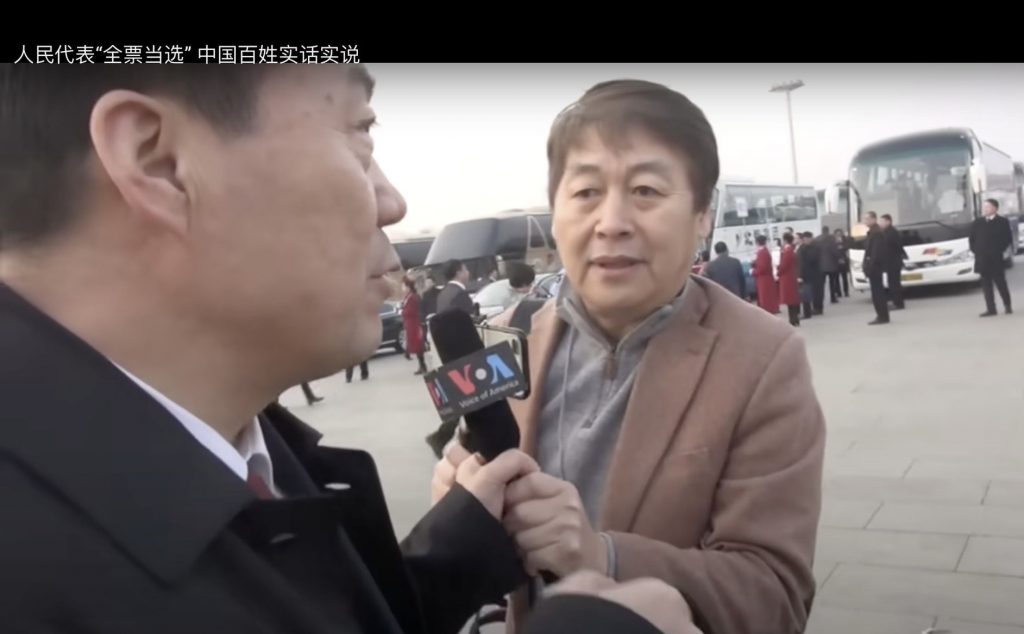


Ye Bing, a Beijing-based reporter for Voice of America (VOA) Chinese, and his assistant Allen were detained by Chinese police in 2018 when they visited retired professor Sun Wenguang in Jinan city Shandong China. VOA reporter Ye Bing visited China during the two sessions in 2018. (VOA data)


The picture is from the CCP party media “Qizhi Net” (旗幟網).


CUSIB Statement for Roundtable Discussion with Members of US Congress

Ann Noonan                                                02-25-2023  ( New York, NY)   

As the Executive Director of the Committee for US International Broadcasting, I would like to thank Members of Congress for participating in today’s round table discussion at Columbia University. Our nonpartisan, not for profit organization supports media freedom and journalists who work in areas of the world that restrict or deny media freedom.


USAGM, formerly known as BBG, serves an important role in our nation and our world. The soft power of international media that USAGM has can be extremely effective in China and Hong Kong and needs your immediate help.


This sleepy federal agency, which falls under your oversight, needs help ensuring the replacement of staff in Voice of America Cantonese, Tibetan and Mandarin Services. When people retire or leave their jobs, their vacancies take too long to fill. This is partially due to shift in necessary employment background searches that now take place in the President’s Office of Personnel.


Radio Free Asia and Voice of America serve two different purposes. RFA helps to report news from nations such as China and Hong Kong that don’t allow media freedom. VOA’s purpose is to share news from America and promote our values and goals. These are vital sources of soft power.


CUSIB respectfully implores you, Members of Congress, to prevent budgetary cuts in these VOA Mandarin, Tibetan and Cantonese Services, as well as prevent cuts in Radio Free Asia’s budget.


We implore you to require short-wave radio, medium-wave radio, and television services in these agencies to remain active. Please don’t let the bureaucrats eliminate these services. Poor people throughout the world cannot all afford cell phones or computers. Radio frequencies are harder to interfere with and radio listeners can’t be tracked and monitored as easily as internet users.


Finally, we have been advised by reputable sources that both VOA China Service and RFA have been effectively pressured by China’s government to censor and regulate news. This needs your prompt investigation. CUSIB’s suggestions to support Radio Free Asia and Voice of America will go a long way to counter and contrast the effort China is attempting on US college campuses.


Thank you.


Ann Noonan is the executive director of the Committee for US International Broadcasting. Contact info: annnoonan@hotmail.com

BBG CEO-Designate Andy Lack Meets CUSIB Supporters of U.S. International Media

                    October 8, 2014


Journalist and media executive Andrew Lack, who had been selected by the Broadcasting Board of Governors (BBG) to be the agency’s CEO, met in New York Tuesday with members of the NGO Committee for U.S. International Broadcasting (CUSIB – cusib.org), which advocates for better management and more funding for U.S. international media outreach. The meeting was chaired by CUSIB Executive Director Ann Noonan and included Chinese writer and democracy activist Wei Jingsheng who spent a total of 18 years as a political prisoner in China.


Image


‘


Photo (R-L) Joey Noonan, Jing Zhang, Wei Jingsheng, Ciping Huang, Andy Lack, Ann Noonan, Justin Yu.


Andy Lack has been Chairman of the Bloomberg Media Group for the past year. He joined Bloomberg in October 2008 as CEO of its Global Media Group. Prior to joining Bloomberg, Lack was Chairman and CEO of Sony Music Entertainment. A BBG press release noted Lack’s strong journalistic credentials in addition to his accomplishments as a media executive.

“Before joining Sony Music Entertainment, he was president and chief operating officer of NBC, where he oversaw entertainment, news (including MSNBC and CNBC), NBC stations, sales and broadcast and network operations. He was responsible for expanding the Today show to three hours and creating the show’s street-side studio in New York’s Rockefeller Center. From 1993 to 2001, Lack was president of NBC News, which he transformed into America’s most-watched news organization through NBC Nightly News, Meet the Press, Today and Dateline NBC. Before going to NBC, Lack spent much of his television career at CBS News. After joining in 1976, within a year, he became a prominent producer for 60 Minutes and subsequently, senior executive producer of CBS Reports. Lack’s broadcasts at CBS earned numerous honors, including 16 Emmy Awards and 4 Alfred I. DuPont-Columbia University Journalism Awards.”

The New York meeting with Andy Lack was organized by CUSIB Executive Director Ann Noonan. She co-founded the organization in 2011 to successfully oppose the previous BBG Board’s decision to cut all Voice of America radio and satellite television broadcasts to China and later VOA radio broadcasts to Tibet. CUSIB member, Justin Yu, the former President of the New York Chinese Journalists Association and the Chair of the Chinese Chamber of Commerce of New York, hosted the meeting.

Wei Jingsheng and some of the other participants at the New York meeting on Tuesday shared with Andy Lack their experiences of living under authoritarian regimes and their views on the importance of U.S. international media outreach for those who are denied freedom of expression and access to uncensored news. Wei Jingsheng authored the essay, “Fifth Modernization,” which was posted on the “Democracy Wall” in Beijing in 1978. He was deported to the United States in 1997. He was awarded the Sakharov Prize for Freedom of Thought, the Robert F. Kennedy Human Rights Award in 1996, the National Endowment for Democracy Award in 1997, the Olof Palme Memorial Prize in 1994, and the International Activist Award by the Gleitsman Foundation.

Wei Jingsheng spoke about his meeting with John Kerry 20 years ago. He stressed the need for all forms of media in China – including shortwave and medium wave radio. He stressed how poor people and people in the countryside cannot afford cell phones or internet.

Jing Zhang presented Andy with a newly published book, “The Orphans of Shao.” The book was published by Women’s Rights in China.

CUSIB Executive Director Ann Noonan said that her organization is primarily interested in management reforms to improve the work of BBG journalists providing uncensored news to some of the least privileged and the most oppressed individuals, groups and societies. These media programs are a lifeline to people who are still in China and in other countries without free media, Noonan said.

CUSIB members include former political prisoners, such as journalist and human rights activist Jing Zhang, president of Women’s Rights in China, who had suffered five years in prison for her belief in freedom and democracy, and Harry Wu, founder of the Laogai Research Foundation, who had spent 19 years as a political prisoner toiling in the factories, mines, and fields of the Chinese Laogai forced labor camp system. Ann Noonan presented Andy Lack with Harry Wu’s book, “Laogai.” CUSIB also has among its Advisory Board members former BBG Governors, including Victor Ashe who was U.S. Ambassador to Poland and served as mayor of Knoxville, TN. CUSIB members also include current and former leaders of BBG employee unions.

CUSIB Director Ted Lipien, journalist, writer and former Voice of America acting associate director, who participated in the meeting with Andy Lack by phone from California, said that CUSIB sees all three provisions of the VOA Charter as “equally important” and as the best guide for Voice of America’s mission. He explained that the third provision of the VOA Charter does not call for promoting U.S. foreign policy, but it does require VOA to report on U.S. foreign policy and on any significant views in support and in opposition to these policies. He also stressed the importance of cultivating strong support for U.S. international media among members of Congress and constituent groups and organizations advocating for media freedom abroad. Lipien noted that the BBG has primarily a public mission rather than a commercial one.

Ann Noonan talked about the need for better treatment of BBG journalists and the importance of keeping radio for those audiences that have no access to other media platforms, can’t afford them, or can’t use them without the risk of being monitored by repressive governments. She noted the continued plight of Office of Cuba Broadcasting (OCB) journalists whom judges found to have been illegally fired by the management and who have still not been reinstated despite legal orders.

While advocating for management reforms, better treatment of journalists and more resources for those who produce programs, CUSIB does not suggest news coverage or program content decisions, a CUSIB member told BBG Watch, but the organization calls for accuracy and objectivity. Some CUSIB members helped to launch BBG Watch, which serves as a watchdog outlet, but the website is run by volunteers and has no official connection with CUSIB.

CUSIB believes that management reforms would result in better journalism at the BBG and in savings that could pay for more programs and more program delivery platforms, including radio, television, Internet, social media, and mobile phones.

Noonan and Lipien described to Andy Lack the tremendous growth in bureaucratic positions within the International Broadcasting Bureau (IBB) and the Voice of America in the last few several years while numerous programs and journalistic jobs were being cut. They talked about the current disconnect between the central federal bureaucracy in Washington and BBG entities, particularly the surrogate ones, and their audiences. They argued for more independence and more resources for BBG media outlets and their journalists. They also mentioned dismal employee morale among the federal entities of the BBG.

CUSIB members told BBG Watch that it is difficult to ask Congress for more money for the BBG while the agency is badly managed, but they also said that more funding from Congress is needed to make it truly successful under a new and improved management, which they hope Andy Lack will provide.

According to some of the participants in the meeting with Andy Lack, he made an excellent impression, appearing highly engaged, asking numerous questions, and expressing strong support for the mission of U.S. international media.

Andy Lack is not expected to take up his position at the BBG until all the administrative procedures are completed, which may include some of the legislative changes proposed in the bipartisan H.R. 4490 bill still pending in the U.S. Senate. Sources told BBG Watch that it may be several weeks before Andy Lack arrives at the BBG headquarters in Washington, DC to assume his new job as CEO.