 中國婦權
——Repost From Chinese Feminism (女權學論)
——Editor: Yue Zhang
A note from Women’s Rights in China
Women’s Rights in China identifies with the women’s rights wing of the feminist movement (婦權派). We have long advocated for women’s rights and for institutions that protect them. In that spirit, we are sharing this in-depth overview from 女權學論. We believe that women, understood on the basis of biological sex, should be the central actors in the women’s movement and in shaping policies concerning women. They have the right to speak about their experiences in their own name, articulate their demands, and take part in decisions that affect their rights.
Since the 1990s, feminists in Taiwan have taken different paths, often described as the “women’s rights” and “sexual rights” approaches. The women’s rights wing has sought institutional reform, stronger laws against sexual harassment and sexual assault, and recognition of women as rights holders in their own right. We see this debate extending beyond Taiwan. In recent years, Western policymakers and participants in public debate have increasingly used terms such as “transgender communities” and “gender diversity” in place of the traditional category of women. In our view, this shift has, to some extent, encroached on resources and spaces previously available to women on the basis of sex and weakened the institutional protections they could rely on. In Taiwan, official terminology has shifted from “the two sexes” toward “gender diversity,” while public debate over changing the sex marker on an identity document without surgery has intensified. For us, a fundamental principle is at stake. As different groups gain protection, women must retain access to safe spaces, and the conditions they face in reproduction and at work must remain visible and receive serious attention.
The article from 女權學論 does something valuable. It traces the history of these debates in Taiwan, explains how the law has evolved, and brings several perspectives into conversation, including that of Professor Yenlin Ku. Our editor has added a brief historical overview and a side-by-side comparison. We hope these additions will help readers understand the institutions and international trends behind the controversy and consider how, in pursuing equality, we can safeguard women’s sex-based protections and their right to speak for themselves.
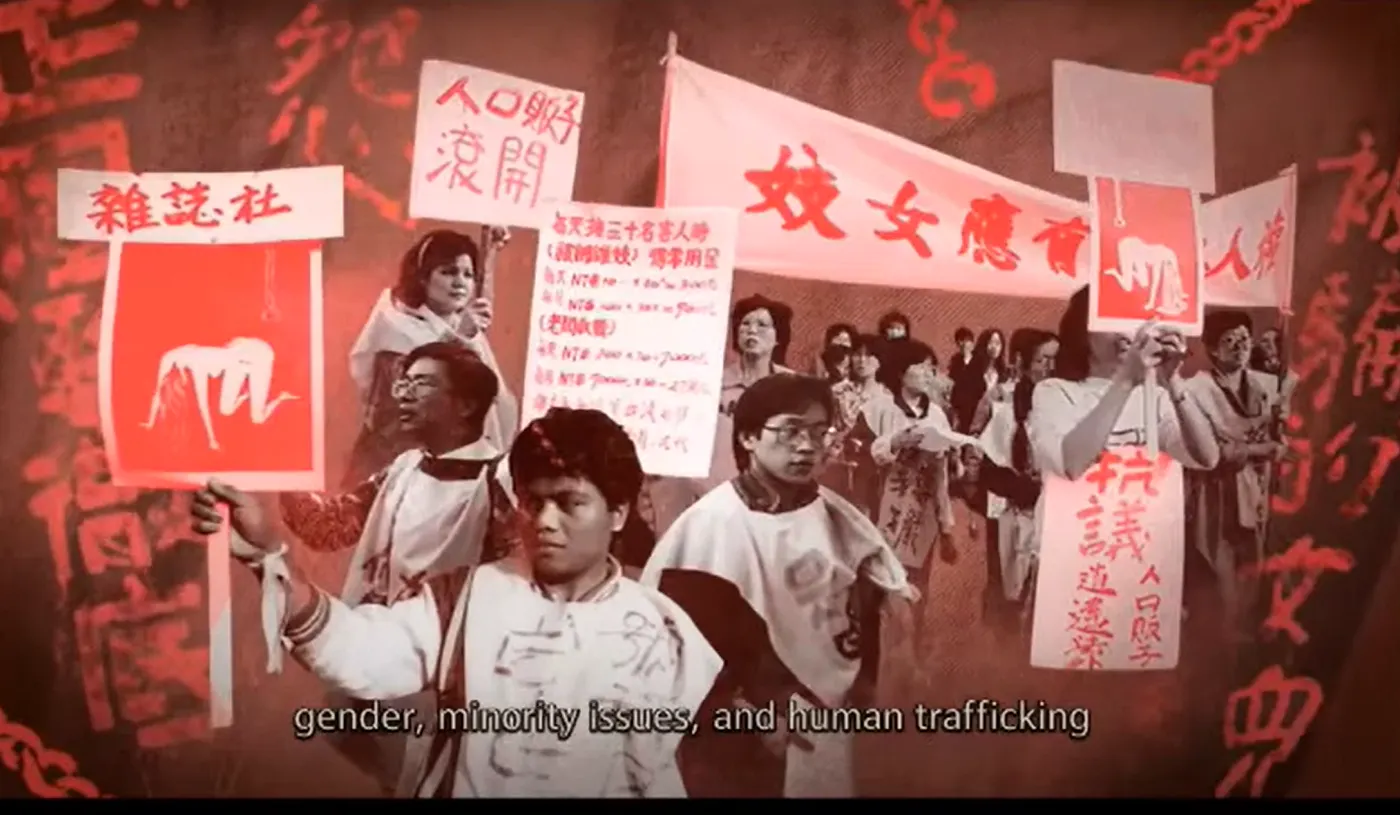
——Photo: FWRPD YouTube
Historical background: From the campaign against child sexual exploitation to Taipei’s abolition of licensed prostitution in 1997
In the late 1980s, Taiwan’s women’s movement was largely united around campaigns to rescue girls exploited in prostitution and combat human trafficking. The movement was broadly critical of the sex industry and generally supported restrictions on it. By 1994, however, a slogan heard at an anti-sexual-harassment march signaled a fundamental disagreement over women’s sexual desire and the sex industry: “I want orgasms. I don’t want sexual harassment.” Background on Taiwan’s feminist movement, Chinese Wikipedia
In September 1997, Taipei Mayor Chen Shui-bian moved swiftly to repeal the city’s regulations governing prostitution, citing a crackdown on the sex trade and the protection of women’s dignity. Overnight, 128 women licensed to sell sex in Baodou Village in Wanhua and on Guisui Street in Datong District lost their livelihoods. The decision sparked two years of protests and brought divisions within Taiwan’s feminist movement into the open. Awakening Foundation
Where the two wings stood
| Issue | Women’s rights wing — critique of the sex industry and the politics of gender | Sexual rights wing — sexual liberation and the politics of desire |
|---|---|---|
| Position on abolition | Supported immediate abolition and regarded women in prostitution as victims of patriarchal oppression. | Opposed the abrupt abolition of licensing and defended the right to choose sex work and earn a living. |
| Understanding of the sex trade | Saw commercial sex as inherently involving men’s objectification of women’s bodies and exploitation rooted in class inequality. | Challenged the moral stigma attached to sexuality and sought to dismantle taboos and discrimination surrounding sex work. |
| Political strategy | Worked within state institutions and built alliances with political parties. Advocated legislation, social welfare, and assistance for women moving into other occupations. | Organized through grassroots labor movements and radical cultural activism. Built alliances with blue-collar workers to challenge the state. |
| Associated organizations and figures | The Garden of Hope Foundation, the Peng Wan-Ru Foundation, some members of the Awakening Foundation, Yenlin Ku, and Fang-mei Lin. | The Center for the Study of Sexualities at National Central University, including Josephine Ho and Ka Wei-po; the women workers’ group 女工團結生產線; and the Collective of Sex Workers and Supporters (日日春協會). |
What each wing advocated
The women’s rights wing emphasized institutional reform and women’s dignity. Groups led by the Garden of Hope Foundation and the Peng Wan-Ru Foundation argued that licensing amounted to state sanction for men to buy access to women’s bodies and violate their dignity. They supported city-funded welfare and employment assistance to help women leave prostitution. In their view, ending the legal sex industry was necessary to improve women’s social standing and dignity as a whole. Garden of Hope Foundation
The sexual rights wing emphasized labor rights and livelihoods. With support from women labor organizers, the Pink-Collar Alliance, and the Center for the Study of Sexualities, licensed sex workers led by Kuan Hsiu-chin formed a self-help association. It later became the Collective of Sex Workers and Supporters. The women pointed out that many of them were older, had limited formal education, and could not support their families under the city’s proposed employment program. Their demand was “We want the right to work, not relief.” They called for a two-year transition period and the decriminalization of sex work.
The outcome and its legacy
After the association staged hundreds of protests, Chen’s successor as mayor, Ma Ying-jeou, agreed in 1999 to grant licensed sex workers a two-year transition period. Taipei’s licensing system formally ended in March 2001.
This dispute helped shape two enduring strands of activism in Taiwan. The women’s rights wing helped secure major legislative reforms, including the Domestic Violence Prevention Act and three key gender-equality laws. The sexual rights wing continued organizing from the margins. Its advocacy contributed to Judicial Yuan Interpretation No. 666 in 2009, which found it unconstitutional to punish the seller of sexual services while exempting the buyer. It also helped lay the intellectual and organizing groundwork for Taiwan’s later gender-diversity and queer movements.
Reprinted article from 女權學論
After we published a commentary submitted by Professor Yenlin Ku, readers wrote to ask for a fuller account of the controversy. We have therefore brought together introductory readings and perspectives from other participants in Taiwan’s debates on nonbinary and transgender issues. As with the earlier commentary, our purpose is to introduce readers to the range of arguments being made in Taiwan. 女權學論 does not endorse any particular position. We encourage readers to consider the different arguments and reach their own conclusions.
Please credit the original source when reprinting.
1. Historical roots: Sexual liberation and the abolition of prostitution in Taiwan’s women’s movement in the 1990s
Taiwan’s women’s movement has experienced significant internal divisions since the 1990s. Scholars commonly refer to its two principal wings as the “women’s rights” and “sexual rights” camps. Another distinction is between the “politics of gender” and the “politics of sexual desire.” Today’s debates over transgender issues and gender diversity do not follow directly from that earlier split. The history does, however, help explain how Taiwanese feminists came to disagree over the meanings of “women” and “sexuality,” and why feminists such as Yenlin Ku have insisted on retaining “women” as a political category.
Hsiao-tan Wang writes:
… Although the two sides took different positions and had scarcely any dialogue after 2000, both placed a similar understanding of “rights” at the heart of their arguments. I therefore use the terms “women’s rights politics” and “sexual rights politics” to convey both what distinguishes them—their respective emphasis on women and sexuality—and what they share: an appeal to rights.
The conflict between these approaches was visible at the 1994 anti-sexual-harassment march, prompted by cases including one at National Taiwan Normal University, and again at the 1996 “Women’s Rights Light Up the Night” march protesting the rape and murder of Peng Wan-ru. The momentum generated by the two marches helped bring about legislative changes in the late 1990s, including the Sexual Assault Crime Prevention Act of 1997 and the 1999 revision of the Criminal Code’s chapter on offenses against sexual autonomy. From the latter half of the 1990s, advocates of women’s rights pressed for legislation and the reconstruction of policies and institutions. By the mid-2000s, they were promoting gender mainstreaming from within government, seeking to bring feminism into the bureaucracy and foster a generation of feminist officials, or “femocrats,” who could transform the state and advance gender equality.
… At the anti-sexual-harassment march, sexual liberation advocate Josephine Ho sought to change the terms of the debate. She led marchers in chanting, “I want orgasms. I don’t want sexual harassment.” At the “Women’s Rights Light Up the Night” march, she called out slogans in support of gay rights. Fang-mei Lin and Yenlin Ku described the alternative to women’s rights politics as the “politics of sexual desire.” Ho and Ka Wei-po spoke of a “women’s rights wing” and a “sexual rights wing.” In recent years, advocates of sexual rights have sharply criticized the laws governing sexuality, and the enforcement practices, established through women’s rights advocacy. They argue that these feminist practices regulate and police sexuality. By inviting people to imagine themselves as victims and to understand citizenship through the impulse to protect the vulnerable, they contend, these practices have produced a pervasive “new moralism” in the governance of gender.
From Hsiao-tan Wang, “Why Did Feminist Practice Fail Fang Si-chi? How the Self Survives and Finds a Way Out,” Streetcorner Sociology, June 6, 2017. Wang examines what each wing has overlooked in addressing sexual violence.
Further reading
- Ka Wei-po, “Two Feminist Paths in Taiwan: The Women’s Rights Wing and the Sexual Rights Wing,” Cultural Studies Monthly, 2001.
- Yenlin Ku, “The Changing Politics of Sexual Desire in Taiwan’s Women’s Organizations: Victims or Subjects of Desire?” Thought and Words, 1997. Ku distinguishes between the politics of gender and the politics of sexual desire within feminism.
2. Gender in language and public policy
Debates over terms such as duoyuan xingbie (多元性別, “gender diversity”) have two distinct histories. One concerns the translation of terms such as LGBTQ+ and the vocabulary that sexual minorities developed locally. The other concerns Taiwan’s gender-equality legislation and the changing language of government.
Since the 1990s, Taiwan has seen a proliferation of terms for sexual minorities and queer communities. Tongzhi (同志), literally “comrade,” came to Taiwan from Hong Kong as a term for gay people and, more broadly, sexual minorities. Scholars including Josephine Ho developed the written expression 性/別, inserting a slash into the Chinese word for gender to bring sex, gender, and sexuality into the same frame. Over time, 多元性別, literally “diverse genders,” also came into common use as an umbrella term for LGBTQ+ people.
The case of Yeh Yung-chih in 2000 marked a turning point in government policy. Official language began to shift from “the two sexes” to “gender,” making room for issues beyond equality between men and women. In December 2000, the Ministry of Education announced that its committee on education for equality between the sexes would become the Gender Equity Education Committee. The shift in name reflected a broader educational mandate. During the drafting of the Gender Equity Education Act, lawmakers included provisions addressing gender characteristics, gender identity, and sexual orientation.
During this period, Taiwan enacted what became known as its three gender-equality laws. The first, enacted in 2002, addressed equality between the sexes in employment. Its Chinese title was changed in 2008 and again in 2023; it is now the Gender Equality in Employment Act. The other two were the Gender Equity Education Act of 2004 and the Sexual Harassment Prevention Act of 2005. In 2012, the Executive Yuan established the Department of Gender Equality, its Committee on Women’s Rights became the Gender Equality Committee, and the law implementing the UN Convention on the Elimination of All Forms of Discrimination against Women (CEDAW) took effect.
These changes to legislation and institutions, alongside the growth of the LGBTQ+ movement, prompted opposition from anti-gay conservatives. Some feminists also raised questions and offered critiques of their own.
Related reading
- Executive Yuan Gender Equality Committee, resources on gender diversity.
- The case of Yeh Yung-chih and its impact, Chinese Wikipedia.
- Hsiao-wei Kuan, “An Introduction to Human Rights Conventions and General Recommendations Concerning the Rights of Gender-Diverse People,” Executive Yuan Department of Gender Equality, training materials, 2020.
3. The debate over gender: Direct responses to Yenlin Ku
Yenlin Ku represents an important critical voice within Taiwanese feminism. The commentary we previously republished examines the government’s translation of LGBTQI+ as 多元性別 (“gender diversity”) and its adoption of that expression as a central term in gender policy.
- Yenlin Ku, “The Politics of Translating LGBTQI+ as ‘Gender Diversity,’” The News Lens, April 23, 2026.
- Yenlin Ku, “The Curious Journey of the Definition of Gender in Taiwan,” The Storm Media, August 27, 2024.
- Yenlin Ku, “The Transitional Existence of ‘Gender,’” 女性主義起點站, April 29, 2026.
Pei-hsuan Liu, “Transgender Studies as Women’s Studies?” Cultural Studies Quarterly, no. 171, September 2020, pp. 66–78.
I write as a transgender feminist in response to Professor Yenlin Ku’s insistence in recent years on retaining “woman” as an identity within the women’s movement. … Professor Ku has expressed goodwill toward transgender women. … She welcomes the inclusion of lesbians and transgender women in the women’s movement and recognizes that transgender women face discrimination as women and may encounter even greater difficulties than cisgender women. Yet she firmly maintains that “women” must not be erased. Erasing women does nothing to improve their status, even as women repeatedly face the prospect of erasure. … She argues that the term “gender” should not be treated as a matter of political correctness, that women should exercise power in their own right, and that “gender diversity” cannot take the place of women.
… Today, women’s reproductive capacity is still controlled and exploited, and girls are still expected to become mothers and domestic laborers. Many experiences particular to cisgender women, which transgender women have not lived through, … remain an important concern of women’s studies. But I hope the social circumstances and community cultures of transgender women can also find a place in women’s studies and receive sustained attention. Visibility within this now highly institutionalized field could, in turn, influence national policy and social welfare provision for women.
… When transgender women participate in women’s studies and the women’s movement, they do not take the place of other women, any more than other women can take theirs. … Transgender women cannot stand in for women speaking about their own experiences of menstruation and pregnancy. Equally, cisgender women cannot stand in for women describing their encounters with medical care relating to gender identity. We can, nevertheless, study women’s experiences across bodily differences. … Under the broad umbrella of “women/female/femininity,” we can pursue distinct lines of work, act together, and build alliances.
Nian-tsu Yeh, “Don’t Turn Back the Clock on Gender Policy: A Response to Professor Yenlin Ku’s ‘From Gender to Sex,’” The Storm Media, November 15, 2025.
In “From Gender to Sex,” Professor Yenlin Ku takes the policy shift under the Trump administration in the United States (2017–2021) as an example. She argues that gender policy has become confused in recent years, that the concept of gender has expanded too far, and that the Democratic Party’s diversity, equity, and inclusion (DEI) policies have fueled public anxiety. These observations do reflect political polarization in the United States. But to understand the dispute over sex and gender fully, we must examine it in the broader context of advances in scholarship, international human rights law, and U.S. constitutional case law.
4. Transgender and trans-inclusive feminism in Taiwan
Many scholars in Taiwan have written in support of trans-inclusive feminism. Alongside the direct responses to Ku quoted above, some have introduced its arguments to general audiences and explored their theoretical foundations. Wen Liu’s public writing offers one example.
Wen Liu, “The Future of the Transgender Movement Is Also the Future of Feminism,” The Reporter, February 21, 2025.
In recent years, this right-wing anti-gender movement has also attracted supporters who invoke “feminism” in the name of “protecting women.” They include people who describe themselves as “gender-critical feminists,” as well as the well-known author J. K. Rowling. They reject poststructuralist theories of gender developed since the 1990s, insist that sex is purely biological and immutable, and believe that the existence of transgender people threatens the ability of “biological women” to survive under patriarchy. Although their stated opposition to patriarchal oppression would ordinarily place them on the left, in contemporary politics their position converges with the gender policies of right-wing governments.
Feminism began as a critique of the very practice of judging the worth of a person or group by differences of sex or gender. Its original purpose was never confined to advocating for the rights of “biological women.”
As women’s and gay identities entered the mainstream, the pursuit of rights for “biological women” and for “gay people attracted to the ‘same’ sex” followed a logic that treated being cisgender as the norm. In the process, transgender people were set apart as an issue concerning “others.” This is larger than any single organization or movement. Within the framework of mainstream identity politics, marginalized people who once challenged heterosexual patriarchy together have been separated from one another, group by group.
Contemporary trans-exclusionary radical feminist (TERF) arguments often ground the claim that “biological women” need protection in the fear of sexual violence.
For more on LGBTQ+ and transgender activism in Taiwan, see the transgender equality resources of the Taiwan Alliance to Promote Civil Partnership Rights.
5. A recent controversy: Changing the sex marker on an ID without surgery
In recent years, debate in Taiwan has centered on 免術換證: whether transgender people can change the sex marker on their identity documents without undergoing surgery. Under the administrative system described here, applicants are required to undergo gender reassignment surgery before changing the sex marker on their national ID cards. To obtain a change without surgery, transgender applicants have had to go to court and secure a ruling that the surgical requirement is unconstitutional in their case. Public debate intensified after the first applicant won in 2021. Some members of the public also raised concerns about women’s safety. As of July 2026, twelve transgender people had obtained a change of sex marker without surgery.
Source for the figure: Kuan-hsun Chen and Fu-tsai Chiu, “Another Court Victory for a Transgender Applicant Seeking an ID Change Without Surgery; Zhonghe Household Registration Office Considers an Appeal,” Taiwan Public Television Service, July 16, 2026.
Yi-ting Chiang, “Taiwan’s Legal Battles over Changing ID Without Surgery: The Struggle to End Compulsory Surgery and the Controversy Surrounding It,” BBC, October 24, 2025.
Ka Fei, “Women, Trans Women, and Safe Public Spaces: Thinking Through the Dispute over Changing ID Without Surgery,” The Reporter, November 20, 2024.
Some comments in online communities stem from misunderstanding and prejudice. Little by little, they have set cisgender women and transgender women against one another. … Their experiences of oppression may differ, but the source of that oppression is the same. If cis women and trans women share an experience, it may be that both have suffered gender-based violence.
Women’s fears and anger have a history. Society must understand those feelings, acknowledge them, and take them seriously. … If we care about women’s safety and how much public space women can use freely, trans women should not be the target of our anger. We should be asking how to make more public spaces safe for women.
Personal accounts of surgery and legal recognition in Taiwan
- Han-ching Hsiao, “‘No One Else Should Have Surgery Just to Change Their ID’: Wu Yu-hsuan’s Journey in Taiwan’s Transgender Movement,” Initium Media, March 7, 2025.
- Han-ching Hsiao, “The Body, Rupture, and the Rebuilding of the Self: Four Transgender People in Taiwan Recount Their Experiences of Surgery,” Initium Media, January 9, 2025.
6. Further reading from 女權學論
Diandian, Sisi, and XG, “Transgender Issues and Feminism,” 女權學論, 2022.